![Boost Hotel Bookings: Affiliate Program Setup [2026 Guide]](https://cdn.sanity.io/images/1la98t0z/production/2165fecb095878ec86478fdd2e1ec2164bf45296-1200x669.png?w=1920&q=65&auto=format&fit=max)
Key Takeaways
- Affiliate marketing offers a performance-based growth channel for hotels, significantly reducing customer acquisition costs compared to OTAs (5-12% vs. 15-25% commission).
- The global hotel affiliate market is projected to reach $3.2 billion by 2025, growing at an 18% annual rate, offering a competitive edge for early adopters.
- Successful program setup involves choosing the right technological infrastructure, defining a clear commission structure, preparing professional marketing materials, and setting transparent terms.
- Focus on partnering with high-quality affiliates like travel bloggers, meta-search engines, corporate travel management companies, and loyalty platforms for optimal conversion rates (3-10%).
- With proper optimization, rigorous tracking, and robust fraud prevention, affiliate programs can contribute 8-15% of total online revenue, enhancing profitability and reducing OTA dependence.
Affiliate Marketing: A Performance-Based Growth Channel for Hotels
Affiliate marketing is a commission-based model where you pay third-party websites and content creators for directing bookings to your hotel. In an environment where OTA commissions typically range between 15-25%, bookings from the affiliate channel are often much more cost-effective, with commission rates usually between 5-12%.
Global hotel affiliate marketing revenue reached $3.2 billion in 2025, making it one of the fastest-growing digital marketing channels with an annual growth rate of 18%. In Turkey, however, the number of hotels actively utilizing this channel is still limited, which presents a significant competitive advantage for early movers.
When structured correctly, an affiliate program means paying only for actualized sales, with no fixed costs. This makes it an extremely attractive model, especially for hoteliers who prioritize budget efficiency.
Related reading: Hotel Revenue Metrics and KPI Guide
Steps to Set Up an Affiliate Program
Establishing a successful hotel affiliate program requires a systematic approach. The following steps provide a roadmap for creating a professional program from scratch:
1. Technological Infrastructure Selection: An affiliate tracking system is the backbone of your program. Two main options are available:
- Joining affiliate networks: Platforms like Commission Junction, Awin, and Partnerize offer ready-to-use infrastructure. Network commissions are typically 20-30%, but they provide immediate access to thousands of publishers.
- Building your own platform: Set up your own system using software like HasOffers or Post Affiliate Pro. The initial investment is higher, but it can be more profitable in the long run.
2. Defining the Commission Structure:
- Fixed fee: A fixed amount paid for each booking (e.g., 50-200 TL)
- Percentage-based: 5-12% of the booking value
- Hybrid: A fixed base + performance bonus
- Tiered: Commission rates increase with booking volume
3. Preparing Marketing Materials: Provide your affiliates with professional banners, text links, hotel images, price widgets, and landing page templates. Well-prepared materials can increase affiliate performance by up to 40%.
4. Terms and Conditions: Clearly define the cookie duration (typically 30-90 days), payment cycle, cancellation policy, and brand usage guidelines.
Finding the Right Affiliate Partners
The success of your affiliate program largely depends on collaborating with the right partners. The most valuable affiliate categories for hoteliers include:
Travel Bloggers and Content Creators: Travel blogs with organic search traffic provide the highest quality affiliate traffic. Bloggers ranking high for long-tail searches like "where to stay in Antalya" direct high-intent users. The conversion rate from this segment averages 3-7%.
Price Comparison Sites: In addition to meta-search platforms like Trivago, Kayak, and HotelsCombined, local price comparison sites also operate on an affiliate model. The conversion rate from this channel is the highest, at 5-10%.
Corporate Travel Management Companies: Business travel agencies and corporate travel platforms bring regular and high-value bookings.
Loyalty and Cashback Platforms: Platforms like Hopi and Tosla have a price-sensitive but high-volume user base.
When selecting your affiliate partners, evaluate traffic quality, content alignment, and target audience overlap. Focus on niche, high-converting partners rather than high-traffic, low-quality sites. Partnering with affiliates is one of the lowest-risk ways to diversify your hotel sales channels.
Related reading: Hotel Distribution Cost Analysis
Commission Optimization and Profitability Analysis
To accurately calculate the profitability of affiliate commissions, a comparative analysis with OTA commissions should be performed.
Channel-based cost comparison (average):
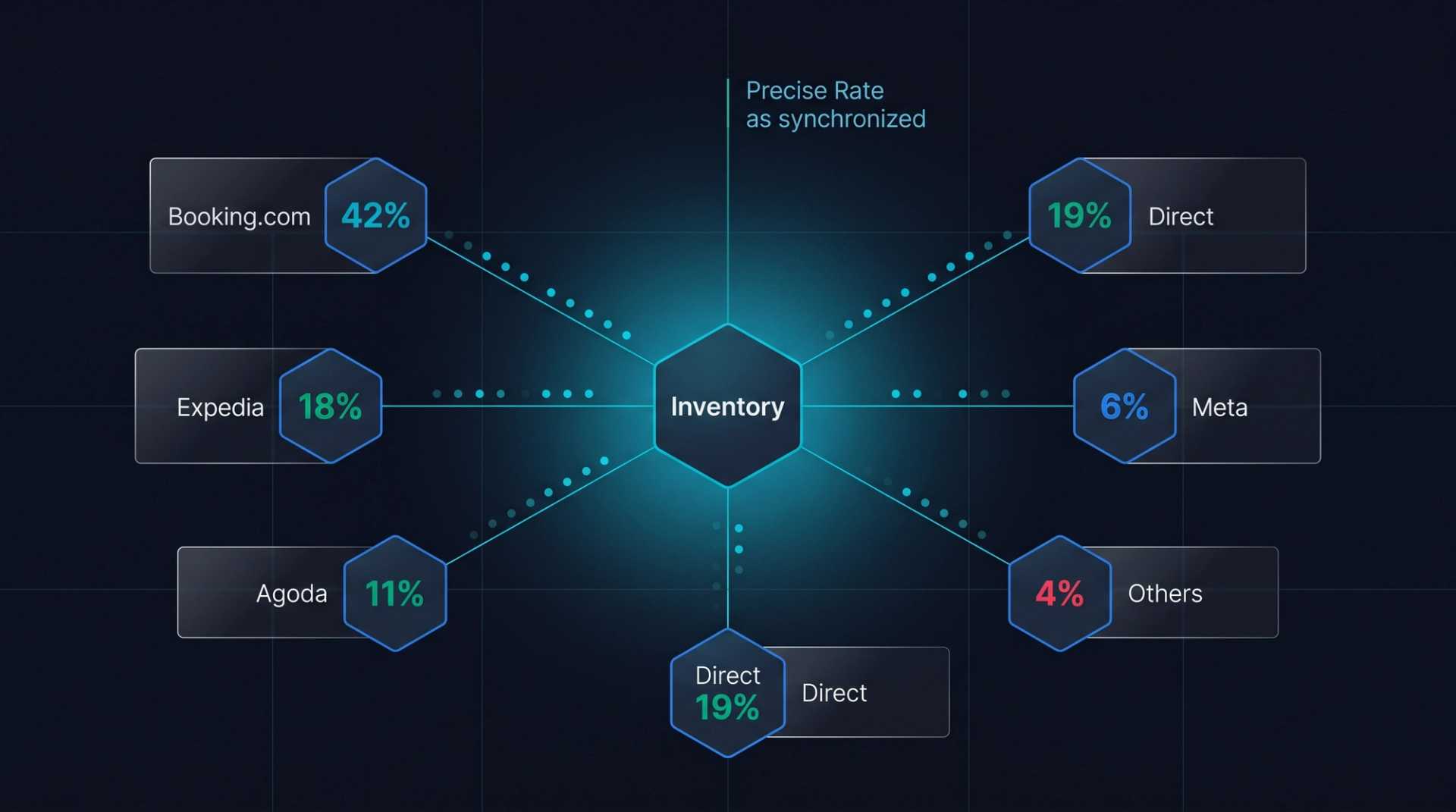
- OTAs (Booking, Expedia): 15-25% commission
- Meta-search (Google Hotels, Trivago): 8-15% CPC-based
- Affiliate channel: 5-12% commission
- Direct website: 0-3% (including marketing costs)
This comparison shows that the affiliate channel is 50-70% more cost-effective than OTAs. However, the total volume is usually lower, so positioning the affiliate channel as a complement to OTAs, rather than a replacement, is the correct approach.
Profitability formula: Average booking value x Conversion rate x Affiliate traffic = Gross revenue Gross revenue - Affiliate commission - Operational costs = Net profit
Example: Average 2,000 TL booking, 5% conversion, 10,000 monthly visitors 10,000 x 0.05 x 2,000 = 1,000,000 TL gross revenue Affiliate commission (8%): 80,000 TL Net revenue: 920,000 TL
Tracking, Reporting, and Fraud Prevention
Accurate tracking and fraud prevention are critical in affiliate marketing. The annual cost of affiliate fraud globally reaches $1.4 billion.
Tracking infrastructure requirements:
- Multiple attribution support (last-click, first-click, multi-touch)
- Real-time reporting dashboard
- Sub-affiliate tracking capability
- Cross-device tracking
Types of fraud and prevention measures:
- Cookie stuffing: Placing an affiliate cookie without the user's knowledge. Prevention: Anomaly detection in click-to-conversion rates.
- Bot traffic: Fake clicks and impressions. Prevention: IP filtering and bot detection software.
- Brand infringement: Affiliates running PPC ads for your brand. Prevention: Prohibiting brand keywords in ad campaigns.
Review affiliate performance reports monthly to detect anomalies. Unusually high click-through rates, very low conversion rates, or traffic surges at specific hours are indicators of potential fraud.
Strategies for Scaling Your Affiliate Program
As your program matures, scaling strategies should be implemented. A program starting with 10-20 active affiliates in the first 6 months can reach 50-100 affiliates by the 12th month.
The most effective scaling tactics include offering special commission increases to high-performing affiliates, creating exclusive promo codes for seasonal campaigns, sharing exclusive content and data with affiliates, and holding regular performance meetings.
A successful affiliate program can account for 8-15% of your hotel's total online revenue. This is one of the most sustainable ways to reduce OTA dependency while lowering customer acquisition costs. With patience and continuous optimization, the affiliate channel can transform into one of your hotel's most efficient marketing channels.
![Europe's Hotel Construction Boom: 2026 Oversupply Risks [Market Analysis]](https://cdn.sanity.io/images/1la98t0z/production/6dfe59137f56aa14bfcba86d9db3cf05ff89f406-2752x1536.jpg?w=1920&q=50&auto=format&fit=max)