The Democratization of Revenue Intelligence
For the past decade, AI-powered revenue management was a tool of the elite. Marriott, Hilton, and IHG invested millions in proprietary pricing engines. Luxury resorts paid six-figure annual fees to Duetto, IDeaS, or Atomize. Independent hotels and small chains watched from the sidelines, relying on spreadsheets, intuition, and manual rate adjustments.
That era is over. In 2026, the combination of cheaper compute, better models, and cloud-native platforms has made AI revenue management accessible to hotels of every size -- from a 15-room boutique in Cappadocia to a 300-room city-center property in Istanbul.
This is not a marginal improvement. It is a structural shift in competitive dynamics. When every hotel has access to AI pricing, the hotels that fail to adopt it will no longer just miss an opportunity -- they will be systematically outpriced by every competitor that does.
What AI Revenue Management Actually Does in 2026
The term "AI revenue management" covers a wide spectrum of capabilities. Understanding what modern systems actually deliver -- and what remains aspirational marketing -- is essential for informed adoption.
Dynamic Pricing Across Room Types and Amenities
First-generation revenue management systems adjusted a single "best available rate" based on occupancy. Modern AI systems manage rate differentiation across every room type, rate plan, and add-on simultaneously.
| Pricing Dimension | Legacy RMS | AI RMS (2026) |
|---|---|---|
| Room types priced | 1-3 (manual tiers) | All types independently |
| Rate plans managed | BAR + 2-3 packages | 10+ plans dynamically |
| Adjustment frequency | Daily or weekly | Every 15-60 minutes |
| Data inputs | Occupancy + historical | 50+ signals real-time |
| Competitor monitoring | Manual rate shops | Automated, continuous |
| Ancillary pricing | Not included | Spa, F&B, packages |
This granularity means that a hotel can simultaneously optimize the rate for a standard double, a sea-view suite, a bed-and-breakfast package, and a non-refundable advance-purchase rate -- each responding to its own demand signals in real time.
Demand Forecasting With Greater Accuracy
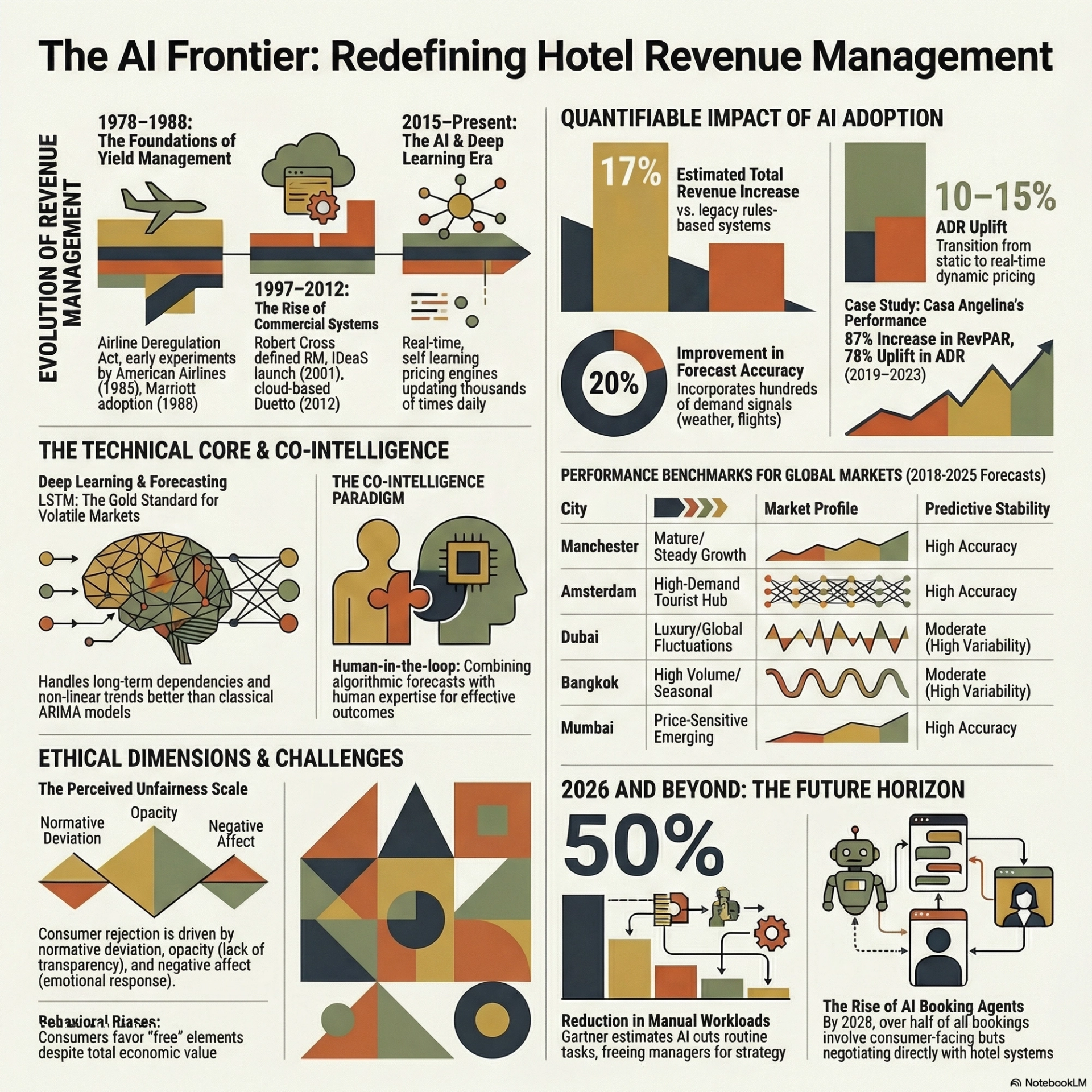
The forecasting accuracy of modern AI models represents a meaningful leap over statistical methods. Current-generation systems achieve 90-96% accuracy for 7-day forecasts and 82-88% accuracy for 30-day forecasts, compared to 75-85% and 65-75% for traditional methods.
The improvement comes from the breadth and depth of data inputs:
| Data Source | What It Signals | Impact on Forecast |
|---|---|---|
| Flight search volume | Inbound travel intent | 3-6 week demand preview |
| Event ticket sales | Compression events | Rate premium estimation |
| OTA search-to-book ratio | Market price sensitivity | Price ceiling calibration |
| Weather forecasts | Leisure demand shifts | 1-2 week adjustment |
| Social media sentiment | Destination popularity | Trend detection |
| Competitor rate changes | Market positioning shifts | Relative pricing signals |
| Economic indicators | Segment spending capacity | Long-range demand trends |
| Google Trends data | Destination search interest | Emerging demand signals |
No human revenue manager can process this volume and variety of data in real time. AI systems ingest, weight, and act on these signals continuously, producing forecasts that improve with each data cycle.
Event-Driven Demand Prediction
One of the most valuable capabilities in modern AI revenue management is automated event detection and demand prediction. Systems now identify demand-generating events -- concerts, conferences, sporting events, festivals, political gatherings -- and estimate their accommodation impact before the hotel's revenue manager is even aware the event exists.
This works through continuous monitoring of:
- Ticketing platform data (Ticketmaster, Eventbrite, StubHub)
- Conference and convention center schedules
- Municipal event permits
- Social media event announcements
- Sports league schedules and playoff scenarios
When a system detects that a Taylor Swift concert has been announced 45 days out in a nearby venue, it can automatically model the expected demand impact, recommend rate adjustments, and implement minimum-stay requirements -- all before a single guest searches for a room.
The Cost Barrier Has Collapsed
The most significant shift enabling widespread adoption is cost reduction. Enterprise RMS platforms that cost $50,000-$200,000 annually a decade ago now have alternatives at every price point.
| Solution Tier | Annual Cost | Target Property | Key Capability |
|---|---|---|---|
| Enterprise RMS | $50,000-$200,000 | Large chains, 500+ rooms | Full suite, custom integrations |
| Mid-market AI RMS | $8,000-$30,000 | Chains, 100-500 rooms | Dynamic pricing, forecasting |
| Cloud-native AI RMS | $2,000-$8,000 | Independent, 30-150 rooms | Core pricing + event detection |
| Embedded AI pricing | $500-$2,000 | Small properties, 10-50 rooms | Basic dynamic pricing |
The bottom tier -- embedded AI pricing available for $500-$2,000 annually -- is the true democratization moment. A 20-room pension in Antalya can now access dynamic pricing algorithms that adjust rates based on demand signals, competitor rates, and seasonal patterns. The ROI calculation at these price points is almost universally positive.
Why Costs Dropped
Three technical shifts drove the cost reduction:
Cloud infrastructure pricing. The cost of running ML inference workloads has dropped approximately 60% since 2022 due to GPU competition (NVIDIA vs. AMD vs. custom silicon) and cloud provider pricing wars.
Foundation model APIs. Instead of training custom models from scratch, modern RMS platforms use foundation model APIs for tasks like natural language event detection and sentiment analysis. This eliminates the need for expensive in-house data science teams.
Multi-tenant architecture. Cloud-native platforms serve hundreds or thousands of hotels on shared infrastructure, amortizing development and operational costs across the customer base.
Real-World Performance: What to Actually Expect
Marketing claims from RMS vendors often promise 15-25% RevPAR improvement. The reality is more nuanced but still compelling.
Conservative Expectations by Property Type
| Property Type | Expected RevPAR Lift | Time to Full Impact | Key Value Driver |
|---|---|---|---|
| Urban business hotel | 5-10% | 2-4 months | Compression night capture |
| Leisure resort | 8-14% | 3-6 months | Seasonal rate optimization |
| Airport hotel | 4-8% | 1-3 months | Last-minute pricing |
| Boutique/independent | 7-12% | 3-6 months | Rate confidence improvement |
| Extended stay | 3-6% | 4-8 months | Length-of-stay optimization |
These figures assume a property moving from manual or basic rule-based pricing to a modern AI system. Properties already using a competitive RMS will see smaller incremental gains from switching.
Where AI Delivers the Most Value
The highest-impact scenarios for AI revenue management share common characteristics:
High demand variability. Properties in markets with significant demand swings -- seasonal destinations, event-driven cities, mixed-use markets -- benefit most because the gap between optimal and suboptimal pricing is largest.
Multiple room types. Properties with 3+ distinct room types benefit from AI's ability to independently optimize each category. A property with only one room type sees less incremental value.
Competitor density. In markets with many competing properties, the speed and accuracy of AI pricing creates meaningful competitive advantage. In monopoly or near-monopoly markets, the incremental benefit is smaller.
Rate change flexibility. Properties with PMS and channel manager integrations that allow frequent rate updates capture more value because AI recommendations can be implemented immediately rather than waiting for manual updates.
Implementation: What Actually Works
After observing hundreds of AI RMS implementations, clear patterns emerge in what separates successful adoptions from disappointing ones.
Start With Clean Data
AI is only as good as its input data. Before implementing any AI pricing system, ensure:
- PMS data is accurate. Room type classifications, rate codes, and market segment codes must be consistent and correct. Garbage in, garbage out.
- Historical data covers 12+ months. AI models need sufficient training data. Properties with less than 12 months of clean PMS history will see delayed time-to-value.
- Competitor set is correctly defined. An AI system optimizing against the wrong competitive set will consistently misprice.
Trust the System, Then Verify
The most common implementation failure is a revenue manager who overrides AI recommendations constantly. Human override is essential as a safety mechanism, but chronic overriding defeats the purpose of AI pricing.
The recommended approach:
- Month 1-2: Run AI in shadow mode. Compare AI recommendations to your actual rates daily. Build understanding of why the system makes specific recommendations.
- Month 3-4: Implement AI rates with guardrails (maximum rate change limits, floor and ceiling rates). Monitor results weekly.
- Month 5+: Expand AI authority. Widen guardrails as confidence builds. Focus human attention on strategic decisions rather than daily rate setting.
Integrate Everything
AI revenue management delivers maximum value when connected to the full technology stack:
- PMS -- real-time occupancy and booking data
- Channel manager -- instant rate distribution across all channels
- CRM -- guest segmentation and lifetime value data
- Reputation management -- review scores that influence demand
- Business intelligence -- market and competitor data feeds
Isolated AI pricing that cannot automatically push rates to distribution channels loses much of its speed advantage.
The Competitive Imperative
The mathematical reality of AI pricing adoption is straightforward. When your competitors use AI to optimize rates every 30 minutes based on 50+ data signals, and you adjust rates manually based on yesterday's pickup report, you will systematically leave revenue on the table during high-demand periods and overprice during low-demand periods.
This is not a technology-for-technology's-sake argument. It is a survival argument. The RevPAR gap between AI-optimized and manually-priced properties in competitive markets is growing, not shrinking. And as AI costs continue to decline, the holdout strategy becomes less defensible with each passing quarter.
The tools are available. The costs are manageable. The performance data is clear. The only remaining variable is the decision to adopt -- and for hotels that make that decision in 2026, the advantage compounds from day one.