![AI-Powered HVAC: Hotel Energy & Comfort Optimization [2026 Guide]](https://cdn.sanity.io/images/1la98t0z/production/e0df2df46317e57af570407c3d5b795934d47c5b-1200x669.png?w=1920&q=65&auto=format&fit=max)
Key Takeaways
- AI-powered HVAC optimization can reduce hotel energy costs by 25-35%, transforming a hotel's largest energy consumer (40-60% of total).
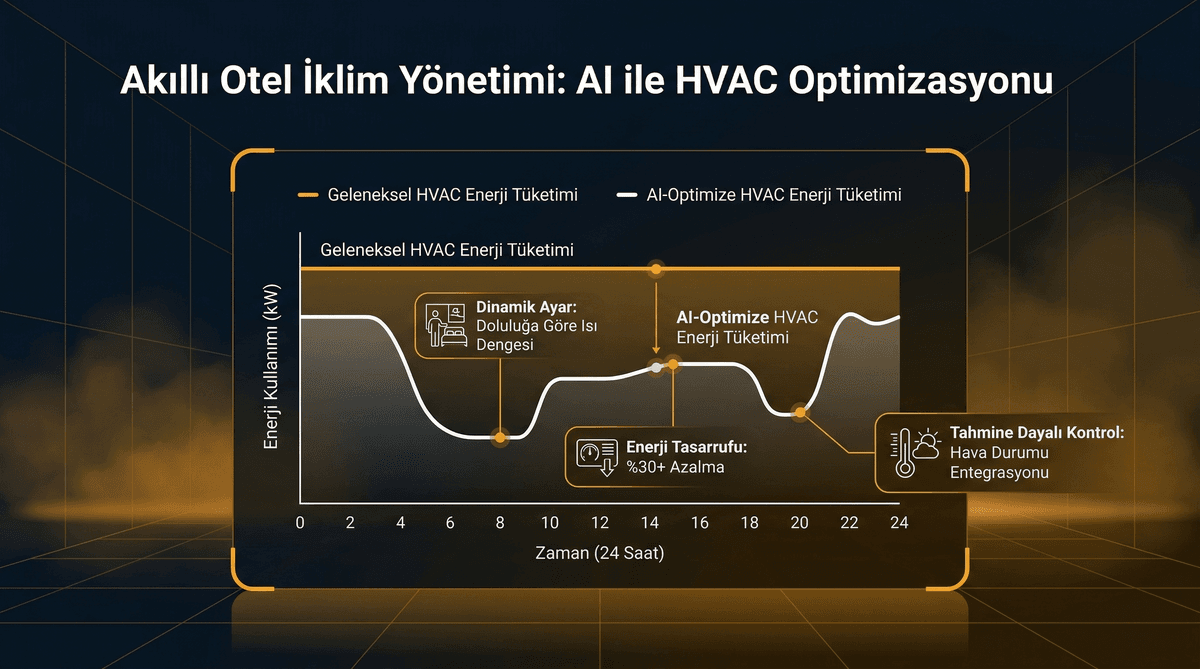
- Traditional HVAC management wastes 15-20% of energy on empty rooms and relies on reactive maintenance, leading to high costs and guest dissatisfaction.
- AI systems leverage real-time data from sensors, PMS, and weather forecasts to predict thermal loads and optimize climate control for individual zones.
- Key features include occupancy-based zone control, pre-arrival room preparation, and predictive maintenance, significantly cutting unplanned failures by 70-80%.
- The average payback period for AI-driven HVAC investment is 1.5-2.5 years, offering substantial long-term savings and enhanced guest comfort.
HVAC Systems: Hotels' Largest Energy Consumer
Heating, ventilation, and air conditioning (HVAC) systems account for 40-60% of a hotel's total energy consumption. For a 200-room city hotel, this figure translates to an annual energy bill of 800.000-1.500.000 TL. In traditional HVAC management, systems operate on fixed schedules: they turn on at 7 AM, shut down at 11 PM, or switch to a low mode. Whether rooms are occupied or empty is not considered.
In 2026, AI-powered HVAC optimization is fundamentally changing this picture. AI systems analyze occupancy data, weather forecasts, guest preferences, and energy price fluctuations together, capable of reducing energy costs by 25-35% while enhancing comfort levels.
Embed this image on your site
<a href="https://otelciro.com/en/news/ai-powered-hvac-hotel-energy-comfort-optimization-2026-guide">
  <img src="https://cdn.sanity.io/images/1la98t0z/production/e0df2df46317e57af570407c3d5b795934d47c5b-1200x669.png" alt="HVAC Optimization Infographic" width="800" />
</a>
<p>Source: <a href="https://otelciro.com">OtelCiro</a> — AI Hotel Revenue Management</p>
Related reading: Operations Management with the OtelCiro Ecosystem
Problems with Traditional HVAC Management
The vast majority of hotels in Türkiye still manage their HVAC systems manually or based on timers. This approach presents five fundamental problems:
Empty room energy waste: When a hotel's occupancy rate is %60, %40 of the empty rooms are still heated or cooled. This means %15-20 of total HVAC energy is directly wasted. For a 200-room hotel, this equates to 150.000-250.000 TL in unnecessary annual expenses.
Reactive intervention: In traditional systems, problems are only noticed when a guest complains. If an air conditioner isn't working properly in a room, it's the uncomfortable guest, not the technical team, who reports it. During this time, energy is wasted, and guest satisfaction declines.
Lack of predictive maintenance: It's unknown when filters become clogged or when compressors lose efficiency. The periodic maintenance schedule is usually based on manufacturer recommendations — not the hotel's actual usage conditions. Clogged filters alone can increase energy consumption by %15-25.
Zone imbalance: The south facade of the hotel receives a different solar load than the north facade. The heating profile of ground floors differs from upper floors. A fixed schedule ignores these differences.
Incompatibility with external conditions: Factors such as sudden weather changes, wind direction, and humidity directly affect HVAC performance. In manual management, adapting to these variables takes hours.
Key Components of AI-Powered HVAC Optimization
An AI-powered HVAC system consists of four layers:
1. Data Collection Layer
The foundation of the system is the sensor infrastructure. Temperature, humidity, CO₂, and motion sensors are positioned in every room and common area. A weather station is installed outside the building. PMS integration provides real-time occupancy data, check-in/check-out times, and guest profile information.
Modern IoT sensors operate wirelessly (LoRaWAN or Zigbee protocol) and have a battery life of 3-5 years. The cost of sensor infrastructure for a 200-room hotel is between 100.000-200.000 TL.
2. Prediction Engine
The AI model combines historical data and real-time inputs to generate short-term (1-6 hours) and medium-term (1-7 days) forecasts:
- Occupancy prediction: If tomorrow's occupancy is %85, start pre-heating all floors; if %40, prepare only occupied floors.
- Thermal load prediction: Models external temperature, sun angle, wind speed, and internal heat sources (number of guests, lighting, equipment).
- Energy price prediction: Forecasts free-market energy prices to perform thermal storage during off-peak hours.
3. Optimization Algorithm
It receives prediction data and creates a minute-by-minute operational plan for each room and zone. Optimization goals include:
- Maintain comfort parameters within the standard range (22-24°C in summer, 20-22°C in winter)
- Minimize total energy consumption
- Reduce equipment wear and tear (prevent frequent on-off cycles)
- Avoid peak load hours
4. Control and Automation Layer
Optimization decisions are implemented via the BMS (Building Management System). Fan speeds, valve openings, compressor stages, and air mixture ratios are automatically adjusted. Guest adjustments made from in-room thermostats are also fed into the system — the AI learns guest preferences and remembers them for future stays.
Related reading: Hotel IoT and Smart Room Technologies
Occupancy-Based Zone Control
The most significant savings feature of AI-powered HVAC is occupancy-based zone control. Hotel floors and areas are divided into separate zones, and each zone is controlled independently.
Empty room mode: When a guest checks out or a motion sensor detects no activity for 30 minutes, the room enters "setback" mode. The temperature is set to 18°C (in winter) or 28°C (in summer). This alone provides %20-25 energy savings.
Pre-preparation mode: Based on PMS data, a room awaiting check-in is brought to a comfortable temperature 45 minutes before the guest's estimated arrival time. When the guest checks in, the room is at the ideal temperature — no waiting, no complaints.
VIP room profile: Temperature preferences learned from loyal guests' previous stays are automatically applied. A guest who prefers 23°C will find their room at 23°C during their second stay.
Common area dynamic control: Restaurants, lobbies, and meeting rooms are climate-controlled according to their occupancy rates. Instead of cooling the entire restaurant when it's %30 full, only active areas are targeted.
Predictive Maintenance and Performance Monitoring
The AI model continuously monitors the performance of HVAC equipment and provides pre-failure warnings:
- Filter clogging prediction: Analyzes pressure difference trends to predict filter replacement time with %95 accuracy. A system operating with a clogged filter consumes %15-25 more energy.
- Compressor efficiency loss: A drop in the cooling capacity/energy consumption ratio indicates compressor failure 2-4 weeks in advance.
- Refrigerant leakage: Anomalies in the performance curve detect gas leaks at an early stage.
- Fan bearing wear: Bearing replacement time is predicted through vibration data analysis.
This approach reduces unplanned failure rates by %70-80. While an unplanned chiller breakdown can incur costs of 50.000-100.000 TL and days of comfort loss, the cost of planned maintenance is a tenth of that.
Implementation Roadmap and ROI Calculation
AI-powered HVAC optimization is implemented in three phases:
Phase 1 — Data Infrastructure (1-3 months): Sensor installation, BMS integration, and 3 months of data collection. Cost: 150.000-300.000 TL.
Phase 2 — AI Model Training and Pilot (3-6 months): Model training with collected data, pilot application in 1-2 floors. Cost: 100.000-200.000 TL. Calibration based on pilot results.
Phase 3 — Full Rollout (6-12 months): Widespread implementation across the entire hotel and continuous optimization. Cost: 50.000-100.000 TL.
Total investment: 300.000-600.000 TL Expected annual savings: 200.000-450.000 TL (%25-35 energy reduction) Payback period: 1.5-2.5 years
In Türkiye, where energy costs increase by %15-20 annually, this payback period will shorten even further over time. HVAC optimization is no longer a luxury but a fundamental condition for remaining competitive. Artificial intelligence offers hotels the opportunity for simultaneous improvements in both comfort and cost — and hotels that do not seize this opportunity fall further behind each day.
![Europe's Hotel Construction Boom: 2026 Oversupply Risks [Market Analysis]](https://cdn.sanity.io/images/1la98t0z/production/6dfe59137f56aa14bfcba86d9db3cf05ff89f406-2752x1536.jpg?w=1920&q=50&auto=format&fit=max)