![AI-Driven Hotel Shift Management Optimization [Strategy Guide]](https://cdn.sanity.io/images/1la98t0z/production/e79ff377f76d06d8c68f4ffcf6a929e6072c69e0-1024x1024.png?w=1920&q=65&auto=format&fit=max)
Key Takeaways
- Manual shift planning takes an average of 8-12 hours per week, with 35% of plans requiring last-minute changes.
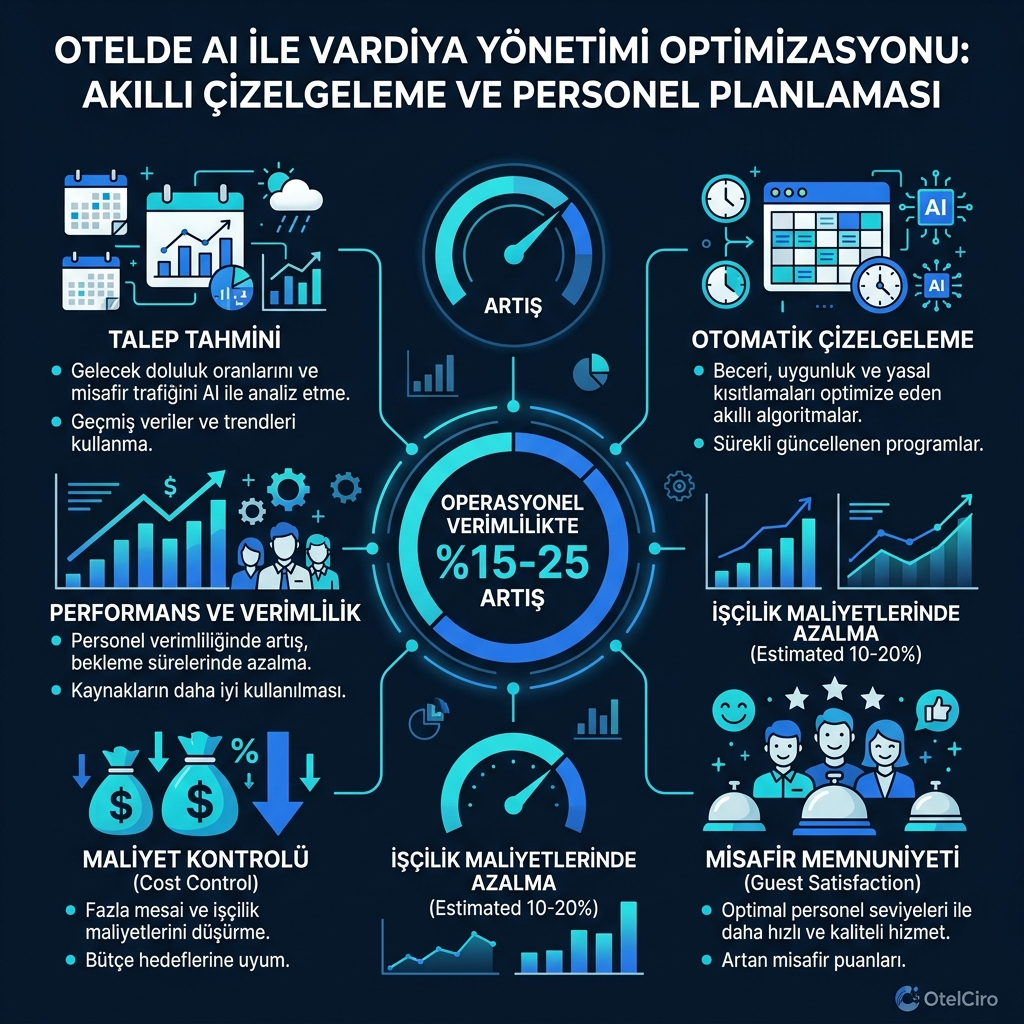
- AI-powered scheduling can reduce labor costs by 12-18% and increase employee satisfaction scores by 25%.
- AI systems achieve 90-95% accuracy in demand forecasting by analyzing historical data, trends, and even weather patterns.
- Optimized scheduling prevents legal risks and financial penalties by ensuring compliance with labor laws and rest periods.
- Beyond cost savings, AI improves employee retention by facilitating fair shift distribution and mobile self-service options.
The Complexity of Shift Management in Hospitality
Shift planning in a hotel is a complex puzzle that requires balancing dozens of variables simultaneously. Achieving the optimal balance between occupancy rates, event calendars, employee preferences, legal constraints, skill requirements, and cost targets is nearly impossible with traditional methods. Research shows that a hotel manager spends an average of 8-12 hours on weekly shift planning, and 35% of these plans are subject to last-minute changes.
AI-supported shift management systems solve this complexity in seconds, both lowering costs and increasing employee satisfaction. It has been reported that hotels using AI optimization achieve 12-18% savings in personnel costs and experience a 25% increase in employee satisfaction scores.
Embed this image on your site
<a href="https://otelciro.com/en/news/ai-driven-hotel-shift-management-optimization-strategy-guide">
  <img src="https://cdn.sanity.io/images/1la98t0z/production/e79ff377f76d06d8c68f4ffcf6a929e6072c69e0-1024x1024.png" alt="Shift Management Optimization" width="800" />
</a>
<p>Source: <a href="https://otelciro.com">OtelCiro</a> — AI Hotel Revenue Management</p>
Related reading: Hotel Automation and Business Processes: Efficiency Guide
Problems with Traditional Shift Planning
Manual shift planning is one of the largest sources of inefficiency in hotel operations. The main problems with this method include:
Overstaffing or Understaffing
In planning done without considering occupancy forecasts and historical data, staff shortages occur during busy periods, while excess staff are scheduled during quiet times. This negatively impacts both service quality and costs. Research indicates that 42% of hotels using manual planning regularly overstaff, resulting in unnecessary costs equal to 8-12% of the annual personnel budget.
Employee Dissatisfaction
Shift plans that ignore employee preferences lead to low motivation and increased turnover rates. According to industry research:
- 58% of employees are dissatisfied with shift planning.
- Shift irregularity accounts for 27% of reasons for quitting.
- Last-minute shift changes cause stress and burnout in 63% of employees.
Legal Risk
Minimum rest periods, overtime limits, and annual leave rights prescribed by labor law can easily be overlooked in manual planning. This can result in legal sanctions and fines. In 2025, the total administrative fines resulting from shift regulation violations in the hospitality sector exceeded 48 million TL.
How AI-Powered Shift Optimization Works
AI-supported shift management systems solve all the problems of traditional planning with a data-driven approach. The working principle of these systems consists of four stages.
Stage 1: Demand Forecasting
AI predicts the expected workload for every day and hour by analyzing variables such as past occupancy data, reservation trends, event calendars, seasonality, and even weather conditions. The accuracy of these forecasts is at the 90-95% level.
OtelCiro’s OtelGPT AI assistant updates demand forecasts in real-time and provides direct input for shift planning.
Stage 2: Constraint Management
The system evaluates the following constraints simultaneously:
- Legal constraints: Daily and weekly working time limits, minimum rest periods, overtime ceilings.
- Skill requirements: Language skills, certifications, and experience required for each position.
- Employee preferences: Leave requests, preferred shift hours, shift-mate requests.
- Budget constraints: Department-based personnel budget limits and overtime budgets.
- Operational rules: Minimum staffing levels, mandatory manager presence, check-in/check-out peak hours.
Stage 3: Optimization
Taking all constraints into account, the AI evaluates thousands of possible combinations and creates a shift plan that provides the optimal balance between cost, efficiency, and employee satisfaction. This process completes calculations that would take a human days in seconds.
Stage 4: Continuous Learning
The AI system learns from the results of each shift period. By analyzing the difference between the actual workload and the forecast, it continuously improves the accuracy of future predictions. Within the first three months, forecast accuracy typically rises from 85% to 95%.
Related reading: Plan Your Hotel's Future with AI Revenue Forecasting
Shift Optimization by Department
Every hotel department has different shift dynamics, and AI creates department-specific plans by taking these differences into account.
Front Office and Reception
The intensity during check-in and check-out hours is the primary determinant of reception shifts. By analyzing daily arrival and departure data, AI:
- Assigns additional reception staff during busy check-in hours (14:00-18:00).
- Maintains operations with minimum staff during the night shift.
- Creates special staffing plans by considering group arrivals and VIP guests.
Housekeeping
Room cleaning planning depends on occupancy rates and departure times. With AI optimization:
- Check-out rooms and available rooms are prioritized.
- Staff distribution is optimized on a floor-by-floor basis.
- The cleaning sequence is adjusted according to early check-in requests.
- Daily cleaning time targets per room are established.
AI-supported planning in the housekeeping department increases personnel efficiency by 20-30% while reducing overtime costs by 35%.
Food and Beverage (F&B)
Restaurant and bar shifts are shaped by meal times and event calendars. In addition to breakfast, lunch, and dinner shifts, banquet and meeting services are included in the planning. AI matches kitchen and service staff by considering menu complexity, cover count forecasts, and service time targets.
Improving the Employee Experience
One of the most important advantages of AI-supported shift management is the improvement of the employee experience.
Preference-Based Planning
In systems where employees can indicate their shift preferences digitally:
- The preference fulfillment rate rises to 75-85% (compared to 30-40% in manual planning).
- Shift change requests decrease by 60%.
- Employee satisfaction scores increase by 25%.
Mobile Access and Self-Service
Systems where employees can view shift plans, request leave, and request shift swaps via a mobile app:
- Reduce the time a manager spends on shift management by 70%.
- Facilitate shift swapping between employees.
- Reduce absenteeism caused by communication problems by 45%.
Fair Distribution
AI ensures the fair distribution of "undesirable" shifts, such as weekend shifts, holidays, and night shifts, among employees. This perception of fairness strengthens team cohesion and trust.
Cost Optimization Results
The tangible financial results of AI-supported shift management are impressive:
- Reduction in overtime costs: 25-40% (unnecessary overtime is eliminated).
- Decrease in overstaffing costs: 15-20% (demand-staff matching improves).
- Reduction in recruitment costs: 10-15% (employee turnover drops).
- Productivity increase: 12-18% (the right person, in the right place, at the right time).
- Managerial time savings: 8-12 hours per week (planning time is shortened).
In total, a medium-sized hotel implementing AI-supported shift management can achieve 12-18% savings in annual personnel costs. For a hotel with 100 employees, this corresponds to a saving of between 400,000-700,000 TL per year.
OtelCiro’s OtelGPT AI platform empowers shift optimization with demand forecasting and operational intelligence capabilities, enabling hotels to make data-driven decisions in personnel management. In the hospitality of the future, shift planning is not a managerial decision, but a data science process optimized by artificial intelligence.
![Europe's Hotel Construction Boom: 2026 Oversupply Risks [Market Analysis]](https://cdn.sanity.io/images/1la98t0z/production/6dfe59137f56aa14bfcba86d9db3cf05ff89f406-2752x1536.jpg?w=1920&q=50&auto=format&fit=max)