
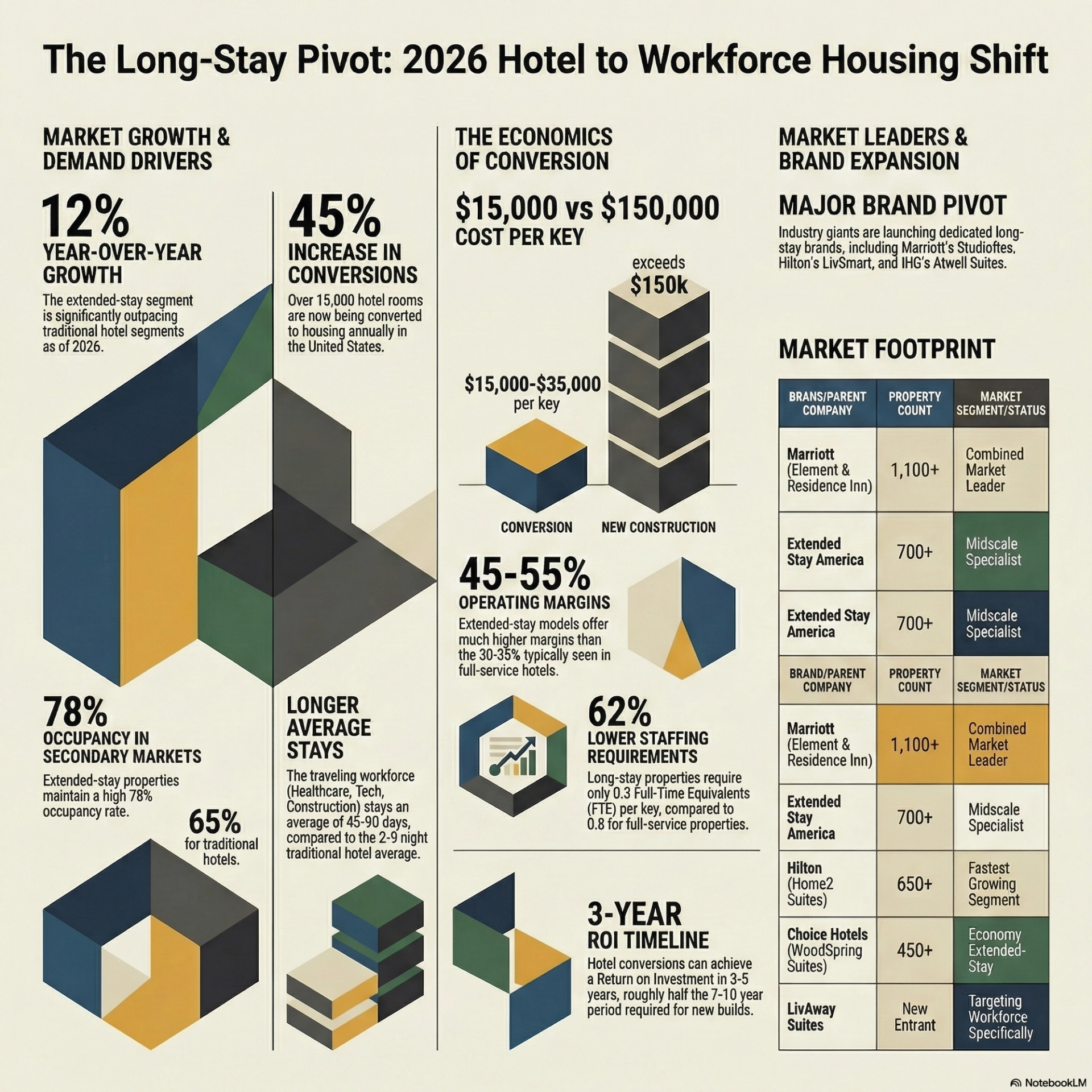
The Workforce Housing Opportunity
Across the United States, Europe, and the Middle East, a generational wave of infrastructure investment is creating a problem that hotels are uniquely positioned to solve: where do tens of thousands of construction workers, engineers, and project managers sleep?
The numbers are staggering. The U.S. alone has over $1.2 trillion in active infrastructure projects under the Infrastructure Investment and Jobs Act, the CHIPS Act, and the Inflation Reduction Act. Each major project — semiconductor fabrication plants, data centers, LNG export terminals, renewable energy installations — requires thousands of workers for 18-36 months in locations that often lack sufficient permanent housing.
This is not a niche opportunity. It is reshaping the economics of hotel operations in dozens of markets across the globe.
The Target Hospitality Model
No company illustrates the workforce housing opportunity better than Target Hospitality (NASDAQ: TH). Originally focused on oil and gas workforce accommodation in the Permian Basin, Target has expanded into government services and broader infrastructure projects, operating over 15,000 beds across North America.
Their financial metrics tell the story:
| Metric | Target Hospitality (2025) | Typical Select-Service Hotel |
|---|---|---|
| Occupancy | 92-97% | 65-72% |
| Revenue Visibility | 12-36 month contracts | 0-90 day booking window |
| Revenue per Available Bed | $85-120/night | $90-130/night (RevPAR) |
| EBITDA Margin | 42-48% | 28-35% |
| Customer Acquisition Cost | Near zero (contract) | 18-22% of revenue (OTA + marketing) |
The key insight is not that per-night rates are dramatically higher — they are often comparable to or slightly below traditional hotel rates. The profitability advantage comes from three sources: near-perfect occupancy, minimal distribution costs, and predictable demand that eliminates revenue volatility.
Where Workforce Housing Demand Is Surging
United States: The CHIPS Act Effect
The semiconductor industry alone is driving an estimated 45,000 construction jobs in locations that were never designed to house transient workers at scale:
- Phoenix, Arizona: TSMC's $65 billion fab complex requires 12,000+ construction workers through 2028
- Columbus, Ohio: Intel's $28 billion facility needs 7,000 construction workers in a market with limited hotel inventory
- Taylor, Texas: Samsung's $17 billion expansion strains an already tight housing market
- Syracuse, New York: Micron's $100 billion project (over 20 years) begins Phase 1 construction requiring 5,000+ workers
Traditional hotels in these markets face a strategic choice: continue competing for transient leisure and business demand, or pivot a portion of inventory to serve the guaranteed workforce housing market.
Middle East: Giga-Projects Drive Demand
Saudi Arabia's NEOM, The Red Sea Project, and Diriyah Gate collectively require an estimated 250,000+ construction workers over the next decade. The Kingdom's existing accommodation infrastructure cannot absorb this demand, creating opportunities for both purpose-built workforce camps and hotel conversions.
Europe: Energy Transition Projects
Offshore wind farms, hydrogen plants, and grid infrastructure projects across Northern Europe (UK, Germany, Netherlands, Denmark) are creating workforce housing demand in coastal and rural areas where traditional hotel supply is thin.
How Traditional Hotels Are Adapting
You do not need to be Target Hospitality to capture workforce housing revenue. Traditional hotel operators are finding creative ways to serve this market:
The Hybrid Model
The most common approach is dedicating a portion of inventory — typically 30-50% of rooms — to workforce contracts while maintaining the remainder for transient demand. This model works particularly well for:
- Select-service and extended-stay properties near active project sites
- Hotels with 80+ rooms where splitting inventory does not create operational complexity
- Properties in secondary markets where transient demand alone cannot sustain viable RevPAR
A 120-room select-service hotel near a semiconductor fab site might contract 50 rooms at $95/night for 24 months. That is $1.7 million in guaranteed annual revenue from those 50 rooms alone — at 100% occupancy with zero distribution cost. The remaining 70 rooms continue to serve transient demand, benefiting from the reduced pressure to fill every room.
Contract Structure Best Practices
Workforce housing contracts differ fundamentally from corporate negotiated rates:
- Minimum stay commitments: 6-36 months, with penalty clauses for early termination
- Take-or-pay provisions: The client pays for contracted rooms regardless of actual occupancy
- Rate escalation clauses: Annual increases of 2-4% tied to CPI or fixed percentages
- Service level agreements: Defined cleaning frequency, meal provisions (if applicable), laundry, and Wi-Fi standards
- Damage and wear provisions: Pre-agreed allowances for accelerated room wear
Operational Adjustments
Workforce housing guests differ from transient travelers in predictable ways that require operational adaptation:
Housekeeping: Full daily service is typically replaced with 2-3 cleanings per week, reducing labor costs by 40-50% for contracted rooms. Weekly deep cleans maintain quality standards.
F&B: Workforce guests value convenience and consistency over variety. Properties serving this segment successfully offer simplified meal programmes — grab-and-go breakfast, packed lunches, and hearty dinner options. Some negotiate meal contracts at $25-40 per person per day, adding significant ancillary revenue.
Laundry: On-site laundry facilities (self-service) are essential. The investment in commercial washers and dryers ($15,000-25,000) pays back within months through guest satisfaction and reduced linen costs.
Common Areas: Workforce guests spend more time in common areas than transient guests. Properties that convert underutilized meeting rooms into recreation spaces (TV lounges, game rooms, fitness areas) report higher guest satisfaction and contract renewal rates.
Revenue Optimization for the Hybrid Model
The hybrid model creates unique revenue management dynamics:
Base Load + Variable Revenue
Think of contracted workforce rooms as your base load — guaranteed revenue that covers fixed costs. This changes your pricing strategy for remaining transient inventory. With 40-50% of rooms generating guaranteed revenue, you can:
- Be more aggressive on transient rate because you are not desperate for occupancy
- Reduce OTA dependency because you need fewer rooms sold through high-commission channels
- Accept more group business because your breakeven occupancy is already covered
Seasonal Arbitrage
In seasonal markets, workforce contracts provide counter-cyclical revenue. A beach-adjacent hotel that fills 90% with tourists in summer can contract 40% of rooms to nearby construction projects during the off-season, eliminating the traditional revenue valley.
RevPAR Impact Analysis
Consider the math for a 100-room hotel at $110 transient ADR and 68% annual occupancy:
| Scenario | Contracted Rooms | Contract Rate | Transient Rooms | Transient Occ. | Transient ADR | Total RevPAR |
|---|---|---|---|---|---|---|
| Traditional | 0 | — | 100 | 68% | $110 | $74.80 |
| Hybrid (40%) | 40 @ 100% | $95 | 60 | 68% | $115 | $82.68 |
| Hybrid (50%) | 50 @ 100% | $95 | 50 | 72% | $120 | $83.50 |
The hybrid model delivers 10-12% higher RevPAR while simultaneously reducing revenue volatility and distribution costs. The transient ADR increases because reduced inventory available for transient sale creates natural compression.
Risks and Mitigation
Workforce housing is not without risks:
Project cancellation or delay: Mitigate with take-or-pay contract provisions and early termination penalties equivalent to 3-6 months of contracted revenue.
Accelerated property wear: Workforce guests are harder on rooms than typical travelers. Budget 15-20% more for FF&E reserves on contracted rooms and negotiate damage allowances in the contract.
Brand standard conflicts: Some franchise agreements restrict the percentage of rooms that can be contracted for extended-stay use. Review your franchise agreement before committing and discuss with your brand representative — most brands are pragmatic about arrangements that improve financial performance.
Reputational risk: Poorly managed workforce housing can create friction with transient guests. Physical separation (dedicated floors), separate entrances where possible, and clear operational protocols minimize conflicts.
Strategic Takeaway
The infrastructure investment supercycle is creating a structural demand shift that will persist for a decade or longer. Hotels in markets with major construction projects have an opportunity to fundamentally improve their revenue stability and profitability by serving the workforce housing segment.
The operators who will capture this opportunity are those who move beyond the traditional hotel mindset of optimizing for nightly transient rate and instead think about total revenue predictability. A contracted room at $95 per night, 365 days per year, with zero distribution cost, is worth more than a transient room at $110 per night, 68% of the year, with 20% going to OTAs.
The math is clear. The demand is real. The question is whether you will capture it before your competitors do.
![Hotel Emergency Communication Plan: 7 Crisis Scenarios Every Property Must Prepare For [2026]](/_next/image?url=%2Fimages%2Finfographics%2Facil-durum-iletisim-plani-kriz-otel.png&w=1920&q=50)
![12 Hotel Green Practices That Cut Costs [2026]](https://cdn.sanity.io/images/1la98t0z/production/411751c83639e7c52437bcea19911157646e95bb-1376x768.jpg?w=1920&q=50&auto=format&fit=max)
![Hotel Digital Transformation: 5-Step Roadmap [2026]](https://cdn.sanity.io/images/1la98t0z/production/340311fa5f6d3a6374d3e71d3cba85cb6186bf3d-1376x768.jpg?w=1920&q=50&auto=format&fit=max)