![Tokenized Hotel Investment: Blockchain & Fractional Ownership [2026 Guide]](https://cdn.sanity.io/images/1la98t0z/production/eab2d3700f623af452314f741d05233f08ae1408-2048x2048.png?w=1920&q=65&auto=format&fit=max)
Key Takeaways
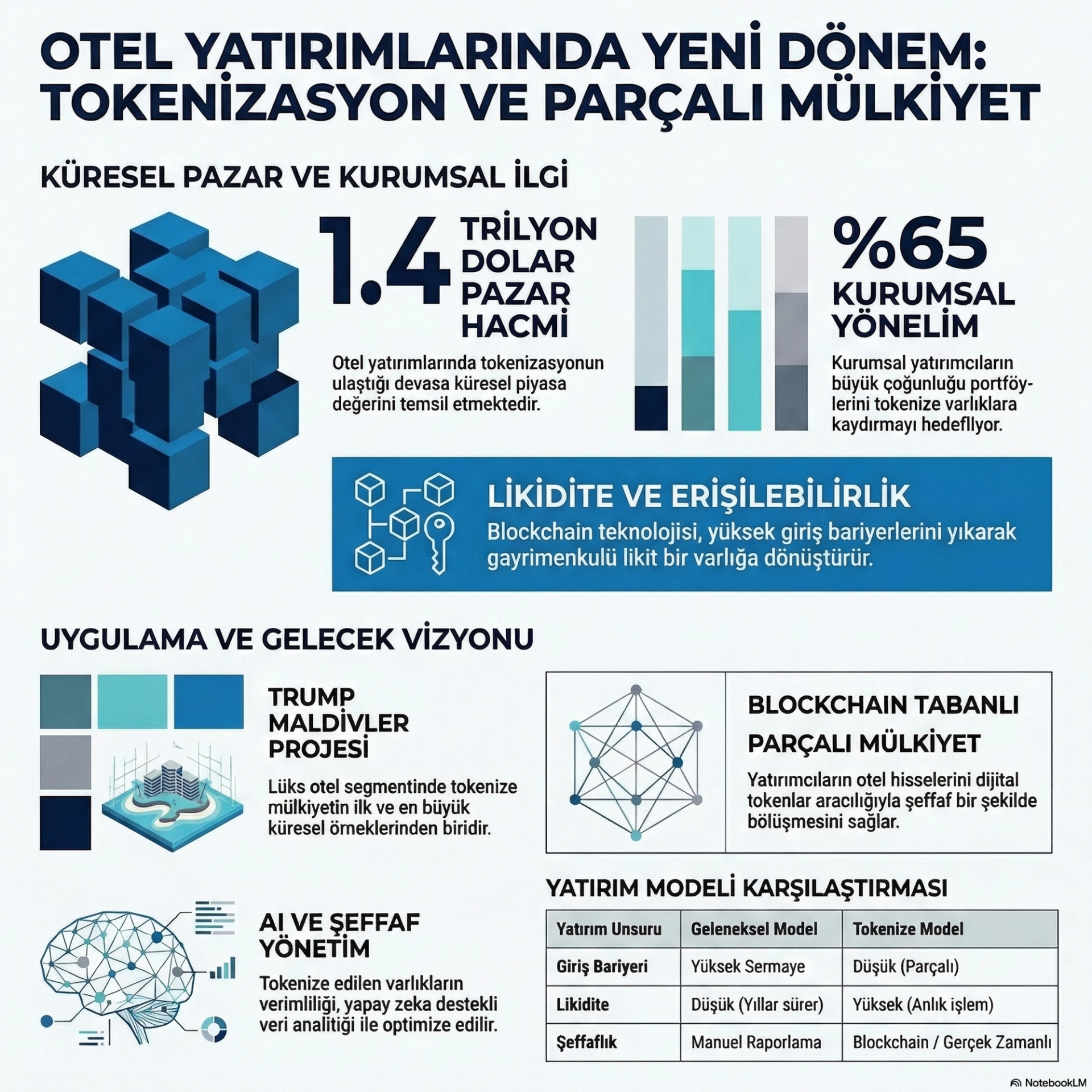
- The global tokenized asset market is projected to reach $1.4 trillion by 2030 with a CAGR exceeding 50%.
- Blockchain-based smart contracts can reduce operational costs for fund management by 40-65%.
- Institutional adoption is surging, with 65% of investors expected to hold tokenized assets by 2027.
- Major projects like the Trump International Hotel Maldives and Aspen St. Regis have already successfully implemented this model.
- Tokenization provides a vital alternative to traditional bank loans, potentially closing a $5-6 billion financing gap in the Turkish hospitality sector.
A Paradigm Shift in Hotel Investment: What is Tokenization?
Traditional hotel investment has long been the playground of high-net-worth individuals and institutional giants due to high capital requirements and long exit horizons. However, blockchain technology and tokenization are fundamentally rewriting this equation. According to a joint report by Boston Consulting Group (BCG) and ADDX, the tokenized asset market will reach a value of $1.4 trillion by 2030, maintaining a compound annual growth rate (CAGR) of over 50%.
Tokenization is the process of dividing a real estate asset—in this case, a hotel—into digital tokens. Each token represents a specific percentage of the asset and is recorded on a blockchain. This allows an investor to purchase 0.1% of a $50 million hotel—a $50,000 share—and receive a proportional share of the hotel's revenue.
This model is truly democratizing hotel investment for the first time. Research by EY-Parthenon indicates that 65% of institutional investors plan to shift a portion of their portfolios to tokenized assets by 2027. This represents a three-fold increase from the 23% level recorded in 2024.
For the Turkish hospitality sector, this development is critical. Boutique hotel owners with limited access to capital markets can reach a global investor pool through tokenization. This reduces reliance on traditional bank loans for renovations, expansions, or new facility investments.
Embed this image on your site
<a href="https://otelciro.com/en/news/tokenized-hotel-investment-blockchain-fractional-ownership-2026-guide">
  <img src="https://cdn.sanity.io/images/1la98t0z/production/eab2d3700f623af452314f741d05233f08ae1408-2048x2048.png" alt="Tokenized Hotel Investment Infographic" width="800" />
</a>
<p>Source: <a href="https://otelciro.com">OtelCiro</a> — AI Hotel Revenue Management</p>
Related reading: Improving Hotel Profitability: 10 Financial Steps
Blockchain Infrastructure: Smart Contracts and Revenue Distribution
Smart contracts form the technical backbone of tokenized hotel investment. Operating on blockchain networks like Ethereum, Polygon, and Avalanche, these contracts automatically manage revenue distribution, voting rights, and token transfers.
When a hotel is tokenized, the smart contract performs several automated functions: it pulls daily revenue data from the PMS (Property Management System), calculates the proportional revenue distribution for token holders, applies tax withholdings, and transfers the remaining amount to the token holders' digital wallets. This process is entirely automated, eliminating the need for third-party intermediaries.
According to Deloitte's 2025 tokenization report, smart contract-based revenue distribution systems reduce operational costs by 40-65% compared to traditional fund management structures. By removing layers such as brokerage firms, escrows, and transfer agents, higher net returns can be delivered to investors.
The technical infrastructure options are categorized as follows:
- Security Token Offering (STO): Regulatory-compliant token issuance. It requires approval from the Capital Markets Board (SPK) or relevant regulators. This is the preferred method for institutional investors.
- Real Estate Investment Token (REIT Token): A tokenized version of the traditional REIT structure. It offers a familiar framework regarding tax advantages and regulatory compliance.
- NFT-Based Ownership Shares: Unique NFTs can be issued for each room or suite. This appeals to collector-investors but offers more limited liquidity.
Polygon and Avalanche networks particularly stand out in hotel tokenization due to their low transaction fees and high processing speeds. With Polygon’s average transaction fee below $0.01, thousands of daily micro-revenue distributions become economically sustainable.
Global Examples: Tokenized Hotel Projects from Trump to Aspen
Tokenized hotel investment has moved beyond a theoretical concept into tangible projects. A standout example is the Trump International Hotel — Maldives project. Announced in late 2025, this project is one of the first large-scale initiatives to apply the blockchain-based fractional ownership model in the luxury hotel segment. With a minimum investment threshold of $1,000, it offers luxury hotel investment opportunities to retail investors.
The Aspen St. Regis Tokenization is another pioneer in the field. Launched in 2018 with $18 million in issued tokens, the project provides regular dividend distributions from hotel revenues. Token holders also benefit from stay discounts and VIP services at the hotel.
Platforms like RealT and Lofty AI have opened real estate tokenization to retail investors, including hotels and hospitality facilities. Transactions conducted via RealT exceeded $200 million in 2025.
In Europe, platforms such as Tokeny Solutions and Securitize provide regulatory-compliant tokenization infrastructure. Germany’s BaFin regulator gave the green light to tokenized real estate securities in 2025, accelerating the tokenization wave across the European hotel sector.
While direct hotel tokenization has not yet been fully realized in Turkey, digital asset regulations and updates to the Capital Markets Law suggest this model will be possible in the near future. High-value hotel assets in Antalya and Istanbul are ideal candidates for tokenization.
Advantage-Risk Matrix: The Investor and Hotel Owner Perspective
While tokenized hotel investment offers clear advantages for both investors and owners, it also carries risks that cannot be ignored.
Investor Advantages:
- Low Entry Barrier: The traditional requirement of millions of dollars is reduced to $1,000–$10,000 through tokenization.
- Liquidity: Tokens can be traded on secondary markets. While traditional real estate sales can take months, token sales can be completed in minutes.
- Diversification: Investors can hold shares in multiple hotels with the same budget, reducing risk through geographic and segment diversification.
- Transparency: All transactions are recorded on the blockchain. Revenue distribution, expense reports, and performance metrics can be monitored in real time.
Hotel Owner Advantages:
- Access to Capital: An alternative, more flexible source of financing compared to bank loans.
- Valuation Boost: The tokenization process strengthens the professional valuation and corporate governance of the hotel.
- Marketing Impact: Token holders become brand ambassadors, contributing to the hotel's promotion.
Primary Risks:
- Regulatory Uncertainty: Regulations regarding tokenized securities are still maturing in many countries. The approach of the SPK in Turkey will be a critical determinant.
- Technology Risk: Risks include smart contract vulnerabilities, blockchain network outages, and the potential loss of digital wallets.
- Liquidity Risk: If the secondary market does not reach sufficient depth, selling tokens may become difficult.
- Operational Risk: The quality of hotel management directly impacts token value. Tokens of a poorly managed hotel will lose value.
According to McKinsey analysis, the majority of these risks will decrease significantly by 2027-2028 as regulatory frameworks mature and technology infrastructure evolves.
Tokenization Roadmap for the Turkish Hospitality Sector
Turkey offers a unique opportunity for tokenized hotel investment. The country’s strong tourism demand, high hotel asset values, and developing fintech ecosystem provide a fertile ground for tokenization.
Tokenization Preparation Checklist:
- Legal Structure: Work with an SPK-authorized intermediary. Research the licenses and permits required for issuing tokenized securities.
- Independent Valuation: Obtain a real estate valuation based on international standards. Transparent and reliable valuation is a prerequisite.
- PMS-Blockchain Integration: Develop a bridge to transfer revenue data to the blockchain via your Property Management System's API.
- Smart Contract Audit: Have your token contract audited by an independent security firm. Audits from firms like Certik or Trail of Bits increase investor confidence.
- Investor Relations Platform: Create a portal for continuous communication with token holders, offering real-time performance dashboards.
- Tax Planning: Plan the tax dimensions of tokenized revenue distribution with expert financial advisors.
The potential impact of tokenization on the Turkish hotel sector is massive. The total investment need in the sector is estimated at $15-20 billion for the 2026-2030 period. Given that traditional financing channels can only meet 60-70% of this need, tokenization could close a financing gap of $5-6 billion.
Related reading: Hotel Investor Relations and Financial Reporting
Conclusion: The Future of Fractional Ownership and the Role of OtelCiro
Tokenized hotel investment is the fastest-growing intersection of fintech and hospitality in 2026. The global tokenization market, projected at $1.4 trillion, will transform the financing structure of the hospitality industry. The fact that 65% of institutional investors are turning toward tokenized assets proves that this transformation is inevitable.
For Turkish hotels, the early-mover advantage is critical. While waiting for the regulatory framework to mature, completing infrastructure preparations—such as PMS integration, transparent reporting, and professional valuation—will accelerate the tokenization process.
OtelCiro provides a powerful reporting and revenue management platform designed to meet the infrastructure requirements of tokenized hotel investment. With real-time revenue data, transparent performance dashboards, and an API-first architecture, OtelCiro offers the ideal PMS infrastructure for blockchain integration. In the age of tokenization, a hotel's digital backbone must be strong—OtelCiro builds that backbone.
Discover OtelCiro and prepare your hotel for the financing model of the future →
![US Hotel Labor Costs Hit $131 Billion in 2026: AI Automation Strategies That Cut Costs Fast [2026 Guide]](https://cdn.sanity.io/images/1la98t0z/production/6765e31b08a1c04cce66f9bf9482693dbefdcce5-2752x1536.jpg?w=1920&q=50&auto=format&fit=max)