
Key Takeaways
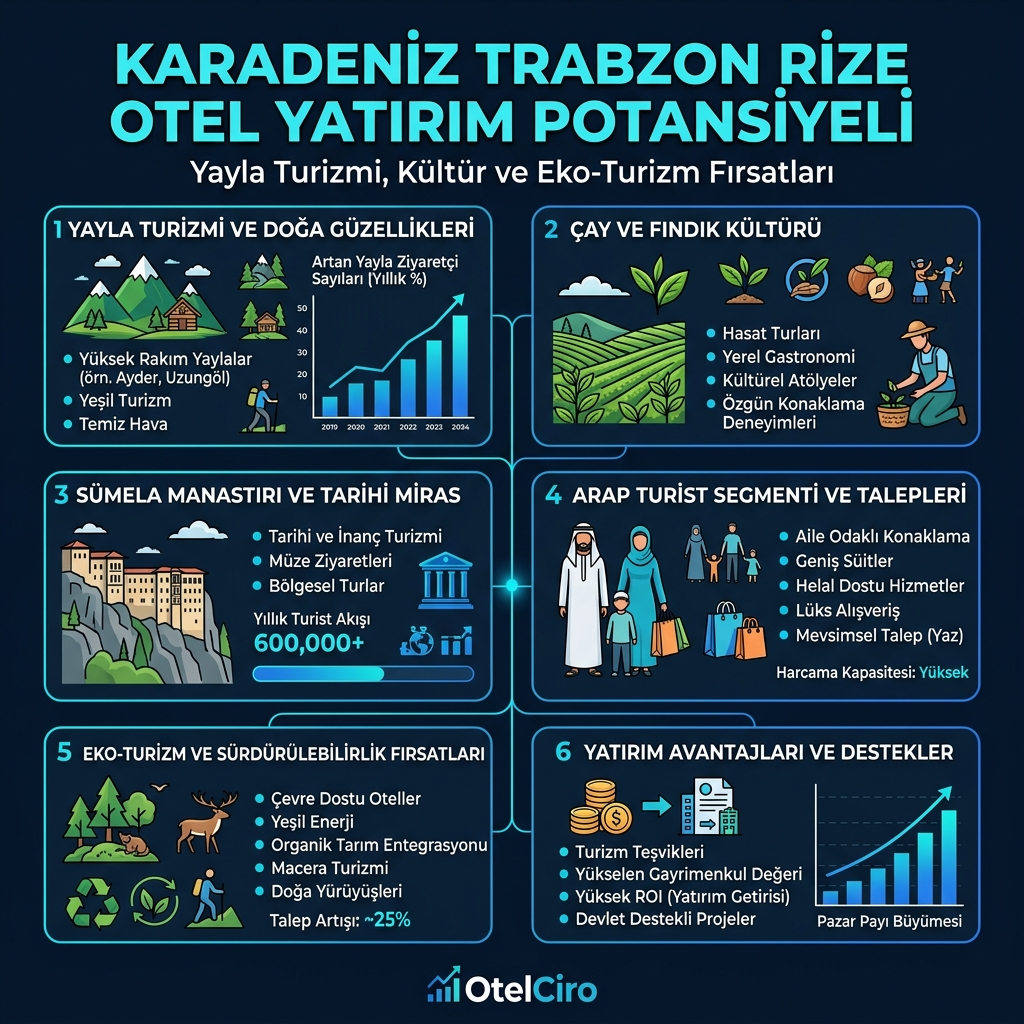
- Trabzon-Rize is an emerging hotel investment hub in 2026, with tourist numbers growing significantly (Trabzon 4.2M visitors, Rize 28% growth in 2025).
- Boutique eco-hotels in plateau tourism offer high returns, with 2025 annual RevPAR averaging 1,050 TL, 2.3 times higher than traditional 3-star hotels.
- The Arab tourist segment drives international growth, characterized by long stays (8-14 nights) and high spending (3,500-6,000 TL/day/family).
- Heritage tourism (Sümela Monastery) and agri-tourism (tea/hazelnut) extend the season, increasing annual occupancy by 15-20% in shoulder months.
- Optimal investments focus on boutique eco-hotels or apart-hotels (15-50 rooms) with a target ROI of 6-9 years, capitalizing on unique regional strengths and government incentives.
Why is Black Sea Tourism Different in 2026?
Turkish tourism investments have traditionally concentrated on the Mediterranean and Aegean coasts. However, in the 2024-2026 period, the Black Sea region, particularly the Trabzon-Rize axis, is exhibiting a remarkable ascent with both domestic and international visitor flows. According to Ministry of Culture and Tourism data, Trabzon province's tourist numbers in 2025 exceeded 4.2 million, breaking a five-year record. Rize, in the same period, became one of Turkey's fastest-growing tourism destinations with a 28% growth.
Several structural factors underpin this growth. First, the strengthening of Trabzon Airport's international connections: as of 2026, there are direct flights from Trabzon to 32 international destinations — this figure was 14 in 2020. Second, the opening of Rize-Artvin Airport in 2022 provided the eastern part of the region with air access for the first time, reaching a capacity of 1.1 million passengers in 2025. Third, dual-carriageway road investments dramatically shortened travel times.
However, the region's accommodation infrastructure is not adequately keeping pace with this growth. The total licensed room capacity in the Trabzon-Rize region is approximately 12,800 rooms — less than a single district in Istanbul. Occupancy rates reach 92% in high season, but remain in the 35-45% range in mid and low seasons. This situation presents both opportunities and risks.
Embed this image on your site
<a href="https://otelciro.com/en/news/black-sea-hotel-investment-trabzon-rize-2026-strategy-guide">
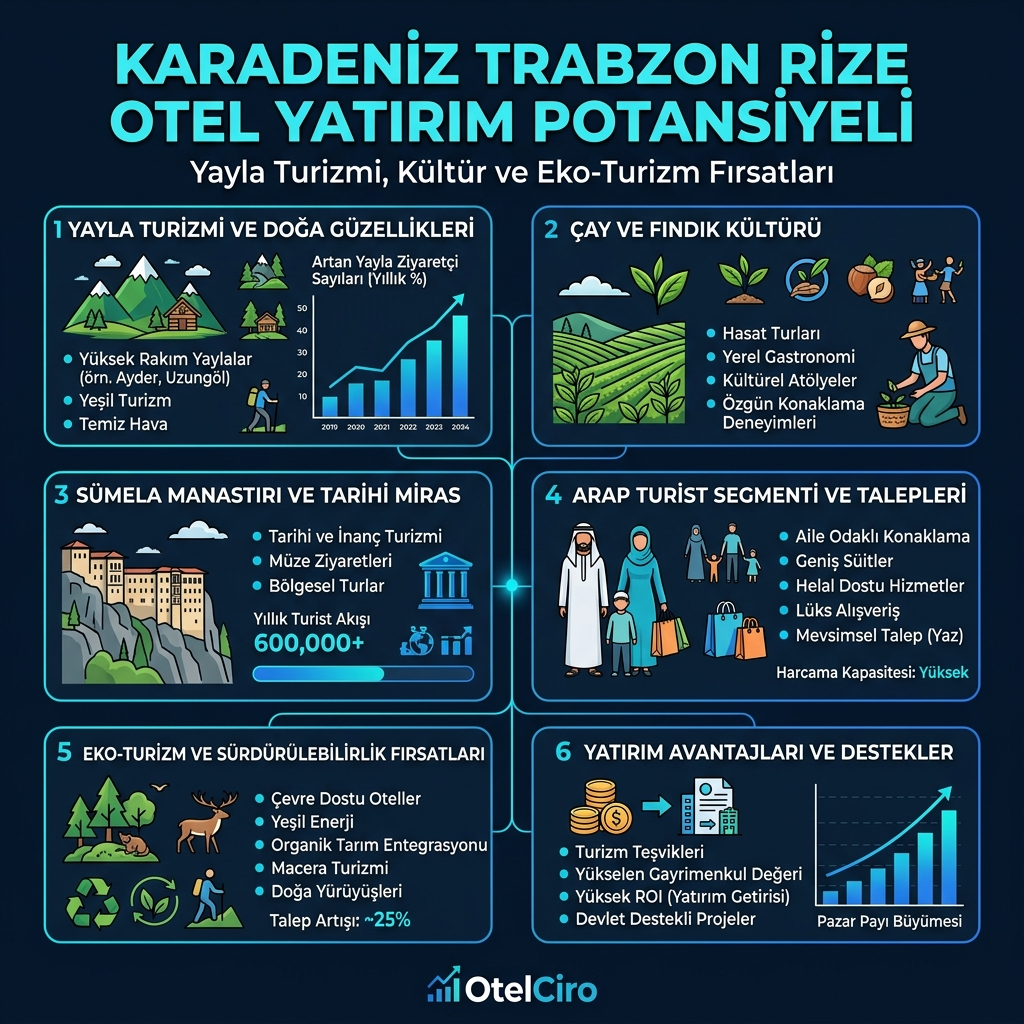
  <img src="https://cdn.sanity.io/images/1la98t0z/production/9f76429d73495cb4d65c8db44e5fbaf95b7d7247-1024x1024.png" alt="Black Sea Trabzon-Rize hotel investment potential and tourism data" width="800" />
</a>
<p>Source: <a href="https://otelciro.com">OtelCiro</a> — AI Hotel Revenue Management</p>
Plateau Tourism: The Golden Age of Nature Tourism Segment
The Black Sea's strongest tourism asset is undoubtedly plateau tourism. The plateaus of Ayder, Pokut, Sal, Hazindağ, Huser, and Elevit witness an increasing flow of visitors each year. According to data from the General Directorate of Nature Conservation and National Parks, Kaçkar Mountains National Park was visited by 680,000 people in 2025 — more than double the figure in 2019.
Plateau Tourism Investment Model
Key parameters for successful accommodation investment in plateau tourism:
- Location selection: Within 15-30 minutes by car to a plateau, with 12-month accessible infrastructure. Direct investment in plateaus that close in winter is risky.
- Capacity: 15-40 rooms is optimal. Large hotels disrupt the plateau's natural texture and face difficulties obtaining environmental permits.
- Design: Integrated with local architecture, predominantly wooden, minimal environmental impact. Prefabricated structures are perceived negatively.
- Pricing: Boutique plateau hotels achieve an average ADR of 1,800-4,500 TL per night — a performance exceeding that of 4-star hotels in Antalya.
- Seasonal distribution: June-September is peak season, October-November and April-May are shoulder seasons. Winter months can cater to the trekking and nature photography segment.
According to STR data, the 2025 annual RevPAR for boutique nature hotels in the Black Sea averaged 1,050 TL. This figure is 2.3 times the RevPAR of traditional 3-star hotels in the region. Boutique and experience-focused concepts yield significantly higher returns.
Arab Tourist Segment: The Region's International Growth Engine
Trabzon has become Turkey's second most popular destination for the Arab tourist segment over the last decade (after Istanbul). According to data from the Trabzon Provincial Directorate of Culture and Tourism, 47% of foreign tourists visiting Trabzon in 2025 came from Gulf countries. Saudi Arabia, Kuwait, UAE, and Qatar lead the way.
Characteristics of the Arab Guest Segment
Critical features of this segment for hotel investment:
- Long stays: Average length of stay is 8-14 nights — significantly higher than the European average of 3-4 nights.
- High spending: Average daily spending per family is 3,500-6,000 TL (including accommodation). This segment's contribution to TrevPAR is 2-3 times that of other segments.
- Family-oriented: Typically travel in large families. 2-3 bedroom apartment suites and connecting rooms are in high demand.
- Summer intensity: June-August is peak season. However, the Ramadan and Eid calendar creates variability throughout the year.
- Preference for nature experiences: Plateau visits, waterfall tours, tea harvesting experiences, and boat tours are the most requested activities.
Considerations for accommodation investment targeting this segment include: Arabic language communication capacity, Halal kitchen certification, family-oriented large rooms, units with washing machines (for long stays), and indoor women's pools or separate pool hours. Hotels that develop concepts tailored to these requirements achieve 20-30% higher ADR.
Related content: For a comparison of Istanbul's hotel investment environment with the Black Sea, refer to our article Istanbul Hotel Investment Outlook 2026.
Heritage Tourism: Sümela Monastery and Cultural Assets
Sümela Monastery fully reopened to visitors in 2024 after extensive restoration during the 2020-2024 period. The monastery, which is on the UNESCO World Heritage Tentative List, welcomed 1.2 million visitors in 2025, reaching a pulling power comparable to Göreme Open-Air Museum in Cappadocia. This adds significant cultural depth to the region's tourism profile.
Other heritage tourism assets in the region:
- Trabzon Hagia Sophia Museum: From the Byzantine period, 400,000+ visitors annually.
- Uzungöl: A crossroads of nature and culture tourism, 2 million+ visitors annually.
- Rize Tea Museum and Factories: Industrial heritage tourism, tea tasting experiences.
- Zilkale (Çamlıhemşin): Historic Georgian castle, a visit route combined with nature walks.
Heritage tourism is a critical factor in extending the region's season depth. Cultural assets can be visited year-round, which increases the annual occupancy rates of accommodation facilities. Especially in the October-November period, as the plateau season closes, monastery and museum visits boost occupancy rates by 15-20%.
Tea and Hazelnut Cultural Tourism: Gastronomy Experience Potential
Rize's tea gardens and the Giresun-Trabzon line's hazelnut plantations offer unique potential for gastronomy and agri-tourism experiences. This area is not yet sufficiently evaluated from a hospitality perspective, but parallel examples worldwide are inspiring.
Tea Tourism Model
Japan's Uji region and Sri Lanka's Hill Country are globally successful examples of tea tourism. In these destinations, tea harvesting experiences, factory tours, tea ceremonies (or tasting rituals), and tea-based spa treatments create high-value-added tourism products. Rize's potential in this area remains untapped.
Applicable concepts:
- Tea garden hotels: Boutique accommodation within working tea gardens. Guests can participate in the harvesting experience.
- Tea tasting routes: Tasting tours of different tea varieties grown under varying altitude and climate conditions.
- Tea-based wellness: Spa treatments with tea extracts, powdered tea products similar to matcha.
- Farm-to-cup experience packages: Half-day programs including the entire process of harvesting, drying, roasting, and brewing.
Similarly, hazelnut harvesting (August-September), hazelnut-based gastronomy experiences, and hazelnut oil production tours offer revenue diversification opportunities, especially for Giresun and the eastern parts of Trabzon.
The contribution of such agri-tourism experience packages to hotels is measured as 25-40% additional revenue per guest. You can find a detailed implementation guide for this model in our article Local Experience Packages: Authentic Activity Design.
Investment Evaluation Matrix
A comparative evaluation for those considering hotel investment in the Trabzon-Rize region:
Strengths
- Increasing international flight connections and airport capacity
- Strong and growing Arab tourist segment (long stays, high spending)
- Unique natural and cultural assets (plateaus, Sümela, tea gardens)
- Low competition environment (limited boutique accommodation supply)
- Government incentives (50-80% investment reduction under tourism incentive zone)
Risks and Threats
- Strong seasonality (July-August peak, November-March low season)
- Infrastructure deficiencies (especially plateau roads and parking)
- Environmental regulations and zoning restrictions (national park boundaries)
- Difficulty in finding qualified personnel
- Climate change risk (changes in rainfall patterns, fog, and greenery impact)
Optimal Investment Profile
- Property type: Boutique eco-hotel or apart-hotel (15-50 rooms)
- Investment budget: 20-60 million TL (including land)
- Expected payback period: 6-9 years (boutique segment), 8-12 years (standard segment)
- Target RevPAR: 900-1,500 TL (boutique), 400-700 TL (standard)
Conclusion: The Right Time for Tourism Investment in the Black Sea
The Black Sea region has long been overlooked on Turkey's tourism investment map. However, as of 2026, the maturation of infrastructure investments, strengthening international connections, and the rise of global nature tourism trends make the region an attractive investment destination. Particularly, boutique eco-tourism and culture-experience-focused concepts yield unit returns significantly higher than traditional coastal tourism.
The key to a successful Black Sea investment is to develop the region's natural and cultural values while preserving them, manage seasonality through experience diversification, and create products tailored to the needs of the Arab tourist segment. OtelCiro's dynamic pricing and channel management solutions offer strong support for seasonality management and segment-based optimization, maximizing investment returns.
Recommended reading: For financial modeling and feasibility analysis in regional investment decisions, you can review the valuation methodology in our article Istanbul Hotel Investment Outlook 2026.
![US Hotel Labor Costs Hit $131 Billion in 2026: AI Automation Strategies That Cut Costs Fast [2026 Guide]](https://cdn.sanity.io/images/1la98t0z/production/6765e31b08a1c04cce66f9bf9482693dbefdcce5-2752x1536.jpg?w=1920&q=50&auto=format&fit=max)
![Hotel ABS: Asset-Backed Securities Funding [2025 Guide]](https://cdn.sanity.io/images/1la98t0z/production/9852648670a07201731fd265640f5d7dacd57c4c-1024x1024.png?w=1920&q=50&auto=format&fit=max)