![Hotel ABS: Asset-Backed Securities Funding [2025 Guide]](https://cdn.sanity.io/images/1la98t0z/production/9852648670a07201731fd265640f5d7dacd57c4c-1024x1024.png?w=1920&q=65&auto=format&fit=max)
Key Takeaways
- Hotel financing is evolving beyond traditional bank loans, with Asset-Backed Securities (ABS) and Commercial Mortgage-Backed Securities (CMBS) emerging as powerful alternatives.
- The global hotel income securitization market surged to $15.2 billion in 2025, offering up to 150-200 basis points lower interest rates than conventional bank loans.
- ABS allows hotels to leverage future income streams for financing, independent of property ownership, while CMBS is ideal for property-backed funding.
- Advanced models, including future income securitization by chains like Marriott and Hilton, and the potential for blockchain-based tokenized ABS, are transforming access to capital.
- Despite local challenges, Türkiye presents significant opportunities for pooled ABS structures, especially given its high-interest rate environment and robust tourism performance.
The Evolution of Hotel Finance: Beyond Bank Loans
The global hospitality industry is fundamentally re-evaluating its financing models in the post-pandemic era. While traditional bank loans remain a primary funding source, Asset-Backed Securities (ABS) and Commercial Mortgage-Backed Securities (CMBS) are becoming increasingly accessible alternatives for hoteliers.
According to S&P Global data, the hotel revenue-based securitization market reached $15.2 billion in 2025 — a 75% increase from the $8.7 billion level in 2019. This growth indicates that not only large chains but also independent and boutique hotels are gaining access to these financing tools.
For hotel investors and owners in Türkiye, these developments present significant opportunities, especially in a high-interest-rate environment. However, to understand the advantages of ABS, one must first grasp its mechanism.
Embed this image on your site
<a href="https://otelciro.com/en/news/hotel-abs-asset-backed-securities-funding-2025-guide">
  <img src="https://cdn.sanity.io/images/1la98t0z/production/9852648670a07201731fd265640f5d7dacd57c4c-1024x1024.png" alt="Hotel ABS — Asset-Backed Securities Financing Model" width="800" />
</a>
<p>Source: <a href="https://otelciro.com">OtelCiro</a> — AI Hotel Revenue Management</p>
Related reading: Tokenized Hotel Investment: Fractional Ownership and Blockchain
What is ABS? A Hotel Sector Perspective
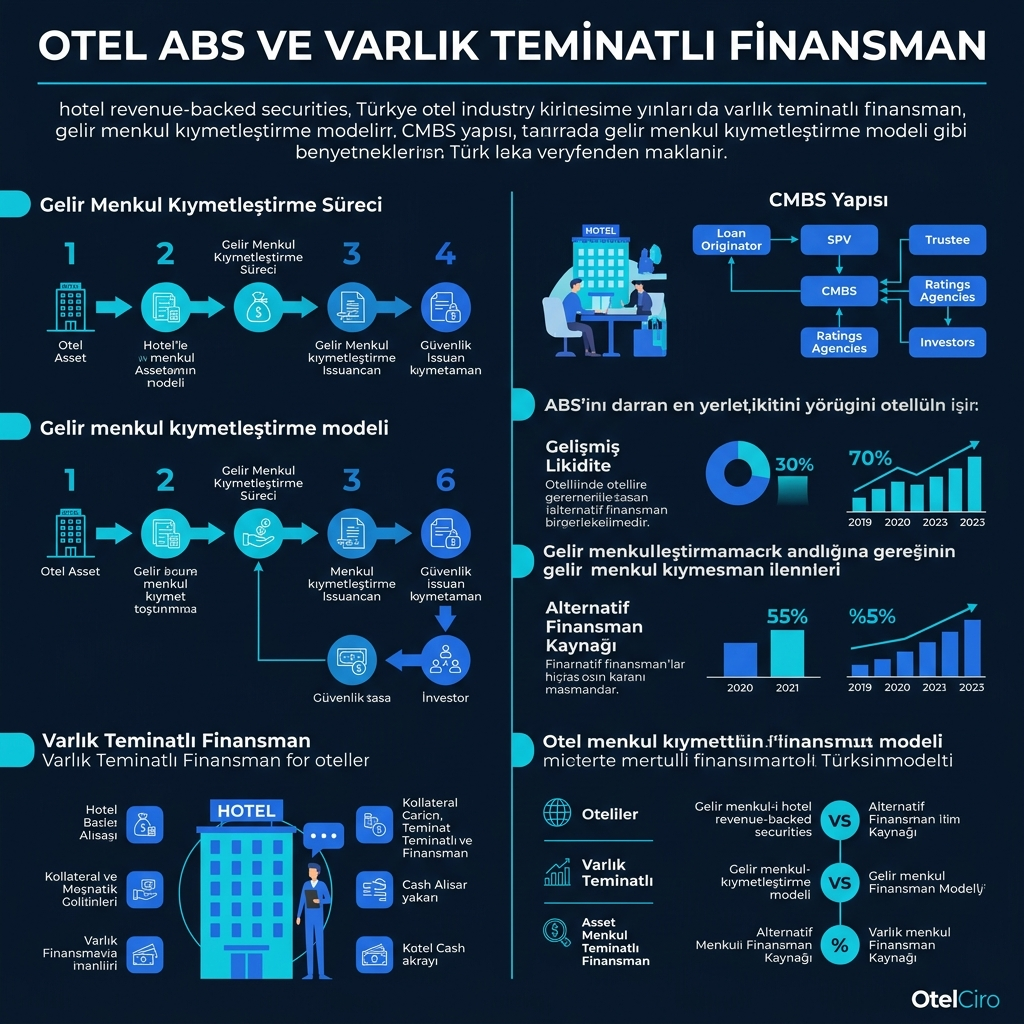
Asset-Backed Securitization (ABS) is a method of raising funds from capital markets by using a hotel's future revenue streams or existing assets as collateral. The simplified mechanism is as follows:
- The hotel transfers future room revenues, F&B revenues, or management contracts into a pool.
- A Special Purpose Vehicle (SPV) is established to manage this pool.
- The SPV issues securities backed by the cash flows in the pool.
- Investors purchase these securities, providing funds to the hotel.
- The hotel makes regular payments to investors using its future revenues.
This structure offers several advantages compared to traditional loans:
| Criterion | Bank Loan | ABS/CMBS |
|---|---|---|
| Interest Rate | Base + 3-6% | Base + 1.5-4% |
| Term | 5-15 years | 5-30 years |
| Collateral | Real estate mortgage | Revenue stream / assets |
| Flexibility | Low | Medium-High |
| Access Speed | 2-6 months | 3-9 months (initial issuance) |
| Balance Sheet Impact | Appears as debt | Structure-dependent (off-balance sheet possible) |
| Minimum Scale | 5M+ TRY | 50M+ TRY (standalone) / 10M+ (pooled) |
Notable data: The interest rate advantage of ABS/CMBS can be 150-200 basis points lower than traditional loans. According to Moody's 2025 analysis, the average coupon rate for hotel ABS in the US market was 5.2%, whereas bank loans with the same profile were at 7.1%.
CMBS vs. ABS: Differences for Hoteliers
Two main types of securitization are used in the hotel sector. Understanding the differences between them is critical for choosing the right financing model.
CMBS (Commercial Mortgage-Backed Securities)
CMBS uses the hotel's real estate as collateral. It is the closest structure to a traditional mortgage loan.
Advantages:
- Lower interest rates (real estate collateral reduces risk premium)
- Potential for high-value funding
- Term options of 10-30 years
Disadvantages:
- Not available to hotels that do not own the property (tenants/managers)
- Loan-to-Value (LTV) ratio typically limited to 60-75%
- High prepayment penalties
ABS (Asset-Backed Securities)
ABS structures the hotel's revenue streams—room revenue, F&B, event revenue—as collateral.
Advantages:
- Does not require property ownership
- Management companies and franchise operators can also utilize it
- Off-balance sheet financing possibility
- Higher funding based on future revenue projections
Disadvantages:
- Higher interest premium due to revenue volatility
- Performance covenants (minimum occupancy, RevPAR thresholds)
- Complex structuring process
Which Model When?
| Scenario | Recommended Model |
|---|---|
| Property owner, new construction finance | CMBS |
| Property owner, refinancing | CMBS or Hybrid |
| Operator with management contract | ABS |
| Franchise operator, growth finance | ABS |
| Renovation / conversion project | Hybrid (CMBS + mezzanine) |
| Chain expansion (5+ properties) | Pooled ABS |
Securitization of Future Revenue: How It Works
The most advanced form of hotel ABS is the securitization of future revenues. This model is an extremely powerful financing tool, especially for hotels with strong brand recognition and a stable performance history.
Case Study: Marriott International
In 2024, Marriott conducted its largest ABS issuance in history, totaling $3.5 billion. The structure:
- Collateral: Future management fees and franchise fees from 1,200+ hotels
- Term: 5 tranches, ranging from 3-15 years
- Coupon: 4.2-5.8% (depending on tranche)
- Rating: 5 credit ratings from AAA to BB
- Purpose: Shareholder returns and strategic acquisitions
The key to Marriott's success is its predictable revenue stream. Management fees (3-5% of revenue) and franchise fees (4-6% of revenue) are considered lower risk by investors because they are less volatile than room revenue.
Case Study: Hilton Hotels
Between 2023-2025, Hilton issued a total of $5.2 billion in CMBS and ABS. Different structures were used:
- Hilton Grand Vacations: ABS backed by vacation ownership revenues ($2.1 billion)
- Hilton Domestic Operating Company: CMBS backed by room revenues ($1.8 billion)
- Franchise fee ABS: Structure backed by franchise fees ($1.3 billion)
According to Fitch Ratings, Hilton's ABS have some of the lowest default rates in the hotel sector. Even during the 2020 pandemic, no payment defaults occurred — proving the robustness of the structuring.
The Intersection of Tokenization and ABS
Blockchain technology has the potential to democratize traditional ABS structures. Tokenized ABS allows large volumes of securities to be divided into smaller units, providing access to a wider investor base.
Advantages of Tokenized Hotel ABS
- Lower minimum investment: The minimum threshold of $100,000-$1 million for traditional ABS can be reduced to $1,000 with tokenization.
- Liquidity: 24/7 trading capability in the secondary market.
- Transparency: Real-time revenue and payment tracking on the blockchain.
- Global reach: Attracting investors without geographical limitations.
- Lower intermediation costs: Reducing traditional fees of 2-4% to 0.5-1%.
According to PwC's 2025 report, the tokenized real estate securities market is projected to reach $35 billion by 2028, with 15-20% of this volume coming from the hospitality sector.
Risk Assessment Models
Risk assessment in ABS issuance requires a different methodology than traditional credit analysis. Key metrics used by rating agencies to evaluate hotel ABS include:
Revenue Stability Metrics
| Metric | Threshold for AAA | Threshold for BBB | Description |
|---|---|---|---|
| DSCR (Debt Service Coverage) | >2.0x | >1.4x | Ratio of revenue to debt service |
| RevPAR Volatility | Less than 10% | Less than 20% | RevPAR fluctuations over the last 5 years |
| Occupancy Floor | Above 60% | Above 45% | Minimum occupancy in worst-case scenario |
| Brand Strength Score | 8+/10 | 6+/10 | Brand recognition and loyalty program |
| Geographic Diversity | 5+ cities | 2+ cities | Portfolio diversification |
| Operator Quality | Tier 1 | Tier 1-2 | Track record of the management company |
Stress Test Scenarios
Rating agencies subject hotel ABS to stress tests with the following scenarios:
- Base scenario: 5-10% occupancy drop, 3-5% ADR contraction
- Adverse scenario: 20-30% occupancy drop, 10-15% ADR contraction (similar to 2020)
- Severely adverse: 40-50% occupancy drop, 20-25% ADR contraction
The 2020 pandemic experience has fundamentally updated stress test models. Now, a "near-zero occupancy" scenario is also included in standard tests.
Hotel Financing in Türkiye and BDDK Regulations
In Türkiye, securitization is regulated within the framework of the Capital Markets Board (SPK) and the Banking Regulation and Supervision Agency (BDDK). The situation specific to the hotel sector:
Current Legal Framework
- SPK Communiqué (III-58.1): Regulation on asset financing funds and asset-backed securities.
- BDDK securitization regulation: Securitization of loan pools on bank balance sheets.
- VFF (Varlık Finansmanı Fonu): The closest instrument to an ABS structure in Türkiye.
Challenges in Türkiye
Factors slowing the development of hotel ABS in Türkiye:
- Lira volatility: Exchange rate risk for dollar-based investors — solution: foreign currency-based or currency-protected structuring.
- Shallow capital market: Limited pool of institutional investors — solution: access to international markets.
- Tax uncertainty: Unclear areas in the taxation of ABS revenues.
- Data standardization: Requirement for hotels to report financial data according to international standards (USALI compliance).
Window of Opportunity
Despite these challenges, positive conditions for the growth of hotel ABS in Türkiye also exist:
- High-interest-rate environment: While traditional bank loan costs are 40%+, ABS can offer an alternative interest rate advantage.
- Strong tourism performance: 60 million+ tourists in 2025, ensuring stable revenue streams.
- Banking sector's lending appetite: The cautious approach of banks to tourism loans due to BDDK regulations increases the need for alternative funding.
- GAP and Diversification: Structures can be combined with incentives for hotel investments in Southeastern and Eastern Anatolia.
According to Deloitte Türkiye's estimates, the hotel-focused securitization market in Türkiye could reach a volume of 3-5 billion TRY by 2028 — currently, this volume is practically close to zero.
ABS Roadmap for Hoteliers
Here's a step-by-step roadmap for hoteliers considering securitization as a financing alternative:
Phase 1: Preparation (6-12 Months)
- Financial reporting standardization: Setup of a USALI-compliant accounting system.
- Revenue data consolidation: Minimum 3 years of monthly revenue/occupancy/ADR data.
- Operational audit: Independent valuation and performance analysis.
- Legal structure: SPV formation and contract preparation.
Phase 2: Structuring (3-6 Months)
- Advisor selection: Engagement with an investment bank and law firm.
- Rating application: Application to an SPK-approved rating agency.
- Issuance design: Determination of maturity, tranche structure, and coupon rate.
- Investor roadshow: Meetings with institutional investors.
Phase 3: Issuance and Management (Ongoing)
- Market offering: Issuance of securities.
- Revenue management: Performance tracking of the ABS-collateralized revenue stream.
- Reporting: Quarterly performance reports to investors.
- Covenant compliance: Maintenance of minimum DSCR and performance thresholds.
Related reading: Hotel Loans & Financing: Renovation Investment Guide
The Intersection of AI and ABS: Data-Driven Funding
Artificial intelligence creates value at three critical points in hotel ABS structures:
1. Revenue Forecast Accuracy
AI-powered revenue management systems enhance the accuracy of revenue projections, the most critical input for ABS. While traditional models have revenue forecast deviations of 15-25%, AI models can reduce this to 5-10%. More accurate revenue forecasts mean a lower risk premium and consequently lower borrowing costs.
2. Dynamic Risk Monitoring
AI algorithms monitor ABS performance in real time, generating early warning signals. Risk factors such as occupancy drops, RevPAR deviations, or changes in the competitive landscape can be detected weeks before human analysts.
3. Automated Covenant Monitoring
Performance covenants (minimum occupancy, DSCR thresholds) in ABS agreements can be automatically monitored with AI. Platforms like OtelCiro have the capability to automatically generate revenue performance reports in investor-standard formats.
Pooled ABS for Small and Medium-Sized Hotels
The minimum scale requirement for ABS can exclude smaller hotels operating independently. However, a pooled ABS (pooled securitization) structure overcomes this barrier by consolidating the revenues of multiple hotels into a single pool.
How a Pooled Structure Works
- 10-50 hotels transfer their revenue streams to a single SPV.
- The SPV issues securities based on the aggregated pool.
- The diversification effect reduces risk and improves the credit rating.
- Each hotel receives funding proportional to its revenue contribution.
Model recommendation for Türkiye: Under the leadership of industry organizations like TÜROB or TUROB, a pooled ABS issuance with a volume of 500 million - 1 billion TRY involving 20-30 medium-sized hotels could be groundbreaking for the sector. Having hotels in the pool from different regions and segments would provide geographical and operational diversification, thereby reducing risk.
Conclusion: The Future of Finance is Diversified
Reliance on a single channel for hotel financing is both costly and risky. Capital market instruments like ABS and CMBS are growing as strong alternatives alongside bank loans.
For hoteliers in Türkiye, the short-term goal is to raise awareness in this area, and in the medium term, to initiate preparatory processes. Standardization of financial reporting, consolidation of revenue data, and operational transparency — these are essential infrastructure elements not only for ABS but also for establishing relationships with any investor.
Global trends are clear: The future of hotel financing lies in a diversified structure comprising bank loans + ABS + tokenization + private equity. Hotels that understand and prepare for this structure will both reduce their costs and accelerate their growth strategies.
![US Hotel Labor Costs Hit $131 Billion in 2026: AI Automation Strategies That Cut Costs Fast [2026 Guide]](https://cdn.sanity.io/images/1la98t0z/production/6765e31b08a1c04cce66f9bf9482693dbefdcce5-2752x1536.jpg?w=1920&q=50&auto=format&fit=max)