Key Takeaways
- Unique Challenge: Seasonal hotels generate revenue for only 5-7 months but incur costs for a full 12 months, making cash flow management critical for survival.
- High Risk: Industry data shows that 35% of seasonal hotels resort to borrowing due to low-season cash crunches.
- Reserve Fund Strategy: Allocate a minimum of 25-30% of high-season revenues to a separate reserve fund, with a practical rule of transferring 40% of net profit from each high-season month.
- Proactive Forecasting: Implement a minimum standard of a 52-week, weekly cash flow projection, and monitor critical metrics like cash coverage ratio (minimum 1.5x) and accounts receivable aging.
- Diversify & Optimize: Boost low-season revenues by 15-25% through alternative opportunities (e.g., long-term stays, local events) and leverage early booking campaigns to secure 20-30% of total seasonal revenue pre-season.
The Greatest Financial Challenge for Seasonal Hotels
Seasonal hotels operating on Turkey's Mediterranean and Aegean coasts generate revenue for only 5-7 months of the year while facing costs for 12 months. This makes cash flow management a matter of survival. According to industry data, 35% of seasonal hotels are forced to borrow due to low-season cash crunches.
Cash flow management is not simply "balancing income and expenses." It requires strategic planning in terms of timing, amount, and direction. In this guide, we delve into how seasonal hotels can maintain financial balance throughout the year.
Related reading: Hotel Seasonality Management Guide
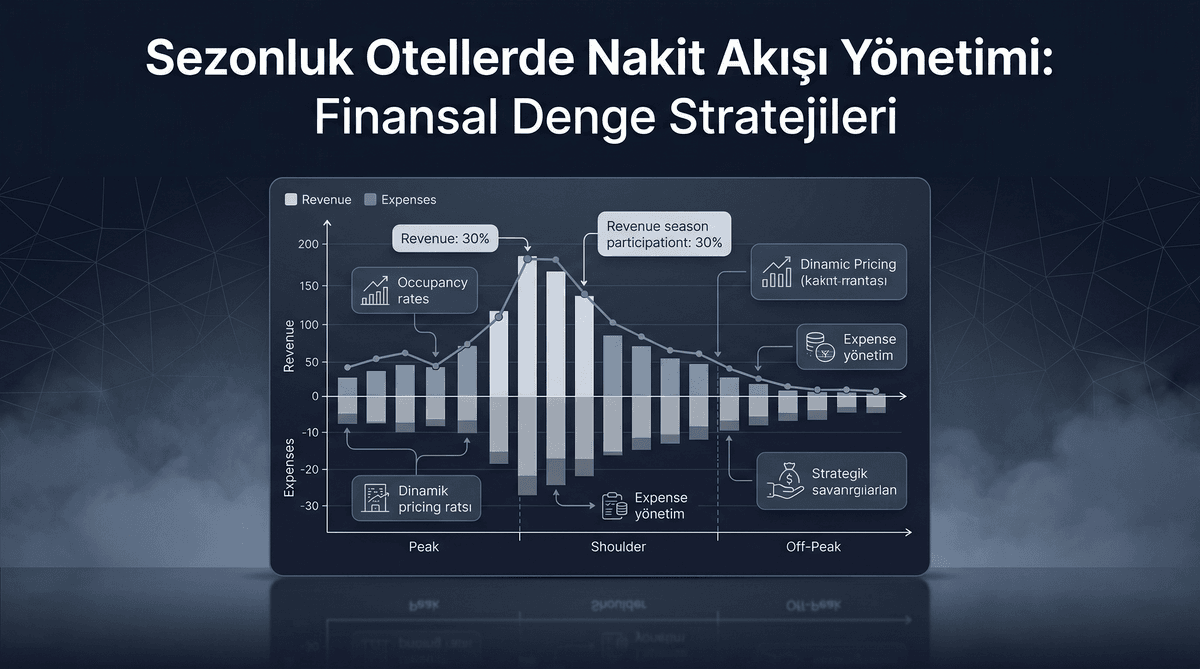
Cash Flow Cycle in Seasonal Hotels
For a typical Mediterranean seasonal hotel, the cash flow cycle consists of four distinct phases:
Phase 1: Preparation Period (March-April)
During this period, cash outflows intensify, and no significant revenue is generated yet:
- Pre-season maintenance and repairs: Accumulated maintenance needs over the winter
- Staff recruitment and training: Building the seasonal team
- Inventory purchases: Room supplies, F&B stocks, cleaning materials
- Marketing investments: OTA commission prepayments, advertising budgets
Cash outflow during this period accounts for 15-20% of total annual expenses and is typically financed by prior season's savings or short-term loans.
Phase 2: Upswing Period (May-June)
Revenues begin to increase but are not yet sufficient to fully cover expenses:
- Room revenues start flowing in with the initial guest arrivals
- Staff expenses continue based on a full team
- Energy costs (especially air conditioning) increase
- Payments from OTAs are reflected with a 15-45 day delay
Phase 3: Peak Season (July-September)
This is the period of strongest cash flow. Net cash inflow during this time constitutes 70-80% of total annual profit:
- Occupancy rates reach 85-95%
- ADR (Average Daily Rate) is at its highest levels
- F&B and ancillary revenues also peak
- Excess cash generated during this period must be managed to cover low-season expenses
Phase 4: Closing and Low Season (October-February)
Revenues rapidly decline while fixed costs persist:
- Room revenues decrease by 80-90%
- A significant portion of staff departs, receiving severance pay
- Winter maintenance and renovation costs begin
- Loan installments, insurance premiums, and tax payments continue
Creating a Cash Flow Forecasting Model
Accurate cash flow forecasting is the financial safety net for a seasonal hotel. A 52-week cash flow projection prepared on a weekly basis should be the minimum standard.
Revenue Side Forecasts
- Room revenues: Occupancy forecast x ADR forecast x number of rooms (on a weekly basis)
- F&B revenues: Spend per guest x expected number of stays
- Ancillary revenues: Spa, tour sales, parking, transfer services
- Payment delays: Account for OTA payments being reflected with an average 30-day delay
Expense Side Forecasts
The timing of expenses is critically important:
| Expense Item | Payment Timing | % of Annual Total |
|---|---|---|
| Personnel expenses | Monthly | 35-45% |
| Energy | Monthly | 8-12% |
| Food and supplies | 15-30 day terms | 15-20% |
| Rent/Loan installment | Monthly (12 months) | 10-15% |
| Insurance | Annually/quarterly | 2-3% |
| Tax payments | Quarterly | 5-8% |
Low Season Cash Management Strategies
Creating a Reserve Fund
A minimum of 25-30% of high-season revenues should be set aside to cover low-season expenses. Maintaining this fund in a separate account and using it only for planned expenditures requires discipline.
Practical rule: 40% of the net profit earned in each high-season month should be transferred to the reserve fund.
Minimizing Fixed Costs
Reducing controllable fixed costs during the low season:
- Energy management: Shutting down systems in unused areas, reducing electricity bills by 40-60%
- Staff planning: Employing non-core staff on seasonal contracts
- Maintenance planning: Performing planned maintenance during the low season to prevent unexpected costs in the high season
- Supplier negotiations: Negotiating more favorable payment terms during the low season
Low Season Revenue Opportunities
Instead of closing the hotel entirely, alternative revenue sources can be considered:
- Long-term stays: Special packages for digital nomads and retired tourists
- Local events: Renting out the venue for weddings, seminars, workshops
- Weekend packages: Capturing demand for short breaks from nearby cities
- Renovation and training: Dedicating the low season to investment and staff development
Hotels implementing these strategies have seen low-season revenues increase by 15-25%.
Related reading: Hotel Annual Budget Planning Guide
Early Booking and Prepayment Strategy
One of the most effective ways to smooth cash flow is to secure cash inflow before the season begins with early booking campaigns:
Early Bird Campaigns
- 3-6 months in advance: 15-20% discount in exchange for non-refundable prepayment
- 1-3 months in advance: 10-15% discount in exchange for 50% prepayment
- Last minute: Full price, standard cancellation terms
With this strategy, 20-30% of total seasonal revenue can be collected in cash before the season begins. This amount covers a significant portion of preparation period expenses.
Payment Terms Optimization
- Direct bookings: Immediate payment or within 48 hours
- OTA bookings: Monitoring payment timelines, evaluating delayed channels
- Group and corporate: 30-50% prepayment requirement
- Tour operators: Clearly define payment schedule in the contract
Financial Early Warning System
OtelCiro's reporting tools monitor cash flow trends in real-time, detecting potential bottlenecks in advance.
Critical monitoring metrics:
- Cash coverage ratio: Current cash / estimated next 30-day expenses (should be minimum 1.5x)
- Accounts receivable aging: Ratio of receivables over 30 days to total receivables (should not exceed 15%)
- Fixed expense coverage period: How many months fixed expenses can be covered with current cash
- Burn rate: Monthly net cash outflow during the low season
An automatic alert system should activate if any of these metrics fall below the critical threshold.
Banking and Financing Relationships
For seasonal hotels, banking relationships are a strategic partnership that must be managed throughout the year:
- Revolving credit line: Flexible credit used in the low season and paid off in the high season
- Seasonal installment plan: Weighting loan installments according to revenue periods
- Factoring: Collecting OTA receivables before their due date
- Currency management: Protecting foreign tourist revenues from exchange rate risk
It should be remembered that negotiating with banks during the high season — when cash flow is strong — often yields more favorable terms.
Conclusion: Proactive Cash Management is Vital
In seasonal hotels, cash flow management is as crucial a competency as the ability to generate revenue. Hotels that achieve record high-season revenues but fall into low-season cash crunches are far from financially sustainable. Proactive cash flow planning, reserve fund discipline, and low-season strategies can maintain financial balance throughout the year.
Do you want to automate your hotel's cash flow forecasts and detect financial risks early? Contact us for a free analysis.
![US Hotel Labor Costs Hit $131 Billion in 2026: AI Automation Strategies That Cut Costs Fast [2026 Guide]](https://cdn.sanity.io/images/1la98t0z/production/6765e31b08a1c04cce66f9bf9482693dbefdcce5-2752x1536.jpg?w=1920&q=50&auto=format&fit=max)