
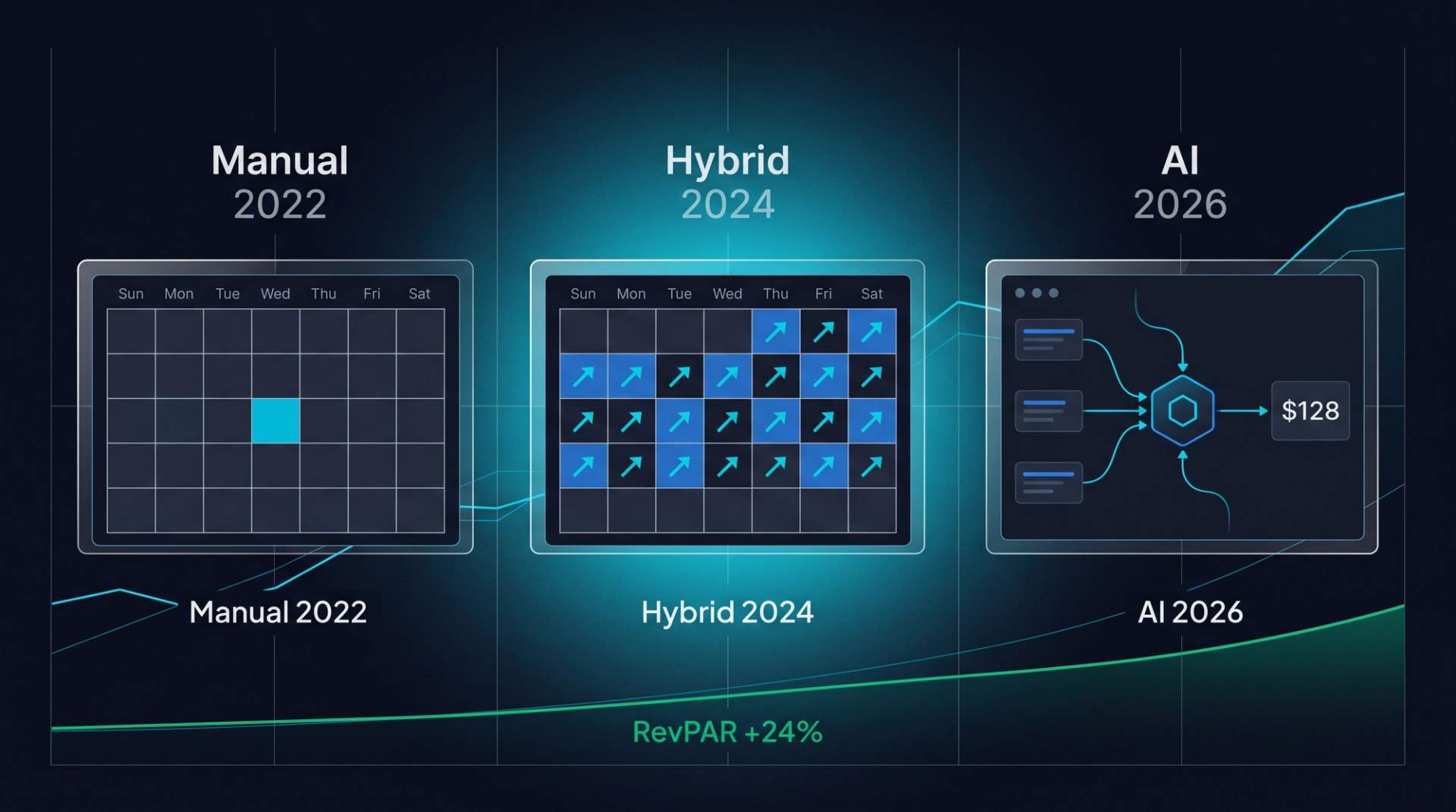
Key Takeaways
- AI revenue management costs have plummeted from $50,000+ to as low as $2,400 annually, making it accessible for boutique and independent hotels.
- AI forecasting models achieve up to 92% accuracy for 7-day occupancy, a significant improvement over the 78% seen in traditional models.
- Implementing dynamic pricing at the room-type level can increase Suite RevPAR by up to 22% by decoupling it from standard room multipliers.
- Total Revenue Management (TRM) powered by AI can boost non-room revenue streams (F&B, Spa, Parking) by 15-25%.
- Small hotels can transition to full AI automation within 3 to 6 months through a structured four-stage implementation roadmap.
Embed this image on your site
<a href="https://otelciro.com/en/news/yapay-zeka-gelir-yonetimi-otomasyon-2026">
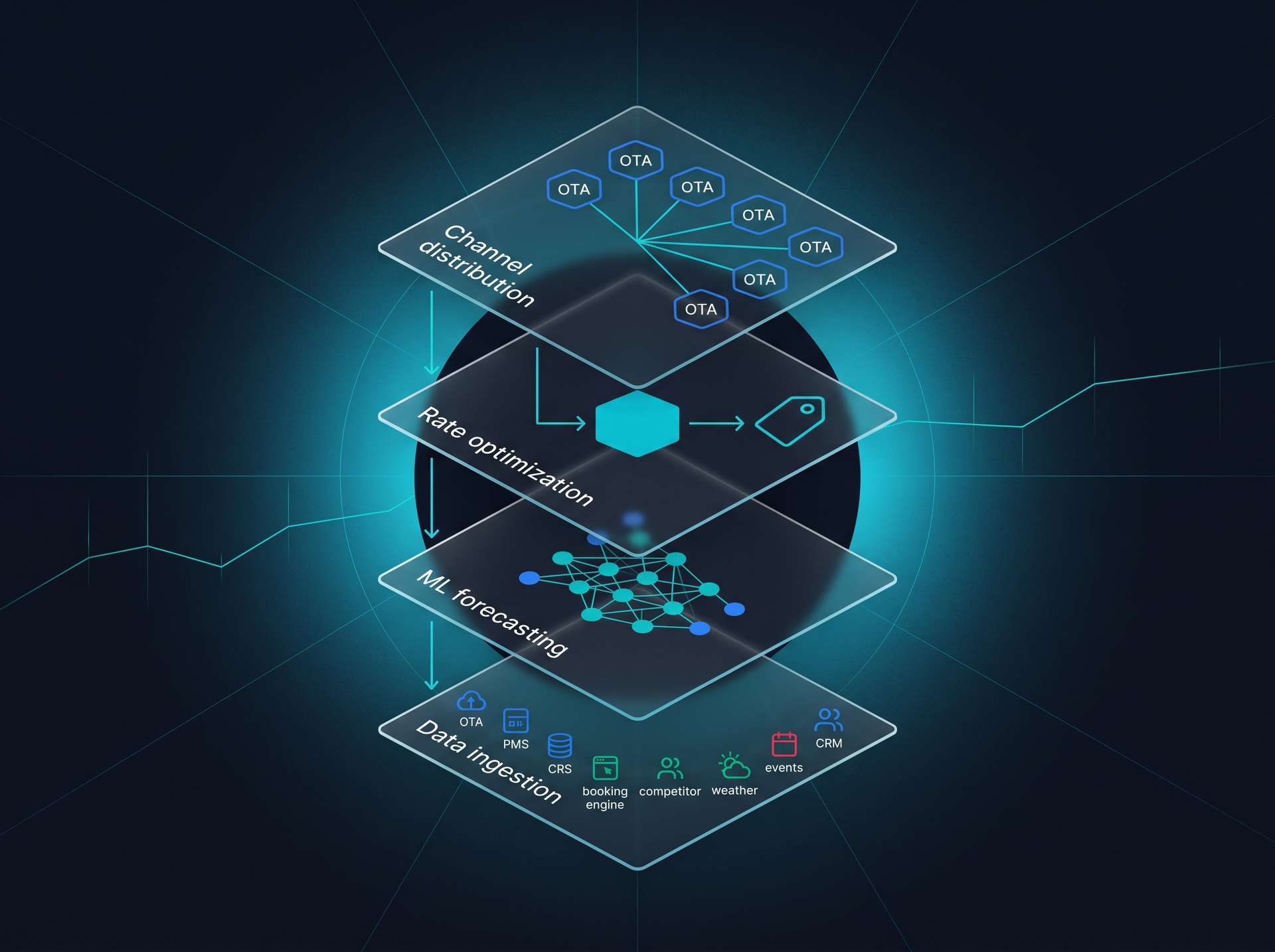
  <img src="https://cdn.sanity.io/images/1la98t0z/production/36d7483e31d2e7d2c0e8e9148193799405f5f871-2400x1792.jpg" alt="Four-layer AI automation stack. Top: data ingestion from 8 sources (OTA, PMS, CRS, booking engine, competitor, weather, events, CRM). Next: ML forecasting shown as a neural-net motif. Next: rate optimization shown as a cyan hexagon producing a price tag. Bottom: channel distribution fanning out to 6 OTA nodes." width="800" />
</a>
<p>Source: <a href="https://otelciro.com">OtelCiro</a> — AI Hotel Revenue Management</p>
AI Revenue Management is Becoming Democratized
For many years, AI-powered Revenue Management remained a luxury accessible only to global chains like Marriott, Hilton, or IHG. The annual licensing costs of these systems ranged between $50,000-$250,000, and integration periods often took months. For a 50-room boutique hotel or a 120-room city hotel, these figures made the return on investment (ROI) nearly impossible.
In 2026, this landscape has changed fundamentally. With the advancement of cloud-based SaaS models, API integrations, and generative AI, hotels of all sizes can now access AI-powered revenue management tools.
Traditional vs. Next-Gen AI Revenue Management
Cost and Accessibility Comparison
| Feature | Traditional RMS | Next-Gen AI RMS |
|---|---|---|
| Annual cost | $50,000-$250,000 | $2,400-$18,000 |
| Integration time | 3-6 months | 1-7 days |
| Minimum room count | 200+ | No limit |
| Training requirement | Certified RM specialist | Basic hotel knowledge sufficient |
| Data requirement (start) | 2-3 years of historical data | 6 months of data sufficient |
| Update frequency | 2-4 times per year | Continuous (automatic) |
| Supported language | Primarily English | Multi-language (including Turkish) |
This table clearly illustrates why AI revenue management is no longer just a tool "for the big chains."
Embed this image on your site
<a href="https://otelciro.com/en/news/yapay-zeka-gelir-yonetimi-otomasyon-2026">
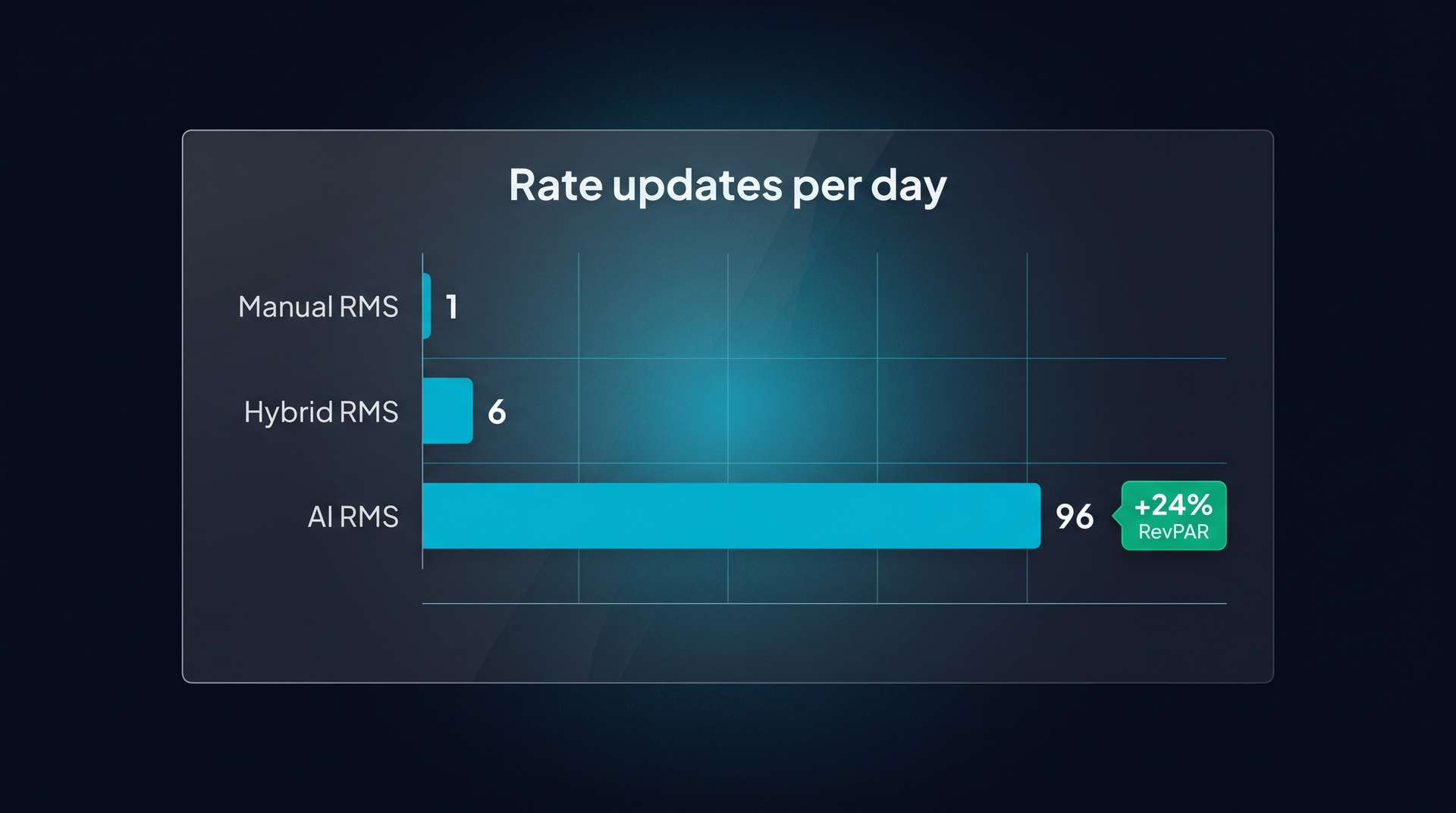
  <img src="https://cdn.sanity.io/images/1la98t0z/production/515550c836666afac80f7418020e12bc76edb5de-2752x1536.jpg" alt="Bar chart comparing daily rate-update frequency across three revenue management approaches. Manual RMS: 1 update per day. Hybrid RMS: 6 updates per day. AI RMS: 96 updates per day, with an emerald badge showing +24% RevPAR lift." width="800" />
</a>
<p>Source: <a href="https://otelciro.com">OtelCiro</a> — AI Hotel Revenue Management</p>
Four Core Capabilities of AI Revenue Management
1. Room-Type Based Dynamic Pricing
Traditional revenue management typically operates based on the "lowest room type" and determines the price of other room types using a fixed multiplier. AI-based systems, however, optimize each room type independently:
Example: An 80-room city hotel
| Room Type | Traditional Approach | AI Approach | Difference |
|---|---|---|---|
| Standard (40 rooms) | $150 (base price) | $142-$168 (demand-based) | Dynamic |
| Superior (25 rooms) | $195 (base x 1.3) | $188-$245 (segment-based) | +12% RevPAR |
| Suite (10 rooms) | $300 (base x 2.0) | $275-$420 (event-based) | +22% RevPAR |
| Family (5 rooms) | $225 (base x 1.5) | $198-$310 (season-based) | +18% RevPAR |
AI calculates the demand elasticity of each room type separately. Suites are priced much more aggressively during event periods, while standard rooms can remain competitive.
2. Occupancy and RevPAR Forecasting
AI forecasting models perform far beyond traditional statistical models:
Forecasting accuracy comparison:
| Metric | Traditional Model | AI Model | Improvement |
|---|---|---|---|
| 7-day occupancy forecast | 78% accuracy | 92% accuracy | +14 points |
| 30-day occupancy forecast | 65% accuracy | 85% accuracy | +20 points |
| RevPAR forecast (weekly) | 72% accuracy | 89% accuracy | +17 points |
| Demand anomaly detection | Manual (detected late) | Automatic (real-time) | Proactive |
This improvement carries significant meaning for small hotels. Independent hotels that do not have access to the data collected by large chains from thousands of properties can achieve similar forecasting accuracy thanks to AI.
3. Dynamic Pricing for Ancillary Services (Total Revenue Management)
Modern AI revenue management optimizes not just the room price, but all revenue sources of the hotel:
Total revenue optimization scope:
- Food & Beverage: Menu pricing, bundle offers, happy hour timing
- Spa and Wellness: Occupancy-based pricing, package creation
- Meeting Rooms: Time-slot and seasonal pricing
- Parking: Dynamic parking fees on event days
- Early check-in / Late check-out: Automated pricing based on occupancy status
- Upgrade offers: Automated pre-arrival upsell emails
Research shows that hotels implementing total revenue management increase their non-room revenue by 15-25%.
4. Event-Based Demand Prediction
AI systems can automatically detect surrounding events and reflect them in pricing:
Demand impact by event type:
| Event Type | Avg. Demand Increase | Optimal Price Increase | Lead Time Detection |
|---|---|---|---|
| Major concert/festival | +45-80% | +30-60% | 3-6 months |
| Sporting event | +25-55% | +20-40% | 2-4 months |
| Convention/Fair | +30-50% | +25-45% | 4-8 months |
| Local holiday | +20-35% | +15-25% | Automatic (calendar) |
| Unexpected event | +15-40% | +10-30% | 1-7 days (real-time) |
The "unexpected event" category is AI's greatest advantage. It can detect situations such as a sudden viral social media post, an unexpected state visit, or a spontaneous cultural event in real-time and immediately reflect them in the pricing.
AI Implementation Roadmap for Small and Medium-Sized Hotels
Phase 1: Data Infrastructure (1-2 weeks)
Fundamental data must be clean for AI systems to operate:
- Ensure your PMS (Property Management System) produces up-to-date and accurate data
- Store historical occupancy, ADR, and RevPAR data in an exportable format
- Regularly collect competitor pricing data
- Segment reservation data by channel
Phase 2: Basic AI Pricing (2-4 weeks)
Start with simple but effective AI pricing rules:
- Demand-based automated price adjustments
- Competitor price tracking and automated response
- Minimum and maximum price guardrails
- Weekly performance reporting
Phase 3: Advanced Optimization (1-3 months)
Activate advanced features once the basic system is established:
- Independent pricing based on room type
- Event calendar integration
- Channel-based price differentiation
- Upsell and cross-sell automation
Phase 4: Full Automation (3-6 months)
Transition to full automation after the system gains trust:
- Automated application of AI recommendations (without human approval)
- Real-time price updates
- Automated channel management
- Proactive alerts and anomaly detection
ROI Analysis: What Returns Does AI Revenue Management Provide?
Expected Returns by Hotel Size
| Hotel Size | Annual AI Cost | Expected RevPAR Increase | Annual Extra Revenue | ROI |
|---|---|---|---|---|
| 30 rooms (Boutique) | $2,400-$4,800 | +6-10% | $15,000-$35,000 | 4-8x |
| 80 rooms (City) | $6,000-$12,000 | +8-14% | $55,000-$120,000 | 6-12x |
| 150 rooms (Resort) | $9,600-$18,000 | +10-16% | $130,000-$280,000 | 10-18x |
| 300 rooms (Large) | $14,400-$24,000 | +12-18% | $350,000-$650,000 | 18-30x |
These figures demonstrate that AI revenue management provides a positive ROI for hotels of every scale. Even a 30-room boutique hotel can generate an additional $15,000-$35,000 in revenue with an annual investment of $2,400.
AI Revenue Management Adoption in Turkey
While the adoption rate of AI revenue management is rising rapidly in Turkey, significant potential still exists:
| Segment | Adoption Rate (2026) | Increase since 2024 |
|---|---|---|
| 5-star chain hotels | 68% | +22% |
| 5-star independent hotels | 34% | +15% |
| 4-star hotels | 18% | +11% |
| Boutique hotels | 12% | +8% |
| Apart-hotels/Resorts | 6% | +4% |
This data shows that adoption rates are particularly low among 4-star and boutique hotels. This represents a massive competitive advantage for early adopters.
Embed this image on your site
<a href="https://otelciro.com/en/news/yapay-zeka-gelir-yonetimi-otomasyon-2026">
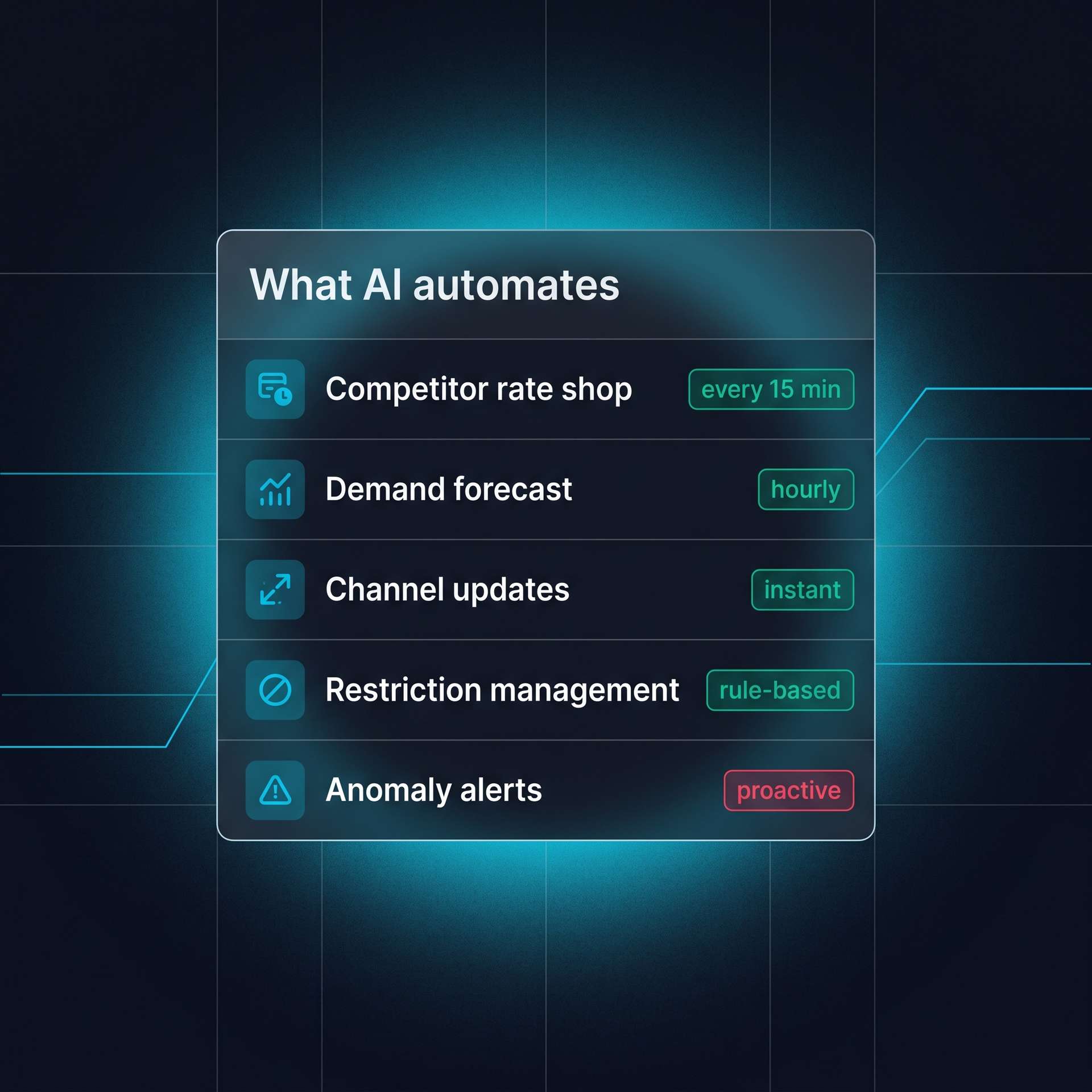
  <img src="https://cdn.sanity.io/images/1la98t0z/production/dda7c65eb0c3d9cc75c8008714cb072027d48ecf-2048x2048.jpg" alt="Five-row card titled 'What AI automates'. Competitor rate shop runs every 15 minutes, demand forecast runs hourly, channel updates are instant, restriction management is rule-based, anomaly alerts are proactive." width="800" />
</a>
<p>Source: <a href="https://otelciro.com">OtelCiro</a> — AI Hotel Revenue Management</p>
Conclusion: The Era of Accessibility
AI revenue management is no longer the monopoly of large chains. In 2026, hotels of all sizes have access to affordable and rapidly integrable AI tools. The 14-20 point improvement in forecasting accuracy, room-type based optimization, and event-based demand prediction provides tangible revenue growth even for small properties.
OtelCiro serves this exact need as Turkey's first AI-native revenue management platform. We aim to enable every hotel in Turkey to benefit from AI revenue management with a solution that fits big-chain technology into a boutique hotel budget.
Take action before your competitors start using AI. The advantage of early adaptation will be the most important factor in determining the winners of this race.
![Hotel Ancillary Revenue: Monetizing Spa, F&B & Activities [2026 Guide]](https://cdn.sanity.io/images/1la98t0z/production/cfce3407a5ef8f70edd19853e8059317fca7b6a6-2752x1536.jpg?w=1920&q=50&auto=format&fit=max)
![FIFA 2026 World Cup: Hotel Dynamic Pricing Strategy [2026 Guide]](https://cdn.sanity.io/images/1la98t0z/production/7a76affe61333341ec47bb0c705011068a1afd24-2752x1536.jpg?w=1920&q=50&auto=format&fit=max)