![Maximize Hotel Profit: Cost vs Revenue Center Strategy [2026 Guide]](https://cdn.sanity.io/images/1la98t0z/production/729be58ee95487c41aac083e00fd3acb73194024-1200x669.png?w=1920&q=65&auto=format&fit=max)
Key Takeaways
- Proper department classification (Revenue vs. Cost Centers) is fundamental for effective hotel financial management, resource allocation, and performance measurement.
- Revenue Centers (e.g., Rooms, F&B, Spa) directly generate income and are accountable for their own profitability, often contributing 55-75% of total revenue.
- Cost Centers (e.g., A&G, S&M, POM) support hotel operations; their management focuses on optimizing costs without compromising service quality.
- Hotels that correctly classify departments and regularly implement performance measurement boost their GOP margins by an average of 8-12%.
- Strategic resource allocation, automation in cost centers, and zero-based budgeting are critical for maximizing efficiency and unlocking significant annual cost savings.
Revenue Center and Cost Center Concepts: Key Difference
In hotel management, proper department classification is fundamental for performance measurement and resource allocation. Effective financial management is impossible without understanding the role of each department.
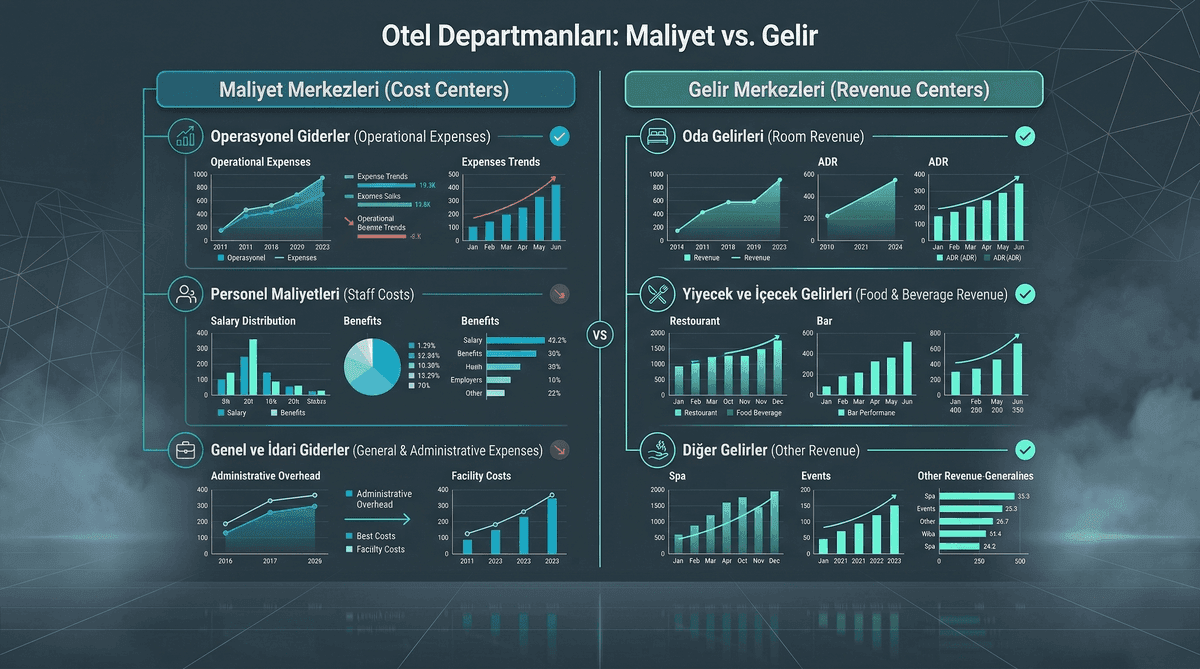
A revenue center is a department that directly generates income and is responsible for its own profitability. A cost center, on the other hand, consists of support departments that do not directly generate income but are essential for the hotel's operation.
It is estimated that 58% of hotels in Turkey do not conduct department-based profitability analysis. This deficiency leads to undetected unnecessary expenditures and inefficient resource allocation. Hotels that correctly classify departments and regularly implement performance measurement succeed in increasing their GOP margins by an average of 8-12%.
Embed this image on your site
<a href="https://otelciro.com/en/news/maximize-hotel-profit-cost-vs-revenue-center-strategy-2026-guide">
  <img src="https://cdn.sanity.io/images/1la98t0z/production/729be58ee95487c41aac083e00fd3acb73194024-1200x669.png" alt="Cost Center vs Revenue Center Infographic" width="800" />
</a>
<p>Source: <a href="https://otelciro.com">OtelCiro</a> — AI Hotel Revenue Management</p>
Related reading: Implementing the USALI Accounting Standard in Hotels
Hotel Revenue Centers and Performance Metrics
Revenue centers are the hotel's primary sources of income. Each revenue center is responsible for its own revenues and expenses, and its departmental profitability is measured.
Rooms Division
The Rooms Division is the largest revenue source for most hotels. It generates 55-75% of total revenue and has the highest profit margin.
Performance Metrics:
- RevPAR (Revenue Per Available Room)
- ADR (Average Daily Rate): Average daily room rate
- Occupancy rate: Rooms sold / total rooms
- Department profit margin target: 72-80%
- CPOR (Cost Per Occupied Room): Cost per occupied room
The high profitability of the Rooms Division stems from its largely fixed cost structure. Basic costs (depreciation, insurance, energy infrastructure) continue whether a room is sold or not. Therefore, every additional sale directly contributes to profit.
Food & Beverage Department (F&B)
F&B generates 20-35% of total revenue. However, due to high food costs and intensive labor, its profit margin is significantly lower than that of the Rooms Division.
Performance Metrics:
- F&B revenue / total revenue ratio
- Food cost percentage: 28-32% target
- Beverage cost percentage: 20-25% target
- Average spend per person (average check)
- Department profit margin target: 25-35%
- Cover count and table turnover rate
Spa and Wellness
The Spa department has become a center that has increased its revenue share in recent years. With the strengthening trend of wellness tourism, the ratio of spa revenue to total revenue has risen from 5% to 12%.
Performance Metrics:
- Revenue per therapist
- Capacity utilization rate
- Product sales / service sales ratio
- Department profit margin target: 40-55%
Other Revenue Centers
- Meetings and Conferences: Room rental income, technical equipment, catering
- Parking: A significant revenue stream, especially in city hotels
- Laundry: A revenue center if it also serves external customers
- Business Center and Co-working: A growing new revenue area with the bleisure trend
Related reading: Department Analysis with OtelCiro Reporting
Hotel Cost Centers and Control Mechanisms
Cost centers do not generate revenue but are indispensable for the hotel's operation. The goal in managing these departments is to optimize costs without compromising service quality.
General Management and Administrative (A&G)
This includes the general manager's office, human resources, legal, accounting, and IT departments. It is recommended to allocate 7-10% of total revenue as budget.
Control Mechanisms:
- Tracking A&G expense / total revenue ratio
- Reducing costs with a shared services model
- Reducing administrative workload through automation investments
- Evaluation of outsourcing
Sales and Marketing (S&M)
Marketing expenses include advertising, sales team salaries, OTA commissions, and PR activities. A budget of 5-8% of total revenue is recommended.
Control Mechanisms:
- Tracking Customer Acquisition Cost (CAC)
- Channel-specific marketing ROI analysis
- OTA commission rate optimization
- Digital marketing spending effectiveness
Property Operations & Maintenance (POM)
This covers expenses for technical staff, repairs, maintenance, renovations, and equipment replacement. A budget of 4-6% of total revenue is recommended. Preventive maintenance programs are 35% less costly than reactive maintenance.
Utilities
This includes expenses for electricity, natural gas, water, and waste management. In hotels in Turkey, energy costs range from 8-12% of total revenue. Smart energy management systems can reduce this ratio to 5-7%.
Classification Debates: Gray Areas
The classification of some departments is debatable and can vary depending on the hotel's structure.
Laundry
It is classified as a cost center if it only serves hotel guests, and a revenue center if it also serves external customers. 28% of large hotels in Turkey generate additional income by offering laundry services to external clients.
IT Department
Traditionally, it is a cost center. However, if digital services (high-speed internet packages, streaming services, digital concierge) generate revenue, a hybrid classification can be applied.
Security
Standard security services are classified as a cost center. However, if paid valet services or external hotel security consulting generate revenue, the classification changes.
Loyalty and CRM
Loyalty program management is generally categorized as a cost center under S&M. However, some hotels track loyalty program revenues (co-branded credit card commissions, points sales) as a separate revenue center.
The Right Approach to Departmental Performance Measurement
Different performance metrics should be applied for each department type. Revenue centers should be evaluated by their revenue and profitability, while cost centers should be assessed by their efficiency and service quality.
KPIs for Revenue Centers
- Departmental revenue growth (annual %)
- Departmental profit margin (%)
- Revenue / employee count
- Budget variance (%)
- Benchmark comparison (STR, HotStats)
KPIs for Cost Centers
- Cost / total revenue ratio (%)
- Service quality scores (guest satisfaction)
- Work order completion time (maintenance and repair)
- Response time (IT, security)
- Staff turnover rate
- Automation rate (percentage of digitized processes)
Balanced Scorecard
Create a balanced scorecard for both revenue and cost centers. Financial metrics alone are insufficient; also include customer satisfaction, internal process efficiency, and learning-and-growth perspectives.
Strategic Approach to Resource Allocation
Properly allocating limited resources is one of the most critical tasks for a hotel manager:
Investment priority for revenue centers: Invest in departments with high revenue growth potential (room renovation, F&B concept renewal, spa expansion). Every 1 TL invested in a revenue center yields an average return of 3-5 TL.
Automation in cost centers: Increase efficiency in cost centers with technology investments. Automation reduces personnel costs by 15-25% while maintaining or improving service quality.
Zero-based budgeting: Justify all cost items from scratch in each budget period. The "we spent this much last year too" approach leads to the continuation of unnecessary expenses. Hotels implementing zero-based budgeting achieve annual cost savings of 8-15%.
Shared services model: Especially in hotel chains, centralize support functions such as accounting, IT, HR, and purchasing to create economies of scale. This model can reduce per-unit support costs by 30-40%.
OtelCiro's reporting platform enables you to classify your revenue and cost centers according to the USALI standard and conduct department-based profitability analysis. With automated performance reports and benchmark comparisons, clearly measure the added value of each department.
![US Hotel Labor Costs Hit $131 Billion in 2026: AI Automation Strategies That Cut Costs Fast [2026 Guide]](https://cdn.sanity.io/images/1la98t0z/production/6765e31b08a1c04cce66f9bf9482693dbefdcce5-2752x1536.jpg?w=1920&q=50&auto=format&fit=max)