
The Scientific Link Between Reputation Score and Revenue
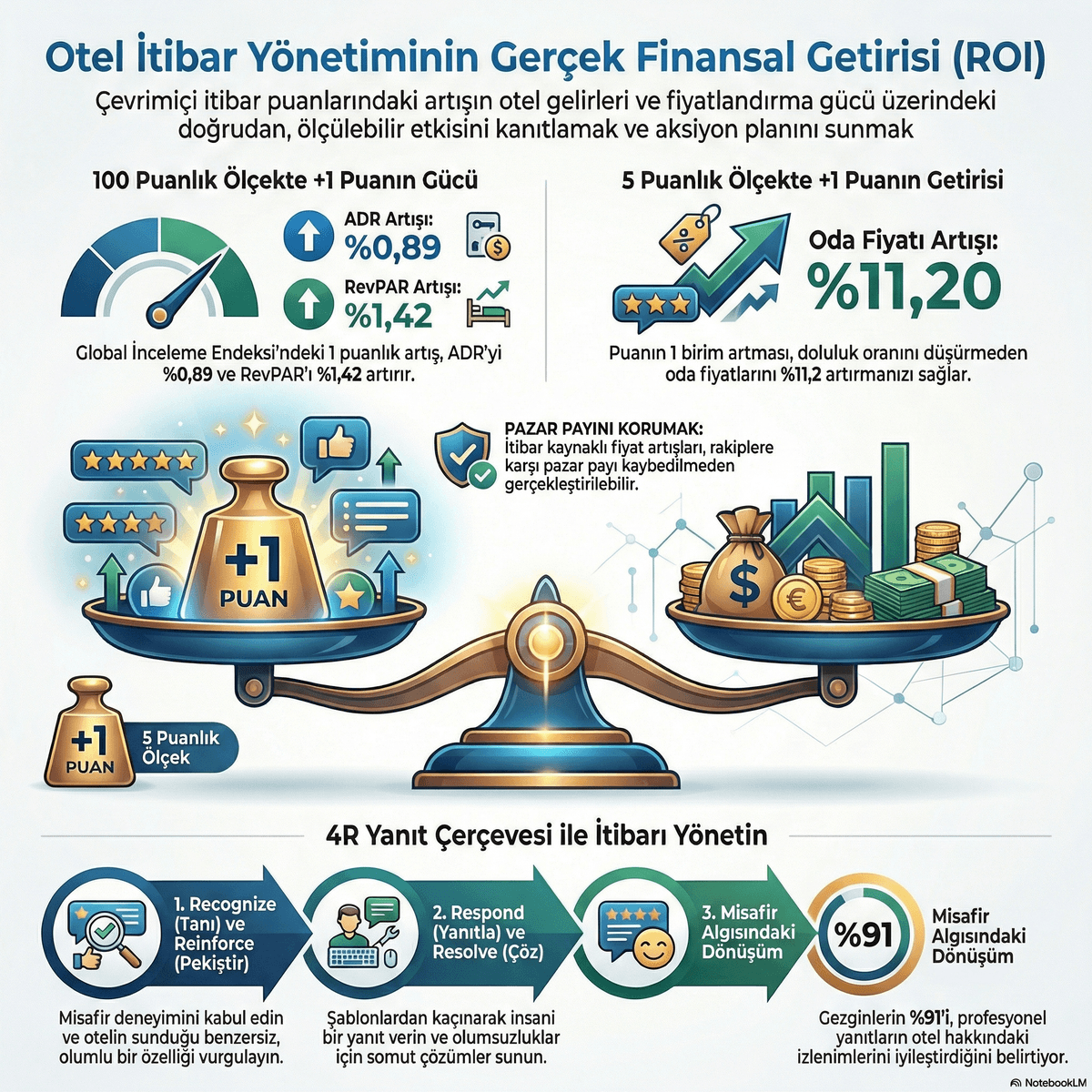
Hotel reputation management has moved from the "nice to have" category to become an inseparable part of revenue management. Extensive research by Cornell University and STR Global has mathematically proven the relationship between reputation score and revenue.
The headline findings:
- +1 point on a 100-point scale = 0.89% ADR increase + 1.42% RevPAR increase
- +1 point on a 5-point scale = the ability to charge 11.20% more per room
- Hotels with high reputation scores can command 24% higher ADR than lower-rated competitors
For a 100-room city hotel, these figures translate to tens or even hundreds of thousands in annual revenue difference.
Related reading: Hotel Revenue Management Guide: Strategies, Metrics & Technology (2026)
The 4R Formula: The Golden Framework for Reputation Management
Effective reputation management consists of four core steps. We call this framework the "4R Formula":
1. Recognize
The first step is to monitor reviews across all platforms centrally. Every review on Booking.com, Google, TripAdvisor, Expedia, and social media is part of your hotel's reputation map.
- Establish a daily review scanning routine
- Aggregate review sources into a single dashboard
- Analyze score trends on a weekly basis
2. Respond
Research shows that review response rates change customer perception 91% of the time. A hotel that responds to a negative review in a professional, solution-oriented manner wins the trust of prospective guests.
Effective response guidelines:
- Respond within 24 hours
- Address the guest by name
- Acknowledge the issue — do not make excuses
- Share a concrete solution or improvement plan
- Invite the guest back for a future stay
3. Resolve
Analyze the root causes behind negative reviews and make operational improvements. When you understand the cost of a bad review, you will see just how valuable this investment is.
Most common complaint areas and solutions:
- Cleanliness (32%): Update housekeeping SOPs, increase inspection frequency
- Noise (18%): Room soundproofing, quiet-floor policy
- Breakfast quality (15%): Menu variety, fresh produce sourcing
- Wi-Fi speed (12%): Infrastructure upgrade, bandwidth increase
4. Redirect
Proactively guide satisfied guests to leave reviews. Handing over a QR code card at checkout or sending an automated review-request email can increase your positive review volume by 40-60%.
Embed this image on your site
<a href="https://otelciro.com/en/news/itibar-yonetimi-roi">
  <img src="https://cdn.sanity.io/images/1la98t0z/production/2d9c99599d308dc44740f17d18a63ef05a6a3127-1200x669.png" alt="Hotel automated pricing rules engine" width="800" />
</a>
<p>Source: <a href="https://otelciro.com">OtelCiro</a> — AI Hotel Revenue Management</p>
The Reputation-Pricing Relationship
There is a linear relationship between reputation score and pricing power. You can observe this clearly in your Booking.com Extranet metrics.
| Reputation Score (out of 10) | Pricing Flexibility | Occupancy Impact |
|---|---|---|
| 9.0+ | 15-20% above competitors | Minimal occupancy loss |
| 8.0-8.9 | At par or 5-10% above | Balanced occupancy |
| 7.0-7.9 | Price pressure, discounting needed | Occupancy fluctuation |
| Below 7.0 | Aggressive discounts required | Serious occupancy issues |
This table shows that a hotel whose reputation score rises from 7.0 to 8.0 can charge 11-15% higher ADR at the same occupancy level.
Related reading: How to Increase RevPAR: 8 Proven Strategies (2026)
The Hidden Cost of Negative Reviews
A single negative review can potentially influence 40-50 guests' decisions. When you factor in Booking.com's hidden penalties, the damage of a low review score is multidimensional:
- Algorithm ranking loss: Lower score = lower rank = lower traffic
- Conversion rate decline: 52% of guests who see negative reviews look for alternatives
- Price pressure: Low-rated hotels are not preferred even at the same price as competitors
- Program exclusion: Some premium programs require minimum review scores
Embed this image on your site
<a href="https://otelciro.com/en/news/itibar-yonetimi-roi">
  <img src="https://cdn.sanity.io/images/1la98t0z/production/7aad3e230cde611ee176402d03b7bcf0a35316f2-1200x2150.png" alt="RevPAR improvement strategies and tactics" width="800" />
</a>
<p>Source: <a href="https://otelciro.com">OtelCiro</a> — AI Hotel Revenue Management</p>
Calculating the ROI of Reputation Management
Let us work through a concrete ROI calculation:
Scenario: 80-room city hotel, average ADR of 150 EUR
- Current reputation score: 7.8/10
- Target reputation score: 8.3/10 (0.5-point improvement)
- Expected ADR increase: 0.89% x 5 = 4.45%
- New ADR: 150 EUR x 1.0445 = 156.68 EUR
- Annual RevPAR impact: 1.42% x 5 = 7.10%
- Investment: Reputation management software + staff training = ~8,000 EUR/year
- Expected incremental revenue: ~45,000 EUR/year
- ROI: 462%
Frequently Asked Questions
How quickly can I raise my reputation score?
With a systematic reputation management program, a 0.3-0.5 point improvement within 3-6 months is a realistic target. Consistency is key: respond to every review, resolve operational issues promptly, and actively request reviews from satisfied guests.
Which platform's reviews matter most?
Booking.com and Google reviews carry the highest impact. Booking.com reviews directly affect your OTA ranking, while Google reviews determine both organic search visibility and Google Hotels placement. Aim for 8.0+ on both platforms.
How do I handle fake or unfair reviews?
Report reviews that violate platform policies (personal insults, competitor-driven attacks, factual falsehoods) through official channels. While the removal process is underway, write a professional response to manage perception among other prospective guests.
OtelCiro aggregates your reputation data from all OTA and review platforms into a single dashboard, automating the 4R formula. Turn your reputation score into revenue by exploring OtelCiro.


![Hotel Upselling: AI-Driven Revenue Growth [2026]](https://cdn.sanity.io/images/1la98t0z/production/9850350573fc466b95b1490c7f689e8ac39c4f11-1200x669.png?w=1920&q=50&auto=format&fit=max)