![Implementing USALI Standards for Hotel Financial Reporting [2026 Guide]](https://cdn.sanity.io/images/1la98t0z/production/fe08c2768347c0b3ce90ef20ece3c18b7b0585fe-1024x1024.png?w=1920&q=65&auto=format&fit=max)
Key Takeaways
- Global Standard: USALI is the definitive global accounting framework for the hospitality industry, currently in its 12th edition and used in over 150 countries.
- Operational Transparency: By separating revenue and support centers, hotels can achieve up to 12% in cost savings through precise departmental profit analysis.
- Financial Advantage: USALI-compliant hotels secure financing 40% faster and often receive interest rates 1.5 percentage points lower than non-compliant peers.
- Valuation Metrics: Key performance indicators like GOP (35-45%) and EBITDA multiples (8-15x) are essential for accurate hotel valuation and investor relations.
- Strategic Implementation: Success requires a 6-step roadmap, including PMS integration and a minimum of 16 hours of specialized staff training.
What is USALI and Why Has It Become the Common Language of the Hotel Industry?
USALI (Uniform System of Accounts for the Lodging Industry) is the global standard accounting framework for the hospitality sector. First published in 1926 by the Hotel Association of New York City, this standard has now reached its 12th edition and is recognized in more than 150 countries worldwide.
It is estimated that only 18% of hotels in Turkey currently utilize USALI-compliant reporting. While this rate climbs to 95% among international hotel chains, it falls below 8% for independent hotels. However, USALI compliance offers a critical competitive advantage in terms of investor confidence, creditworthiness, and operational transparency.
The core philosophy of USALI is simple: to make the profitability of each unit measurable by classifying hotel revenues and expenses on a departmental basis. This approach differs fundamentally from the single-line item income-expense tracking often found in traditional Turkish accounting practices.
Embed this image on your site
<a href="https://otelciro.com/en/news/implementing-usali-standards-for-hotel-financial-reporting-2026-guide">
  <img src="https://cdn.sanity.io/images/1la98t0z/production/fe08c2768347c0b3ce90ef20ece3c18b7b0585fe-1024x1024.png" alt="USALI Accounting Standard Infographic" width="800" />
</a>
<p>Source: <a href="https://otelciro.com">OtelCiro</a> — AI Hotel Revenue Management</p>
Related reading: Hotel Revenue Metrics and KPI Guide
USALI’s Departmental Reporting Structure
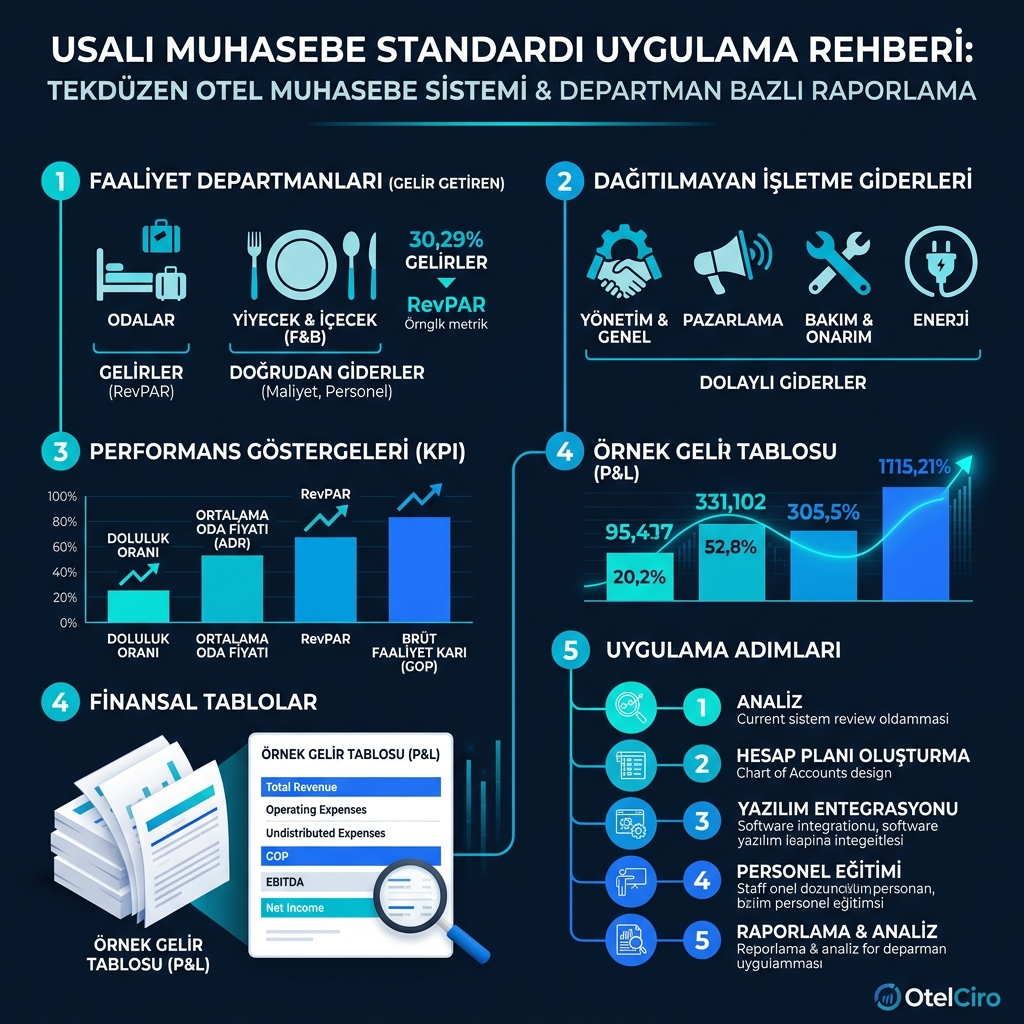
The USALI system divides hotel operations into two main categories: revenue-generating departments and support departments. This structure makes it possible to evaluate the financial performance of each department independently.
Revenue Centers
- Rooms Department: Room revenues, room expenses, departmental profit.
- Food & Beverage (F&B): Restaurant, bar, room service, and banquet revenues and costs.
- Spa & Wellness: Spa service revenues, personnel, and material expenses.
- Other Operational Income: Laundry, parking, business center, and telephone services.
Support Centers
- Administrative & General (A&G): Executive salaries, legal fees, insurance.
- Sales & Marketing (S&M): Advertising, sales team costs, commissions.
- Property Operations & Maintenance (POM): Technical team, repairs, and maintenance.
- Utilities: Electricity, water, natural gas, and waste management.
The greatest strength of USALI is its ability to clearly reveal departmental profitability. For example, if a hotel’s F&B department has a 28% gross profit margin while the industry average is 32%, it becomes immediately clear that cost optimization is required in that specific unit.
GOP, NOP, and EBITDA: Key Profitability Metrics in USALI
There are three primary layers of profitability in USALI reporting. These layers allow you to evaluate hotel performance from different perspectives.
Gross Operating Profit (GOP)
GOP is the profit remaining after deducting departmental expenses and undistributed expenses from all departmental revenues. According to industry benchmarks, a successful hotel should achieve a GOP level of 35-45% of total revenue.
GOP Calculation Formula: Total Departmental Profit - Undistributed Expenses (A&G + S&M + POM + Utilities) = GOP
Net Operating Profit (NOP)
NOP is obtained by deducting fixed expenses such as management fees, insurance, property taxes, and rent from the GOP. NOP shows the actual operational performance of the hotel. In Turkey, the average NOP margin ranges between 18-25%.
EBITDA
EBITDA (Earnings Before Interest, Taxes, Depreciation, and Amortization) is the most frequently used metric in hotel valuation. Investors typically calculate a hotel's value based on an EBITDA multiplier. In Turkey, city hotels generally see EBITDA multiples of 8-12x, while resort hotels see 10-15x.
Related reading: OtelCiro Reporting Features
Challenges Faced by Turkish Hotels in USALI Implementation
Several critical challenges are observed during the transition of Turkish hotels to USALI:
Chart of Accounts Mismatch
There are significant differences between the Uniform Chart of Accounts (UCA) used in Turkey and the USALI chart of accounts. While the UCA provides a general framework regardless of business type, USALI includes categories specific to hospitality. Running these two systems in parallel creates an additional workload.
Difficulty in Departmental Classification
In small and medium-sized hotels, departmental boundaries are often blurred. Situations such as reception staff also providing concierge services, or a restaurant manager handling banquet sales, complicate cost allocation.
Lack of Technological Infrastructure
USALI-compliant reporting requires a PMS (Property Management System) that supports departmental revenue and expense tracking. It is estimated that 42% of hotels in Turkey still do not use a USALI-compliant PMS.
Shortage of Trained Personnel
It is difficult to find accounting personnel who are proficient in USALI standards. The USALI curriculum remains limited in the tourism departments of universities.
How to Implement USALI in Your Hotel: A 6-Step Roadmap
A systematic transition plan is required to make USALI implementation successful:
Step 1 — Current State Analysis: Compare your current chart of accounts and reporting habits with USALI standards. Identify the gaps.
Step 2 — Chart of Accounts Mapping: Map your Turkish Uniform Chart of Accounts (UCA) with USALI department codes. Establish a double-entry recording system.
Step 3 — PMS and Accounting Integration: Ensure your PMS supports USALI-compliant department codes. Perform system updates if necessary.
Step 4 — Staff Training: Provide USALI training to your accounting team and department managers. A minimum 16-hour training program is recommended.
Step 5 — Pilot Implementation: Run the system in parallel with your old system for the first 3 months to compare data. Resolve any inconsistencies.
Step 6 — Full Transition and Benchmarking: Fully transition to USALI reporting and begin comparing your performance with industry benchmark platforms such as STR or HotStats.
Tangible Benefits of USALI Compliance
Hotels that transition to the USALI standard achieve tangible financial and operational gains:
- Investor Confidence: Hotels providing USALI-compliant reporting can secure financing from international investors 40% faster.
- Credit Terms: Banks apply interest rates that are, on average, 1.5 percentage points lower for USALI-compliant hotels.
- Operational Efficiency: Thanks to departmental cost tracking, an average of 12% cost savings is achieved in the first year.
- Benchmarking Capabilities: The ability to perform industry comparisons accelerates strategic decision-making processes by 60%.
- Management Contracts: USALI reporting is a mandatory condition in the management contracts of international hotel chains.
OtelCiro’s reporting module allows you to create departmental financial reports fully compliant with the USALI standard. Working with automated chart of accounts mapping and integrated industry benchmark data, the system significantly simplifies your transition process.
In conclusion, USALI is no longer a luxury but a necessity. Global investors, industry benchmark platforms, and international hotel chains all speak this language. For Turkish hotels, adopting this common language will directly increase not only accounting quality but also strategic competitiveness.
![US Hotel Labor Costs Hit $131 Billion in 2026: AI Automation Strategies That Cut Costs Fast [2026 Guide]](https://cdn.sanity.io/images/1la98t0z/production/6765e31b08a1c04cce66f9bf9482693dbefdcce5-2752x1536.jpg?w=1920&q=50&auto=format&fit=max)