Key Takeaways
- The contract model between a hotel investor and operator is paramount for long-term financial success, directly impacting profitability.
- Turkey's hotel sector primarily uses three models: fixed lease (38%), revenue sharing (27%), and hybrid (35%) as of 2026.
- High inflation and currency volatility have led to a significant shift away from traditional fixed lease models towards revenue sharing and hybrid alternatives.
- Hybrid models, combining minimum guarantees with revenue sharing, provide a balanced approach, offering stability and upside potential.
- Selecting the right model requires careful consideration of factors like owner profile, market conditions, operator expertise, financing structure, contract duration, and the macroeconomic environment.
Strategic Importance of Hotel Contract Models
The contract model between a hotel investor and operator is one of the most critical decisions, directly determining the long-term financial success of the project. Choosing the wrong model can lead to millions of liras in annual revenue loss; a correct model, however, creates sustainable profitability for both parties.
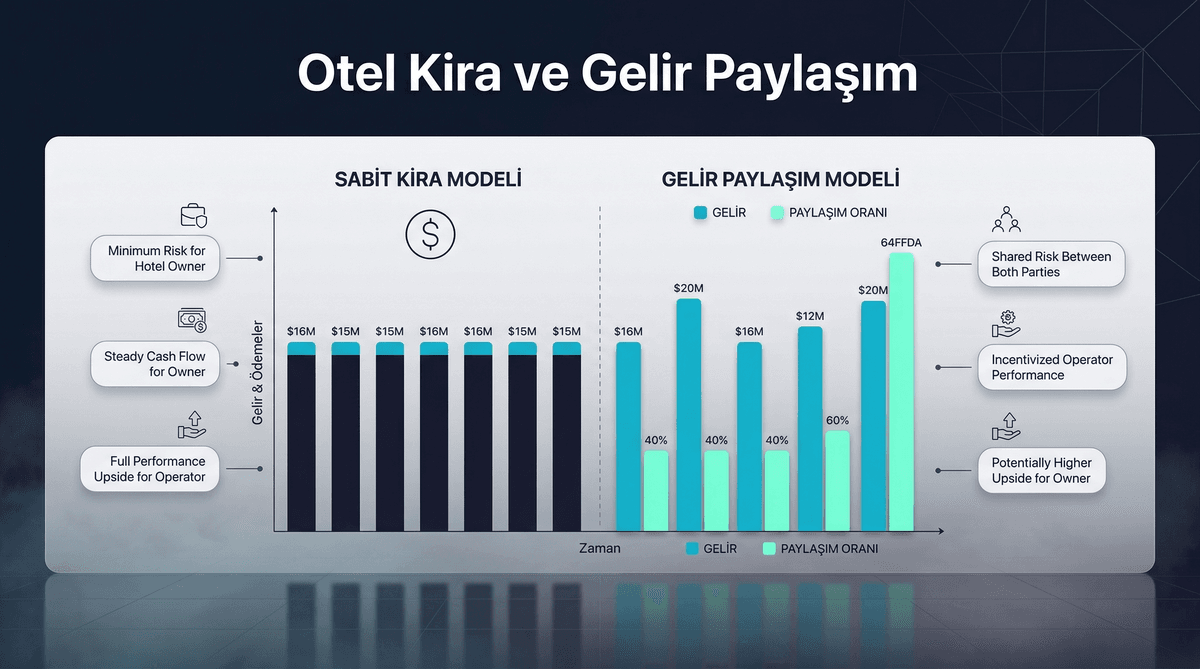
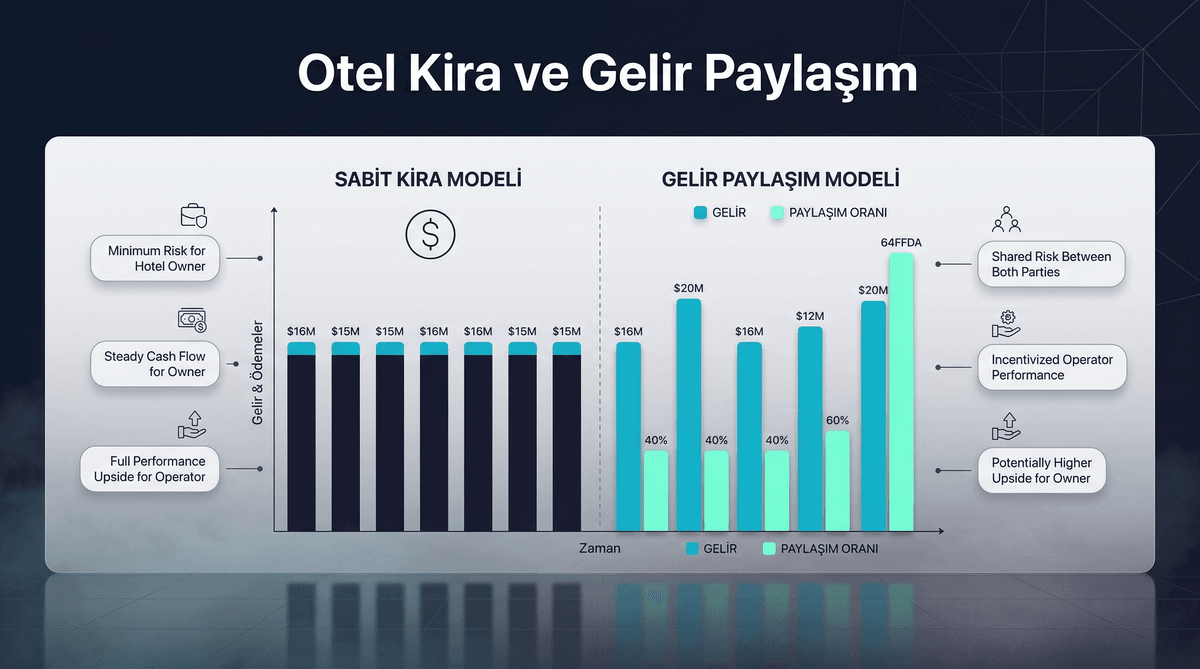
There are three primary contract models used in the Turkish hotel industry: fixed lease, revenue sharing (variable lease), and hybrid model. As of 2026, 38% of hotel contracts in Turkey are based on fixed lease, 27% on revenue sharing, and 35% on a hybrid model.
In recent years, high inflation and exchange rate fluctuations have challenged the sustainability of the traditional fixed lease model. Consequently, a strong transition trend towards revenue sharing and hybrid models is being observed.
Embed this image on your site
<a href="https://otelciro.com/en/news/hotel-lease-revenue-sharing-2026-contract-strategy-guide">
  <img src="https://cdn.sanity.io/images/1la98t0z/production/a62694095e96cc98e644aa88c90f759032286bb4-1200x669.png" alt="Hotel Lease and Revenue Sharing Model Infographic" width="800" />
</a>
<p>Source: <a href="https://otelciro.com">OtelCiro</a> — AI Hotel Revenue Management</p>
Related reading: Hotel Investment Exit Strategy: Sales and Valuation
Fixed Lease Model: Advantages and Risks
The fixed lease model is the most traditional model, stipulating that the operator makes a specific periodic payment to the property owner. In Turkey, this is typically determined on an annual basis in Turkish Lira or foreign currency.
Advantages of the Fixed Lease Model
- Predictability for the property owner: The revenue stream is stable, and the occupancy risk is borne by the operator.
- Simplicity: Calculation and reporting complexity are minimal.
- Bankability: Banks more easily finance properties with fixed lease income.
- Operator motivation: Since the rent is fixed, every lira increase in revenue directly translates to the operator's profit.
Risks of the Fixed Lease Model
- Inflation risk: In fixed leases denominated in TL, the property owner's real return erodes during periods of high inflation. In the 2024-2026 period, the real loss in TL lease contracts ranged from 25-40%.
- Currency risk: In fixed leases denominated in USD or EUR, increases in exchange rates can wipe out the operator's profitability.
- Crisis period risk: During pandemics, natural disasters, or economic crises, the operator may be unable to meet their lease obligations.
- Market incongruity: In long-term fixed leases, the lease amount may become incompatible with market conditions as market conditions change.
Fixed Lease Benchmark Values in Turkey
Fixed lease rates vary depending on the property's location, star segment, and number of rooms:
- Istanbul central (5-star): Annual per room 8,000-15,000 USD
- Istanbul periphery: Annual per room 4,000-7,000 USD
- Antalya resort: Annual per room 3,000-6,000 USD
- Anatolian cities: Annual per room 1,500-3,500 USD
Revenue Sharing (Variable Lease) Model
In the revenue sharing model, the property owner receives a proportional share of the hotel's total revenue or a specific revenue stream. This model distributes risk more fairly between the parties.
Revenue Sharing Formulas
In practice, three different revenue sharing formulas are applied:
1. Total Revenue Share: A specific percentage of all hotel revenues (room + F&B + other) is paid to the property owner. Common rate in Turkey: 20-30%.
2. Room Revenue Share: Only room revenues are shared. F&B and other revenues remain with the operator. Common rate: 30-40%.
3. GOP Share: The share is based on Gross Operating Profit. This model also accounts for operating costs. Common rate: 50-65% to the property owner, 35-50% to the operator.
Advantages of the Revenue Sharing Model
- Risk sharing: In periods of low occupancy, the property owner's share also decreases; pressure on the operator is reduced.
- Performance motivation: Both parties directly benefit from revenue growth, creating a shared motivation.
- Inflation protection: When revenue increases with price hikes, the property owner's share automatically increases.
- Long-term sustainability: Its flexible structure, adapting to market conditions, reduces contract disputes by 45%.
Related reading: Revenue Analysis with OtelCiro Reporting
Hybrid Model: The Best of Both Worlds
The hybrid model combines fixed lease with revenue sharing and has been the fastest-growing contract model in recent years. In Turkey, the hybrid model's adoption rate increased from 22% in 2020 to 35% in 2026.
Hybrid Model Structures
Minimum Guarantee + Revenue Share: The operator pays a minimum fixed lease. If revenue exceeds a specified threshold, an additional share is paid from the excess portion. This structure offers the property owner minimum income security while allowing them to benefit from upside potential.
Example: Monthly minimum 50,000 USD + 8% of total revenue (from the portion exceeding the minimum guarantee)
Tiered Rate: Different rates are applied based on revenue tiers. A lower rate for lower revenue, a higher rate for higher revenue. This structure ensures both parties benefit from revenue growth at an increasing rate.
Fixed + GOP Share: A lower fixed lease + a specific percentage of GOP. This model directly rewards operational efficiency, encouraging the property owner to also be interested in operational performance.
6 Factors to Consider When Choosing the Right Model
There is no single "right" model; however, some fundamental factors guide the decision-making process:
1. Property Owner Profile: Professional real estate investors tend to prefer revenue sharing, while individual property owners prefer the predictability of a fixed lease.
2. Market Maturity: In destinations with high and stable demand, a fixed lease is suitable, whereas in developing or volatile markets, revenue sharing is more logical.
3. Operator Competence: If working with an experienced and strong operator (international chain), GOP sharing is advantageous for both parties.
4. Investment Financing Structure: Property owners utilizing bank loans should prefer models that include a minimum guarantee to secure loan repayments.
5. Contract Duration: For short-term contracts (5-10 years), a fixed lease is more appropriate, while for long-term contracts (15-25 years), revenue sharing or a hybrid model maintains its suitability.
6. Macroeconomic Environment: In Turkey, where high inflation and currency uncertainty prevail, a foreign currency-based fixed lease carries high risk for the operator. In this environment, the hybrid model stands out as the most balanced solution.
Critical Clauses in Contract Negotiations
Once the model is determined, particular attention should be paid to the following clauses in the contract details:
- Audit rights: The property owner's right to review income and expense records with an independent auditor.
- FF&E reserve: How the fund for furniture, fixtures, and equipment renewal (typically 3-5% of revenue) will be managed.
- Performance test: The operator's obligation to meet specific GOP or RevPAR targets, and termination conditions if targets are not met.
- Force majeure: How lease obligations will be adjusted in situations such as pandemics, wars, and natural disasters.
- Exit mechanism: Conditions for compensation and the transition process for early termination of the contract.
OtelCiro's financial reporting tools enable you to transparently track your income and cost data, regardless of which contract model you use. The system, which automates revenue sharing calculations, forms the foundation of trust and transparency in the property owner-operator relationship.
The right contract model is key to establishing a fair and sustainable relationship between parties throughout the hotel's lifespan. Do not rush the model selection; seek professional advice and analyze scenarios in detail.
![US Hotel Labor Costs Hit $131 Billion in 2026: AI Automation Strategies That Cut Costs Fast [2026 Guide]](https://cdn.sanity.io/images/1la98t0z/production/6765e31b08a1c04cce66f9bf9482693dbefdcce5-2752x1536.jpg?w=1920&q=50&auto=format&fit=max)