![Hotel Greenwashing Risks 2026: Legal Penalties & True Sustainability [Guide]](https://cdn.sanity.io/images/1la98t0z/production/f09d5787e960836f945cd2c23947eb10cfd81156-1024x1024.png?w=1920&q=65&auto=format&fit=max)
Key Takeaways
- Stricter Regulations Incoming: The EU Green Claims Directive, effective mid-2026, mandates scientific proof and third-party verification for all environmental claims, with penalties up to 4% of annual turnover.
- Widespread Problem: A 2024 European Commission study found 67% of environmental claims in the hospitality sector to be vague, misleading, or unsubstantiated.
- Carbon Offsetting Scrutiny: Relying solely on carbon offsetting for "carbon neutral" or "zero-emission" claims is now prohibited, pushing hotels to focus on genuine emission reduction.
- Reliable Certifications are Key: Opt for GSTC-recognized certifications (e.g., Green Key, EU Ecolabel, EarthCheck, Travelife) over self-declared or unaccredited programs.
- Boost Guest Trust & Revenue: Hotels with verified sustainability initiatives see higher guest satisfaction (NPS +12), increased OTA click-through rates (+12-15%), and improved RevPAR performance (+8-14%).
What is Greenwashing and Why is the Hotel Industry at Risk?
Greenwashing — the concept known as "yeşil badana" (green paint) in Turkish — is when a business exploits consumers' environmental awareness by exaggerating or misleadingly presenting its true environmental performance. In the accommodation sector, greenwashing is both common and often done unwittingly.
According to a 2024 European Commission study, 53% of environmental claims across the EU were found to be vague, misleading, or unsubstantiated. In the hotel and tourism sector, this rate rises to 67% — meaning two-thirds of environmental claims in the industry are problematic. The most common greenwashing patterns in the accommodation sector include:
- "Eco-friendly" or "environmentally friendly" labels: General terms used without reliance on any standard or certification.
- "Carbon neutral" claims: Asserting zero emissions solely by purchasing carbon offsets, without actual emission reductions.
- Towel and linen reuse programs: Presented as a standalone sustainability strategy, but often primarily driven by cost savings.
- Selective data presentation: Highlighting only metrics that show improvement while concealing deteriorating ones.
- Certification confusion: Using "green certifications" with low credibility, self-issued, or obtained in exchange for payment.
Embed this image on your site
<a href="https://otelciro.com/en/news/hotel-greenwashing-risks-2026-legal-penalties-true-sustainability-guide">
  <img src="https://cdn.sanity.io/images/1la98t0z/production/f09d5787e960836f945cd2c23947eb10cfd81156-1024x1024.png" alt="Infographic: Hotel greenwashing risks and legal penalties 2026" width="800" />
</a>
<p>Source: <a href="https://otelciro.com">OtelCiro</a> — AI Hotel Revenue Management</p>
Related reading: Eco-Friendly Hotels: The Zero-Carbon Accommodation Concept
EU Green Claims Directive: The Rules of the Game Are Changing
The European Union, with the Green Claims Directive (Yeşil İddialar Direktifi) adopted in 2024, has brought environmental claims under legal regulation. The directive will come into force in member states starting mid-2026 and has very concrete implications for the hotel sector.
Key Provisions of the Directive
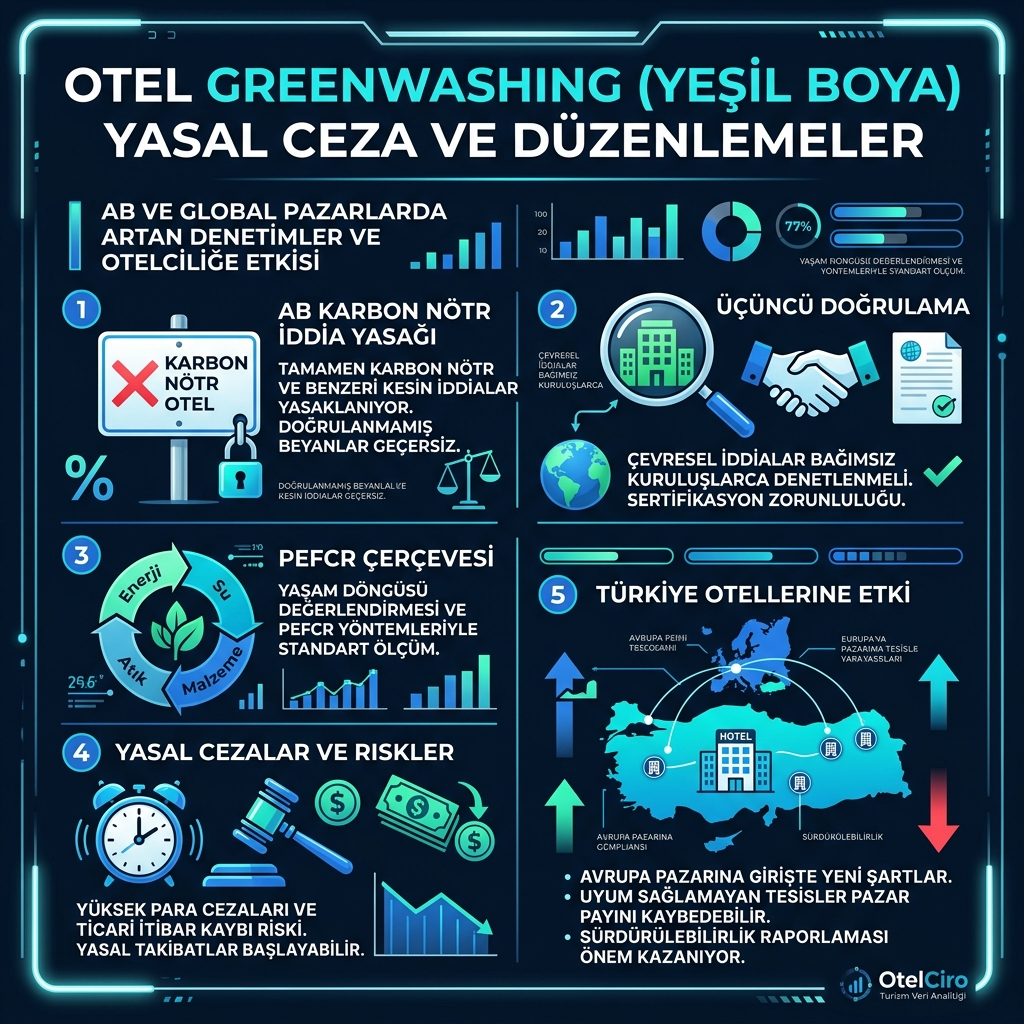
1. Burden of Proof: Every environmental claim must be substantiated with scientifically recognized methodologies. To claim "eco-friendly hotel," measurements must be made according to PEF (Product Environmental Footprint) or an equivalent framework.
2. Third-Party Verification: All environmental claims must be verified by an independent and accredited body. The hotel's own declaration is no longer sufficient.
3. Ban on Carbon Offsetting: Phrases such as "carbon neutral," "climate positive," or "zero emissions" cannot be used if they are based solely on the purchase of carbon offsets. Emissions must genuinely be reduced.
4. Comparison Rules: Comparisons like "30% greener than the industry average" must only be made with equivalent products, and the methodology used must be clearly stated.
5. Sustainability Labels: Only labels based on official certification programs can be used. Hotels are prohibited from presenting their own logo as a "green seal."
Sanctions: Up to 4% of Turnover in Penalties
The sanctions envisaged by the Green Claims Directive are severe:
- Fines: Up to 4% of annual turnover (similar to GDPR rates). For a hotel chain with a 50 million euro turnover, this means a 2 million euro fine.
- Advertising bans: Businesses found in violation may be temporarily prohibited from environmental marketing.
- Consumer compensation: Guests who made reservations based on misleading environmental claims gain the right to claim compensation.
- Blacklisting: Publication of repeat offenders on a public list.
These regulations impact Turkish hotels through several channels. Marketing campaigns targeting guests from the EU market fall under EU law. Booking.com, Expedia, and other EU-based OTAs will demand verification of environmental claims on their platforms. EU tour operators, in turn, will request compliance documents from their package tour partners.
Carbon Offset Debate: Why is it Being Banned?
The carbon offsetting mechanism has long been a primary tool for hotels to support their "carbon neutral" claims. However, the scientific community and regulators are increasingly critical of this mechanism.
According to a 2023 investigation published by The Guardian and SourceMaterial, 94% of projects certified by Verra, the world's largest voluntary carbon offsetting standard, did not achieve the stated carbon reductions. A 2024 study by the University of Berkeley found that 68% of forest protection projects did not meet the additionality criterion — meaning these forests would have been protected even without the sale of carbon credits.
These findings demonstrate that a hotel's claim of "$5 carbon offset purchased per stay, therefore we are carbon neutral" is scientifically invalid. The EU Green Claims Directive explicitly prohibits "neutral" claims based on carbon offsetting for this reason.
What Should Hotels Do?
Instead of carbon offsetting, the focus must shift to emission reduction:
- Energy efficiency: Reduce energy consumption by 25-40% with LED lighting, smart HVAC systems, and IoT sensors.
- Renewable energy: Decrease reliance on fossil fuels with solar panels and green energy procurement agreements.
- Supply chain: Reduce transportation emissions by prioritizing local suppliers.
- Waste management: Reduce methane emissions by cutting food waste by 50%.
Certification Landscape: Which are Reliable, Which are Risky?
The hotel sector has dozens of "green certification" programs, but there's a huge disparity in their reliability levels. A significant quality difference exists between certifications recognized by the Global Sustainable Tourism Council (GSTC) and those that are self-declared or obtained in exchange for payment.
Reliable Certifications with GSTC Recognition
- Green Key: Implemented in 3,200+ properties, mandatory third-party audits.
- EU Ecolabel: The official environmental label of the EU, based on life cycle analysis.
- EarthCheck: Based on scientific methodology, with annual independent audits.
- Travelife: GSTC-recognized, hotel-specific sustainability standard.
Certifications to Approach with Caution
- Certifications obtained solely by filling out an application form.
- Programs that do not include on-site audits.
- Certifications focused on a single criterion (e.g., only energy).
- Programs without GSTC recognition or independent accreditation approval.
With Booking.com's 2025 update, the Travel Sustainable program now only accepts GSTC-recognized certifications as "Level 3." This is a significant indicator that OTAs are also starting to filter the quality of certifications.
Real-World Cases: Greenwashing Penalties
Examples of legal sanctions due to greenwashing are increasing, and penalties are becoming heavier:
Case 1 — Scandinavian hotel chain (2024): A chain marketing with the claim "carbon-neutral accommodation" received an 850,000 euro fine from the Norwegian Consumer Authority. Reason: Using a "neutral" claim by only purchasing carbon offsetting certificates without actual emission reductions.
Case 2 — Mediterranean resort chain (2025): A resort marketed as a "zero-plastic hotel" was found to have reduced single-use plastic consumption by only 40% during an independent audit. The Spanish consumer court ruled it misleading advertising and ordered 1.2 million euro in compensation.
Case 3 — Booking.com label cancellation (2025): 12 hotels were removed from Booking.com's Travel Sustainable program after their sustainability declarations could not be verified by on-site audits. These hotels lost their "sustainable" badges on the OTA and their associated ranking advantages — some experienced an 18% drop in organic traffic.
Case 4 — Dutch Advertising Authority (2025): A luxury hotel brand received a warning for its slogan "eco-friendly luxury." The authority ruled that the claim of "eco-friendly" was inconsistent with "luxury" accommodation, considering an energy consumption of 890 kWh per room per night.
Guest Trust and Booking Impact
Greenwashing is not just a legal risk, but also a serious reputational and commercial risk. According to Deloitte's 2025 Sustainable Tourism Survey:
- 73% of travelers consider sustainability claims when choosing a hotel.
- 62% doubt the authenticity of these claims — indicating a trust crisis.
- 81% of guests who identify greenwashing will not choose that brand again.
- The NPS score of sustainably certified hotels is +12 points higher than uncertified ones.
According to Phocuswright's 2026 data, hotels with verified sustainability certifications have:
- 12-15% higher OTA click-through rates.
- 8% higher direct website conversion rates.
- 10-18% higher Average Daily Rate (ADR) (in the premium sustainable segment).
These data reveal that the marketing value of true sustainability is much higher than that of greenwashing.
Related reading: Waste Management and Recycling: A Hotel Sustainability Guide
The Situation in Turkey: Green Star and Legal Framework
Turkey's sustainability regulatory framework lags behind the EU but is rapidly developing:
Green Star Program: With the 2026 update by the Ministry of Culture and Tourism, Green Star criteria have been tightened. Carbon measurement has become mandatory, but third-party verification is not yet required. As of 2026, 180+ hotels hold a Green Star certificate.
KVKK and Consumer Law: In Turkey, misleading environmental claims can be considered "misleading advertising" under Law No. 6502 on the Protection of Consumers. The Advertising Board has enforcement powers, but there is no specific regulation for environmental claims yet.
EU Harmonization Process: As part of Turkey's EU accession process, a regulation similar to the Green Claims Directive is expected to be on the agenda during the 2028-2030 period.
However, the main risk for Turkish hotels precedes national regulations: Any hotel marketing to the EU market, listed on EU-based OTAs, and working with EU tour operators is already subject to EU law.
10 Steps to Transition from Greenwashing to Real Sustainability
Step 1: Environmental Claims Audit
List all environmental claims on your website, OTA profiles, brochures, and social media. For each claim, ask, "Can we prove this?" Immediately remove unsubstantiated claims.
Step 2: Establish a Baseline Year
Define 2024 or 2025 as your baseline year. Measure metrics for energy consumption (kWh/room-night), water consumption (liters/room-night), waste volume (kg/room-night), and carbon emissions (kg CO2/room-night).
Step 3: Use Specific Language
Instead of "eco-friendly," use concrete, measurable, and verifiable statements like "22% reduction in water consumption per room compared to 2024."
Step 4: Obtain Third-Party Certification
Apply for a GSTC-recognized program (Green Key, Travelife, EarthCheck). The certification process typically takes 6-12 months and costs between 3,000-8,000 euro annually.
Step 5: Data Infrastructure
Monitor energy, water, waste, and supply chain data digitally. OtelCiro's integrated data management system automatically collects operational data, providing a reliable infrastructure for sustainability reporting.
Step 6: Staff Training
Educate marketing and sales teams on greenwashing risks and legal consequences. Involve housekeeping and F&B teams in sustainability practices.
Step 7: Supplier Policy
Request environmental data from suppliers. Increase the proportion of local suppliers to reduce transportation emissions. Ask chemical suppliers for biodegradable product alternatives.
Step 8: Revise Carbon Offsetting Strategy
Stop using the phrase "carbon neutral." If you purchase carbon offsets, position them as an "additional contribution," not as "neutralization."
Step 9: Transparent Reporting
Publish an annual sustainability report that includes all good and bad results. Clearly state areas where targets were not met — transparency is the most powerful antidote to greenwashing.
Step 10: Continuous Improvement
Set annual goals and regularly track progress. According to STR Global data, hotels implementing continuous improvement programs see an average 8-12% increase in sustainability performance per year.
Conclusion: Transparency is the Strongest Brand Strategy
As of 2026, "green" claims in the hotel sector have shifted from a marketing tool to a legal obligation. Unsubstantiated environmental claims can result in penalties up to 4% of turnover under the EU Green Claims Directive, badge cancellations from OTAs, and a loss of guest trust.
However, when done correctly, sustainability becomes one of the strongest competitive advantages. Booking.com data shows that hotels with a Travel Sustainable badge have a 12% higher click-through rate, and the conscious traveler segment is growing every year. McKinsey's 2026 analysis indicates that sustainability-leading hotels outperform the industry average in RevPAR by 8-14%.
OtelCiro's data management platform collects hotels' operational data, providing a reliable infrastructure for sustainability reporting. By monitoring all metrics from energy consumption to waste volume, water usage, and supply chain data from a single dashboard, it supports you in creating verifiable environmental claims.
Avoid greenwashing, invest in true sustainability — both the planet and your revenue will benefit.
![EU Ecolabel for Hotels: How Green Certification Boosts Revenue [2026 Guide]](https://cdn.sanity.io/images/1la98t0z/production/8ee831a08361640644cf1e535d78c369291e715d-2752x1536.jpg?w=1920&q=50&auto=format&fit=max)