![Hotel Cloud Accounting Software Selection [2026 Guide]](https://cdn.sanity.io/images/1la98t0z/production/187bf38be6cc6a3c58e124506377403dc02e8fed-1200x669.png?w=1920&q=65&auto=format&fit=max)
Key Takeaways
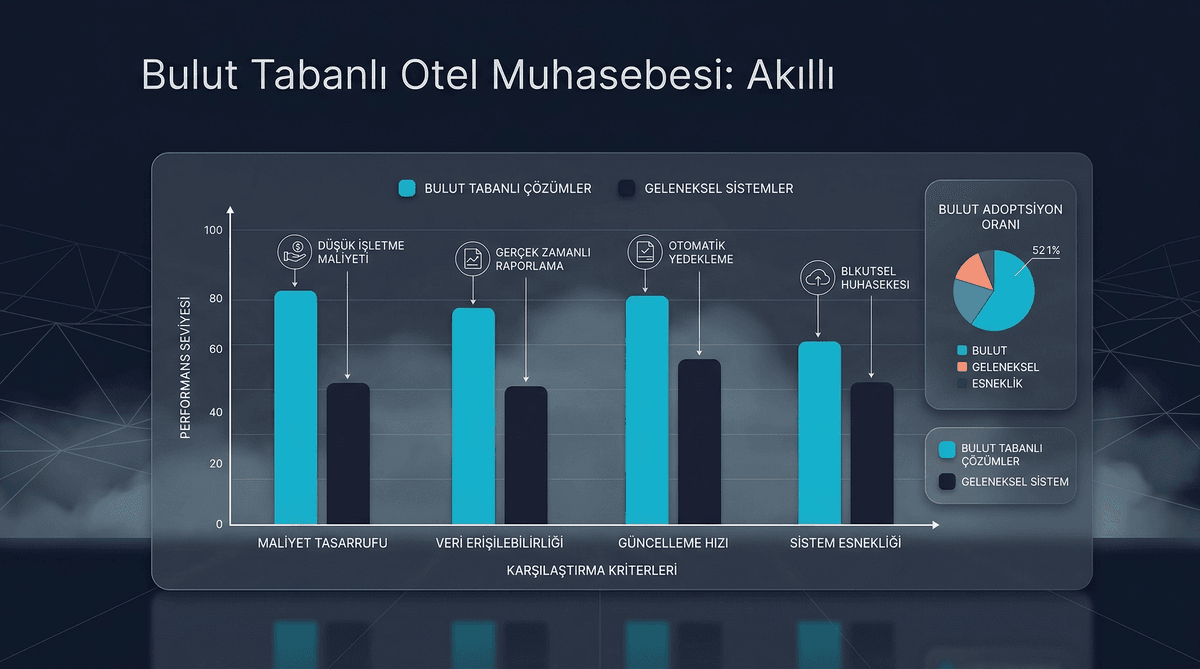
- Cloud-based hotel accounting software offers significant advantages over on-premise solutions, including 40-50% lower 5-year Total Cost of Ownership (TCO) and 65% faster accounting processes.
- Essential features for hotel accounting software include two-way PMS integration (cutting accounting closing times by 55%), USALI compliance, multi-currency support, and e-invoice/e-ledger integration.
- Cloud solutions improve accounting staff efficiency by 40-60% and reduce manual errors by 90%, leading to an average annual net saving of 250,000-400,000 TL for a 100-room hotel.
- A well-planned 6-week migration roadmap, covering preparation, data migration, integration setup, training, and parallel operation, is crucial for a smooth transition.
- The adoption of cloud accounting in the Turkish hotel industry reached 46% by 2026, growing at an annual rate of 12%, signaling a strategic shift towards operational efficiency.
The Critical Importance of Software Selection in Hotel Accounting
Accounting software is the financial backbone of a hotel. Choosing the wrong software leads to inaccurate reporting, tax non-compliance, cash flow problems, and delays in decision-making processes. The right choice, however, accelerates accounting processes by 65%, reduces the error rate by 90%, and provides managers with real-time financial visibility.
54% of hotels in Turkey still use desktop-based or on-premise accounting software. These hotels spend, on average, 30% more on accounting labor compared to their competitors who have switched to cloud-based solutions. Cloud accounting software offers not just a technology upgrade, but also an operational efficiency revolution.
As of 2026, the use of cloud accounting software in the Turkish hospitality sector has reached 46%, and this rate shows an annual growth of 12%.
Embed this image on your site
<a href="https://otelciro.com/en/news/hotel-cloud-accounting-software-selection-2026-guide">
  <img src="https://cdn.sanity.io/images/1la98t0z/production/187bf38be6cc6a3c58e124506377403dc02e8fed-1200x669.png" alt="Hotel Accounting Software Infographic" width="800" />
</a>
<p>Source: <a href="https://otelciro.com">OtelCiro</a> — AI Hotel Revenue Management</p>
Related reading: Implementing the USALI Accounting Standard
Cloud-Based vs. On-Premise Accounting Software
Understanding the fundamental differences between cloud-based and on-premise accounting software is the first step to making the right choice.
Advantages of Cloud-Based Software
- Anywhere Access: Access accounting data from anywhere, on any device with an internet connection. Hotel owners can instantly monitor financial status even while on vacation.
- Automatic Updates: Software updates and legal regulation changes are applied automatically. e-Invoice format changes, VAT rate updates are reflected instantly.
- Low Initial Cost: No server investment, IT personnel, or maintenance costs. The monthly subscription model protects cash flow.
- Scalability: As a hotel chain grows, additional locations can be easily added to the system.
- Data Security: Professional data centers protect data with automatic backups and encryption.
- Ease of Integration: Thanks to its API-based architecture, it integrates seamlessly with PMS, POS, channel manager, and banking systems.
Disadvantages of On-Premise Software
- High initial investment (server, license, installation)
- Requirement for IT personnel
- Manual updates and maintenance
- Difficulties with remote access
- Risk of data loss (local storage)
- Limited integration capabilities
Cost Comparison (5-Year TCO)
The 5-year Total Cost of Ownership (TCO) comparison for a 100-room hotel is as follows: An on-premise solution costs an average of 850,000-1,200,000 TL, while a cloud-based solution costs an average of 420,000-650,000 TL. The cloud solution provides a 40-50% cost advantage over a 5-year period.
8 Must-Have Features in Hotel Accounting Software
When choosing hotel accounting software, attention must be paid to meeting industry-specific requirements.
1. PMS Integration
Two-way, real-time integration of accounting software with the PMS is critical. Accommodation revenues, room expenses, and guest folio data should automatically flow into the accounting system. Manual data entry is both a time sink and a source of errors. Software with PMS integration shortens accounting closing times by 55%.
2. USALI Compliant Reporting
A USALI-compliant chart of accounts and reporting module is necessary for department-based revenue-expense tracking, GOP calculation, and industry benchmarking.
3. Multi-Currency Support
It should have features for transacting in different currencies with international guests, OTAs, and suppliers, automatic exchange rate calculation, and foreign exchange accounting.
4. e-Invoice and e-Ledger Integration
It must be capable of direct integration with GİB (Revenue Administration of Turkey) to create e-invoices, e-archive invoices, and e-ledgers. It must fully meet the legal requirements in Turkey.
5. Bank Integration
Automatic bank reconciliation, automatic pulling and matching of account transactions via open banking APIs save significant time. Manual bank reconciliation consumes an average of 20% of an accountant's time.
6. Budget and Forecasting Module
Features for annual budget creation, monthly budget-to-actual comparison, and rolling forecasts strengthen financial planning.
7. Multi-Location Support
For hotel chains, centralized accounting, location-based reporting, and consolidation features are essential. The ability to view the financial status of all hotels from a single panel is indispensable for chain managers.
8. Mobile Access and Dashboard
There should be dashboard and mobile application support allowing managers to instantly monitor daily revenue, cash status, and budget performance from mobile devices.
Related reading: OtelCiro Reporting Features
Cloud Accounting Solutions in the Turkish Market
The evaluation criteria for cloud-based solutions that can be used for hotel accounting in Turkey are as follows:
Evaluation Matrix
Areas where scoring out of 10 should be done in software selection:
- Turkish legal compliance (must be 10/10): e-Invoice, e-ledger, VAT declaration, Ba-Bs form
- PMS integration quality (minimum 8/10): Real-time data flow, two-way synchronization
- USALI compliance (minimum 7/10): Department-based chart of accounts, GOP reporting
- User experience (minimum 7/10): Intuitive interface, Turkish language support
- Customer support (minimum 8/10): Turkish support, hospitality knowledge, response time
- Price-performance (minimum 6/10): Monthly cost / feature ratio
- Data security (minimum 9/10): ISO 27001, KVKK (Personal Data Protection Law) compliance
Pitfalls to Watch Out For
- Hidden cost items: Additional fees per user, module-based pricing, data storage limits
- Data portability: Your right to export your data if you change software
- SLA (Service Level Agreement): Minimum 99.5% uptime guarantee
- Integration limitations: API access restrictions or additional charges
Software Transition Process: A 6-Week Roadmap
Transitioning from existing accounting software to a cloud-based solution requires a planned process:
Week 1-2: Preparation Clean existing system data, determine export format. Set up the chart of accounts in the new software and perform USALI mapping. Define user roles and access permissions.
Week 3: Data Migration Migrate historical data to the new system. Verify open accounts, receivables/payables balances, and fixed asset records. Perform consistency checks in a test environment.
Week 4: Integration Setup Set up PMS, POS, bank, and e-invoice integrations. Test data flow, correct incorrect matches.
Week 5: Training Provide role-based training to the accounting team, department managers, and senior management. Document frequently asked questions.
Week 6: Parallel Operation and Go-Live Run the old and new systems in parallel for at least 2 weeks. Compare data, resolve inconsistencies. Confirm full transition.
ROI Calculation of Cloud Accounting Software
The tangible benefits of switching to cloud accounting software can be calculated:
- Labor Savings: 40-60% increase in accounting staff efficiency — 80-120 hours saved per month
- Reduction in Error Costs: 90% decrease in manual entry errors — an average annual saving of 75,000 TL
- Earlier Closing: Monthly closing time reduced from 8 days to 3 days — earlier decision-making
- Tax Compliance: Minimizing the risk of e-invoice and declaration penalties
- IT Costs: 70% reduction in server maintenance, update, and backup costs
For an average 100-room hotel, the annual net saving ranges from 250,000-400,000 TL. The return on investment period is usually 6-10 months.
OtelCiro's reporting module seamlessly integrates with your cloud-based accounting software to provide department-based profitability analysis, budget-to-actual comparisons, and USALI-compliant financial reports. Keep your financial status under control at all times with real-time dashboards.
Transitioning to cloud accounting software is not just a technological upgrade, but a strategic transformation. Choosing the right software and executing a planned transition will permanently strengthen your hotel's financial management.
![US Hotel Labor Costs Hit $131 Billion in 2026: AI Automation Strategies That Cut Costs Fast [2026 Guide]](https://cdn.sanity.io/images/1la98t0z/production/6765e31b08a1c04cce66f9bf9482693dbefdcce5-2752x1536.jpg?w=1920&q=50&auto=format&fit=max)