![CPOR Analysis: Maximize Hotel Profitability & Efficiency [2026 Guide]](https://cdn.sanity.io/images/1la98t0z/production/578d6593e9c999e04d501306ed90d9f7eed6b15e-1200x669.png?w=1920&q=65&auto=format&fit=max)
Key Takeaways
- CPOR is a Vital Metric: Cost Per Occupied Room (CPOR) is essential for measuring operational efficiency and forms the foundation for profitable pricing strategies. Hotels actively tracking CPOR report 18-22% higher GOP margins.
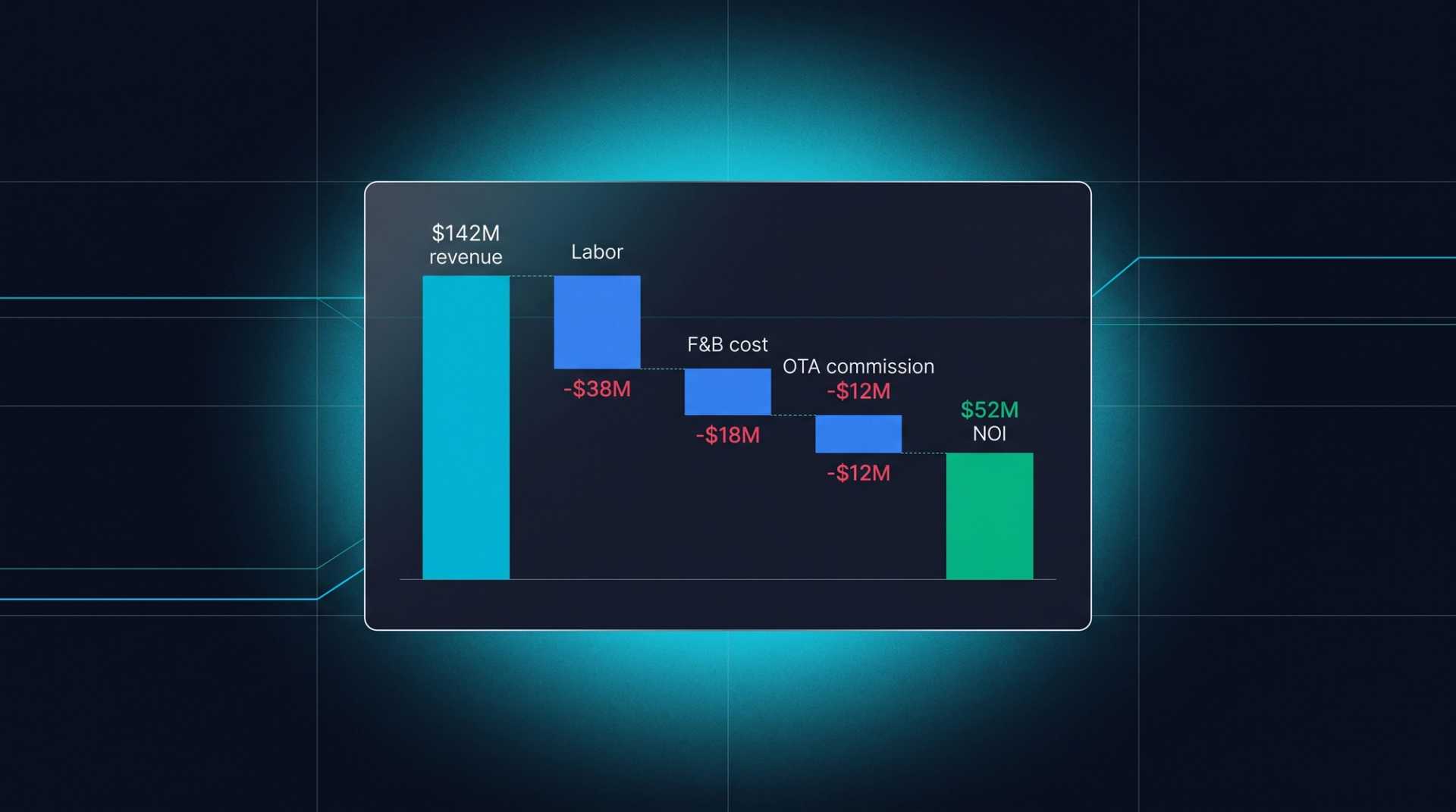
- Accurate Cost Classification is Key: Proper CPOR calculation requires distinguishing between fixed costs (e.g., salaries, rent, insurance) and variable costs (e.g., housekeeping, energy, F&B, OTA commissions) that fluctuate with occupancy.
- Departmental Analysis Drives Insights: Beyond the overall CPOR, analyzing costs by department (Housekeeping, Energy, F&B) provides granular insights, revealing specific areas for optimization and potential savings.
- Benchmark for Competitive Edge: Comparing your hotel's CPOR against industry benchmarks for your segment and region helps identify strengths and weaknesses, guiding strategic cost control efforts.
- Strategic Cost Reduction: Implement strategies such as technology automation (self check-in, smart rooms), supply chain optimization, staff cross-training, and advanced energy management to significantly reduce CPOR without compromising guest experience.
- CPOR Informs Pricing: CPOR is a fundamental input for setting minimum acceptable room rates, ensuring that every booking contributes positively to your hotel's bottom line.
What is CPOR and Why is it Critical?
In hotel management, understanding the cost side is as crucial as focusing on the revenue side. Cost Per Occupied Room (CPOR) represents the total cost your hotel incurs for every night a guest stays. This metric is the most direct way to measure your hotel's operational efficiency.
According to STR Global data, the average CPOR in city hotels in Turkey ranged between 680-950 TL in 2025. Without knowing this figure, forming a healthy pricing strategy is almost impossible. This is because if you sell your room below its CPOR, you will incur losses regardless of how high your occupancy is.
Accurately calculating the CPOR metric allows you to determine your hotel's profitability baseline. Industry research shows that hotels that regularly monitor their CPOR achieve 18-22% higher GOP margins compared to those that do not.
Related reading: Hotel Revenue Metrics and KPI Guide
CPOR Calculation Formula and Components
CPOR calculation is based on a fundamentally simple formula:
CPOR = Total Operational Expenses / Number of Occupied Rooms
However, for this formula to yield accurate results, cost components must be correctly classified. The cost structure is examined in two main categories:
Fixed Costs (Independent of Occupancy)
Fixed costs are expenses you incur even if there isn't a single guest in your hotel:
- Staff salaries: Expenses for full-time personnel such as management, security, and technical teams
- Rent or depreciation: Building usage costs or investment depreciation
- Insurance premiums: Building, earthquake, occupational accident, and liability insurance
- License and permit fees: Business license, tourism certificate renewal
- Basic maintenance expenses: Building protection, landscaping, minimum general cleaning staff
- Fixed technology subscriptions: PMS, internet infrastructure, security system
In the Turkish market, fixed costs typically constitute an average of 45-55% of total operational expenses.
Variable Costs (Proportional to Occupancy)
Variable costs are expenses that increase as occupancy rises:
- Housekeeping costs: Linens, towels, amenities, cleaning supplies, extra staff
- Energy consumption: Per-room electricity, natural gas, water usage
- Breakfast and F&B costs: Per-guest food and beverage expenses
- OTA commissions: Channel commissions paid per occupied room (between 15-25%)
- Laundry expenses: Per-person washing and ironing costs
- Guest satisfaction expenses: Welcome packages, minibar treats, special requests
Variable costs generally represent 45-55% of total expenses, and their absolute amount increases with occupancy.
Department-Based CPOR Analysis
Tracking CPOR as a single figure is not sufficient. True operational insight comes from department-based CPOR analysis.
Housekeeping CPOR
Housekeeping is one of the largest variable cost items per occupied room. In Turkish hotels, the average housekeeping cost per room ranges from 85-140 TL. This figure includes:
- Room cleaning time (average 25-35 minutes) x hourly wage
- Linen and towel set washing cost (18-28 TL per set)
- Amenity kit cost (12-22 TL per person)
- Cleaning chemicals and consumables (8-15 TL per room)
Eco-friendly practices (towel reuse programs, amenity dispenser systems) can provide 12-18% savings in housekeeping CPOR.
Energy CPOR
Energy costs have seen a significant increase in Turkey, especially during the 2024-2025 period. The energy CPOR per room varies between 45-120 TL depending on the season and hotel type. Keycard-based energy management systems can reduce this cost by 20-30%.
F&B CPOR
In hotels that include breakfast, F&B CPOR accounts for 15-25% of the total CPOR. The average breakfast cost per person ranges from 65-110 TL. Savings of 8-15% in this category are possible through menu engineering and portion control.
Related reading: Food Cost Percentage Control: F&B Profitability Management
CPOR Benchmark and Comparison
Comparing your CPOR value against industry benchmarks is critical for understanding your position. Here are the 2025/2026 benchmark values for the Turkish market:
| Hotel Segment | Average CPOR | Target CPOR | GOP Target |
|---|---|---|---|
| Economy (2-3 stars) | 420-580 TL | <500 TL | 25-30% |
| Mid-Segment (4 stars) | 680-950 TL | <800 TL | 30-38% |
| Luxury (5 stars city) | 1,100-1,600 TL | <1,300 TL | 35-45% |
| Resort (All-inclusive) | 1,800-2,800 TL | <2,200 TL | 28-35% |
When comparing these values with your own CPOR, it's essential to consider regional differences, hotel age, and brand positioning. The CPOR of a 4-star hotel in Istanbul's Taksim area can differ by 25-40% from a similar segment hotel in Cappadocia.
Strategies to Reduce CPOR
Reducing CPOR means increasing operational efficiency without compromising the guest experience. Here are proven strategies:
Automation through technology investments: Widespread adoption of self check-in kiosks can reduce reception staff costs by 15-20%. Smart room control systems decrease energy CPOR. With OtelCiro's reporting module, you can track department-based CPOR in real-time and instantly detect deviations.
Supply chain optimization: Bulk purchasing agreements, developing a local supplier network, and seasonal inventory planning can lead to 10-18% savings in consumable material costs.
Staff efficiency: Cross-training programs enable staff to work in multiple departments, creating cost flexibility during low occupancy periods. Hotels have reported a 12-16% improvement in staff CPOR with this approach.
Energy management: LED lighting conversion, heat pump systems, solar panels, and smart HVAC control can result in a 25-40% reduction in energy CPOR.
CPOR and Pricing Relationship
CPOR is one of the fundamental inputs for your pricing strategy. You cannot accurately determine your minimum selling price without knowing your CPOR value.
The minimum acceptable room rate is calculated using the following formula:
Minimum Price = CPOR + Target Profit Margin + OTA Commission Share
For example, if your CPOR is 750 TL, your target GOP margin is 35%, and your average OTA commission is 18%:
- Minimum selling price = 750 / (1 - 0.35) / (1 - 0.18) = 1,407 TL
This calculation ensures you avoid selling at a loss, even during last-minute pricing decisions. OtelCiro's revenue reporting system automatically calculates the CPOR-based price floor and integrates it into its dynamic pricing engine.
In conclusion, CPOR is one of the most fundamental indicators of your hotel's financial health. Regularly monitoring this metric, performing department-based analyses, and benchmarking against industry standards are indispensable for a profitable hotel operation. Hotels that get their CPOR under control increase their profitability much faster and more sustainably than through revenue growth alone.
![US Hotel Labor Costs Hit $131 Billion in 2026: AI Automation Strategies That Cut Costs Fast [2026 Guide]](https://cdn.sanity.io/images/1la98t0z/production/6765e31b08a1c04cce66f9bf9482693dbefdcce5-2752x1536.jpg?w=1920&q=50&auto=format&fit=max)