![Boost Hotel Profitability: 10 Financial Steps [2026 Guide]](https://cdn.sanity.io/images/1la98t0z/production/b3364a2ab7d1fe484ad6c21aba72aed655d54514-1200x669.png?w=1920&q=65&auto=format&fit=max)
Key Takeaways
- Profitability Under Pressure: The Turkish hotel industry faces significant profitability challenges in 2026 due to a 45% increase in energy costs, a 55% rise in personnel costs, and food inflation exceeding 65%, driving GOP margins to historic lows.
- Holistic Strategy Required: Countering cost increases solely with revenue growth is insufficient; a synchronized, systematic approach to both revenue generation and cost management is essential to improve GOP margins.
- Revenue Optimization: Implementing dynamic pricing (up to 18% ADR increase) and Total Revenue Management (TRevPAR, up to 12% total revenue increase) across all hotel revenue streams is crucial for maximizing income.
- Strategic Cost Control: Significant savings can be achieved through personnel efficiency (e.g., occupancy-based scheduling, cross-training), energy management (e.g., smart controls, LED, solar), and by increasing direct bookings to reduce OTA commissions.
- Data-Driven Decisions: Leveraging real-time data, benchmark comparisons, and scenario analysis is fundamental for effective financial decision-making, enabling hotels to respond faster to challenges and seize opportunities.
Why Is Hotel Profitability Under Pressure?
The Turkish hotel industry is facing a severe profitability squeeze in 2026. A 45% increase in energy costs, a 55% rise in personnel costs, and food inflation exceeding 65% have driven GOP margins to historic lows. The industry average GOP margin has declined from 36.5% in 2024 to 31.8% in the first quarter of 2026.
This scenario is not a cause for pessimism but a call for strategic action. Balancing cost increases solely with revenue growth is not enough; simultaneous, systematic improvements are required on both the revenue and cost fronts.
Research indicates that hotels that diligently implement the following 10 financial steps achieve profitability 20-30% above the industry average. These steps are not independent; when applied as an integrated strategy, they create a synergistic effect.
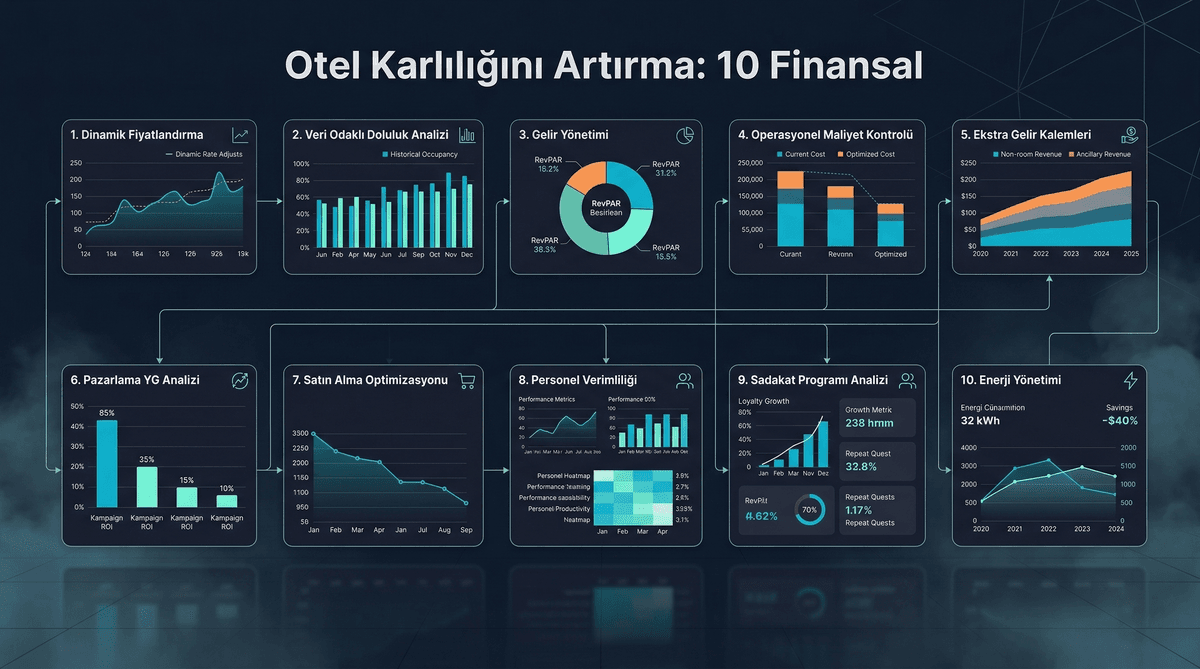
Embed this image on your site
<a href="https://otelciro.com/en/news/boost-hotel-profitability-10-financial-steps-2026-guide">
  <img src="https://cdn.sanity.io/images/1la98t0z/production/b3364a2ab7d1fe484ad6c21aba72aed655d54514-1200x669.png" alt="Otel Karlılığı 10 Adım İnfografiği" width="800" />
</a>
<p>Source: <a href="https://otelciro.com">OtelCiro</a> — AI Hotel Revenue Management</p>
Related reading: Hotel Revenue-Cost Ratios: Industry Benchmark Values
Step 1: Transition to Dynamic Pricing
Switching from fixed to dynamic pricing is the most powerful lever for increasing profitability. Hotels implementing dynamic pricing typically increase their ADR by 12-18%.
Dynamic pricing determines the optimal price by analyzing demand forecasts, competitor prices, occupancy rates, event calendars, and seasonal factors in real-time. AI-powered pricing engines reduce human-induced pricing errors by 85% while increasing revenue by 15-22%.
It is critical that price changes are applied instantly and consistently across all channels (OTA, website, GDS, direct sales). Without channel manager integration, dynamic pricing remains ineffective.
Step 2: Shift to Total Revenue Management (TRevPAR)
Optimizing only room revenue is no longer sufficient. Total Revenue Management optimizes all of the hotel's revenue streams in an integrated manner.
Track the TRevPAR metric: Calculate total revenue per available room by dividing total hotel revenue by the number of available rooms. F&B, spa, meetings, parking, and all ancillary revenue sources are included in this metric. A TRevPAR-focused approach increases total revenue by an average of 8-12%.
Consider every guest touchpoint as a revenue opportunity. Offer room upgrades during check-in, F&B promotions during the stay, and loyalty program invitations after check-out.
Step 3: Optimize Staff Productivity
Personnel costs are the largest expense item for most hotels and directly impact profitability. However, cost reduction should not compromise staff quality.
Occupancy-based scheduling: Adjust staff planning according to occupancy forecasts. Flexible working hours during low occupancy, additional staff during high occupancy. AI-powered scheduling reduces overtime costs by 25-35%.
Cross-training: Train staff in multiple roles. During periods of low demand, the same staff can work in different departments. This approach reduces overall staffing needs by 10-15%.
Performance-based compensation: Shift from fixed salaries to a base salary + performance bonus model. A bonus system tied to upselling, guest satisfaction, and efficiency metrics increases both motivation and productivity.
Related reading: Track Performance with OtelCiro Reporting
Step 4: Energy Cost Management
Energy is the fastest-rising cost item for hotels in 2026. It is possible to reduce energy costs, which account for 8-12% of total revenue, to 5-7%.
Smart room control systems: Reduce energy consumption per room by 30-40% with automatic HVAC shutdown in empty rooms, occupancy-sensor lighting, and smart thermostat applications.
LED conversion: Converting all lighting to LED reduces lighting energy costs by 60-70%. The return on investment is typically 12-18 months.
Solar energy: Rooftop solar panels can reduce electricity costs by 25-35%, especially in resort hotels. Turkey's advantage in sunshine hours reduces the return on investment to 4-6 years.
Step 5: Increase Direct Booking Rate
OTA commissions can consume 15-22% of total revenue. Increasing the direct booking rate directly boosts net revenue.
Website optimization: User-friendly booking engine, mobile compatibility, speed optimization, and strong visual content. Increasing the conversion rate on the direct channel from 2% to 4% means hundreds of thousands of Turkish Lira in additional annual revenue.
Price advantage: Offer prices 5-10% lower on the direct channel than OTAs. Guests should clearly see the advantage of booking direct.
Loyalty program: A loyalty program that steers repeat guests to the direct channel can increase the direct booking rate by 15-25%.
A hotel that increases its direct booking rate from 30% to 45% can generate an additional 500,000-1,500,000 TL in annual profit solely from commission savings.
Step 6: F&B Cost Control and Menu Engineering
The food & beverage department is the most complex revenue center requiring strict cost control discipline.
Menu engineering: Analyze menu items on a popularity and profitability matrix. Highlight high-profit items, remove or reprice underperforming items. Menu engineering can increase F&B profitability by 8-15%.
Portion control: Set standard portion weights and monitor them regularly. Portion standardization reduces food waste by 10-20%.
Local sourcing: Focus on local and seasonal products to reduce transportation costs and improve fresh product quality. Hotels increasing their local sourcing rate above 60% reduce food costs by 8-12%.
Step 7: Systematize Upselling and Cross-Selling
Generating additional revenue from existing guests is 5-7 times less costly than acquiring new guests.
Pre-arrival upselling: Send email offers for room upgrades, early check-in, and late check-out before arrival. Automated upselling systems increase room revenue by 5-8%.
In-stay cross-selling: Offer spa reservations, restaurant packages, and special experiences during the stay. Personalized recommendations have a 3x higher conversion rate than standard offers.
Check-out sales: Loyalty program sign-ups, future stay discounts, and gift product sales at check-out.
Step 8: Supply Chain Optimization
Smart purchasing can lead to a 5-10% reduction in total costs.
Centralized purchasing: Centralize purchasing processes for all departments. Reduce unit prices with bulk purchasing agreements.
Supplier consolidation: Reduce the number of suppliers to decrease management complexity and increase your bargaining power. Hotels that reduced their supplier count by 30% achieved an average of 7% cost savings.
Digital procurement platforms: Digitize price comparisons, order automation, and inventory management with e-procurement platforms.
Related reading: Cost Center vs. Revenue Center: Department Classification
Step 9: Preventive Maintenance Program
Reactive maintenance (waiting for a breakdown and then repairing) is 35-50% more costly than preventive maintenance (planned maintenance). Moreover, unexpected breakdowns severely damage guest satisfaction.
Planned maintenance schedule: Create a maintenance schedule for all critical equipment according to manufacturer recommendations. HVAC, elevators, generators, pool systems, and kitchen equipment are priorities.
IoT sensors: Monitor critical equipment with IoT sensors. Detect vibration, temperature, and energy consumption anomalies early to prevent breakdowns. IoT-based predictive maintenance reduces unexpected breakdown costs by 60%.
Energy efficiency audit: Conduct an annual energy efficiency audit to identify leakage points. An average hotel has an annual energy saving potential of 5-8%.
Step 10: Data-Driven Decision-Making Culture
Basing financial decisions on data rather than intuition is a prerequisite for the success of all other steps.
Real-time dashboard: Monitor daily revenue, occupancy, ADR, cost ratios, and cash flow on a single screen. Data delay means decision delay. Hotels with real-time reporting can intervene in problems an average of 3 days earlier.
Benchmark comparison: Regularly compare your performance with STR and HotStats data. Know in which areas you are below the industry average.
Scenario analysis: Model "what if" scenarios. What happens to GOP if occupancy drops by 10%, energy prices increase by 20%, or personnel costs rise by 15%? Being prepared enables quick action in a crisis.
Regular financial review: Hold monthly financial review meetings. Evaluate budget variances, cost trends, and revenue opportunities with department managers.
OtelCiro's reporting platform offers a comprehensive data infrastructure supporting each of these 10 steps. Base your profitability strategy on data with real-time revenue-cost analysis, department-based profitability tracking, and industry benchmark comparison.
Profitability improvement is not a one-time project but a continuous discipline. Hotels that implement these 10 steps as an integrated strategy achieve significantly higher GOP margins than the industry average and strengthen their financial resilience. Take the first step today.
![US Hotel Labor Costs Hit $131 Billion in 2026: AI Automation Strategies That Cut Costs Fast [2026 Guide]](https://cdn.sanity.io/images/1la98t0z/production/6765e31b08a1c04cce66f9bf9482693dbefdcce5-2752x1536.jpg?w=1920&q=50&auto=format&fit=max)