![2026 Hotel Profitability: Revenue-Cost Benchmarks [Strategy Guide]](https://cdn.sanity.io/images/1la98t0z/production/2fbae0502decc9f67e5260a9d33fb7850d0fbb46-1200x669.png?w=1920&q=65&auto=format&fit=max)
Key Takeaways
- Benchmarking is Crucial: Hotels regularly conducting benchmark analysis achieve 15-22% higher annual profitability by identifying problem areas early.
- Key Ratios to Monitor: Personnel (target 20-38% of total revenue), F&B (target 28-32% of F&B revenue), and Energy (target 8-12% of total revenue) are critical cost ratios with specific industry benchmarks for different hotel types.
- GOP Margin as Performance Metric: Gross Operating Profit (GOP) margin is a vital indicator of operational efficiency, with 2026 benchmarks ranging from 25-45% depending on hotel segment. Turkey's average GOP margin declined to 31.8% in Q1 2026.
- Department-Specific Profit Targets: Follow USALI standards with target profit margins of 72-80% for Rooms, 25-35% for F&B, and 40-55% for Spa & Wellness.
- 5 Strategic Improvement Areas: Optimize revenue management, enhance labor efficiency, implement smart energy management, streamline supply chain, and invest in technology to improve cost ratios and boost profitability.
Why Benchmarking is Crucial for Hotel Financial Performance
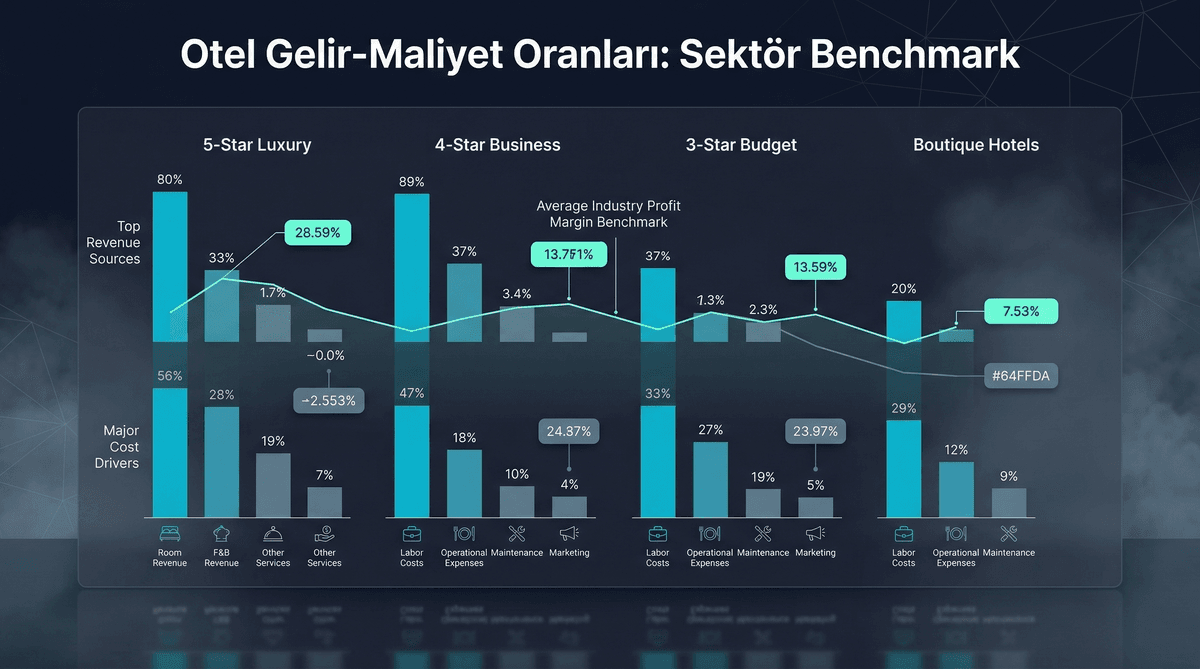
The most effective way to assess a hotel's financial health is to compare its revenue-cost ratios against industry benchmark values. Simply stating "we are profitable" is not enough; the real question should be "where do we stand compared to the industry average?"
According to research in the Turkish hotel industry, hotels that regularly perform benchmark analysis achieve 15-22% higher annual profitability compared to those that do not. The reason is simple: Benchmarking allows you to identify problematic areas early and direct resources effectively.
As of 2026, the cost structure of hotels in Turkey has undergone significant changes. A 45% increase in energy costs, minimum wage updates, and food inflation have disrupted traditional cost balances. Under these conditions, cost management based on benchmark data is a cornerstone of survival strategy.
Embed this image on your site
<a href="https://otelciro.com/en/news/2026-hotel-profitability-revenue-cost-benchmarks-strategy-guide">
  <img src="https://cdn.sanity.io/images/1la98t0z/production/2fbae0502decc9f67e5260a9d33fb7850d0fbb46-1200x669.png" alt="Otel Gelir-Maliyet Benchmark İnfografiği" width="800" />
</a>
<p>Source: <a href="https://otelciro.com">OtelCiro</a> — AI Hotel Revenue Management</p>
Related reading: Hotel TRevPAR and Total Revenue Management
Key Revenue-Cost Ratios and Industry Averages
Let's examine the critical revenue-cost ratios that hotel executives should track, along with industry averages in Turkey.
Personnel Cost / Total Revenue Ratio
Personnel cost constitutes the largest expense item in most hotels. Industry averages are as follows:
- City hotels (4-5 stars): %28-35
- Resort hotels (all-inclusive): %22-28
- Boutique hotels: %30-38
- Budget/economy hotels: %20-25
Alarm bells should ring when the personnel cost to total revenue ratio exceeds %35. This ratio, which averaged %31 in 5-star hotels in Istanbul in 2025, increased to %34 in 2026.
Food Cost / F&B Revenue Ratio
Controlling food costs in the food and beverage department is key to profitability:
- Optimal range: %28-32
- Acceptable upper limit: %35
- Danger zone: %38 and above
With food inflation exceeding %65 in Turkey, keeping this ratio under control has become challenging. Successful hotels manage to stay below %30 through menu engineering and supply chain optimization.
Energy Cost / Total Revenue Ratio
Energy costs are the fastest-growing expense item for hotels in 2026:
- Industry average: %8-12
- Energy-efficient hotels: %5-7
- Inefficient hotels: %14-18
Hotels investing in energy efficiency can reduce this ratio by up to %40.
GOP Margin: The Hotel's Operational Report Card
Gross Operating Profit (GOP) margin is the most important metric indicating a hotel's operational efficiency. The factors determining the GOP margin and benchmark values are as follows:
GOP Margin Benchmarks in Turkey (2026)
- Luxury city hotels: %38-45
- 5-star resorts (all-inclusive): %30-38
- 4-star city hotels: %32-40
- 3-star city hotels: %25-32
- Boutique hotels: %35-42
- Thermal hotels: %28-35
When the GOP margin falls below %30, the hotel's capacity to cover fixed costs and make investments is severely limited. The average GOP margin across Turkey, which was %34.2 in 2025, declined to %31.8 in the first quarter of 2026.
Factors Affecting GOP Margin
Three fundamental factors determine the GOP margin: quality of revenue management, discipline in cost control, and operational efficiency. Weakness in any of these three areas directly reduces the GOP margin. For example, a %5 improvement in revenue management can increase GOP by %12-15, while the same effect through cost control can only be achieved at %8-10.
Related reading: Financial Analysis with OtelCiro Reporting Module
Department-Based Cost Breakdown and Target Ratios
Each department should have its own profitability target. Let's examine department-based cost targets according to USALI standards.
Rooms Department
The Rooms department is the most profitable unit in hotels. The target departmental profit margin should be between %72-80. Rooms department costs include:
- Housekeeping personnel: %8-12 of revenue
- Room supplies (amenity): %2-4 of revenue
- Laundry: %3-5 of revenue
- Front desk personnel: %5-8 of revenue
Food & Beverage Department
The target profit margin in the F&B department is between %25-35. Cost breakdown:
- Food cost: %28-32 of F&B revenue
- Beverage cost: %20-25 of beverage revenue
- Personnel: %30-38 of F&B revenue
- Other expenses: %5-8 of F&B revenue
Spa & Wellness
The target profit margin in the Spa department is between %40-55. Care should be taken to ensure that personnel costs do not exceed %35-40 of spa revenue.
How to Access Benchmark Data and Make Accurate Comparisons
There are several key sources and methods for accessing benchmark data and making accurate comparisons:
Data Sources
- STR (Smith Travel Research): Global hotel performance data. RevPAR, ADR, and occupancy benchmarks.
- HotStats: Department-level profitability data and GOP benchmarks.
- TÜROB Reports: Industry-specific data for Turkey from the Turkish Hoteliers Association.
- Horwath HTL: Annual Turkish hotel industry report.
Rules for Accurate Comparison
When using benchmark data, critical rules must be observed. First, you should compare for the same segment, the same region, and the same period. Comparing the GOP margins of a luxury hotel on the Bosphorus in Istanbul with an all-inclusive resort in Antalya is meaningless. Second, you must consider seasonal factors. Cost ratios during summer months will differ from those in winter months.
5 Strategic Ways to Improve Revenue-Cost Ratios
After benchmark analysis, the real question is: How do we improve these ratios?
1. Revenue Management Optimization: Increasing ADR by %8-15 through dynamic pricing automatically lowers cost ratios. Revenue growth is the most effective cost ratio improvement strategy.
2. Labor Efficiency: Optimize staff scheduling based on occupancy forecasts. AI-powered scheduling systems can reduce personnel costs by %10-15.
3. Energy Management: You can reduce energy costs by %20-30 with smart room control systems and energy management software.
4. Supply Chain Optimization: Centralized purchasing, bulk buying agreements, and local supplier relationships can reduce food costs by %5-10.
5. Technology Investment: Automation and digitalization investments provide %8-12 operational cost savings in the first year.
OtelCiro's reporting module enables real-time revenue-cost ratio tracking and industry benchmark comparison. With department-based cost analysis, it helps you quickly identify problematic areas and take prompt action.
Hotels that regularly monitor benchmark data and take strategic actions can achieve profitability %20-30 above the industry average. In this process, accessing accurate data and transforming it into meaningful information is the first step to success.
![US Hotel Labor Costs Hit $131 Billion in 2026: AI Automation Strategies That Cut Costs Fast [2026 Guide]](https://cdn.sanity.io/images/1la98t0z/production/6765e31b08a1c04cce66f9bf9482693dbefdcce5-2752x1536.jpg?w=1920&q=50&auto=format&fit=max)