
![Total Revenue Management Guide: Optimizing Hotel Profits [2026 Strategy]](https://cdn.sanity.io/images/1la98t0z/production/3bdf8351cd13f141a20275cd0279cdaebcd8796d-1024x1024.png?w=1920&q=65&auto=format&fit=max)
Key Takeaways
- Room revenue typically accounts for only 55-65% of a hotel's total income, leaving significant untapped potential in other departments.
- Implementing Total Revenue Management (TRevM) can increase total revenue by 18-25% compared to room-only strategies.
- Shifting from RevPAR to TRevPAR is essential for understanding the true lifetime value of different guest segments.
- AI-driven cross-departmental optimization can boost GOPPAR by up to 22% through predictive analytics and spending pattern modeling.
- A successful TRevM transition requires a phased roadmap: data infrastructure, TRevPAR tracking, cross-optimization, and finally AI integration.
Beyond Room Revenue: A Holistic Approach to Revenue
When revenue management is mentioned in the hospitality industry, most professionals think exclusively of room revenue. However, in an average hotel, room revenue accounts for only 55-65% of the total income. The remaining 35-45%—consisting of F&B, spa, event spaces, parking, mini-bars, and other revenue streams—is often left unoptimized.
Total Revenue Management (TRevM) is the strategic approach of managing every revenue source of a hotel enterprise under a single unified roof. According to STR Global data, hotels that implement TRevM achieve 18-25% higher total revenue compared to those that do not.
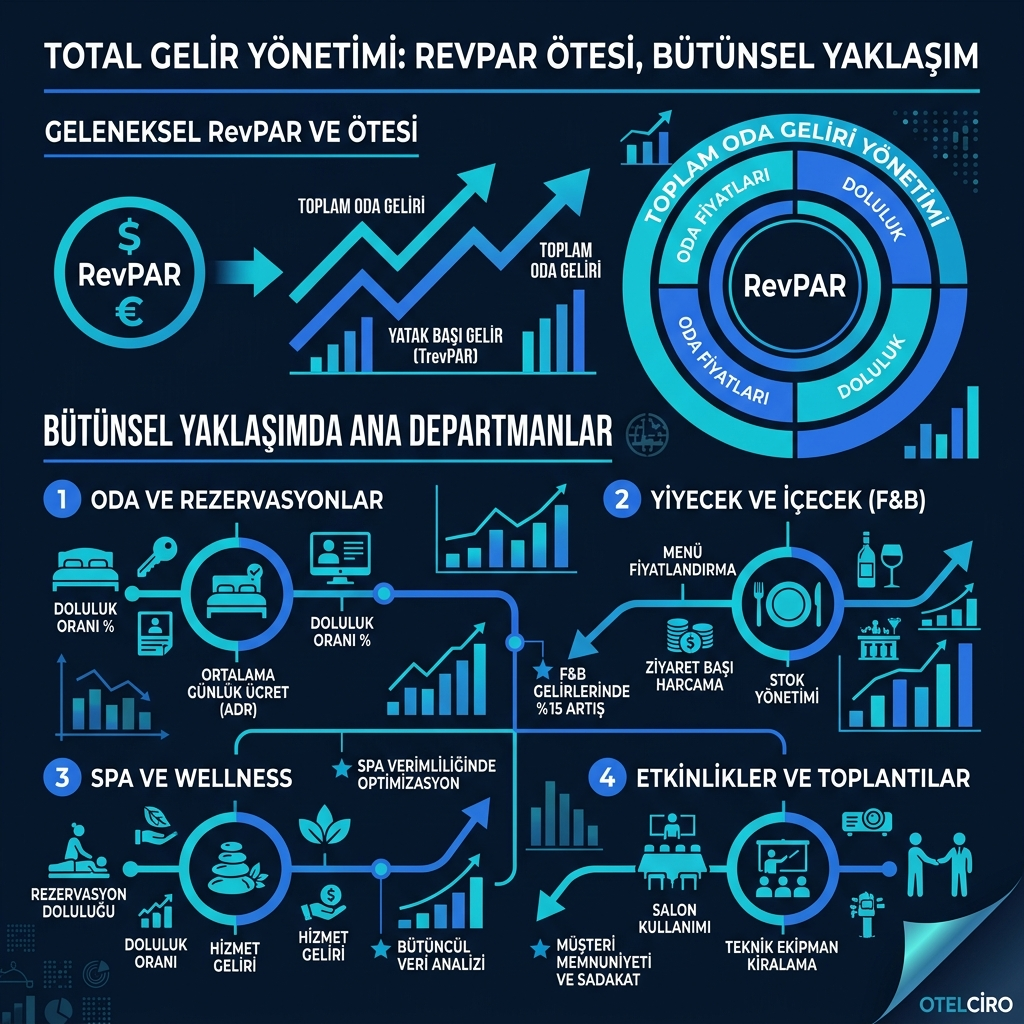
Embed this image on your site
<a href="https://otelciro.com/en/news/total-revenue-management-guide-optimizing-hotel-profits-2026-strategy">
  <img src="https://cdn.sanity.io/images/1la98t0z/production/3bdf8351cd13f141a20275cd0279cdaebcd8796d-1024x1024.png" alt="Total Revenue Management Infographic" width="800" />
</a>
<p>Source: <a href="https://otelciro.com">OtelCiro</a> — AI Hotel Revenue Management</p>
In this article, we cover the fundamentals of total revenue management, department-based optimization strategies, and how AI-powered holistic revenue analysis works.
Related reading: Hotel Revenue Metrics and KPI Guide
TRevPAR: Measuring the Right Metric
RevPAR (Revenue Per Available Room) has been the gold standard metric in hospitality for many years. However, this metric only reflects room revenue. To see the total amount a guest spends at the hotel, a transition to the TRevPAR (Total Revenue Per Available Room) metric is essential.
The TRevPAR calculation is quite simple:
TRevPAR = Total Hotel Revenue / Number of Available Rooms
For example, if a 200-room hotel has a total monthly revenue of 6,000,000 TL and the month has 30 days:
TRevPAR = 6,000,000 / (200 × 30) = 1,000 TL
Tracking this metric allows you to understand which guest segment adds the most total value to the hotel. A business traveler might pay 1,200 TL per room and only take breakfast, while a vacationer might spend 1,800 TL total across spa, restaurant, and tour services despite a 900 TL room rate.
With the OtelCiro reporting module, you can monitor all revenue metrics, including TRevPAR, in real-time on a per-department basis.
Department-Based Revenue Optimization
F&B (Food and Beverage)
Hotel restaurants and bars can account for 25-35% of total revenue when managed correctly. For successful F&B revenue management:
- Menu Engineering: Position every menu item on a popularity and profitability matrix. High-profit but low-sales items fall into the "puzzle" category and require marketing support.
- Dynamic Pricing: Fill slow periods with happy hours and early bird discounts. Research shows that a 10% price elasticity in F&B, when combined with increased occupancy, boosts revenue by 7-12%.
- Package Integration: Room + dinner packages increase perceived value while raising the occupancy rate of the F&B department.
Spa and Wellness
The spa department is one of the most effective areas for total revenue management due to high profit margins (65-80%). Since it operates on an appointment basis, capacity management is even more critical than room management:
- Peak-Hour Pricing: Apply premium pricing for weekends and evening hours.
- Pre-Check-in Marketing: Send a personalized spa package offer to the guest 48 hours before arrival. Acceptance rates typically range between 22-28%.
- Loyalty Integration: Increase repeat visit rates by offering complimentary 15-minute add-on services to recurring guests.
Meetings and Events (MICE)
Event revenues can represent 15-30% of total revenue, especially for city hotels. Optimization opportunities in this area include:
- Daily Delegate Rate (DDR): Offer food, room rental, and technology services in a single per-person package.
- Seasonal Pricing: Apply special discounts for corporate events during low-demand periods.
- Ancillary Revenue Opportunities: AV equipment rental, premium menu options, and conference materials serve as additional revenue sources.
Cross-Department Optimization with AI
The biggest challenge of total revenue management is creating synergy between departments. In traditional models, each department tracks its own goals independently. However, AI-powered systems provide holistic optimization by analyzing the complex relationships between departments.
For example, an AI system can perform the following types of cross-analysis:
- Guest Spending Patterns: Identifies which room types lead to higher F&B spending.
- Package Optimization: Determines which service combinations produce the highest total revenue.
- Price Elasticity: Models how a price change in one department affects revenue in others. For instance, it may detect that a 5% discount in room rates leads to an 8% increase in F&B spending.
According to Cornell Hospitality Research’s 2025 report, hotels implementing AI-supported TRevM perform 22% higher in GOPPAR (Gross Operating Profit Per Available Room) compared to hotels using manual department-based management.
Related reading: Hotel Upselling and Cross-selling Techniques
Implementation Roadmap
The transition to total revenue management does not happen overnight. A phased approach is recommended:
Phase 1 — Data Infrastructure (1-2 months): Integrate revenue data from all departments into a single platform. Ensure data flow between the PMS, POS, spa management system, and event management software.
Phase 2 — TRevPAR Tracking (2-3 months): Begin tracking TRevPAR by department and guest segment. Establish benchmark values.
Phase 3 — Cross-Optimization (3-6 months): Implement cross-departmental packages, dynamic pricing, and personalized offers.
Phase 4 — AI Integration (6-12 months): Deploy AI systems for forecasting, automated price recommendations, and real-time optimization.
Conclusion: See the Whole Revenue Picture
Hotel revenue management is no longer just about setting a room price. There is an opportunity to create value at every touchpoint from the moment a guest steps into the hotel until they depart. Total revenue management is a holistic approach that systematically identifies and optimizes these opportunities.
Industry data clearly shows: hotels implementing TRevM achieve 18-25% higher total revenue and 22% higher gross operating profit compared to competitors focused only on room revenue. This difference provides a sustainable advantage, especially in highly competitive markets.
Start your department-based revenue analysis today with OtelCiro reporting solutions and discover your hotel's true potential.
![Hotel Ancillary Revenue: Monetizing Spa, F&B & Activities [2026 Guide]](https://cdn.sanity.io/images/1la98t0z/production/cfce3407a5ef8f70edd19853e8059317fca7b6a6-2752x1536.jpg?w=1920&q=50&auto=format&fit=max)
![FIFA 2026 World Cup: Hotel Dynamic Pricing Strategy [2026 Guide]](https://cdn.sanity.io/images/1la98t0z/production/7a76affe61333341ec47bb0c705011068a1afd24-2752x1536.jpg?w=1920&q=50&auto=format&fit=max)