
![Optimizing Hotel Net Revenue with Channel Pricing [Strategy Guide]](https://cdn.sanity.io/images/1la98t0z/production/a05dc46a961eb30153243422790bf4bc44427fb5-1200x669.png?w=1920&q=65&auto=format&fit=max)
Key Takeaways
- End of Rate Parity: Regulatory changes, including the EU's Digital Markets Act (DMA) and national competition authorities' decisions, have largely removed rate parity restrictions, empowering hotels to set unique prices per channel.
- Net Revenue Focus: Strategic channel-based price differentiation, rather than random adjustments, is crucial for optimizing net revenue, with studies showing potential increases of 10-18%.
- Channel-Specific Strategies: Each distribution channel requires a tailored approach; direct channels should offer the lowest price and highest value, OTAs should balance billboard effect with net revenue, metasearch should focus on high visibility and low cost, and GDS/corporate channels should leverage segmented pricing.
- Indirect Differentiation: Beyond direct price changes, hotels can use value-adds (e.g., free breakfast), room type restrictions, minimum length of stay, and flexible cancellation policies to create indirect price advantages.
- Technology is Essential: A robust Channel Manager with capabilities for channel-specific pricing, rule-based automation, real-time synchronization, and net revenue reporting is vital for efficient and effective implementation, potentially increasing net income by 23% compared to manual management.
The End of Single-Price Policy
For years, the golden rule in hospitality was "rate parity" — meaning the same price across all channels. Booking.com, Expedia, and other OTAs included parity clauses in their contracts, preventing hotels from implementing channel-based price differentiation. However, with the European Union's Digital Markets Act (DMA) and decisions by national competition authorities, this landscape has fundamentally changed.
As of 2024, even narrow rate parity is prohibited in EU countries. In Turkey, the Turkish Competition Authority's 2023 decision abolished Booking.com's wide rate parity practices. These developments have granted hotels the freedom to set different prices for each channel.
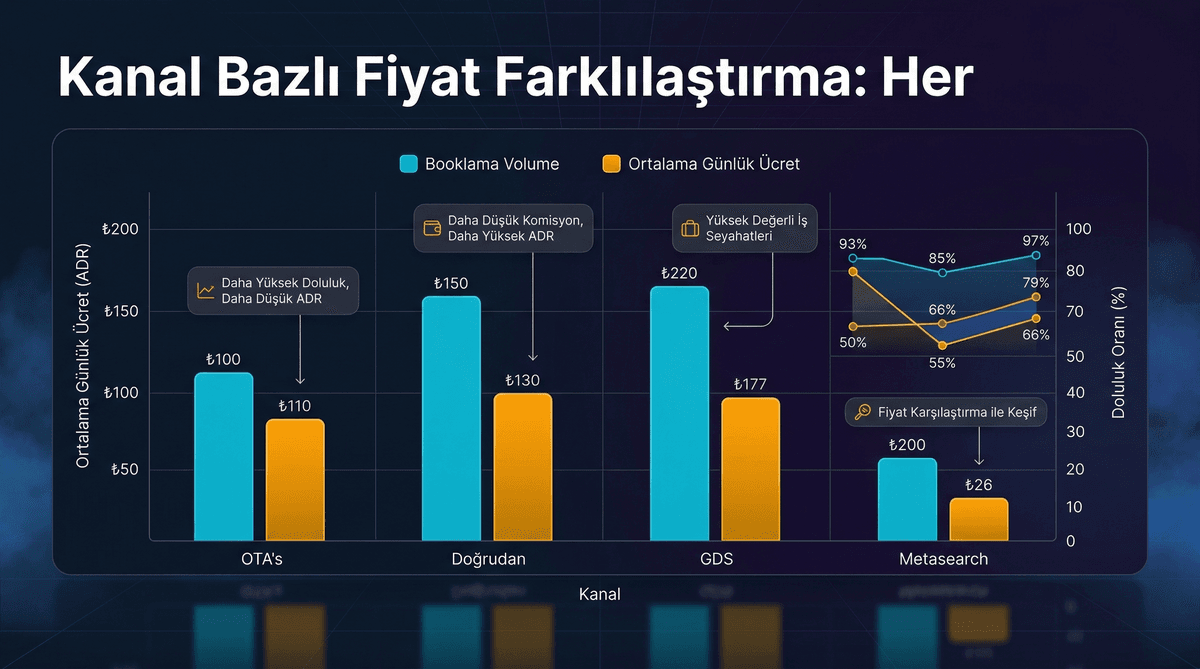
Embed this image on your site
<a href="https://otelciro.com/en/news/optimizing-hotel-net-revenue-with-channel-pricing-strategy-guide">
  <img src="https://cdn.sanity.io/images/1la98t0z/production/a05dc46a961eb30153243422790bf4bc44427fb5-1200x669.png" alt="Kanal Bazlı Fiyat Farklılaştırma İnfografiği" width="800" />
</a>
<p>Source: <a href="https://otelciro.com">OtelCiro</a> — AI Hotel Revenue Management</p>
So, how should this newfound freedom be utilized? It's not about randomly assigning different prices to each channel, but rather implementing strategic price differentiation from a net revenue optimization perspective. Research shows that hotels employing a channel-based pricing strategy increase their net revenue by 10-18%.
Related reading: DMA and Pricing Freedom: What Has Changed for Hotels?
Net Revenue Perspective: The True Cost of Each Channel
The foundation of channel-based price differentiation lies in understanding each channel's net revenue contribution. Even if the same room is sold at the same price, the cost difference between channels is dramatic:
| Channel | Gross Price | Commission/Cost | Net Revenue |
|---|---|---|---|
| Direct (website) | 2,000 TL | 3-5% (payment processing fees) | 1,900-1,940 TL |
| Booking.com | 2,000 TL | 15-18% | 1,640-1,700 TL |
| Expedia | 2,000 TL | 18-22% | 1,560-1,640 TL |
| GDS (corporate) | 2,000 TL | 10-12% | 1,760-1,800 TL |
| Wholesaler | 2,000 TL | 25-35% | 1,300-1,500 TL |
| Metasearch (Google Hotels) | 2,000 TL | 8-12% (CPC/CPA) | 1,760-1,840 TL |
This table clearly shows: a room sold at the same price can generate a net revenue difference of up to 600 TL depending on the channel chosen. For a hotel selling 50,000 room-nights annually, this difference amounts to millions of Turkish Liras.
Channel Strategy Matrix
Each distribution channel requires a different strategic approach:
Direct Channel (Hotel Website)
Strategy: Lowest price + highest value
Offering the lowest price on the direct channel should be every hotel's primary goal. This is now possible in markets where rate parity restrictions have been lifted. Suggested approach:
- Set prices 5-10% lower than OTA prices.
- Add value propositions: complimentary breakfast, early check-in, late check-out.
- Offer an additional 5% discount for returning guests through a loyalty program.
- Provide flexible cancellation policies to reduce perceived risk.
Increasing direct channel share from 25% to 40% can result in an annual net revenue increase of 1.2-1.8 million TL for a 200-room hotel.
OTA Channels (Booking.com, Expedia)
Strategy: Billboard effect + net revenue balancing
OTAs remain a significant source of demand — especially for new guest acquisition. However, you can optimize your OTA strategy with OtelCiro sales module to protect net revenue:
- Minimum price threshold: Set a floor price below which net revenue will not fall below the direct channel's net revenue.
- Inventory control: Reduce OTA allocation during high-demand periods, increase during low-demand periods.
- Room type differentiation: Direct high-margin room types (suites, deluxe) to the direct channel, while standard rooms go to OTAs.
- Promotion control: Participate selectively in OTA campaigns — only join campaigns that fill occupancy gaps.
Metasearch (Google Hotels, Trivago)
Strategy: High visibility, low cost
Metasearch channels offer 40-60% lower acquisition costs compared to OTAs. Strategy:
- Control costs with a CPA (Commission Per Acquisition) model.
- Optimize the "Hotel Website" listing that directs traffic to your direct channel.
- Ensure price consistency — price discrepancies are most noticeable on metasearch.
GDS and Corporate Channels
Strategy: Segmentation-based pricing
Corporate rates are typically determined by annual agreements. However, a dynamic approach can be adopted:
- Dynamic corporate pricing: Instead of a fixed 10-15% discount on BAR (Best Available Rate), use a dynamically calculated discount each day.
- Last Room Availability (LRA): Retain the right to close sales at the corporate rate on high-demand days.
- Volume-based tiered discounts: Offer deeper discounts to high-volume companies and limited discounts to low-volume companies.
Price Differentiation Tools and Tactics
Channel-based price differentiation doesn't always have to involve overt price differences. Indirect differentiation tactics are also effective:
Value-add: Same price, different included services. Breakfast included on the direct channel, breakfast excluded on OTAs — creating an actual price difference of 8-12%.
Room type restriction: Offer the most attractive room types (sea view, balcony, upper floor) exclusively on the direct channel or preferred channels.
Minimum length of stay: Apply a minimum 2-night restriction on OTAs to steer single-night reservations to the direct channel. Single-night stays often have higher operational costs.
Cancellation policies: Offer flexible cancellation on the direct channel and restricted cancellation on OTAs, creating an indirect price advantage.
Related reading: Hotel Distribution Cost Analysis: The True Cost of Each Channel
Technology Infrastructure: Channel Manager Integration
Channel-based price differentiation requires a robust technology infrastructure. Manual price updating is prone to both errors and delays when managing 5+ channels.
Channel Manager requirements:
- Channel-specific pricing: Ability to send different prices to each channel.
- Rule engine: Automatic rules such as "Booking.com price = BAR × 1.05".
- Inventory control: Channel-based inventory allocation and automatic closing.
- Real-time synchronization: Price changes reflected across all channels within seconds.
- Net revenue reporting: Ability to show each channel's post-commission net revenue performance.
Industry data shows that hotels using an integrated channel manager achieve 23% higher net revenue compared to those managing manually.
Conclusion: Smart Price, Smart Channel
Channel-based price differentiation is no longer an option, but a necessity. Applying the same price across all channels means subsidizing high-commission channels and neglecting the potential of your direct channel.
The right approach is simple: measure each channel's net revenue contribution, determine the price for each channel that maximizes net revenue, and automate this process with technology. Optimize your channel-based pricing strategy today with OtelCiro sales solutions and increase your net revenue by 10-18%.
![Hotel Ancillary Revenue: Monetizing Spa, F&B & Activities [2026 Guide]](https://cdn.sanity.io/images/1la98t0z/production/cfce3407a5ef8f70edd19853e8059317fca7b6a6-2752x1536.jpg?w=1920&q=50&auto=format&fit=max)
![FIFA 2026 World Cup: Hotel Dynamic Pricing Strategy [2026 Guide]](https://cdn.sanity.io/images/1la98t0z/production/7a76affe61333341ec47bb0c705011068a1afd24-2752x1536.jpg?w=1920&q=50&auto=format&fit=max)