
![NLP for Hotel Reviews: AI-Powered Insights & Action [2026 Guide]](https://cdn.sanity.io/images/1la98t0z/production/2c49833e701df5c3efb1231500a7602554c97b6f-1200x669.png?w=1920&q=65&auto=format&fit=max)
Key Takeaways
- Overcoming Data Overload: While 72% of hotel managers monitor reviews, only 18% systematically analyze them, leading to lost critical insights from the 2,000-5,000 reviews an average city hotel receives annually.
- AI-Powered Analysis: NLP automates theme extraction, sentiment analysis (achieving 89% accuracy for Turkish), intensity measurement, and comparative analysis against competitors.
- Automated Action Plans: The system detects trends, performs root cause analysis, prioritizes actions by impact and difficulty, and assigns responsibilities to relevant department heads.
- Enhanced Staff Performance & Strategy: NLP identifies praised or criticized staff, boosting motivation by 35%, informs hiring criteria, and provides competitive insights into strengths, weaknesses, and emerging trends among rivals.
- Strategic Implementation: Maximize NLP's benefits by integrating all feedback sources, customizing theme trees, automating response drafts to increase response rates from 40% to 95%, establishing monthly reporting cycles, and measuring ROI.
Drowning in a Sea of Reviews
An average city hotel receives 2,000-5,000 online reviews annually. These reviews across Booking.com, TripAdvisor, Google, Expedia, and social media platforms are an invaluable source of feedback for hotel management. However, manually reading and extracting meaningful insights from such a large volume of data is practically impossible.
Research shows that while 72% of hotel managers state they regularly monitor reviews, only 18% implement a systematic analysis process. Consequently, critical information hidden within reviews—recurring complaints, staff performance patterns, and competitor advantages—are lost unnoticed.
NLP (Natural Language Processing) technology transforms this data overload into structured and actionable insights.
NLP Review Analysis: The Mechanics of the Technology
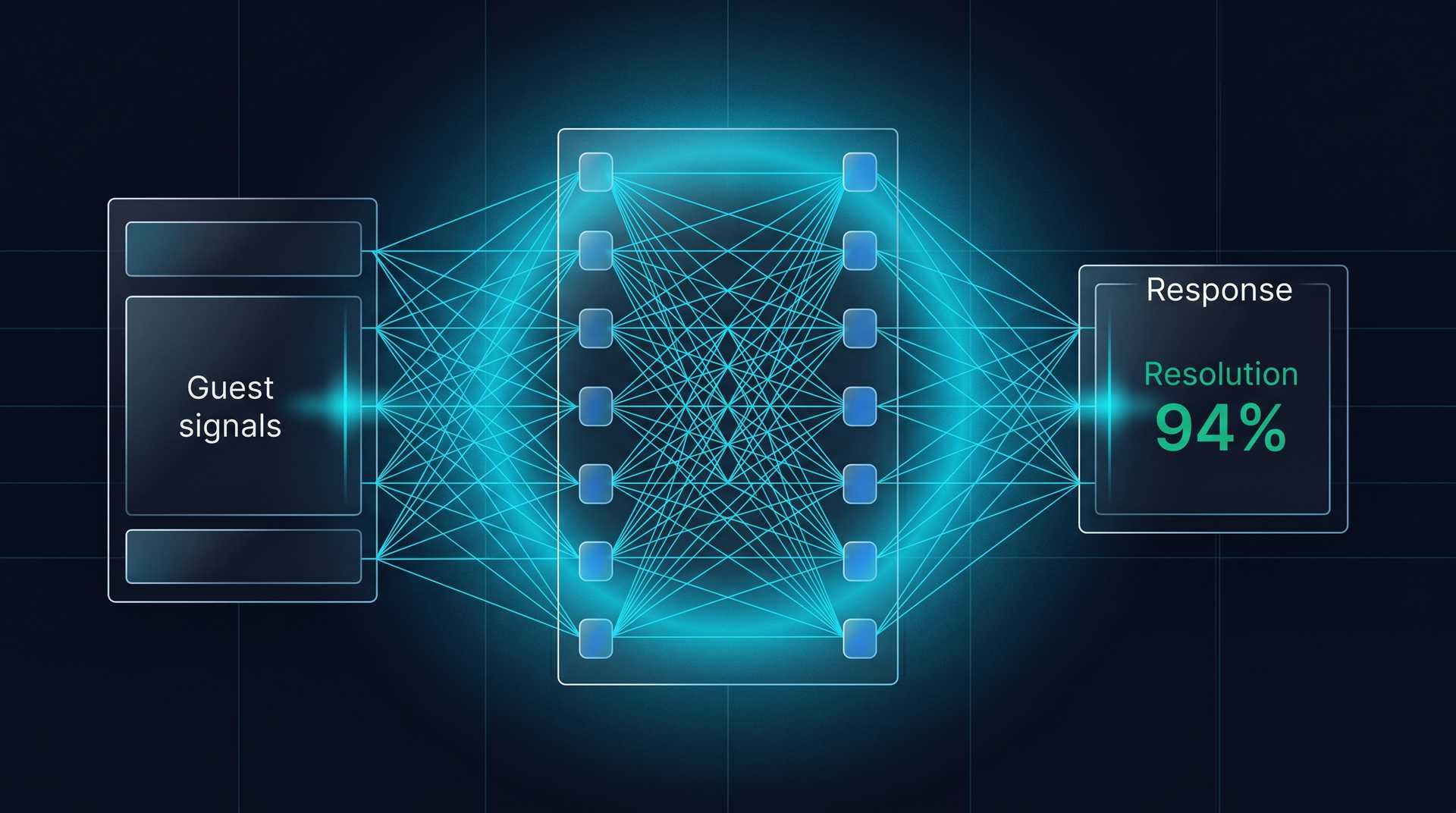
OtelGPT's review analysis module collects reviews from all platforms in real-time and subjects them to a multi-layered analysis process:
Topic Extraction: Each review is automatically tagged according to the topics it contains. A single review might simultaneously include "cleanliness," "breakfast," and "staff" themes. NLP evaluates each theme mentioned within a review independently. A typical hotel continuously monitors 15-25 different themes.
Sentiment Analysis: A separate sentiment score is calculated for each theme. A guest might have liked the room but been dissatisfied with breakfast — NLP accurately captures this distinction. Models trained for Turkish sentiment analysis achieve an 89% accuracy rate.
Intensity Measurement: Not only is the positive/negative sentiment determined, but its intensity is also measured. The difference between "The room was nice" and "The room was amazing, the best decor I've ever seen" is quantified.
Comparative Analysis: Your hotel's theme-based scores are compared with competitors in the region. If your cleanliness score is 85% while your competitors' average is 90%, this area is flagged as a priority requiring improvement.
Automated Action Plan Creation
The most valuable output of NLP analysis is the transformation stage from raw data to concrete action plans. The system follows this workflow:
Trend Detection: If the rate of negative reviews on a specific theme has increased in the last 30 days, the system issues a "declining trend" alert. For example, if the satisfaction score in restaurant reviews has dropped from 4.2 to 3.8 within 3 months, this situation is reported instantly.
Root Cause Analysis: AI categorizes negative reviews to identify the source of the problem. When analyzing "breakfast was bad" reviews, it might emerge that 45% of complaints relate to variety, 30% to freshness, and 25% to service speed.
Prioritization: Each action is ranked based on its estimated impact size and implementation difficulty. Actions with high impact at low cost are moved to the top of the list.
Responsibility Assignment: Identified actions are automatically communicated to relevant department managers. Housekeeping managers receive cleaning-related issues, while F&B managers receive restaurant-related topics.
Related Reading: Real-time Sentiment Analysis: AI in Guest Feedback — Sentiment analysis techniques in instant feedback.
Staff Performance Insights
NLP review analysis also makes individual staff performance visible:
- Praise Patterns: Comments like "Ayşe at the reception was wonderfully helpful" are detected and integrated with the staff recognition system. Staff recognized by name show a 35% increase in motivation.
- Complaint Patterns: Recurring problems in a specific shift or department indicate a need for training.
- Service Moment Analysis: Performance at touchpoints like check-in, room service, and check-out is evaluated separately. The weakest link is identified, and targeted improvements are made.
A Cappadocia boutique hotel used NLP staff analysis to identify common traits among its top 3 most praised employees and integrated these traits into its hiring criteria. Result: the new staff's contribution to guest satisfaction increased by 28% in their first 3 months.
Competitor Analysis and Benchmarking
The NLP system analyzes not only your hotel's reviews but also those of your competitors:
Strengths and Weaknesses: It determines which themes your competitors are strong or weak in. This information shapes your competitive strategy. If your competitor receives high scores for location, you might choose to stand out with service quality.
Price-Value Perception: By analyzing the frequency of phrases like "expensive," "worth the price," or "affordable" in reviews, a price-value perception map is created for each hotel.
New Trends: New themes emerging in competitor reviews (e.g., "EV charging station" or "digital key") are reported as early warnings. This information guides your investment decisions.
Implementation and Measurement
To implement an NLP review analysis system and maximize its efficiency:
-
Integrate All Sources: Collect Booking.com, TripAdvisor, Google, Expedia, social media, and survey responses on a single platform. Missing sources mean missing insights.
-
Customize the Theme Tree: In addition to general themes (cleanliness, location, price), add themes specific to your hotel. If you're a spa hotel, define sub-themes like "thermal pool"; if a boutique hotel, "decoration."
-
Response Automation: Automatically generate thank-you messages for positive reviews and personalized draft responses for negative ones. Increasing the review response rate from 40% to 95% is possible with NLP.
-
Monthly Reporting Cycle: Conduct monthly review analysis meetings with department managers. Trend changes, action tracking, and success stories are shared in this meeting.
-
ROI Measurement: After implementing the NLP system, online review average, repeat stay rate, and average review response time are tracked as KPIs.
NLP review analysis uncovers everything your guests are telling you, but you might not be hearing. Start using this technology today with OtelGPT and transform guest feedback into a strategic advantage.
![AI Chatbot Revenue Impact for Hotels: 2026 Strategy [Data Analysis]](https://cdn.sanity.io/images/1la98t0z/production/28a6b8cebd12686a668a97549c9e9a619c6f4277-2752x1536.jpg?w=1920&q=50&auto=format&fit=max)
![Hotel AI Technology Budgets 2027: 8-Point Investment Framework That Delivers 15x ROI [2026]](https://cdn.sanity.io/images/1la98t0z/production/7e64ec0aab777ec433ec0f4f1257373a84f39d1d-2048x2048.png?w=1920&q=50&auto=format&fit=max)