
![Neural Networks for Hotel Demand Forecasting [2026 Guide]](https://cdn.sanity.io/images/1la98t0z/production/9ecca4e8f09e6bfc2e03832cb519779ddd308bbf-1200x669.png?w=1920&q=65&auto=format&fit=max)
Key Takeaways
- Precise demand forecasting influences 60-70% of a hotel's total revenue performance.
- Deep learning architectures like LSTM and Transformers reduce forecasting error rates from 25% to under 8%.
- The Transformer (TFT) model is the current industry gold standard, offering 92-95% accuracy by utilizing self-attention mechanisms.
- High-quality forecasting requires a minimum of 2-3 years of historical data integrated with external variables like weather and flight occupancy.
- Specialized models are required to handle regional volatility, such as shifting holiday calendars and macroeconomic fluctuations.
Why Demand Forecasting is the Most Critical Decision in Hospitality
Between 60-70% of a hotel's revenue performance depends directly on the accuracy of demand forecasting. If you cannot predict demand accurately, pricing decisions will fail, staffing schedules will falter, and supply management becomes inefficient. Demand forecasts made using traditional methods (same period last year + intuitive adjustments) typically carry an average margin of error between 18-25%. For a 200-room hotel, this error margin translates to an annual revenue loss of 500,000-800,000 TL.
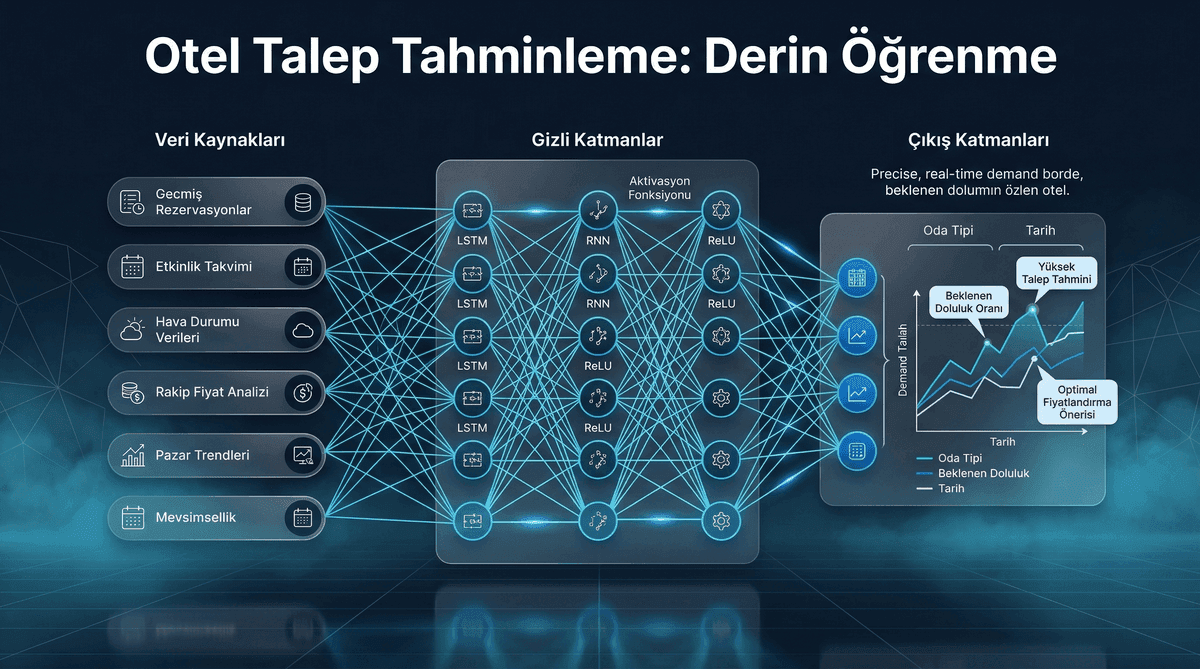
Deep learning and neural networks are revolutionizing demand forecasting by driving this margin of error below 8%. LSTM (Long Short-Term Memory), GRU (Gated Recurrent Unit), and the star of recent years, the Transformer architecture, can learn complex demand patterns in hospitality at a depth that traditional statistical models simply cannot reach.
Embed this image on your site
<a href="https://otelciro.com/en/news/neural-networks-for-hotel-demand-forecasting-2026-guide">
  <img src="https://cdn.sanity.io/images/1la98t0z/production/9ecca4e8f09e6bfc2e03832cb519779ddd308bbf-1200x669.png" alt="Neural Networks for Hotel Demand Forecasting Infographic" width="800" />
</a>
<p>Source: <a href="https://otelciro.com">OtelCiro</a> — AI Hotel Revenue Management</p>
Neural Network Architectures and Hospitality Applications
Each neural network architecture excels with different types of data. The three most effective architectures for hotel demand forecasting are:
LSTM (Long Short-Term Memory)
LSTM is particularly successful at learning long-term dependencies in time-series data. Its advantage in hospitality is the ability to capture both short-term trends (weekday/weekend cycles) and long-term patterns (seasonal fluctuations, annual trends) simultaneously.
Technical Detail: Thanks to the "forget gate" mechanism, an LSTM cell decides which information to retain and which to discard. In a hotel context, this means it can learn sliding window patterns, such as Ramadan occurring on different dates every year.
Performance: When tested on hotel data in Turkey, the LSTM model demonstrated 89-92% accuracy in 30-day demand forecasting, while the traditional ARIMA model remained at 74-78% accuracy on the same dataset.
Transformer Model
This is the most sought-after architecture in the 2024-2026 period. Through the "Attention" mechanism, it dynamically weights the most relevant points in a dataset. This architecture, which forms the basis of ChatGPT, is also creating a breakthrough in time-series forecasting.
Technical Detail: The self-attention mechanism automatically determines which days in the past most influence today's demand forecast. For example, it dynamically calculates the weights of the same week last year, the trend from 2 weeks ago, and the current event calendar.
Performance: The Temporal Fusion Transformer (TFT) model, when trained with multi-hotel data, provides 92-95% accuracy and exhibits superior performance in capturing unexpected demand shifts (event cancellations, natural disasters, exchange rate shocks).
Hybrid Models (CNN + LSTM)
Combining Convolutional Neural Networks (CNN) with LSTM creates a powerful hybrid model that captures both local patterns and long-term trends concurrently. The CNN layer extracts weekly micro-patterns, while the LSTM layer learns seasonal macro-trends.
The OtelCiro AI engine provides the highest forecasting accuracy by training these hybrid architectures specifically for your hotel data.
Related reading: Hotel Revenue Forecasting with AI: AI-Powered Revenue Management
Data Preparation: The Foundation of the Model
The "Garbage in, garbage out" rule applies exponentially in deep learning. The accuracy of a neural network model is directly dependent on the quality of the data it is fed.
Required Datasets:
- Historical occupancy data: Daily occupancy, ADR, and RevPAR data for at least 2-3 years. More data allows the model to learn seasonal patterns better.
- Price history: Your own price changes and competitor price movements. This is critical for modeling price-demand elasticity.
- Event calendar: Dates of fairs, congresses, sports events, and festivals in the city. This data is a determinant in predicting sudden demand spikes.
- Weather: A 0.72 correlation has been measured between demand and weather, particularly for resort hotels.
- Economic indicators: Exchange rates, inflation rates, and consumer confidence indices.
- Flight data: Flight occupancy rates to the destination and new route openings.
Data Cleaning Steps:
- Detection and filling of missing data using appropriate methods (interpolation or modeling).
- Flagging outliers (COVID-19 period, natural disasters)—these should be tagged with a special flag rather than deleted.
- Aligning time-series data to equal intervals.
- Encoding categorical variables (day of the week, month, holiday/regular day).
- Normalization: Scaling all numerical variables to a 0-1 range.
Model Training and Hyperparameter Optimization
Training a neural network model requires more computational resources and expertise than traditional machine learning. A successful training process includes:
Data Partitioning: Data is split into 70% for training, 15% for validation, and 15% for testing. In time-series data, random splitting is avoided; chronological order is maintained, and the most recent period is kept as test data.
Hyperparameter Selection:
- Number of hidden layers: 2-4 layers are usually sufficient. More layers increase the risk of overfitting.
- LSTM cell size: Between 64-256, determined by the size of the dataset.
- Learning rate: Starts at 0.001 and is reduced via cosine annealing.
- Batch size: Between 32-128, adjusted according to GPU memory capacity.
- Dropout rate: Between 20-40%, to control overfitting.
Training Duration: Training an LSTM model with 3 years of daily data takes an average of 4-8 hours on a single GPU, while a Transformer model takes 12-24 hours. With cloud-based solutions and multi-GPU setups, these times can be shortened by 2-3 times.
Related reading: Dynamic Pricing and AI: The Complete Guide
Challenges and Solutions Specific to Turkey
Demand forecasting models in the Turkish hospitality sector face some unique challenges:
High Inflation and Exchange Rate Volatility: Turkey's macroeconomic conditions create a dynamic environment that constantly changes the price-demand relationship. The model should process real prices and exchange rate effects as separate variables instead of nominal prices.
Shifting Holiday Calendars: Ramadan and Sacrifice Feasts (Eid al-Fitr and Eid al-Adha) fall on different dates every year. The model must be able to perform Hijri calendar conversion automatically and predict holiday demand accurately.
Regional Diversity: The demand patterns of a resort hotel in Antalya are fundamentally different from an urban hotel in Istanbul. Using the Transfer Learning technique, a general base model is trained and then fine-tuned with the specific data of each property.
Geopolitical Risks: Regional conflicts, diplomatic crises, and travel warnings can create sudden and significant impacts on demand. It is important for the model to capture such external shocks through news feeds and social media sentiment analysis.
Conclusion: Seeing the Future Through Data
Demand forecasting with neural networks is fundamentally changing decision-making processes in the hospitality industry. Being able to foresee the future with 92%+ accuracy means taking data-driven steps in pricing, personnel planning, supply management, and marketing budget distribution. Hotels investing in this technology gain a calculable advantage over their competitors, while those relying on traditional methods will continue to lose increasingly more revenue.
![AI Chatbot Revenue Impact for Hotels: 2026 Strategy [Data Analysis]](https://cdn.sanity.io/images/1la98t0z/production/28a6b8cebd12686a668a97549c9e9a619c6f4277-2752x1536.jpg?w=1920&q=50&auto=format&fit=max)
![Hotel AI Technology Budgets 2027: 8-Point Investment Framework That Delivers 15x ROI [2026]](https://cdn.sanity.io/images/1la98t0z/production/7e64ec0aab777ec433ec0f4f1257373a84f39d1d-2048x2048.png?w=1920&q=50&auto=format&fit=max)