
![Maximize Revenue: Hotel Rule-Based Pricing [2026 Guide]](https://cdn.sanity.io/images/1la98t0z/production/2d9c99599d308dc44740f17d18a63ef05a6a3127-1200x669.png?w=1920&q=65&auto=format&fit=max)
Key Takeaways
- Manual pricing is obsolete: Daily management of over 1,350 price points for a 100-room hotel is impossible manually, with 67% of hotels underperforming their revenue potential.
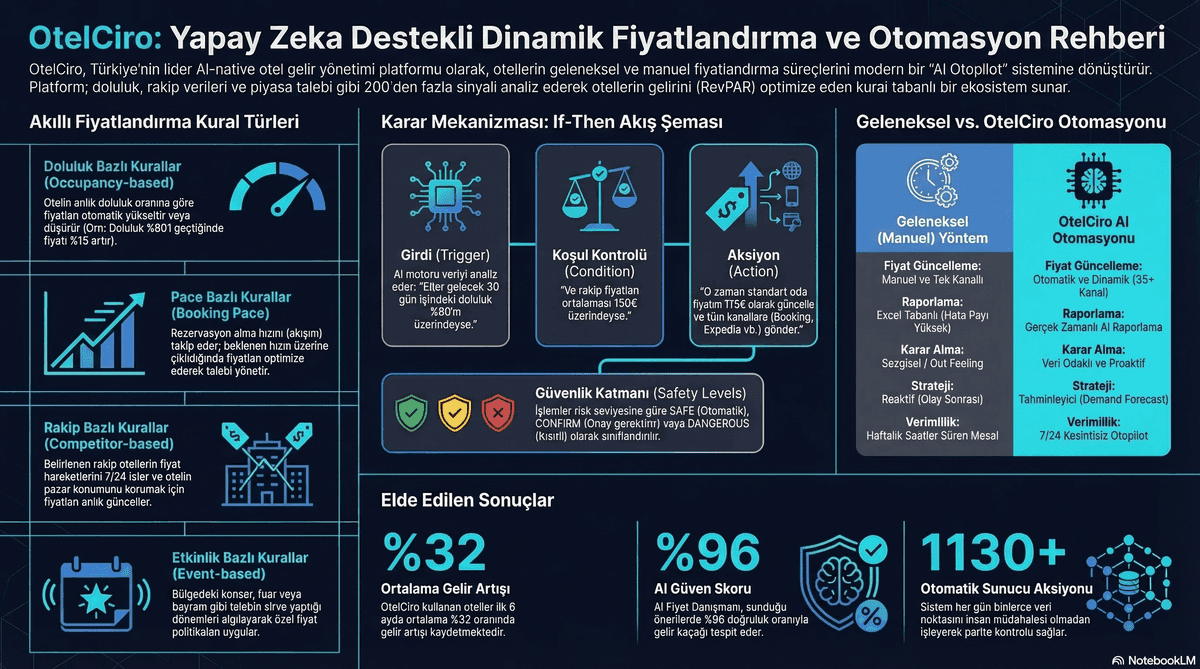
- Rule-based pricing automates adjustments: Implement predefined conditions based on occupancy, pace, competitor rates, events, and lead time to dynamically adjust prices.
- Implement best practices: Define rule hierarchies, set clear floor and ceiling prices, apply changes incrementally (5-8% bandwidth), and regularly test rules with historical data.
- Continuous optimization is key: Treat rules as living entities, updating them as market conditions evolve and continuously monitoring performance.
- Significant revenue growth: Hotels without a full-time revenue manager can increase revenue by 8-15% by implementing well-established rule-based pricing systems.
Manual Pricing Is No Longer Sufficient
Imagine a hotel manager needing to make pricing decisions daily for every room type, every channel, and every date. In a 100-room hotel, for 3 room types, 5 channels, and a 90-day look-ahead window, 1,350 price points must be managed daily. This number is too large to optimize manually.
According to a 2025 Skift Research report, 67% of hotels still performing manual price updates are underperforming their potential revenue. Automatic pricing rules (rule-based pricing) offer an approach that solves this problem by enabling automatic price adjustments based on predefined conditions.
In this guide, we will detail how to create effective pricing rules, explore the most common rule types, and discuss how to avoid automation pitfalls.
Embed this image on your site
<a href="https://otelciro.com/en/news/maximize-revenue-hotel-rule-based-pricing-2026-guide">
  <img src="https://cdn.sanity.io/images/1la98t0z/production/2d9c99599d308dc44740f17d18a63ef05a6a3127-1200x669.png" alt="Automatic pricing rules and rule-based pricing system" width="800" />
</a>
<p>Source: <a href="https://otelciro.com">OtelCiro</a> — AI Hotel Revenue Management</p>
Related reading: How Many Hours Does Your Hotel Operate in Vain Annually? The True Cost of an Empty Room
Related reading: Dynamic vs. Static Pricing: Maximize Your Profit with the Taylor Swift Effect
Types of Pricing Rules
1. Occupancy-Based Rules
This is the most fundamental and commonly used rule type. Prices automatically adjust when occupancy rates exceed or fall below certain thresholds.
| Occupancy Threshold | Price Action | Multiplier |
|---|---|---|
| %0-30 | Approach minimum price | ×0,85 |
| %31-50 | Keep below BAR | ×0,92 |
| %51-70 | Apply BAR | ×1,00 |
| %71-85 | Price above BAR | ×1,10 |
| %86-95 | Aggressive price increase | ×1,25 |
| %95+ | Maximum price | ×1,40 |
Important Note: Occupancy-based rules are not sufficient on their own. Dropping prices at 50% occupancy is a wrong decision if the remaining rooms will be booked by a high-value segment. Therefore, combine occupancy rules with other rule types.
2. Pace (Booking Velocity)-Based Rules
Pace analysis measures the rate at which bookings are coming in for a specific date. This data provides a powerful input for pricing rules.
- If pace is 20% above last year → Increase price by 8-12%
- If pace is equal to last year → Maintain price
- If pace is 20% below last year → Trigger a promotion or decrease price by 5-10%
3. Competitor Price-Based Rules
Automatic price adjustment rules can be created by monitoring the prices of hotels in your CompSet.
Example rules:
- If you are more than 15% below the competitor's average price → Increase price (you're undervaluing your property)
- If you are more than 15% above the competitor's average price → Check occupancy trends, adjust if necessary
- If a key competitor drops prices → Do not automatically follow, first evaluate occupancy data
4. Event and Date-Based Rules
Define predefined price multipliers for events, conferences, and holiday periods in your region.
- National holidays → ×1,30-1,50
- Local festivals → ×1,15-1,25
- Conference and exhibition periods → ×1,20-1,40
- Low season weeks → ×0,85-0,95
5. Lead Time-Based Rules
Price adjustment based on time remaining until arrival date:
- 90+ days prior: Early bird rate (×0,90)
- 30-89 days: Standard BAR
- 14-29 days: Adjust based on demand
- 7-13 days: Dynamic (occupancy + pace)
- 0-6 days: Last-minute strategy
Embed this image on your site
<a href="https://otelciro.com/en/news/maximize-revenue-hotel-rule-based-pricing-2026-guide">
  <img src="https://cdn.sanity.io/images/1la98t0z/production/38381e0dd477a4816db7ad9b1359befc08268365-1200x669.png" alt="Open pricing strategy" width="800" />
</a>
<p>Source: <a href="https://otelciro.com">OtelCiro</a> — AI Hotel Revenue Management</p>
Rule Creation Best Practices
Define Rule Hierarchy
Define which rule takes precedence when multiple rules are triggered simultaneously. For example, if an occupancy rule and a competitor rule conflict, giving priority to the occupancy rule is generally the correct approach — because your own demand is a more reliable signal than competitor pricing.
Set Ceiling and Floor Prices
Regardless of how aggressive a rule is, always set minimum and maximum price limits. These limits include:
- Floor price: Variable cost + minimum profit margin
- Ceiling price: Upper limit acceptable to market perception
Proceed in Small Steps
When a single rule is triggered, keep price changes within a 5-8% bandwidth. Large price jumps can cause issues in both algorithms and guest perception.
Test and Learn Cycle
Before implementing new rules, simulate them with historical data. How would revenue have been affected if the rule had been active during those periods?
Related reading: Dynamic Pricing and AI: The Complete Guide to Hotel Price Optimization with Artificial Intelligence
Related reading: 65% of Travelers Accept Dynamic Pricing: Transparency Builds Trust
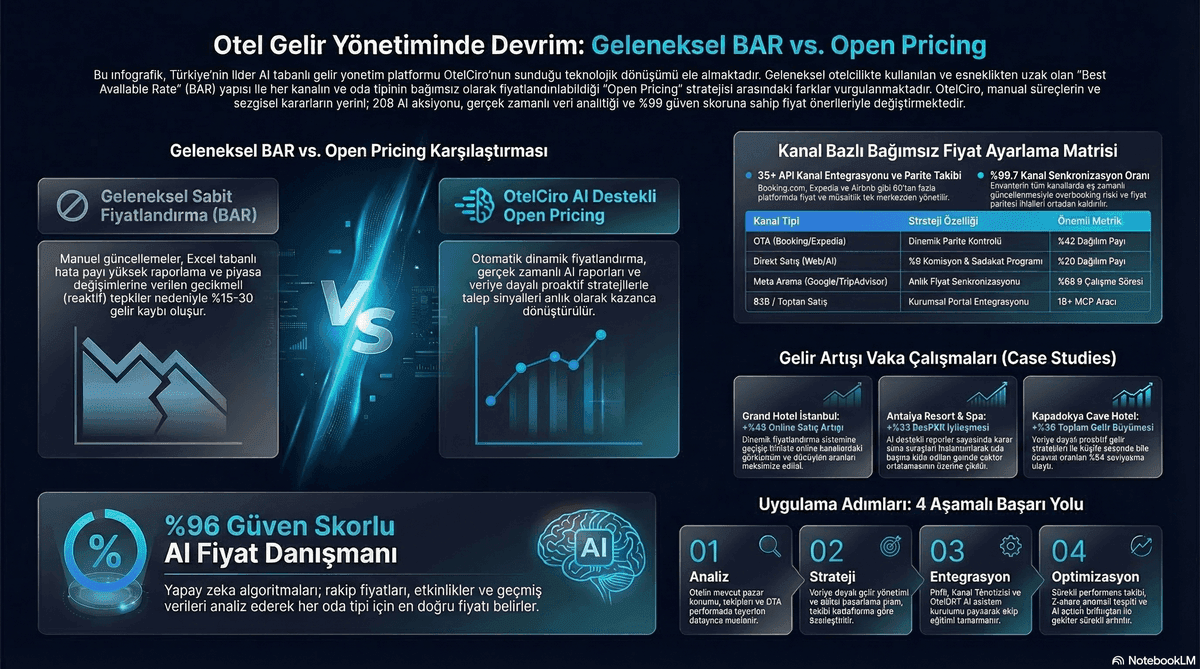
Manual vs. Automated: Comparison
| Criterion | Manual Pricing | Rule-Based Pricing | AI-Powered Pricing |
|---|---|---|---|
| Response Time | Hours-days | Minutes | Instant |
| Consistency | Low | High | Very high |
| Scalability | Limited | Good | Excellent |
| Contextual Understanding | High | Limited | High |
| Cost | Staff time | Moderate | Moderate-High |
| Error Risk | High | Moderate | Low |
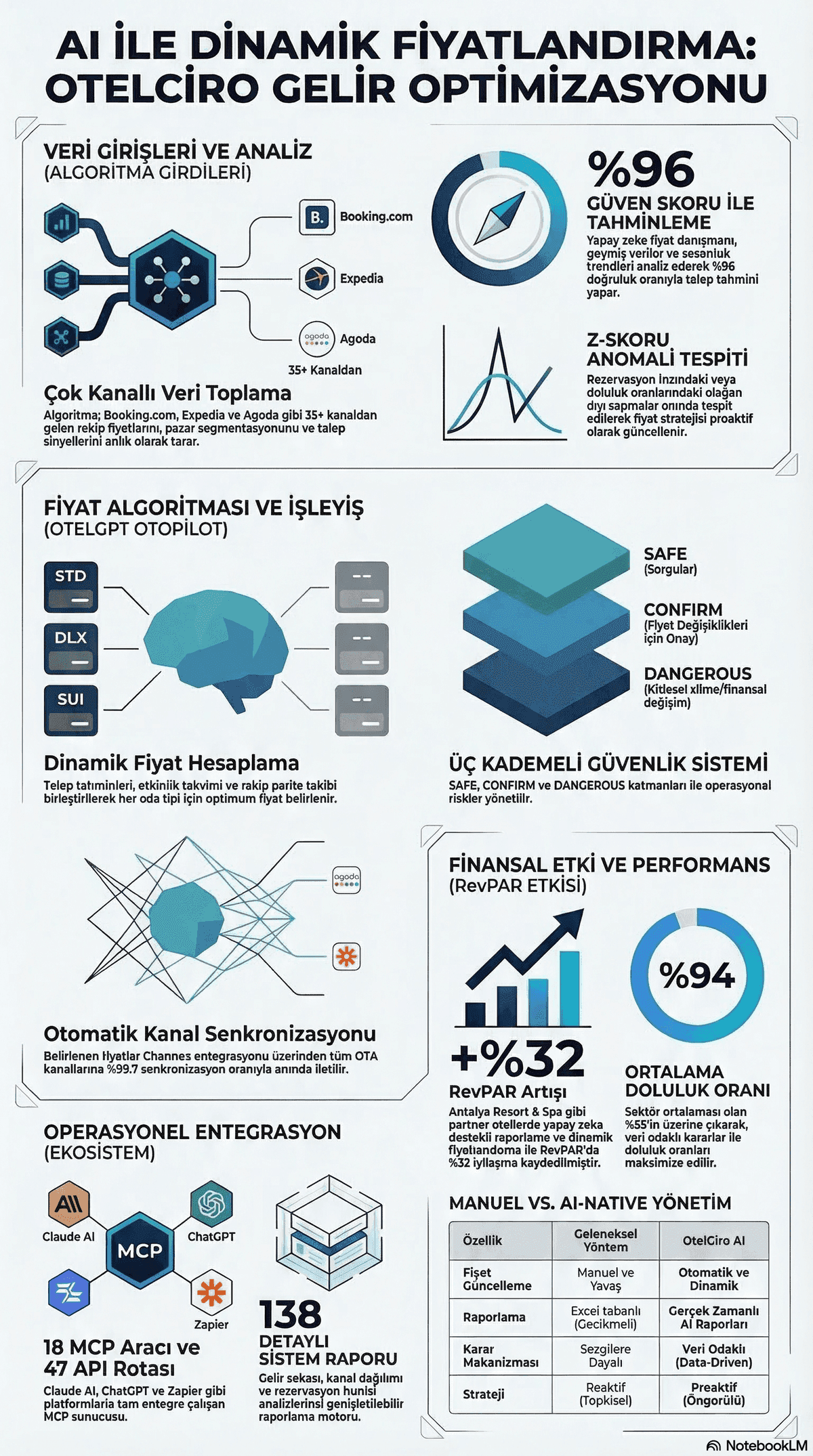
Rule-based pricing is an excellent bridge to fully AI-powered pricing. As your rules mature, you can combine them with AI-powered forecasting models to evolve into a more sophisticated system.
Embed this image on your site
<a href="https://otelciro.com/en/news/maximize-revenue-hotel-rule-based-pricing-2026-guide">
  <img src="https://cdn.sanity.io/images/1la98t0z/production/6a97229e7f35d7df9e4e8a2cd6f4cfebc97cdc5b-1200x2150.png" alt="AI-powered dynamic pricing process" width="800" />
</a>
<p>Source: <a href="https://otelciro.com">OtelCiro</a> — AI Hotel Revenue Management</p>
Automatic Pricing Rules with OtelCiro
The OtelCiro AI Engine enables you to manage occupancy, pace, competitor, and event-based pricing rules on a single platform. Define your rules, and let the system make automatic price adjustments 24/7. At an advanced level, allow AI to continuously optimize your rules through its own learning cycle.
Start price automation with OtelCiro AI Engine
Related reading: What is Dynamic Pricing? 5 Ways to Increase Your Hotel Revenue
Conclusion
Automatic pricing rules are a tool that democratizes revenue management. Even hotels without a full-time revenue manager can increase their revenue by 8-15% with well-established rules.
The important thing is not to set up the rules once and forget them. Rules should be treated like a living organism; they must be updated as market conditions change and their performance regularly monitored.
Discover how OtelCiro's AI Engine can automate this process.
![Hotel Ancillary Revenue: Monetizing Spa, F&B & Activities [2026 Guide]](https://cdn.sanity.io/images/1la98t0z/production/cfce3407a5ef8f70edd19853e8059317fca7b6a6-2752x1536.jpg?w=1920&q=50&auto=format&fit=max)
![FIFA 2026 World Cup: Hotel Dynamic Pricing Strategy [2026 Guide]](https://cdn.sanity.io/images/1la98t0z/production/7a76affe61333341ec47bb0c705011068a1afd24-2752x1536.jpg?w=1920&q=50&auto=format&fit=max)