
![Maximize Revenue: 7 Hotel Demand Forecasting Methods [2026 Guide]](https://cdn.sanity.io/images/1la98t0z/production/210396617c1796a0ed2c8cf19eeff94b06c1d625-1376x768.jpg?w=1920&q=65&auto=format&fit=max)
Key Takeaways
- Demand forecasting is critical: It underpins crucial decisions in pricing, inventory, promotions, and staffing, with accurate forecasts potentially increasing annual revenue by 10-20% and RevPAR by 2-3%.
- Beyond traditional methods: Post-COVID shifts and new demand sources necessitate moving beyond simple historical comparisons to more advanced forecasting techniques.
- Seven diverse methods: The article outlines historical data analysis, pace analysis, regression analysis, machine learning models, weather-based, event-based, and competitor-based forecasting.
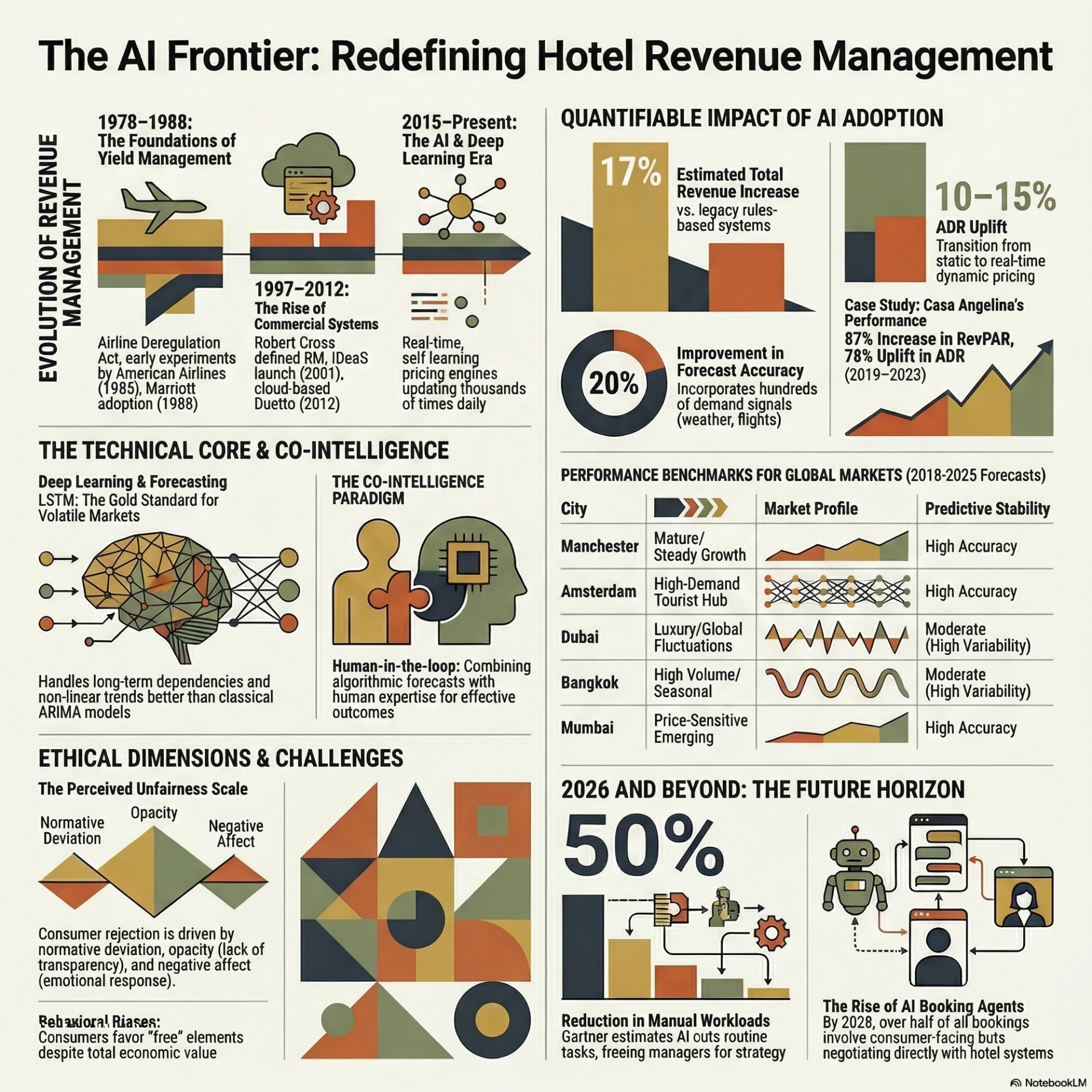
- AI's transformative power: Machine Learning models offer the highest accuracy by integrating vast datasets and external factors, providing continuous learning and precise predictions.
- Continuous improvement: Forecasts are living documents requiring regular updates, accuracy measurement (using MAPE), and adaptation across long-term, mid-term, short-term, and instant cycles to remain effective.
Seeing the Future: Why Demand Forecasting Is Critical?
Hotel demand forecasting is the brain of revenue management. Pricing, inventory control, promotional planning, and staff management — all these decisions are based on demand forecasting. An accurate hotel forecast can increase annual revenue by 10-20%, while inaccurate predictions lead to significant revenue losses.
According to research by the Cornell Hotel School, when demand forecast accuracy improves by 5%, RevPAR increases by 2-3%. This relationship demonstrates that forecast quality directly reflects financial results.
Traditional forecasting methods (e.g., last year's same period) are no longer sufficient on their own. Post-COVID shifts in travel patterns, new demand sources, and AI-powered demand forecasting tools have fundamentally transformed hotel prediction methods.

Embed this image on your site
<a href="https://otelciro.com/en/news/maximize-revenue-7-hotel-demand-forecasting-methods-2026-guide">
  <img src="https://cdn.sanity.io/images/1la98t0z/production/210396617c1796a0ed2c8cf19eeff94b06c1d625-1376x768.jpg" alt="Hotel demand forecasting methods and AI-powered forecast infographic" width="800" />
</a>
<p>Source: <a href="https://otelciro.com">OtelCiro</a> — AI Hotel Revenue Management</p>
Related reading: How Many Hours Does Your Hotel Operate Empty Annually? The True Cost of an Empty Room
Related reading: Dynamic vs. Static Pricing: Maximize Your Profits with the Taylor Swift Effect
7 Demand Forecasting Methods
1. Historical Data Analysis
The most fundamental method: predicting future demand by looking at the same period in previous years.
How it's done: Analyze daily occupancy, ADR, and revenue data from the last 3-5 years. Calculate year-over-year growth rates.
Strengths: Easy, fast, establishes a reliable baseline Weaknesses: Sensitive to extraordinary events (pandemic, economic crisis)
2. Pace (Booking Velocity) Analysis
Estimating final occupancy by tracking how quickly bookings are coming in for a specific date.
How it's done: Compare the booking pace for your target date against the same period last year.
| Metric | Last Year (30 days out) | This Year (30 days out) | Difference |
|---|---|---|---|
| Occupancy | 45% | 55% | +10% (strong pace) |
| ADR | 1,200 TRY | 1,350 TRY | +12.5% (demand increase) |
Strengths: Real-time, supports dynamic decisions Weaknesses: Doesn't capture last-minute demand shifts
3. Regression Analysis
Modeling the relationship between demand and independent variables (price, season, holidays, events) using statistical models.
Strengths: Accounts for multiple factors Weaknesses: Requires statistical knowledge, model maintenance is necessary
4. Machine Learning (ML) Models
AI and machine learning algorithms identify complex patterns in large datasets, generating predictions beyond human analysis.
Data utilized:
- Historical bookings and occupancy
- Competitor prices
- Weather forecasts
- Flight search volume
- Google Trends data
- Local event calendar
Strengths: Most accurate predictions, continuous learning Weaknesses: Data quality is critical, high initial investment
5. Weather-Based Forecasting
Especially for leisure hotels, weather is a strong determinant of demand.
How to use:
- Monitor 7-14 day weather forecasts
- Good weather forecast = opportunity for price increase
- Bad weather forecast = consider last-minute promotions
6. Event-Based Forecasting
Account for the demand impact of local and national events:
| Event Type | Demand Impact | Advance Forecast |
|---|---|---|
| Major convention | +30-50% | 6-12 months |
| Sports event | +20-40% | 3-6 months |
| Festival | +15-30% | 2-4 months |
| Holiday (religious/national) | +40-80% | Fixed date |
| School holiday | +20-35% | Fixed date |
7. Competitor-Based Forecasting
Your competitors' pricing movements and occupancy levels are strong signals reflecting market demand.
What to monitor:
- Competitor price increases (signal of rising demand)
- Competitor launching promotions (signal of falling demand)
- New competitor entry (supply increase, pricing pressure)
- Competitor closure (opportunity for demand increase)
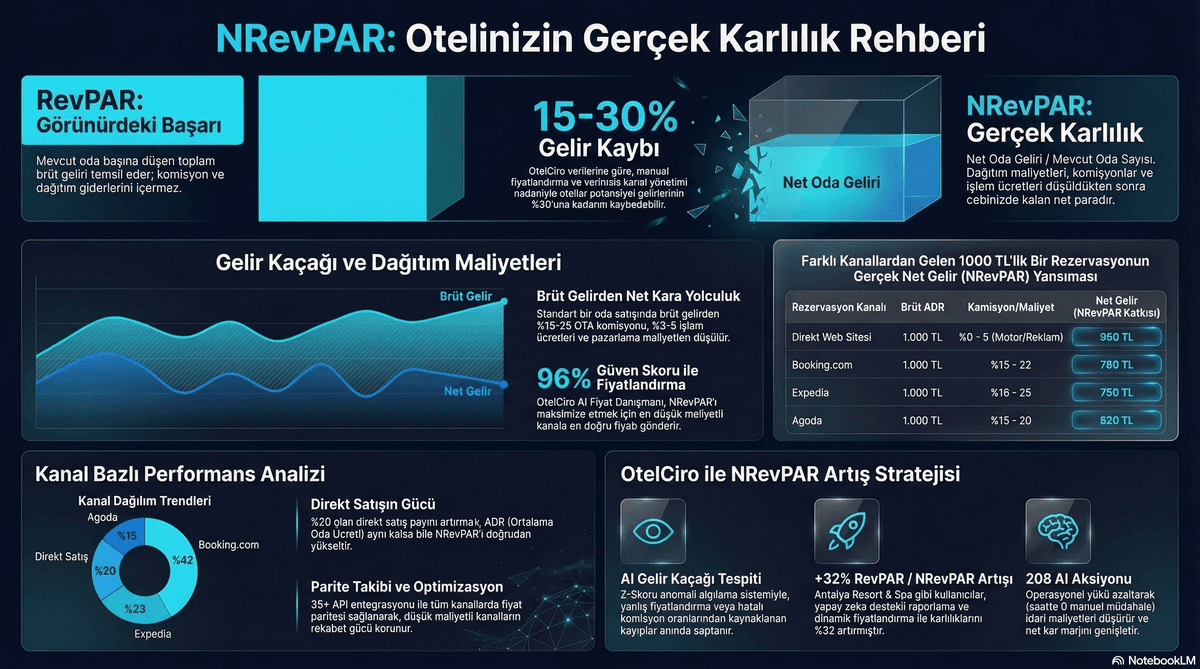
Embed this image on your site
<a href="https://otelciro.com/en/news/maximize-revenue-7-hotel-demand-forecasting-methods-2026-guide">
  <img src="https://cdn.sanity.io/images/1la98t0z/production/bbd5fe1bd7958fd95861b71905cdb9701e352e80-1200x669.png" alt="NRevPAR (Net Revenue) calculation method" width="800" />
</a>
<p>Source: <a href="https://otelciro.com">OtelCiro</a> — AI Hotel Revenue Management</p>
Measuring Forecast Accuracy
MAPE (Mean Absolute Percentage Error)
The most commonly used metric to measure forecast accuracy:
MAPE = |Actual - Forecast| / Actual × 100
| MAPE | Assessment |
|---|---|
| <5% | Excellent |
| 5-10% | Very good |
| 10-15% | Good |
| 15-20% | Acceptable |
| >20% | Improvement needed |
Forecast Cycle
- Long-term forecast (12 months): Annual budget and strategy
- Mid-term forecast (90 days): Tactical pricing planning
- Short-term forecast (30 days): Daily price adjustments
- Instant forecast (7 days): Last-minute decisions
The forecast should be revised and its accuracy measured in each cycle.
Related reading: Dynamic Pricing and AI: The Complete Guide to Hotel Price Optimization with Artificial Intelligence
Related reading: 65% of Travelers Accept Dynamic Pricing: Transparency Builds Trust
Forecasting Errors and What to Avoid
- Relying on a single source: Relying solely on historical data is insufficient
- Not updating: A forecast is a living document, not a one-time exercise
- Excessive optimism: Be realistic, don't plan for only the best-case scenario
- Ignoring external factors: Economy, politics, health crises
- Not segmenting: Forecast based on segments rather than overall occupancy
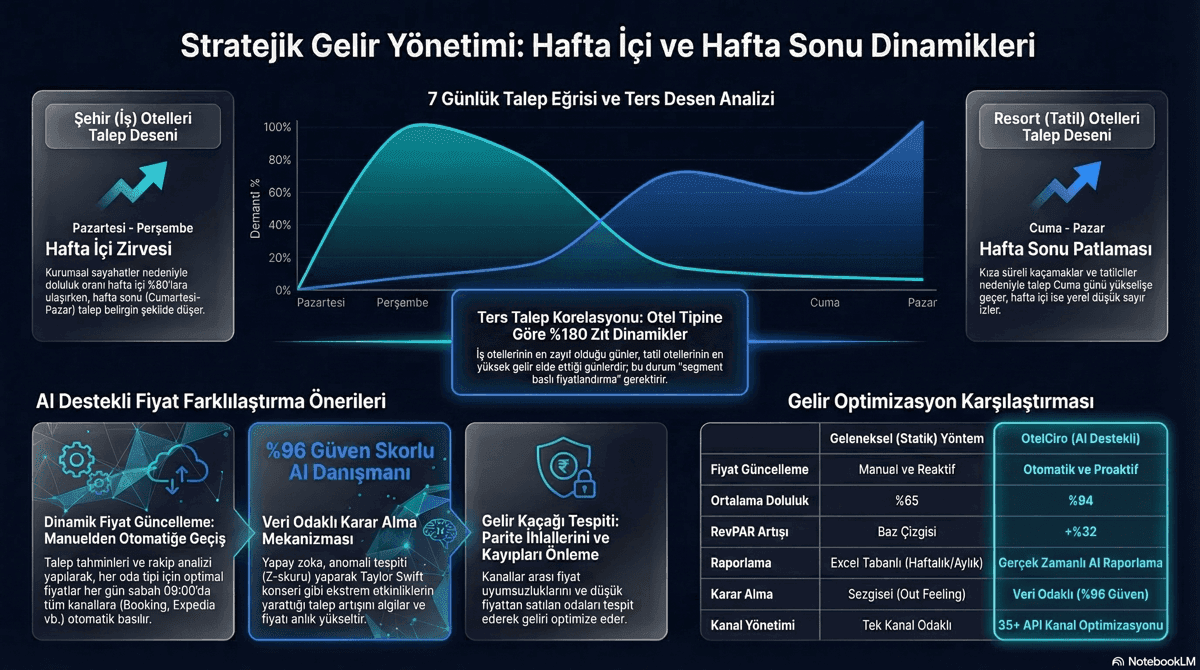
Embed this image on your site
<a href="https://otelciro.com/en/news/maximize-revenue-7-hotel-demand-forecasting-methods-2026-guide">
  <img src="https://cdn.sanity.io/images/1la98t0z/production/c0edb393f0dd45ca1363f938dbc43e2d65427273-1200x670.png" alt="TRevPAR total revenue management calculation" width="800" />
</a>
<p>Source: <a href="https://otelciro.com">OtelCiro</a> — AI Hotel Revenue Management</p>
AI-Powered Forecasting with OtelCiro
OtelCiro's AI engine uses a hybrid forecasting model that combines all 7 of the methods above. It processes historical data, pace analysis, competitor prices, weather, and event calendars in real time to generate a demand forecast for each day.
- 90%+ prediction accuracy: Hybrid AI model
- 365-day forecast: Daily updated predictions
- Segment-based: Separate demand forecasts for each segment
- Automated price adjustment: Price recommendations based on forecasts
Explore OtelCiro AI Engine Details
Related topics: Hotel Pace Analysis and Seasonal Pricing.
Related reading: What is Dynamic Pricing? 5 Ways to Increase Your Hotel Revenue
Conclusion
Demand forecasting is the heart of hotel revenue management. Utilize the spectrum of methods, from historical data to AI, to generate the most accurate predictions. Regularly update your forecast, measure its accuracy, and base your decisions on data. You cannot see the future, but you can make your best prediction.
Automate your demand forecasts and determine the right price for each day with OtelCiro's AI pricing engine.
![Hotel Ancillary Revenue: Monetizing Spa, F&B & Activities [2026 Guide]](https://cdn.sanity.io/images/1la98t0z/production/cfce3407a5ef8f70edd19853e8059317fca7b6a6-2752x1536.jpg?w=1920&q=50&auto=format&fit=max)
![FIFA 2026 World Cup: Hotel Dynamic Pricing Strategy [2026 Guide]](https://cdn.sanity.io/images/1la98t0z/production/7a76affe61333341ec47bb0c705011068a1afd24-2752x1536.jpg?w=1920&q=50&auto=format&fit=max)