
Key Takeaways
- Rate parity, especially wide parity, remains a contentious issue in the hotel industry; EU regulations increasingly favor narrow or non-parity models.
- Parity violations lead to significant revenue losses (an average of 850,000-1,500,000 TL annually per hotel) due to operational errors, OTA opaque discounts, and wholesale leakage.
- Implement a robust rate parity monitoring system, including automated rate shopping, alert systems, and wholesale channel tracking, aiming for 95%+ compliance.
- Leverage legal differentiation strategies such as member-exclusive rates, value-adds (e.g., free breakfast), and channel-specific room types or packages to gain a competitive edge.
- Prioritize increasing direct channel share through price guarantee programs, remarketing campaigns, and mobile app advantages, potentially saving 1.2-2.5 million TL annually on commissions.
Rate Parity: The Hotel Industry's Most Debated Topic
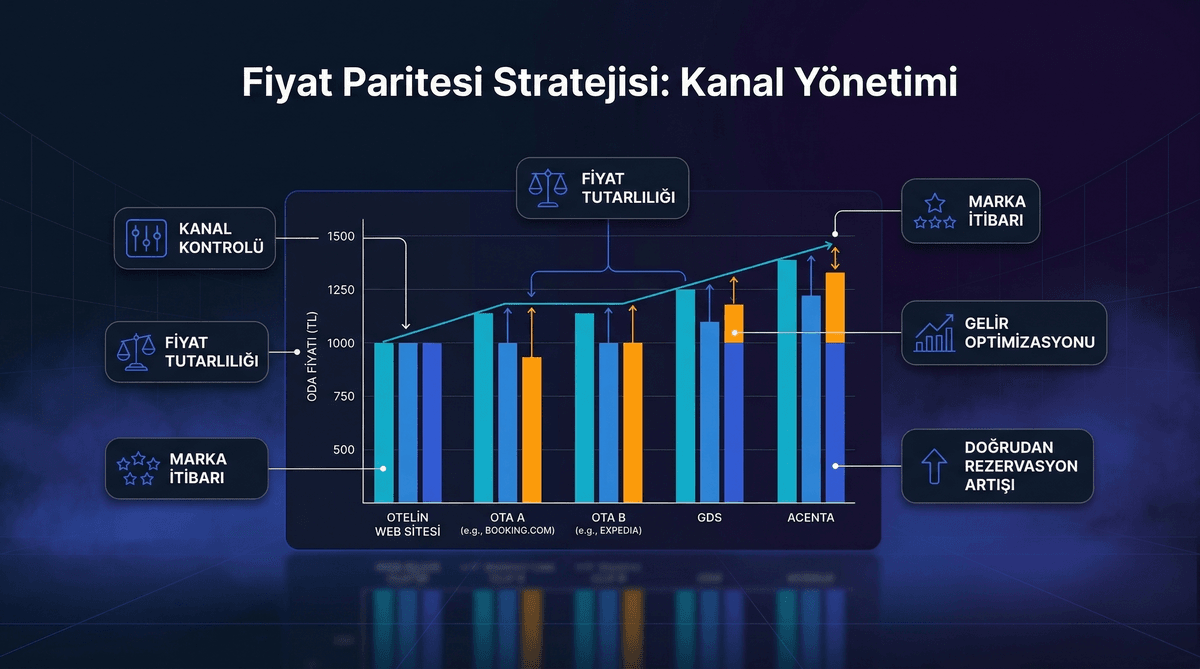
Rate parity refers to an hotel being sold at the same or similar price across all its distribution channels. This concept has been made mandatory by OTAs' contractual terms – and it is a major point of tension between hoteliers and OTAs.
As of 2026, European Union competition regulations have issued decisions favoring narrow parity, with wide parity requirements lifted in many countries. The situation in Turkey, however, remains complex – OTA contracts typically include wide parity clauses, but there are areas of flexibility in practice.
Studies show that rate parity violations lead to an average 850,000-1,500,000 TL revenue loss per hotel per year. This loss stems from OTA penalties, erosion of brand reliability, and guest behavior losing price trust.
Related reading: Explore OtelCiro's sales and channel management solutions
Types of Rate Parity and the Legal Framework
To correctly understand the concept of rate parity, it's essential to know its types:
Wide parity: The requirement for a hotel to offer the same price across all online channels (OTA, own website, meta-search, GDS). This is the most restrictive form and is prohibited in many European countries.
Narrow parity: The requirement for a hotel to offer equal prices with OTAs – but it can offer lower prices on its own website. This model is applied in countries like France, Italy, Austria, and Belgium.
Non-parity model: The freedom for a hotel to offer different prices across all channels. This has been applied in Germany since 2013.
Current situation in Turkey: There is no official regulation. OTA contracts typically demand wide parity, but the Competition Authority is known to have initiated investigations into the hotel industry sector. Hotels are advised to evaluate this matter with their legal advisors.
Sources of Parity Violations
Price inconsistencies usually stem from operational errors, not intentional acts:
Channel Manager synchronization delays: When prices are updated, not all channels are updated simultaneously. Even if an old price remains on one channel for just 30 minutes, guests will notice the difference. A scan of Turkish hotels found that at any given moment, 34% of hotels had price inconsistencies on at least one channel.
OTA opaque channel discounts: Booking.com's "Genius" program and Expedia's "Member Deals" features automatically apply discounts. These discounts are typically in the 10-20% range and disrupt the hotel's parity strategy.
Wholesale channel leakage (rate leakage): Contracted rates given to tour operators leak through B2B channels to B2C platforms. When a hotel provides a 600 TL contract price, this price can appear as 650-700 TL on flash sale sites via Bedbanks – significantly below the 900 TL on the hotel's website.
Meta-search price discrepancies: Prices displayed on Google Hotel Ads, Trivago, and TripAdvisor can be inconsistent as they are pulled from different channels.
Establishing a Rate Parity Monitoring System
A systematic monitoring mechanism is essential to maintain price consistency:
Automated rate shopping: Use tools that scan prices across all channels at least 2-3 times a day. Tools like OTA Insight, Rate Gain, and Fornova instantly report inconsistencies. OtelCiro's sales module also provides channel-based price tracking.
Alert system: Automatic notifications should be sent when a price difference exceeds a certain threshold (e.g., 5%). The notification should include the channel, the price difference, and the estimated revenue impact.
Wholesale channel tracking: Check if B2B prices are leaking to B2C. Regularly scan sales made through bedbanks.
Weekly parity report: Create a weekly analysis that consolidates all channel prices into a single report. Aim to maintain your parity violation rate at a 95%+ compliance level.
Channel-Specific Pricing Strategy
Legally applicable price differentiation strategies within the framework of rate parity rules:
Member-exclusive rates: Offer a 5-10% discounted rate to registered members on your own website. This is a practice permitted in most OTA contracts. The message "Join as a member, guarantee the best price" is a strong direct channel strategy.
Value-add differentiation: For the same room rate, offer breakfast included on the direct channel and excluded on the OTA. Or add extras on the direct channel such as free parking, spa discounts, late checkout. The price is the same – but the perceived value is higher.
Channel-specific room type/rate: Offer certain room types or rate plans exclusively on the direct channel. For example, a "web exclusive" room category or a "minimum 3-night stay" rate might only be available on your own website.
Package strategy: Offering room + experience packages (e.g., accommodation + city tour, accommodation + romantic dinner) exclusively on the direct channel, not on OTAs, makes price comparison more difficult.
Increasing Direct Channel Share
The ultimate goal of a rate parity strategy is to increase direct channel share, thereby reducing OTA dependency:
Price guarantee program: "Best price guarantee – if you find a lower price, we'll match it and give an additional 5% discount." This program eliminates guests' need to compare.
Remarketing campaigns: Direct users who researched prices on OTAs but haven't booked yet to your direct site using Google and Meta ads. Remarketing can increase direct channel conversion by 35%.
Mobile app advantage: Offer an extra 3-5% discount or instant points for reservations made through the hotel's mobile app.
Hotels in Turkey that increase their direct channel share from 25% to 40% save 1.2-2.5 million TL annually from OTA commissions (based on a 200-room hotel).
Future Trends and Preparation
Industry trends regarding rate parity are shaping up as follows:
Regulatory pressure is increasing: The Competition Authority in Turkey is also expected to examine OTA parity requirements. Hotels that are prepared will gain an advantage when this regulation comes into effect.
AI-powered channel optimization: Artificial intelligence can determine dynamic pricing strategies for each channel within parity rules, maximizing total revenue.
Metasearch gaining importance: Metasearch platforms like Google Hotel Ads and Trivago make price comparison accessible to everyone. Making your direct channel advantage visible on these platforms is critical.
Managing price consistency is not just a matter of compliance, but a strategic revenue management tool. With the right parity strategy, you can both maintain your OTA relationships and increase overall profitability by growing your direct channel share.
![Hotel Ancillary Revenue: Monetizing Spa, F&B & Activities [2026 Guide]](https://cdn.sanity.io/images/1la98t0z/production/cfce3407a5ef8f70edd19853e8059317fca7b6a6-2752x1536.jpg?w=1920&q=50&auto=format&fit=max)
![FIFA 2026 World Cup: Hotel Dynamic Pricing Strategy [2026 Guide]](https://cdn.sanity.io/images/1la98t0z/production/7a76affe61333341ec47bb0c705011068a1afd24-2752x1536.jpg?w=1920&q=50&auto=format&fit=max)