
![Last-Minute Hotel Pricing: 5 Mistakes & Revenue Boost [2026 Guide]](https://cdn.sanity.io/images/1la98t0z/production/2ecc0662684f5bb1bfe89139fe2cd527a820ba16-1200x669.png?w=1920&q=65&auto=format&fit=max)
Key Takeaways
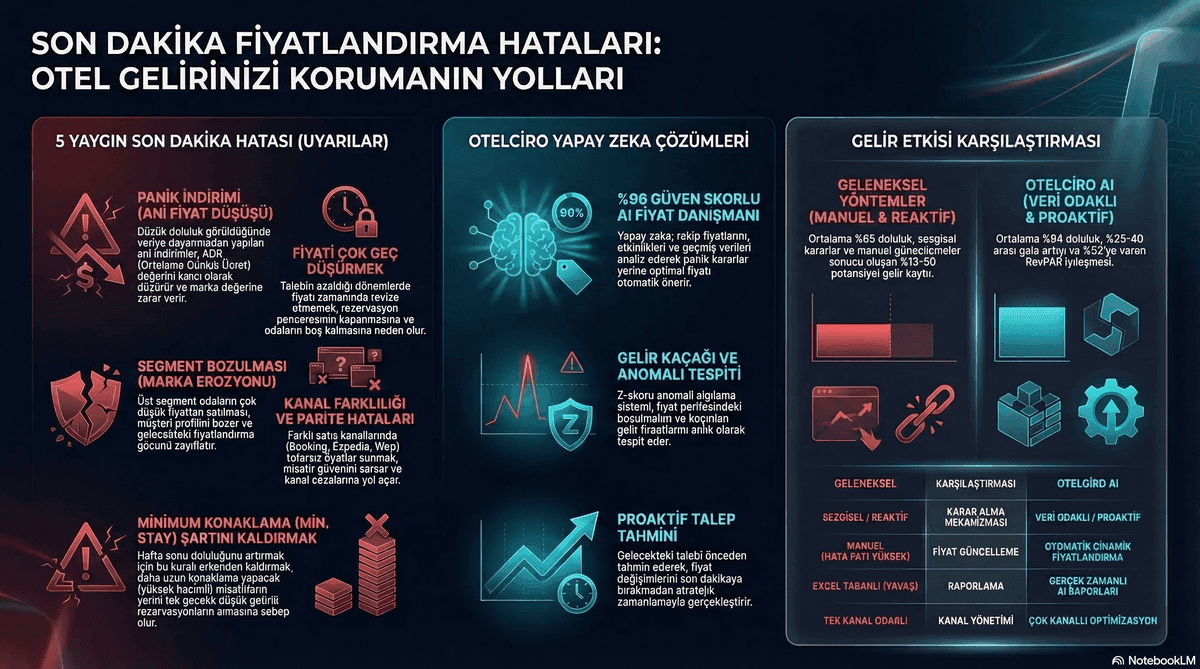
- Avoid Panic Discounts: Last-minute price drops, especially 30-50%, often lead to long-term brand value erosion, algorithmic penalties, and rate leakage, costing hotels 60% of annual revenue according to a 2025 Cornell study.
- Intervene Early: Effective revenue management begins well before the arrival date. Utilize pace analysis to identify and address booking shortfalls 30+ days in advance for higher impact.
- Protect Segment Structure: Prevent last-minute discounts from disrupting your existing corporate agreements or high-value segments. Use differentiated room types, opaque channels, or minimum stay restrictions.
- Implement Channel-Specific Strategies: Avoid applying the same discount across all channels. Prioritize aggressive offers on direct channels with added value, limited discounts on OTAs, and use opaque channels for deep discounts.
- Optimize Length of Stay (LOS): Don't completely remove minimum stay restrictions to increase occupancy. Strategically adjust LOS to capture longer, higher-revenue bookings, especially before high-demand periods.
Last-Minute Pricing Panic: A Familiar Scenario
It's 4:00 PM, and you still have 15 empty rooms for tomorrow. The instinctive reaction: "Let's drop prices immediately." This response is often the starting point for one of the most common revenue management mistakes in the hotel industry.
According to a 2025 study by Cornell Hospitality Research, 60% of last-minute price reductions cause hoteliers to lose revenue on an annual basis. The paradox is this: a discount made to fill an empty room ultimately creates more empty rooms in the long run.
In this article, we detail the 5 critical mistakes hotels make in last-minute pricing and how to avoid them.
Embed this image on your site
<a href="https://otelciro.com/en/news/last-minute-hotel-pricing-5-mistakes-revenue-boost-2026-guide">
  <img src="https://cdn.sanity.io/images/1la98t0z/production/2ecc0662684f5bb1bfe89139fe2cd527a820ba16-1200x669.png" alt="Last-minute pricing mistakes and correct approaches" width="800" />
</a>
<p>Source: <a href="https://otelciro.com">OtelCiro</a> — AI Hotel Revenue Management</p>
Related reading: How Many Hours a Year Does Your Hotel Run Empty? The True Cost of an Empty Room
Related reading: Dynamic vs. Static Pricing: Maximize Your Profit with the Taylor Swift Effect
Mistake 1: Panic Discount (Bottom Price Syndrome)
The most common mistake is dropping prices by 30-50% at the last minute. While this approach increases occupancy in the short term, it creates three serious long-term damages:
Brand value erosion: Guests begin to perceive the low price as your hotel's "real price." Research shows that once a hotel offers a bottom price, the willingness to pay the full price for the same period drops by 22%.
Algorithmic disadvantage: Booking.com and Expedia algorithms view frequent price fluctuations as negative signals. This leads to a loss of organic ranking in the medium term.
Rate leakage: Low prices given to wholesalers or OTAs appear on metasearch platforms, undercutting your direct channel price.
Correct Approach
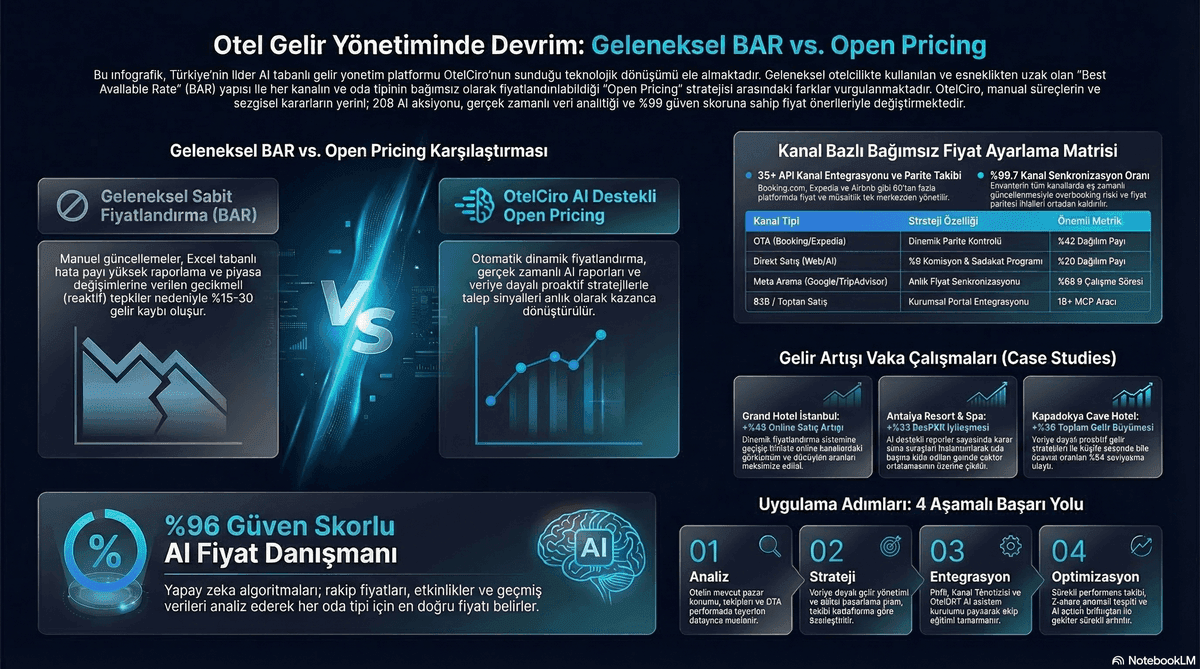
Instead of a 40% last-minute discount, add value with a 10-15% discount: offer complimentary breakfast, late check-out, or parking. While perceived value increases, net revenue loss remains minimal.
Embed this image on your site
<a href="https://otelciro.com/en/news/last-minute-hotel-pricing-5-mistakes-revenue-boost-2026-guide">
  <img src="https://cdn.sanity.io/images/1la98t0z/production/38381e0dd477a4816db7ad9b1359befc08268365-1200x669.png" alt="Open pricing strategy" width="800" />
</a>
<p>Source: <a href="https://otelciro.com">OtelCiro</a> — AI Hotel Revenue Management</p>
Mistake 2: Intervening Too Late
Many hoteliers wait until the "last minute" to adjust prices. However, effective price management begins much earlier than the arrival date.
| Intervention Timing | Impact Strength | Recommended Action |
|---|---|---|
| 30+ days prior | High | Pace analysis, strategic price adjustment |
| 14-30 days | Medium-High | Channel-based promotion |
| 7-14 days | Medium | Targeted campaigns |
| 3-7 days | Low-Medium | Limited discount + value add |
| 0-3 days | Low | Opaque channels (Hotwire, etc.) |
By performing pace analysis, detect problems early. If booking velocity is lower than last year, intervening 30 days in advance is much more effective.
Related reading: Dynamic Pricing and AI: The Complete Guide to Hotel Price Optimization with Artificial Intelligence
Related reading: 65% of Travelers Accept Dynamic Pricing: Transparency Builds Trust
Mistake 3: Disrupting the Segment Structure
A last-minute discount disrupts your existing segment structure. A business traveler staying at €120 with a corporate agreement, seeing the same hotel sold for €80, will use that price as a reference in contract renewal negotiations.
To prevent this:
- Direct last-minute prices to different room types: Sell standard rooms at a discount, but do not touch superior room prices.
- Use opaque channels: The hotel name is hidden on platforms like Hotwire and Priceline, reducing the risk of segment disruption.
- Add a minimum stay restriction: A 2-night minimum stay filters out the business traveler segment.
- Increase package value instead of price: Compete by offering more services at the same price.
Embed this image on your site
<a href="https://otelciro.com/en/news/last-minute-hotel-pricing-5-mistakes-revenue-boost-2026-guide">
  <img src="https://cdn.sanity.io/images/1la98t0z/production/6a97229e7f35d7df9e4e8a2cd6f4cfebc97cdc5b-1200x2150.png" alt="AI-powered dynamic pricing process" width="800" />
</a>
<p>Source: <a href="https://otelciro.com">OtelCiro</a> — AI Hotel Revenue Management</p>
Mistake 4: Same Discount Across All Channels
Applying the same last-minute discount simultaneously on Booking.com, Expedia, and direct channels is harmful in two ways:
Firstly, when a discount is applied on OTA channels, the commission-based cost decreases, but the commission rate remains constant. For example, 18% commission on €100 is €18, while 18% commission on €70 is €12.6 – your net revenue drops dramatically along with the difference.
Secondly, offering the same price on the direct channel strengthens guests' habit of price comparison.
Channel-Based Last-Minute Strategy
- Direct channel: Most aggressive discount + extra benefits (always do this)
- OTAs: Limited discount or mobile-only price
- GDS: Do not touch corporate rates
- Opaque: Direct the deepest discounts here
Mistake 5: Completely Removing Minimum Stay Restrictions
Removing minimum stay restrictions to increase occupancy can be tempting. However, allowing 1-night bookings, especially on days immediately preceding high-demand periods, prevents longer stays with high revenue potential.
For example: You expect high demand from Friday to Sunday. If you remove the minimum stay on Thursday and get a 1-night Thursday booking, you might miss out on a potential 3-night Thursday-Sunday booking.
Correct approach: Use length of stay optimization to keep minimum stay rules flexible but not completely remove them. Reduce the minimum stay to 1 on low-demand days, but maintain it on days before high-demand periods.
Last-Minute Pricing Checklist
When you feel the pressure of empty rooms, follow this checklist:
- I checked pace analysis — is there really a problem?
- I checked competitor prices — is the market low overall?
- I evaluated segment impact — which segment will be affected?
- I determined a channel strategy — the same discount will not apply to every channel.
- I considered value-add options — can I increase value instead of decreasing price?
- I calculated the minimum stay impact — should I remove the restriction?
Related reading: What is Dynamic Pricing? 5 Ways to Increase Your Hotel Revenue
Smart Last-Minute Management with OtelCiro
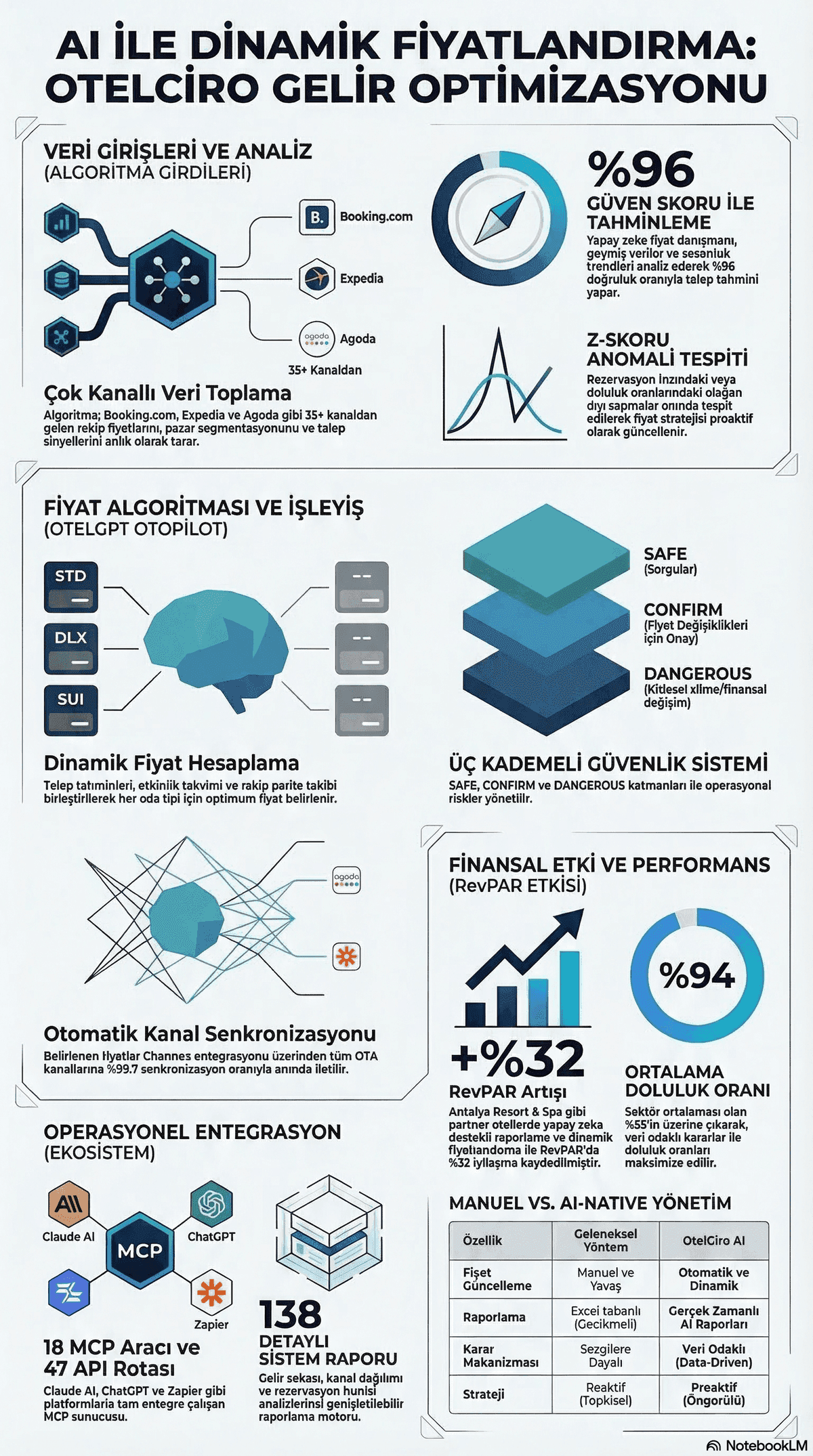
OtelCiro's AI Engine module detects last-minute risks in advance with demand forecasting and pace analysis. Instead of panic discounts, it offers channel-optimized price recommendations and protects your segment structure.
Optimize last-minute pricing with OtelCiro AI Engine
Conclusion
Last-minute pricing is one of the most stressful topics in hospitality. However, with the right approach, it is possible to manage empty room pressure without turning it into revenue loss. The basic rule is simple: don't panic, plan.
Establish early warning systems, develop channel-based strategies, and evaluate every discount decision alongside its long-term impact.
Discover how you can automate this process with OtelCiro's AI Engine.
![Hotel Ancillary Revenue: Monetizing Spa, F&B & Activities [2026 Guide]](https://cdn.sanity.io/images/1la98t0z/production/cfce3407a5ef8f70edd19853e8059317fca7b6a6-2752x1536.jpg?w=1920&q=50&auto=format&fit=max)
![FIFA 2026 World Cup: Hotel Dynamic Pricing Strategy [2026 Guide]](https://cdn.sanity.io/images/1la98t0z/production/7a76affe61333341ec47bb0c705011068a1afd24-2752x1536.jpg?w=1920&q=50&auto=format&fit=max)