
![Hotel Revenue Management: Strategies & Tech [2026 Guide]](https://cdn.sanity.io/images/1la98t0z/production/0a1fa2df5f42c9541a20e1a6fe42805f6e5e4ba4-1376x768.jpg?w=1920&q=65&auto=format&fit=max)
Key Takeaways
- Holistic Approach: Hotel revenue management is the discipline of selling the right room to the right guest, at the right time, price, and through the right channel, maximizing revenue potential from limited inventory.
- Essential Metrics: Key performance indicators like RevPAR, ADR, Occupancy Rate, GOPPAR, and TRevPAR are crucial for measuring success and informing strategic decisions.
- Core Strategies: Effective revenue management involves demand forecasting, customer segmentation, dynamic pricing, channel optimization, length-of-stay pricing, upselling/cross-selling, and controlled overbooking.
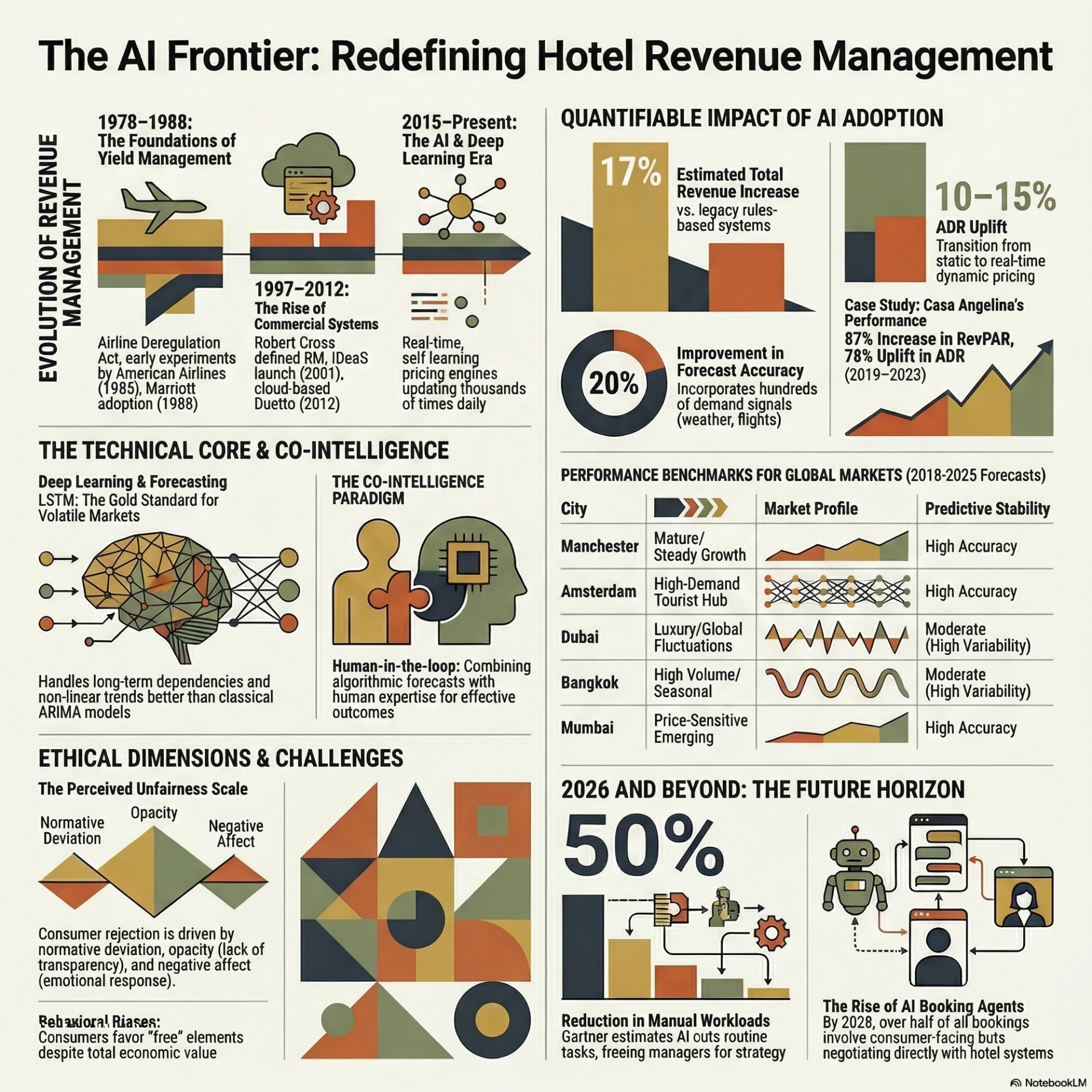
- AI-Driven Transformation: AI-native revenue management systems provide superior accuracy, real-time decision-making, and significant RevPAR increases (18-35%) compared to traditional rule-based systems.
- Continuous Optimization: Success requires ongoing analysis, competitor benchmarking, technology adoption (PMS, channel manager, RMS), and a commitment to continuous improvement.
What is Hotel Revenue Management?
Hotel revenue management is the discipline of selling the right room to the right customer, at the right time, at the right price, and through the right channel. Born in the airline industry in the 1980s, it has become one of the most critical competitive advantages in hospitality today.
Simply defined: revenue management is the science of maximizing the revenue potential of a limited inventory (number of rooms). However, today this definition has taken on a much broader meaning. Modern hotel revenue management is a holistic strategy encompassing pricing, distribution channel management, demand forecasting, customer segmentation, and competitor analysis.
Why Is It So Important?
The hotel sector has a unique economic structure:
- Perishable inventory: An unsold room loses its value entirely at midnight. A manufacturer can sell its stock the next day; a hotelier does not have this luxury.
- High fixed costs: Whether a room is occupied or empty, expenses such as staff salaries, electricity, and insurance continue.
- Demand fluctuation: Huge differences occur between weekdays-weekends, peak season-off-season, and event days-normal days.
- Price transparency: Thanks to OTAs and meta-search engines, prices can be compared in seconds.
When these four factors combine, it becomes almost impossible to maintain profitable operations without a systematic revenue management approach.
Related reading: Dynamic Pricing and AI: The Complete Guide to Hotel Price Optimization with Artificial Intelligence
Related reading: Hotel Revenue Metrics and KPI Guide: A Complete Guide from RevPAR to GOPPAR
Key Metrics of Hotel Revenue Management
Standard KPIs are used to measure success in revenue management. Developing a strategy without knowing these metrics is equivalent to embarking on a journey without a compass.
1. RevPAR (Revenue Per Available Room)
RevPAR is the most fundamental metric in hotel revenue management. It indicates revenue per available room and is calculated using the following formula:
RevPAR = Total Room Revenue / Total Number of Available Rooms
or alternatively:
RevPAR = ADR × Occupancy Rate
For example, if a 100-room hotel has an average daily rate of 2,000 TL and an occupancy rate of 70%:
RevPAR = 2,000 × 0.70 = 1,400 TL
RevPAR's strength lies in combining both price and occupancy performance into a single figure. It balances situations of high price but low occupancy, or vice-versa, revealing true performance.
2. ADR (Average Daily Rate)
The average daily rate shows the average revenue for sold rooms:
ADR = Total Room Revenue / Number of Rooms Sold
ADR directly reflects the effectiveness of your pricing strategy. In 2025, the average ADR for city hotels in Turkey is approximately 3,200 TL, while for resort hotels, it is around 5,800 TL.
3. Occupancy Rate
Occupancy Rate = Number of Rooms Sold / Total Number of Available Rooms × 100
The occupancy rate alone can be misleading. 100% occupancy, if achieved with very low prices, could even be detrimental to revenue. The important thing is to find the optimum balance between occupancy and price.
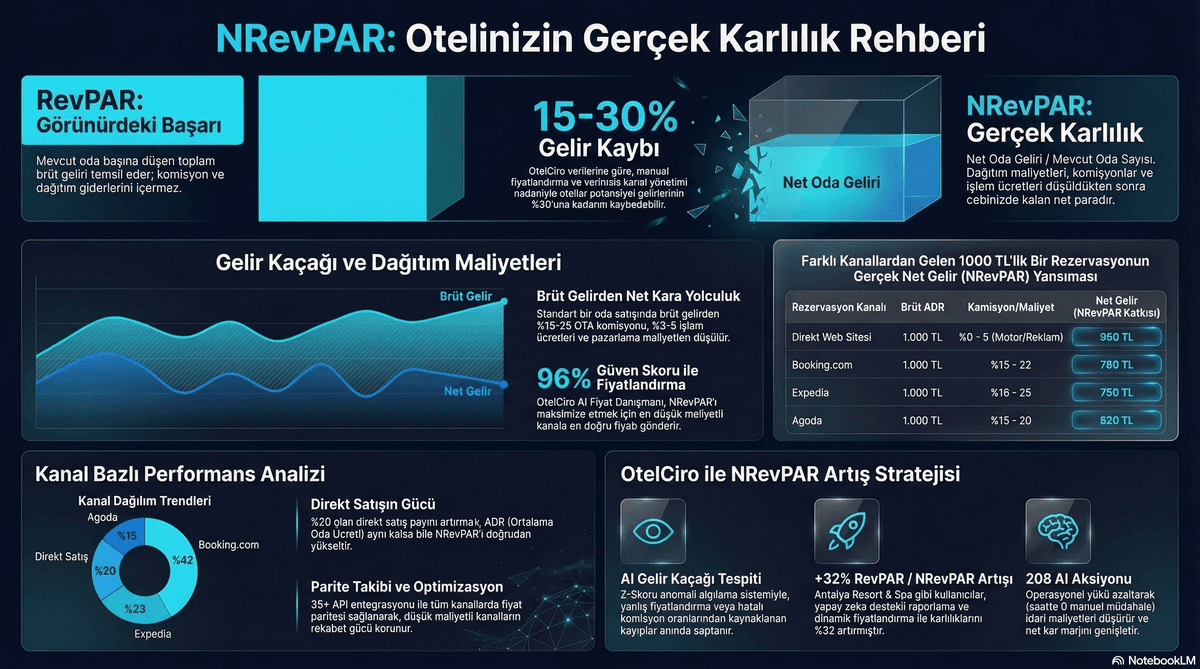
4. GOPPAR (Gross Operating Profit Per Available Room)
GOPPAR goes a step beyond RevPAR by also accounting for operational costs:
GOPPAR = Gross Operating Profit / Total Number of Available Rooms
This metric shows true profitability. High RevPAR generated from high-commission channels might mean low GOPPAR.
5. TRevPAR (Total Revenue Per Available Room)
This includes not only room revenue but all revenue sources such as restaurants, spas, and meeting rooms. In a total revenue management approach, this metric holds central importance.
Embed this image on your site
<a href="https://otelciro.com/en/news/hotel-revenue-management-strategies-tech-2026-guide">
  <img src="https://cdn.sanity.io/images/1la98t0z/production/bbd5fe1bd7958fd95861b71905cdb9701e352e80-1200x669.png" alt="NRevPAR (Net Revenue) calculation method" width="800" />
</a>
<p>Source: <a href="https://otelciro.com">OtelCiro</a> — AI Hotel Revenue Management</p>
7 Core Strategies of Revenue Management
Strategy 1: Demand Forecasting and Predictive Pricing
Accurate demand forecasting is the cornerstone of successful revenue management. Modern hotel revenue management systems analyze the following data:
- Past 3-5 years of booking patterns
- Local event calendar (conventions, festivals, fairs)
- Flight data and airport traffic
- Economic indicators and exchange rates
- Weather forecasts
- Competitor price movements
AI-powered revenue management engines process this data in real-time, offering optimal price recommendations for each room type, every day. Manually managing this data density is no longer physically possible.
Strategy 2: Customer Segmentation
Not all guests are the same. Effective revenue management segments customers based on their behavioral patterns:
| Segment | Price Sensitivity | Booking Window | Preferred Channel |
|---|---|---|---|
| Business Travel | Low | Short (1-7 days) | Corporate/Direct |
| Leisure Family | Medium | Long (30-90 days) | OTA/Direct |
| Last Minute | Low-Medium | Very Short (0-3 days) | Mobile OTA |
| Group/MICE | Low | Very Long (90+ days) | Direct Sales |
| Digital Nomad | Medium | Medium (7-30 days) | Direct/Meta |
Creating different price points, room types, and package offers for each segment can increase total revenue by 15-25%.
Strategy 3: Dynamic Pricing
Instead of static price lists, setting prices that are continuously updated according to market conditions is essential for modern revenue management. The three basic components of dynamic pricing are:
- Floor price: The minimum price below which costs should not be breached.
- Ceiling price: The maximum price that maintains brand perception.
- Optimum price: The ideal price calculated instantly based on supply and demand balance.
Hotels using AI-powered dynamic pricing achieve an average of 18-28% higher RevPAR compared to static pricing.
Strategy 4: Channel Management and Distribution Optimization
Each reservation channel has a different cost structure:
- Direct website: 0-5% cost (payment processing fee)
- Booking.com: 15-25% commission
- Expedia: 18-25% commission
- GDS (corporate): 8-15% commission
- Meta-search (Google Hotels): CPC-based, average 8-12%
Effective channel management aims to increase the reservation rate from the lowest-cost channels. The OtelCiro Sales and Distribution Module allows you to manage all channels from a single panel and monitor profitability per channel in real-time.
Strategy 5: Length-Based Pricing (Length of Stay Pricing)
Length of stay is a critical tool in revenue optimization:
- Minimum Length of Stay (MinLOS): Imposing a minimum stay requirement of 2 or 3 nights on high-demand days prevents short stays from blocking long weekends.
- Long-stay discount: Offering a 10-15% discount for stays of 5+ nights to increase occupancy duration.
- Closed to Arrival (CTA): Closing arrivals on specific days to strategically encourage more profitable stay patterns.
Strategy 6: Upselling and Cross-selling
Revenue management should not be limited to room sales:
- Room upgrade (upselling): Offers to upgrade from a standard room to a suite. Upselling offers made at check-in see a 20-30% acceptance rate.
- Additional service sales (cross-selling): Spa, restaurant, transfer, tour packages.
- Package creation: Bundled offers like room + breakfast + spa package increase perceived value and raise ADR.
The OtelCiro Smart PMS system automatically offers upselling and cross-selling suggestions based on guest profiles, increasing non-room revenue by an average of 22%.
Strategy 7: Overbooking Management
Controlled overbooking is one of the most controversial yet effective tools in revenue management. Based on cancellation and no-show rates, selling 3-8% above capacity saves revenue from otherwise vacant rooms.
The key is to have a pre-prepared alternative plan for overbooking situations: relocation to a higher-segment hotel, transportation support, and compensation package.
Related reading: The Real Financial Return on Investment (ROI) of Hotel Reputation Management
The Role of Technology in Revenue Management
From Excel to AI: 4 Stages of Evolution
Stage 1 — Manual (pre-2000): Pricing based on experience and intuition. Competitor prices learned by phone calls, prices updated seasonally.
Stage 2 — Basic software (2000-2010): Simple PMS reports and Excel spreadsheets. Historical data analyzed, but forecasting capacity is limited.
Stage 3 — RMS systems (2010-2022): Rule-based revenue management systems. Automatic price updates begin, but algorithms are still deterministic.
Stage 4 — AI-native systems (2022-present): Machine learning and deep learning models analyze thousands of variables simultaneously. Forecasting accuracy reaches 85-95%.
What Difference Does Artificial Intelligence Make?
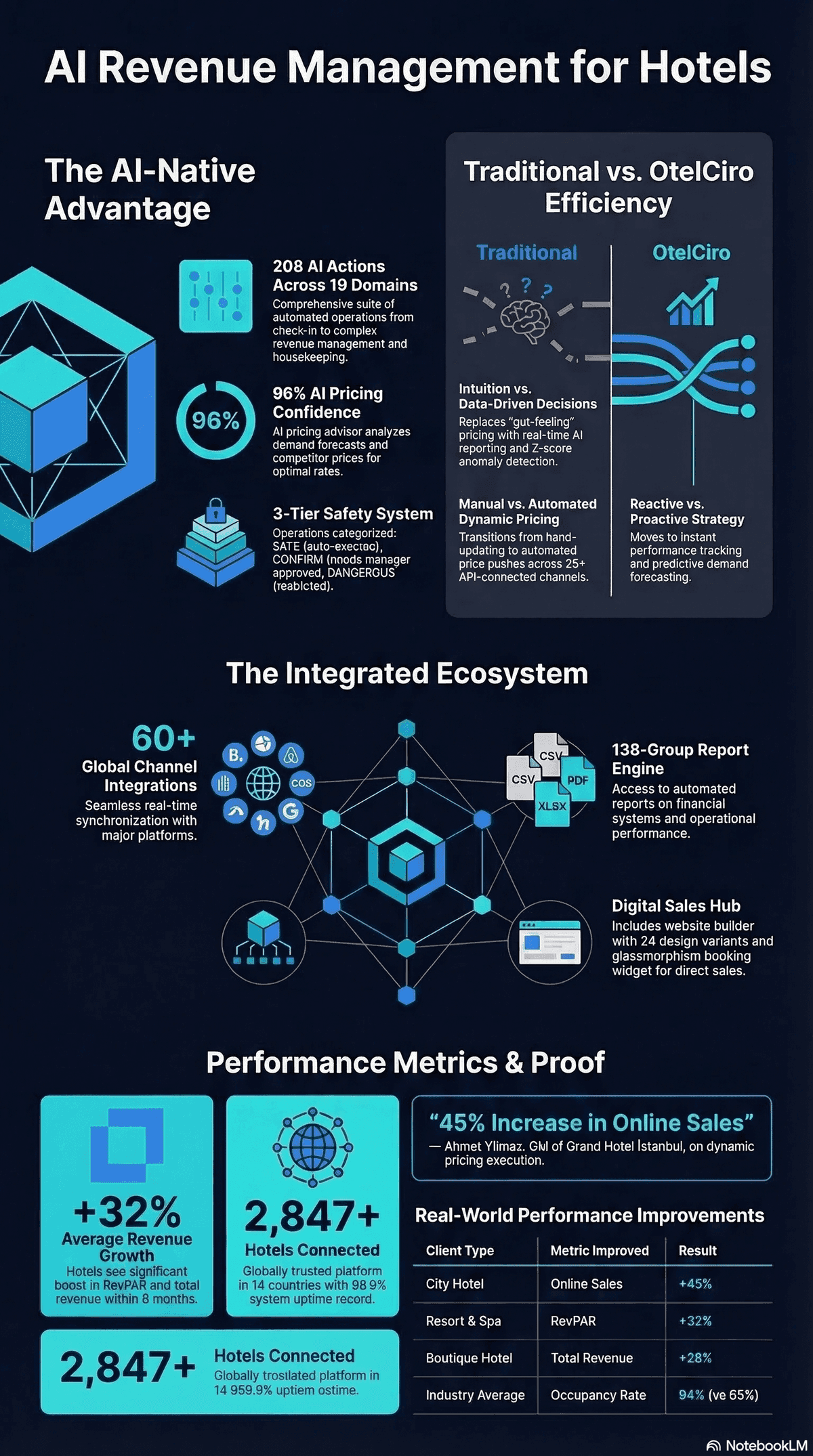
Let's look at the difference between traditional RMS and AI-native systems with concrete figures:
| Parameter | Traditional RMS | AI-Native RMS |
|---|---|---|
| Number of data sources | 5-10 | 50-200+ |
| Price update frequency | Daily | Hourly/Instant |
| Prediction accuracy | 60-75% | 85-95% |
| Segment granularity | 3-5 segments | 20-50+ micro-segments |
| Decision time | Minutes | Milliseconds |
| RevPAR increase | 8-15% | 18-35% |
The OtelCiro AI Engine operates with machine learning models specifically trained for the Turkish market. It is the only revenue management platform that understands local dynamics such as holiday periods, currency fluctuations, and domestic travel patterns.
Embed this image on your site
<a href="https://otelciro.com/en/news/hotel-revenue-management-strategies-tech-2026-guide">
  <img src="https://cdn.sanity.io/images/1la98t0z/production/d36123c644ddc3c115453411f9a55397cf34970b-1200x2150.png" alt="AI-powered revenue management platform architecture" width="800" />
</a>
<p>Source: <a href="https://otelciro.com">OtelCiro</a> — AI Hotel Revenue Management</p>
Revenue Management Success Stories: Results in Numbers
Case 1: Antalya Boutique Hotel (48 rooms)
Starting situation: Fixed seasonal prices, 55% average annual occupancy, annual RevPAR 980 TL
Strategies implemented:
- Transition to daily dynamic pricing
- Direct booking website optimization
- Segment-based packaging
Results after 12 months:
- Occupancy: 55% → 68% (+24%)
- ADR: 1,780 TL → 2,340 TL (+31%)
- RevPAR: 980 TL → 1,590 TL (+62%)
- Direct booking rate: 12% → 28%
Case 2: Istanbul City Hotel (120 rooms)
Starting situation: Manual pricing, 70% reliance on Booking.com
Strategies implemented:
- Installation of an AI-based revenue management system
- Multi-channel distribution strategy
- Corporate segment development
- Upselling program
Results after 12 months:
- RevPAR: 2,100 TL → 3,150 TL (+50%)
- OTA dependency: 70% → 45%
- GOPPAR: 38% increase
- Non-room revenue share: 8% → 15%
5 Steps to Get Started with Hotel Revenue Management
Step 1: Analyze Your Current Situation
Collect your data from the last 12-24 months: daily occupancy, ADR, RevPAR, channel-based distribution, segment distribution. Without data, there is no strategy.
Step 2: Define Your Competitive Set
Identify 5-8 hotels for accurate competitor analysis. Use criteria such as the same star category, similar location, and target audience.
Step 3: Create Basic Segmentation
Define at least 3 main customer segments and develop a pricing strategy for each.
Step 4: Establish Your Technology Infrastructure
The right technology investment determines the scalability of revenue management. An integrated hotel management system, channel manager, and revenue management engine trio are minimum requirements.
Step 5: Establish a Continuous Optimization Cycle
Revenue management is a process, not a project. Establish a continuous improvement cycle with weekly performance meetings, monthly strategy reviews, and quarterly goal updates.
Common Mistakes
- Focusing only on occupancy: High occupancy does not equal high revenue. Monitor GOPPAR.
- Dependency on a single channel: OTA commissions erode profits. Channel diversification is essential.
- Ignoring historical data: Intuition is important, but data is more reliable.
- Copying competitor prices: Copying prices without knowing the competitor's cost structure is detrimental.
- Delaying technology adoption: Competing with manual methods becomes increasingly difficult every day.
Related reading: Hotel Revenue Crisis: Why Your Hotel Is Losing 15-30% of Revenue Annually
Conclusion: Revenue Management is No Longer a Luxury, It's a Necessity
In 2026, the Turkish hotel sector faces increasing competition, rising costs, and changing guest expectations. Hotels that do not implement systematic revenue management are being outpaced by competitors in terms of price and occupancy.
The good news is that revenue management technology is no longer exclusive to large chains. The OtelCiro platform offers AI-powered revenue management solutions suitable for businesses of all sizes, from boutique hotels to large chain hotels.
To start your revenue management journey or take your current strategy to the next level, you can chat with the OtelGPT AI assistant today and receive personalized recommendations for your hotel.
Remember: Every unsold room is a lost revenue opportunity that will not return. Act today.
![Hotel Ancillary Revenue: Monetizing Spa, F&B & Activities [2026 Guide]](https://cdn.sanity.io/images/1la98t0z/production/cfce3407a5ef8f70edd19853e8059317fca7b6a6-2752x1536.jpg?w=1920&q=50&auto=format&fit=max)
![FIFA 2026 World Cup: Hotel Dynamic Pricing Strategy [2026 Guide]](https://cdn.sanity.io/images/1la98t0z/production/7a76affe61333341ec47bb0c705011068a1afd24-2752x1536.jpg?w=1920&q=50&auto=format&fit=max)