
![Hotel Revenue Analytics: Powering Data-Driven Decisions [2026 Guide]](https://cdn.sanity.io/images/1la98t0z/production/4c1fd0354871b99a765effae41f1f866a5deab0b-1200x2150.png?w=1920&q=65&auto=format&fit=max)
Key Takeaways
- Modern Reporting is Crucial: Beyond basic summaries, 2026 hotel reporting provides instant data, predictive analytics, competitor benchmarking, and AI-powered recommendations for strategic decision-making.
- Essential KPIs: Metrics like RevPAR, ADR, Occupancy Rate, TRevPAR, and GOPPAR are fundamental for measuring and optimizing hotel performance and profitability.
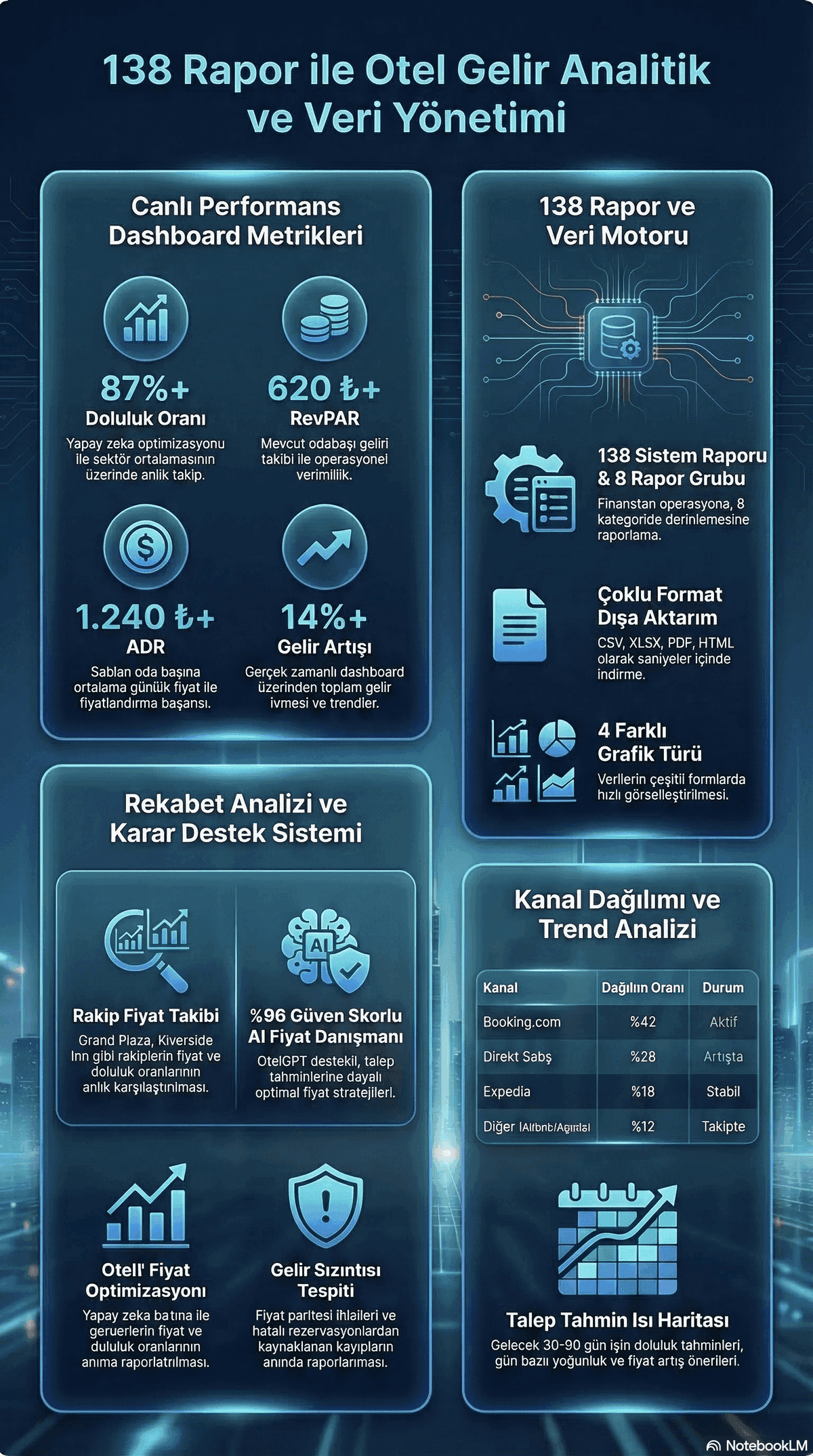
- Comprehensive Insights: OtelCiro's 138-report system offers granular data across 7 categories, including revenue, occupancy, distribution channels, competitor analysis, guest analytics, operations, and financials.
- Real-time & Predictive Power: Dashboards deliver live data and AI-supported alerts for proactive adjustments. Predictive reporting (e.g., 90-day revenue projections with <4% error) and scenario analysis enable forward-looking strategies.
- Quantifiable Impact: Data-driven decision-making leads to significant performance gains: 12-18% higher RevPAR, market response times reduced from 2-3 days to 2 hours, and an 8% increase in direct bookings.
The Critical Importance of Hotel Reporting
In hospitality, an unsold room each night represents forever lost revenue. This simple truth explains why accurate and timely reporting is vital. However, in 2026, the concept of "reporting" has evolved far beyond Excel spreadsheets and monthly income summaries.
Modern hotel reporting is a decision support system offering instant data streams, predictive analytics, competitor benchmarking, and AI-backed recommendations. Reports no longer just answer "what happened?" but also "why did it happen?", "what will happen?", and "what should I do?".
Embed this image on your site
<a href="https://otelciro.com/en/news/hotel-revenue-analytics-powering-data-driven-decisions-2026-guide">
  <img src="https://cdn.sanity.io/images/1la98t0z/production/4c1fd0354871b99a765effae41f1f866a5deab0b-1200x2150.png" alt="138 Rapor ile Otel Gelir Analitik İnfografiği" width="800" />
</a>
<p>Source: <a href="https://otelciro.com">OtelCiro</a> — AI Hotel Revenue Management</p>
OtelCiro's reporting module provides hotel managers with every piece of data they need, precisely when they need it, through 138 different reports. In this article, we examine the structure of this reporting system, key KPIs, and how data-driven decision-making impacts your hotel's revenue.
Related reading: Dynamic Pricing & AI: The Complete Guide to AI-Powered Hotel Price Optimization
Key KPIs for Hotel Management
The first step to effective reporting is tracking the right metrics. The universal performance indicators in hospitality include:
RevPAR (Revenue Per Available Room)
RevPAR measures revenue per available room and is the most critical performance indicator in hospitality.
Formula: RevPAR = Total Room Revenue / Total Available Rooms
or
Formula: RevPAR = ADR × Occupancy Rate
RevPAR's strength lies in combining both pricing and occupancy performance into a single figure. High prices but low occupancy, or high occupancy but low prices — both scenarios result in low RevPAR. Successful revenue management is about optimizing this balance.
Example: For a 100-room hotel with an ADR of 2,500 TL and 70% occupancy, RevPAR = 1,750 TL. If the same hotel lowers its ADR to 2,200 TL and increases occupancy to 85%, RevPAR = 1,870 TL — total revenue increases even if the price drops.
ADR (Average Daily Rate)
ADR indicates the average price per sold room.
Formula: ADR = Total Room Revenue / Number of Sold Rooms
ADR alone can be misleading. A very high ADR with very low occupancy does not optimize your revenue. OtelCiro's AI engine calculates the optimal balance between ADR and occupancy for each room type and each night.
Occupancy Rate
The occupancy rate shows what percentage of available rooms have been sold.
Formula: Occupancy = Sold Rooms / Total Available Rooms × 100
100% occupancy does not always mean good results. If all your rooms are filled at 30% lower prices than your competitors, you are losing revenue. Dynamic pricing exists precisely to solve this problem.
TRevPAR (Total Revenue Per Available Room)
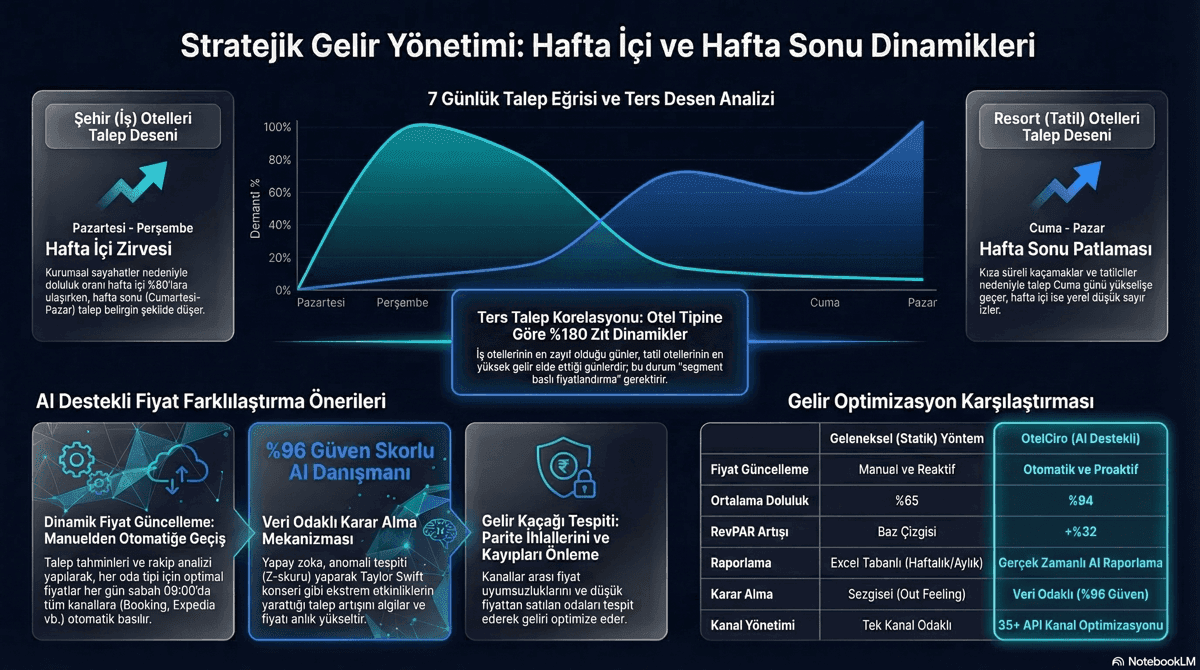
TRevPAR includes not only room revenue but all revenue sources: restaurant, spa, minibar, meeting rooms, parking, and other income.
Formula: TRevPAR = Total Hotel Revenue / Total Available Rooms
This metric measures your hotel's performance in increasing total guest spending. High TRevPAR indicates an effective upsell and cross-sell strategy.
GOPPAR (Gross Operating Profit Per Available Room)
GOPPAR goes a step beyond revenue to measure profitability.
Formula: GOPPAR = Gross Operating Profit / Total Available Rooms
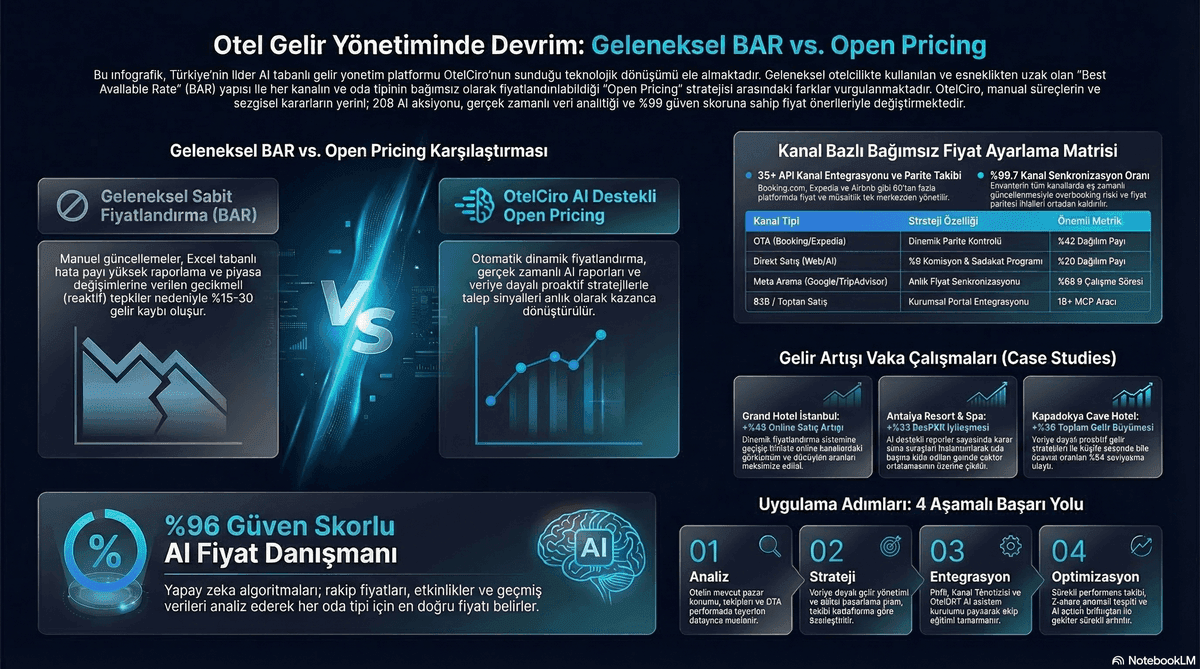
High revenue can mean low profit. High occupancy from an OTA with a 15-25% commission might be less profitable than low occupancy from a direct channel. GOPPAR reveals this reality.
Embed this image on your site
<a href="https://otelciro.com/en/news/hotel-revenue-analytics-powering-data-driven-decisions-2026-guide">
  <img src="https://cdn.sanity.io/images/1la98t0z/production/38381e0dd477a4816db7ad9b1359befc08268365-1200x669.png" alt="Open pricing (açık fiyatlandırma) stratejisi" width="800" />
</a>
<p>Source: <a href="https://otelciro.com">OtelCiro</a> — AI Hotel Revenue Management</p>
OtelCiro's 138 Report System: A Comprehensive Overview
OtelCiro's reporting module offers 138 different reports in 7 main categories. Each report is designed to answer a specific question and trigger a particular action.
Category 1: Revenue Performance Reports (28 reports)
Reports in this category analyze your hotel's revenue performance from every angle:
- Daily/Weekly/Monthly RevPAR trend — Monitors changes in revenue performance over time.
- ADR analysis (by room type, channel, segment) — Shows which room type was sold through which channel at what price.
- Revenue mix report — Distribution of room, F&B, spa, meeting, and other revenues.
- Forecast vs. actual comparison — Compares AI predictions with actual results.
- Segment performance — Comparative analysis of individual, corporate, group, and OTA segments.
Category 2: Occupancy and Demand Reports (22 reports)
- Occupancy rate trend — Daily, weekly, monthly, and annual occupancy performance.
- Pick-up report — Daily booking pace for future dates.
- Pace analysis — Comparative booking pace against the same period last year.
- Demand forecast — AI-powered 90-day demand projection.
- Season analysis — Performance comparison of high, medium, and low seasons.
- Event impact — The effect of local events and fairs on occupancy.
Category 3: Distribution Channel Reports (24 reports)
Measures and compares the performance of each channel separately:
- RevPAR per channel — Which channel generates the highest room revenue?
- Channel cost analysis — Matches commission and marketing expenses with channels.
- Net RevPAR (post-commission) — Reveals actual profitability.
- Channel mix optimization — Recommendations for ideal channel distribution.
- OTA performance comparison — Comparison of Booking.com, Expedia, HRS, and other OTAs.
5 channel optimization strategies lead to tangible revenue growth when implemented using these reports.
Category 4: Competitor Analysis Reports (18 reports)
Monitors your competitive position in real-time:
- Competitor price monitoring — Daily price changes of your defined competitor hotels.
- Rate shopping report — Market comparison for the same date and room type.
- Price position index — Your position in the market: cheapest, average, or premium.
- Competitor occupancy forecast — AI-powered prediction of competitor occupancy rates.
- Market share analysis — Your share of total revenue in your region.
Category 5: Guest Analytics Reports (20 reports)
- Guest segmentation — Demographic, behavioral, and value-based segments.
- Repeat stay rate — Loyalty and return analysis.
- Average length of stay — Stay duration trends by segment and season.
- Nationality distribution — Source market analysis.
- Spending profile — Total spending per guest and composition analysis.
Category 6: Operational Reports (16 reports)
- Housekeeping performance — Room cleaning times and efficiency metrics.
- Check-in/check-out analysis — Peak hours and waiting times.
- Maintenance report — Maintenance requests and resolution times.
- Energy consumption — Energy analysis proportional to occupancy.
Category 7: Financial and Management Reports (10 reports)
- P&L by department — Profit and loss status of each department.
- GOPPAR trend — Gross operating profit performance.
- Cash flow projection — Future 30-60-90 day cash flow forecast.
- Budget vs. actual — Progress against annual budget targets.
Related reading: Dynamic vs. Static Pricing: Maximize Your Profits with the Taylor Swift Effect
Real-time Dashboard: Instant Decision-Making
OtelCiro's analytics dashboard goes beyond traditional reporting, serving as an instant decision-making tool. It offers customized views for general managers, revenue managers, and operations managers.
Dashboard Features
Live Data Stream: Price, occupancy, and revenue metrics are updated second by second. A new reservation coming through an OTA instantly appears on the dashboard.
AI-Powered Alerts: The system automatically detects unusual changes and sends alerts:
- "Tomorrow's occupancy rate is 20% below last week — price drop suggestion."
- "Competitor X increased Friday-Sunday prices by 15% — opportunity window."
- "Booking pace from Booking.com is 3 times higher than normal — is there an event?"
Customizable Widgets: Each user can create their own dashboard. A revenue manager might prioritize RevPAR and ADR, while an operations manager monitors housekeeping and check-in metrics.
In our article AI revenue forecast, we detailed how this reporting infrastructure, combined with predictive analytics, achieved a 96% accuracy rate.
Embed this image on your site
<a href="https://otelciro.com/en/news/hotel-revenue-analytics-powering-data-driven-decisions-2026-guide">
  <img src="https://cdn.sanity.io/images/1la98t0z/production/c0edb393f0dd45ca1363f938dbc43e2d65427273-1200x670.png" alt="TRevPAR toplam gelir yönetimi hesaplaması" width="800" />
</a>
<p>Source: <a href="https://otelciro.com">OtelCiro</a> — AI Hotel Revenue Management</p>
Trend Analysis and Predictive Reporting
Reporting past data is valuable, but predicting the future is far more valuable. OtelCiro's reporting system works integrated with its AI engine to provide predictive reports:
90-Day Revenue Projection
AI combines historical performance data, current booking pace, competitor prices, local event calendars, weather forecasts, and flight capacity data to generate a revenue projection for the next 90 days.
This projection is updated daily and compared with actual data. The average deviation rate is below 4%.
Scenario Analysis
It provides concrete answers to questions like "What if I lower the price by 10%?" The AI simulates different pricing scenarios and calculates their impact on occupancy, revenue, and profit.
Early Warning System
Detects negative trends early:
- Slowdown in booking pace
- Increase in cancellation rates
- Performance drop in a specific channel
- Competitor price aggression
Competitive Benchmarking: Your Position in the Market
Without comparing your hotel's performance with competitors, you cannot know if you are doing well or poorly. OtelCiro's benchmarking reports continuously compare your hotel against your defined competitor set.
RGI (Revenue Generation Index)
Compares your hotel's RevPAR with the average of your competitor set:
- RGI > 1.0 → Outperforms the market
- RGI = 1.0 → Market average
- RGI < 1.0 → Underperforms the market
MPI (Market Penetration Index)
Compares your occupancy rate with competitors. A low MPI may indicate a pricing or visibility issue.
ARI (Average Rate Index)
Compares your ADR with competitors. High ARI but low MPI could signal "we are too expensive." Low ARI but high MPI could mean "we are too cheap."
The Impact of Reporting on Revenue
Hotels that make data-driven decisions perform measurably better than those relying on intuition:
- RevPAR difference: Data-driven hotels achieve an average of 12-18% higher RevPAR compared to their competitors.
- Faster reaction: Price adjustments to market changes within an average of 2 hours (this takes 2-3 days with manual management).
- Lower OTA dependency: Hotels that measure channel performance increase their direct booking rate by an average of 8%.
- Higher guest satisfaction: Guest complaint rates decrease by 22% in hotels using operational reports.
Related reading: 65% of Travelers Accept Dynamic Pricing: Transparency Builds Trust
Integration and Access
OtelCiro's reporting module is fully integrated with its Smart PMS and operations management modules. Data flows from a single source, ensuring consistency.
Reports can be accessed from desktop, tablet, and mobile devices. Critical reports can be automatically sent via email and WhatsApp. PDF and Excel export are supported.
Conclusion
138 reports are not a luxury, but a necessity. You cannot manage your hotel's revenue, costs, competitive position, and operational efficiency without measuring them. OtelCiro's analytics dashboard provides this measurement in a real-time, AI-backed, and actionable format.
Related Articles:
![Hotel Ancillary Revenue: Monetizing Spa, F&B & Activities [2026 Guide]](https://cdn.sanity.io/images/1la98t0z/production/cfce3407a5ef8f70edd19853e8059317fca7b6a6-2752x1536.jpg?w=1920&q=50&auto=format&fit=max)
![FIFA 2026 World Cup: Hotel Dynamic Pricing Strategy [2026 Guide]](https://cdn.sanity.io/images/1la98t0z/production/7a76affe61333341ec47bb0c705011068a1afd24-2752x1536.jpg?w=1920&q=50&auto=format&fit=max)