
![Hotel Ransomware Attacks 2026: Protection & Recovery [Strategy Guide]](https://cdn.sanity.io/images/1la98t0z/production/145b9f0e0233e6a2390e0414ad0f11c31a79718a-1024x1024.png?w=1920&q=65&auto=format&fit=max)
Key Takeaways
- Ransomware attacks in the hospitality sector increased by %67 in 2026, with an average cost of $4.2 million per incident.
- Social engineering (especially AI-powered phishing) and remote access vulnerabilities are the primary attack vectors, highlighting the need for robust staff training and MFA.
- A layered defense strategy is crucial, combining human-factor training, technical controls (network segmentation, EDR/XDR, patch management, email security), and a robust 3-2-1 backup system.
- An incident response plan is critical for the first 72 hours, guiding detection, isolation, assessment, communication, and recovery, with a firm recommendation not to pay the ransom.
- Cyber insurance offers financial protection against ransomware risks, but requires adherence to minimum security standards such as MFA, EDR, and tested backups.
Hospitality: A Favorite Target for Ransomware Attackers
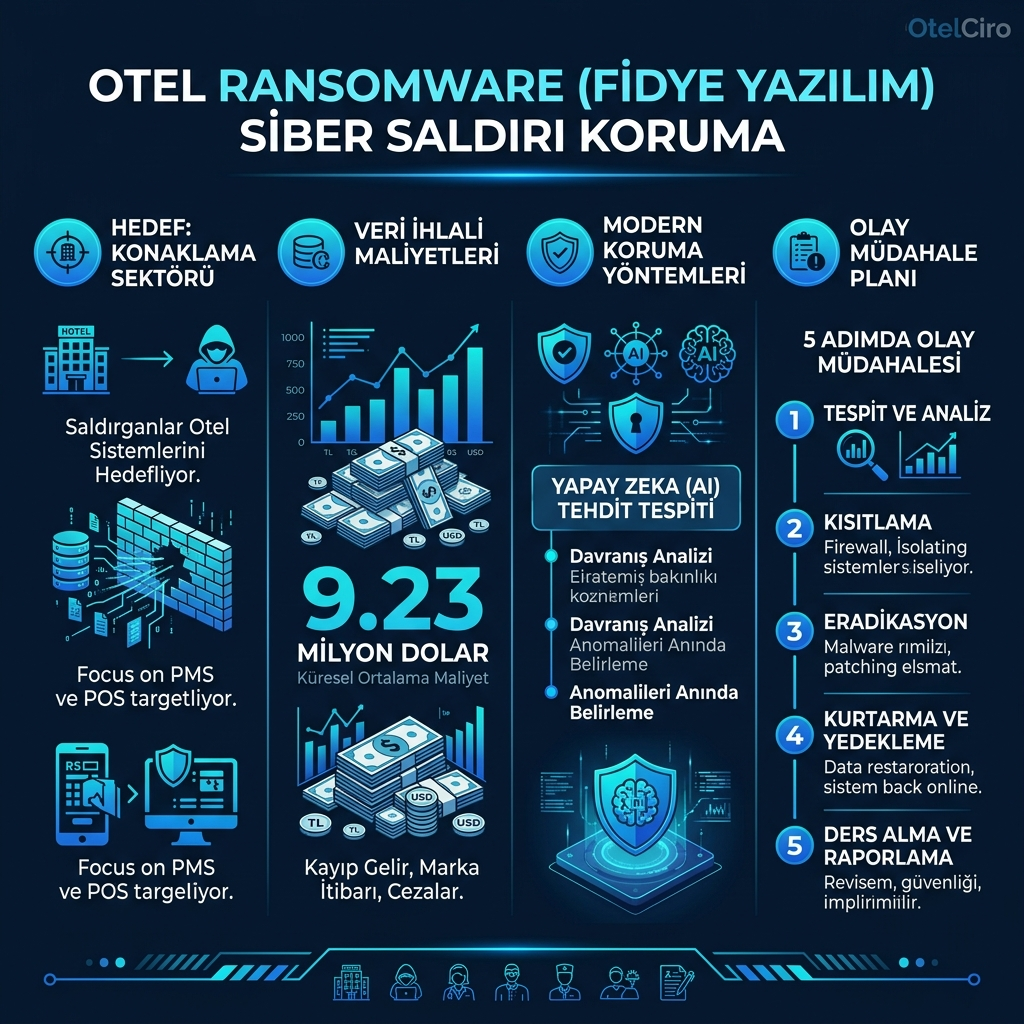
The hospitality sector presents "perfect storm" conditions for ransomware attackers: 24/7 operational necessity, reliance on PMS-dependent business processes, high customer expectations, and pressure to pay ransoms. According to Sophos's 2025 State of Ransomware in Hospitality report, %67 of businesses in the hospitality sector suffered at least one ransomware attack in the last 12 months — the third-highest rate across all industries.
According to IBM Security X-Force data, the average cost of a hotel ransomware attack is $4.2 million. This cost includes operational downtime, data recovery, legal proceedings, reputation management, and guest compensation. However, for large chain hotels, this figure can be significantly higher.
Across the sector, average ransomware payments reached $812,000 in 2025. According to Coveware data, only %65 of hotels that paid the ransom were able to fully recover their data.
Embed this image on your site
<a href="https://otelciro.com/en/news/hotel-ransomware-attacks-2026-protection-recovery-strategy-guide">
  <img src="https://cdn.sanity.io/images/1la98t0z/production/145b9f0e0233e6a2390e0414ad0f11c31a79718a-1024x1024.png" alt="Hotel ransomware protection cyber attack guide 2026" width="800" />
</a>
<p>Source: <a href="https://otelciro.com">OtelCiro</a> — AI Hotel Revenue Management</p>
Major Hotel Ransomware Cases: Lessons Learned
MGM Resorts: A $100 Million Nightmare
In September 2023, MGM Resorts International experienced an operational paralysis for 10 days due to a ransomware attack carried out by the Scattered Spider group. Attackers gained system access using social engineering, calling the help desk via an IT employee's LinkedIn profile.
Impacts:
- PMS was completely disabled — check-ins/outs were handled manually
- Slot machines and digital key cards were non-functional
- Operational disruptions at 30+ properties in Las Vegas
- Estimated total cost: $100 million
- Share value dropped %6
Lesson: Social engineering can bypass even the most sophisticated security infrastructure. Staff training and multi-factor authentication (MFA) are critical.
Marriott International: Recurring Breaches
Marriott has experienced three major cyberattacks since 2018. In the 2023 breach, 5.2 million guest records were compromised. These recurring breaches highlight that the cybersecurity culture in the hotel industry has not yet matured sufficiently.
InterContinental Hotels Group (IHG): 2 Weeks of Disruption
IHG's 2022 attack rendered its reservation systems ineffective for 14 days. Attackers infiltrated the network by cracking a weak VPN password.
Related reading: Hotel Cybersecurity: Guest Data Protection and PCI-DSS
Hotel Ransomware Attack Vectors
According to Mandiant's 2025 Hospitality Sector Threat Report, the primary entry points for ransomware attacks targeting hotels are:
1. Phishing and Social Engineering (%43)
The most common attack vector. Hotel staff receive hundreds of emails daily — fake Booking.com notifications, guest complaints, and invoice-lookalike emails are the most frequently used tactics.
Typical scenario: An attacker sends an email titled "Booking.com Extranet - Urgent Invoice Correction." The attached PDF, when opened, installs malware. The malware spreads within the network, reaches the PMS server, and encryption begins.
New trend (2025-2026): Ultra-realistic phishing emails generated with artificial intelligence. Instead of traditional "typo-ridden fake emails," these are personalized messages that understand hotel jargon and current operations. According to Abnormal Security data, AI-powered phishing emails have a %78 higher click-through rate.
2. Remote Access Vulnerabilities (%27)
Security weaknesses in VPN, RDP (Remote Desktop Protocol), and remote management tools. Many hotels that rapidly built remote access infrastructure after the pandemic neglected security standards.
Risk factors:
- Leaving the default RDP port (3389) open
- Weak or reused VPN passwords
- Remote access without MFA enforcement
- Outdated VPN software
3. POS and Payment Systems (%16)
Attacks targeting credit card payment terminals are used for both data theft and ransomware installation. Older POS software and unpatched payment infrastructure are particularly vulnerable.
4. IoT Devices and Smart Room Systems (%9)
Smart thermostats, digital key card systems, IPTV, and room automation devices — each connected to the network and often lacking security updates. According to Forescout Research data, %53 of IoT devices in a hotel have known security vulnerabilities.
5. Supply Chain Attacks (%5)
Attacks originating through PMS providers, channel managers, or third-party software. In 2024, a security breach at a major PMS provider affected 2,300 hotels.
Ransomware Protection Strategies
Layer 1: The Human Factor
Staff training is the most cost-effective line of defense. According to KnowBe4 data, in hotels with regular security training, the phishing click-through rate drops from %35 to %4.
- Monthly phishing simulations: Send realistic test emails, measure results
- Department-specific training: Customized scenarios for reception, finance, and IT
- Culture of reporting suspicious emails: Easy reporting button and rewards
- New employee onboarding: Mandatory cybersecurity training in the first week
Layer 2: Technical Defense
Network Segmentation: Divide the hotel network into logical segments:
| Network Segment | Content | Isolation Level |
|---|---|---|
| PMS/Operational | Reservations, payments, PMS | Maximum |
| Staff | Email, office applications | High |
| Guest Wi-Fi | Internet access | Fully Isolated |
| IoT/Automation | Smart room, HVAC, IPTV | High |
| Security | CCTV, access control | Maximum |
Endpoint Security (EDR/XDR):
- EDR (Endpoint Detection and Response) solution on all computers and servers
- Behavioral analysis-based detection — signature-based antivirus is no longer sufficient
- Enterprise solutions like CrowdStrike, SentinelOne, or Microsoft Defender for Endpoint
Patch Management:
- Apply critical security patches within 48 hours
- Prioritize PMS and POS updates
- Isolate or replace legacy systems
Email Security:
- SPF, DKIM, and DMARC records
- Advanced email filtering (sandbox analysis)
- Attachment type restrictions (blocking .exe, .ps1, .bat)
Layer 3: Backup — The Last Line of Defense
The most effective protection against ransomware is a robust backup strategy. Implement the 3-2-1 rule:
- 3 copies of data (original + 2 backups)
- 2 different media types (disk + cloud)
- 1 copy offsite (physically in a different location)
Critical backup rules:
- Keep backups isolated from the network (air-gapped or immutable storage)
- Daily automated backups — PMS data, guest records, financial data
- Weekly full backups — all systems
- Monthly recovery tests — verify data can actually be restored from backup
Related reading: KVKK Hotel Compliance Guide: Guest Data Protection and Privacy 2026
Incident Response Plan: The First 72 Hours
When a ransomware attack is detected, the first few hours are critical. A pre-prepared incident response plan ensures a controlled process instead of chaos.
Hour 0-2: Detection and Isolation
- Immediately disconnect affected systems from the network (pull the cable, turn off Wi-Fi)
- Shut down unaffected servers to stop encryption from spreading
- Notify the IT team and management
- Preserve digital evidence — do not erase or reinstall systems yet
Hour 2-12: Assessment
- Determine the scope of the attack: which systems were affected?
- Check backup integrity — were backups also encrypted?
- Contact a cybersecurity expert/firm
- Inform legal counsel (the clock is ticking for KVKK notification)
Hour 12-24: Communication
- Update staff on the situation — what to do and what not to do
- Transparent notification to guests (if personal data was affected)
- Notify OTAs and channel managers
- Notify the cyber insurance company
Hour 24-72: Recovery Commencement
- Restore systems from clean backups
- Data breach notification to the KVKK Board (72-hour limit)
- Activate manual operational processes
- Initiate forensic analysis — how was access gained, when did it start
Should You Pay the Ransom?
The consistent advice from the FBI, Europol, and CISA: Do not pay. Reasons:
- Payment encourages attackers and makes you a repeat target
- There is no guarantee that data will be recovered
- In some countries, paying groups on sanction lists constitutes a legal offense
- Even if paid, a backdoor might have been left
Cyber Insurance: A Guide for Hoteliers
Cyber insurance is the most effective tool for financially managing ransomware risk. According to Munich Re data, in 2025, the average cyber insurance premium in the hospitality sector ranges from %0.3 to %0.8 of annual revenue.
Cyber Insurance Coverage
A typical hospitality cyber insurance policy covers:
- Business interruption: Loss of revenue during system downtime
- Data recovery: Cost of recovering encrypted data
- Legal expenses: KVKK/GDPR fines and litigation costs
- Crisis management: PR consultancy, guest notification costs
- Ransom payment: Depending on the policy (controversial coverage)
- Forensics: Attack analysis and evidence collection
Minimum Security Required for Insurance
Cyber insurance companies look for specific security controls before issuing a policy:
- MFA: Mandatory for all remote access and privileged accounts
- EDR: Endpoint security solution
- Backup: Isolated and tested backup system
- Patch management: Timely application of critical security patches
- Staff training: Documented security awareness program
Lack of these controls can increase insurance premiums by %200-400 or lead to policy denial.
2026 Ransomware Trend Forecast
AI-Powered Attacks
Attackers are now using artificial intelligence to develop customized attack scenarios. They analyze a hotel's website, staff profiles, and OTA listings to plan targeted attacks. According to Recorded Future's projections, %30 of attacks in the hotel sector in 2026 will use AI-powered tools.
Double Extortion
Not just encrypting data, but also threatening to leak stolen guest data. This method is a serious pressure tactic, especially for hotels hosting VIP and celebrity guests. According to Palo Alto Unit 42 data, %72 of hotel attacks use the double extortion method.
Supply Chain Targeting
Attacks carried out through PMS, channel manager, and payment providers are increasing. A single vendor breach can affect hundreds of hotels. Therefore, vendor security assessment is now a mandatory process.
Hotel Cybersecurity Budget Guide
According to Gartner's 2025 data, IT security spending in the hotel sector should be %8-12 of the total IT budget. For a mid-sized hotel (150-300 rooms), the estimated annual cybersecurity budget is:
| Item | Estimated Annual Cost |
|---|---|
| EDR/XDR licenses | 30,000-60,000 TL |
| Email security | 15,000-30,000 TL |
| Backup infrastructure | 25,000-50,000 TL |
| Staff training (platform) | 10,000-20,000 TL |
| Penetration testing (annual) | 40,000-80,000 TL |
| Cyber insurance premium | 50,000-150,000 TL |
| Security consulting | 30,000-60,000 TL |
| Total | 200,000-450,000 TL |
This investment is less than %1 of the potential cost of a single ransomware attack (average $4.2 million). From an ROI perspective, cybersecurity investment is one of the highest-return expenditures your hotel can make.
Conclusion: Preparation is the Only Defense
Ransomware attacks are not a matter of "if" but "when." The hospitality sector, with its 24/7 operational structure and volume of sensitive data, cannot escape this threat — but it can be prepared.
Three fundamental steps: strengthen the human factor with staff training, implement technical defense layers, and build your last line of defense with a robust backup strategy. Cyber insurance makes financial risk manageable; an incident response plan ensures controlled action during a crisis.
OtelCiro's Smart PMS module operates on SOC 2 and ISO 27001 compliant cloud infrastructure, enhancing your hotel's cybersecurity posture with automatic backups, encrypted data storage, and role-based access control. Request a free demo and evaluate your security infrastructure.
![AI Chatbot Revenue Impact for Hotels: 2026 Strategy [Data Analysis]](https://cdn.sanity.io/images/1la98t0z/production/28a6b8cebd12686a668a97549c9e9a619c6f4277-2752x1536.jpg?w=1920&q=50&auto=format&fit=max)
![Hotel AI Technology Budgets 2027: 8-Point Investment Framework That Delivers 15x ROI [2026]](https://cdn.sanity.io/images/1la98t0z/production/7e64ec0aab777ec433ec0f4f1257373a84f39d1d-2048x2048.png?w=1920&q=50&auto=format&fit=max)