
![Hotel Price Ladder: Boost Early Booking Revenue [2026 Guide]](https://cdn.sanity.io/images/1la98t0z/production/958a66641fed491f0a0586a0dece305f9dae1dc7-1200x669.png?w=1920&q=65&auto=format&fit=max)
Key Takeaways
- The price ladder strategy systematically increases prices based on proximity to check-in, significantly boosting early booking rates by 25-40% and improving RevPAR by 8-14%.
- An optimal price ladder typically consists of 4-6 steps, with each step showing an 8-10% price increase, balancing operational ease with revenue maximization.
- AI-powered systems dynamically optimize price ladders by analyzing demand forecasts, competitor behavior, guest segment lead times, and cancellation probabilities, providing more precise pricing than traditional methods.
- Effective communication of step transitions via email marketing (e.g., 4.2% click-through rate) and website transparency is crucial for driving conversions and creating a sense of urgency.
- Successful implementation requires careful management of room quotas for each step and consistent pricing across all channels, while mitigating risks like price credibility issues and competitive reactions.
What is a Price Ladder and Why Does It Work?
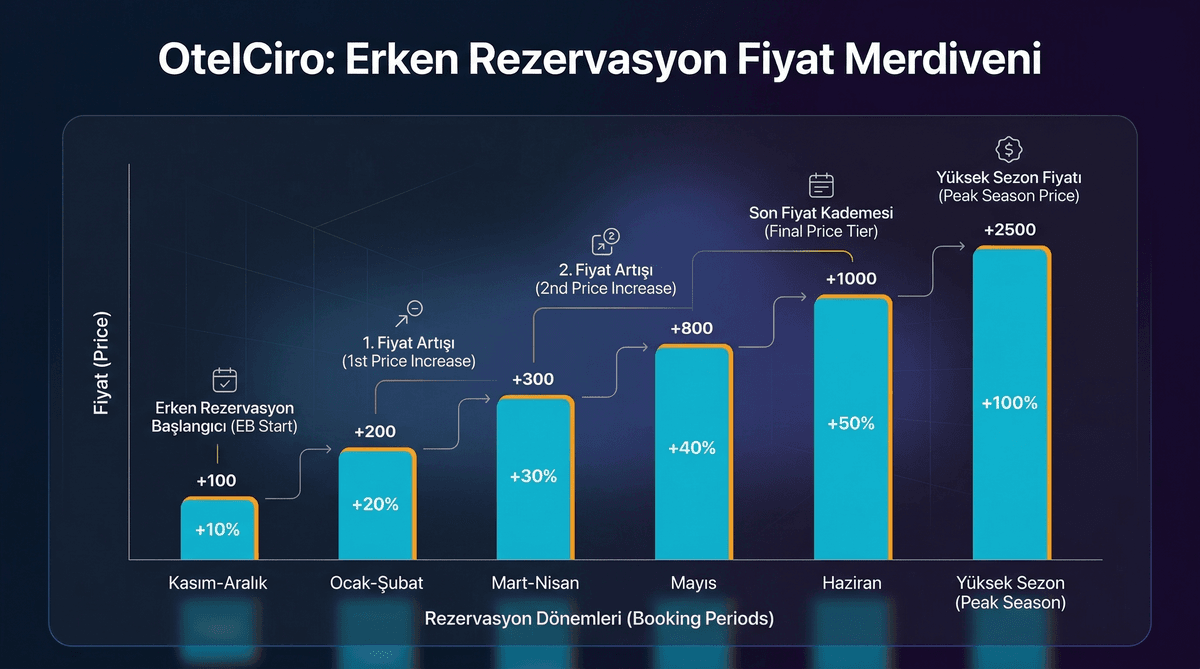
A price ladder is an early booking strategy based on the principle of progressively increasing prices according to the time remaining until the check-in date. The lowest price is offered for the earliest bookings, while the highest price is reserved for last-minute sales. This model has been used for decades in the airline industry and is rapidly being adopted in the hotel sector.
The basic principle is simple: guests who decide early pay a lower price, while those who decide later pay a premium. The psychological foundation for why this approach works is loss aversion — people feel the pain of missing out on an opportunity 2.5 times more intensely than the joy of an equivalent gain.
Embed this image on your site
<a href="https://otelciro.com/en/news/hotel-price-ladder-boost-early-booking-revenue-2026-guide">
  <img src="https://cdn.sanity.io/images/1la98t0z/production/958a66641fed491f0a0586a0dece305f9dae1dc7-1200x669.png" alt="Early Booking Price Ladder Infographic" width="800" />
</a>
<p>Source: <a href="https://otelciro.com">OtelCiro</a> — AI Hotel Revenue Management</p>
According to research from the Cornell Hotel Administration School, hotels implementing a structured price ladder have:
- Increased early booking rates by 25-40%
- Accelerated cash flow by an average of 6.2 weeks
- Reduced the need for last-minute discounts by 35%
- Improved overall RevPAR by 8-14%
Related reading: Dynamic Pricing and AI: Hotel Price Optimization with Artificial Intelligence
Step Structure: How Many Steps Are Optimal?
The number of steps in a price ladder varies depending on the hotel type, seasonality, and target audience. However, research consistently shows that 4-6 steps is the ideal range for both operational manageability and revenue optimization.
Example 5-Step Structure (Summer Season, Standard Room)
| Step | Duration | Price | Discount |
|---|---|---|---|
| 1st Step | 120+ days prior | 1.800 TL | 25% |
| 2nd Step | 90-119 days prior | 2.000 TL | 17% |
| 3rd Step | 60-89 days prior | 2.200 TL | 8% |
| 4th Step | 30-59 days prior | 2.400 TL | Base rate |
| 5th Step | 0-29 days prior | 2.600 TL | +8% (premium) |
This structure creates a ladder where each step shows an 8-10% increase. The critical point is that step transitions must be clear and understandable. Guests should know why the price is changing and feel compelled to act before moving to the next step.
An important detail: fewer than 3 steps are insufficient, leaving guests in a dilemma of "early or last minute?" More than 7 steps can create confusion and undermine price credibility.
AI for Optimal Step Determination
Traditional price ladders rely on historical data and the manager's experience. However, AI-powered systems offer a much more precise and dynamic approach.
The OtelCiro AI engine designs a customized ladder for each date and room type using the following data sources:
Demand forecasting: Expected demand levels for each date are calculated by analyzing booking curves from the past 3 years, regional event calendars, holidays, and economic indicators. A steeper ladder (larger difference between steps) is recommended for dates with high anticipated demand, while a flatter ladder is suggested for low-demand dates.
Competitor behavior: Early booking discount rates and timing strategies of competitor hotels are monitored. If the average early booking discount in the market is 20%, offering 25% provides a competitive advantage.
Segment analysis: Knowing the average lead time (the duration between booking and check-in) for each guest segment helps place steps in the correct timeframes. For example, the average lead time for the German market is 94 days, whereas for domestic Turkish tourists, it is 32 days.
Cancellation probability: Early bookings typically carry a higher risk of cancellation. AI models the cancellation probability for each step, optimizing based on net revenue. While the cancellation rate for the first step is 28%, it drops to 8% for the fifth step.
Quota Management: How Many Rooms for Each Step?
The success of a price ladder depends on accurately determining the number of rooms (quota) allocated to each step. Opening all rooms at the lowest step means revenue loss, while allocating too few rooms means missing out on early booking opportunities.
As a general rule, the distribution of the total room inventory is recommended as follows:
- 1st Step (earliest): 10-15%
- 2nd Step: 15-20%
- 3rd Step: 25-30%
- 4th Step: 20-25%
- 5th Step (last minute): 15-20%
This distribution should be dynamically adjusted based on demand intensity. When 80% of the quota for a step is filled, the AI system can automatically trigger a transition to the next step — thus preventing too many sales at a lower price than necessary.
Communication Strategy: Properly Conveying Urgency
The price ladder is not just a pricing model but also a marketing tool. Communicating step transitions effectively to guests dramatically impacts conversion rates.
Email marketing: Messages such as "Prices increase on March 15th — book your reservation at the current price now" yield the highest conversion rates when sent 7-10 days before the step transition (4.2% click-through rate — twice the hotel industry average).
Website transparency: Clearly display the price ladder structure on your website. Real-time information like "You are currently in the 2nd step — take advantage of this price until April 30th" builds trust and creates a sense of urgency.
Social proof: Notifications like "Our 1st step prices for this date are sold out" provide both transparency and FOMO effect. A/B tests show that social proof messages increase conversion rates by 18%.
Related reading: Seasonal Pricing Strategy on Booking.com
Risks and Considerations
The price ladder strategy also has potential risks:
- Price credibility issues: If step transitions are too frequent or inconsistent, guests may question, "What is the real price?" Steps must be clear and consistent.
- Competitor reactions: Competitors may offer more aggressive early booking discounts. Market monitoring and flexible response mechanisms are essential.
- Cancellation policy alignment: More flexible cancellation terms should be offered for earlier steps. Otherwise, guests may be unwilling to take the risk.
- Channel consistency: Implementing the same step structure across all channels can create operational difficulties. Channel manager integration is critical.
Conclusion: Timing is Everything
When properly structured, the early booking price ladder is a powerful strategy that strengthens cash flow, improves occupancy forecasting, and reduces pressure for last-minute discounts. AI support enables dynamic optimization of ladder structures for each date, room type, and segment, generating 12-18% higher revenue compared to traditional fixed discount tables.
Leverage the OtelCiro AI engine to make your early booking strategy data-driven and start every season a step ahead.
![Hotel Ancillary Revenue: Monetizing Spa, F&B & Activities [2026 Guide]](https://cdn.sanity.io/images/1la98t0z/production/cfce3407a5ef8f70edd19853e8059317fca7b6a6-2752x1536.jpg?w=1920&q=50&auto=format&fit=max)
![FIFA 2026 World Cup: Hotel Dynamic Pricing Strategy [2026 Guide]](https://cdn.sanity.io/images/1la98t0z/production/7a76affe61333341ec47bb0c705011068a1afd24-2752x1536.jpg?w=1920&q=50&auto=format&fit=max)