
![Hotel Price Elasticity: Maximize Revenue [2026 Strategy Guide]](https://cdn.sanity.io/images/1la98t0z/production/cd640559b7e2baeb3213041a2a2f0051fdcbe0a6-1200x670.png?w=1920&q=65&auto=format&fit=max)
Key Takeaways
- Understanding Elasticity: Price elasticity measures the percentage change in demand relative to a percentage change in price, forming a critical foundation for data-driven revenue management.
- Elastic vs. Inelastic Demand: Identify whether your hotel's demand is elastic (price-sensitive, typical for leisure guests, low season, competitive markets) or inelastic (price-insensitive, common for corporate travelers, special events, high season).
- Segment-Based Analysis is Key: Different guest segments exhibit varying price sensitivities. A corporate traveler's demand is typically less elastic than that of an OTA-sourced leisure guest.
- AI for Real-Time Optimization: AI-powered systems can calculate real-time, segment-specific elasticity, predict future demand responses, and automatically adjust prices for optimal revenue.
- Strategic Application: Leverage elasticity data from historical records, A/B tests, and continuous optimization to define optimal pricing bands and implement consistent, data-backed strategies across all sales channels.
Hotel Price Elasticity: The Impact of Price Increases on Demand
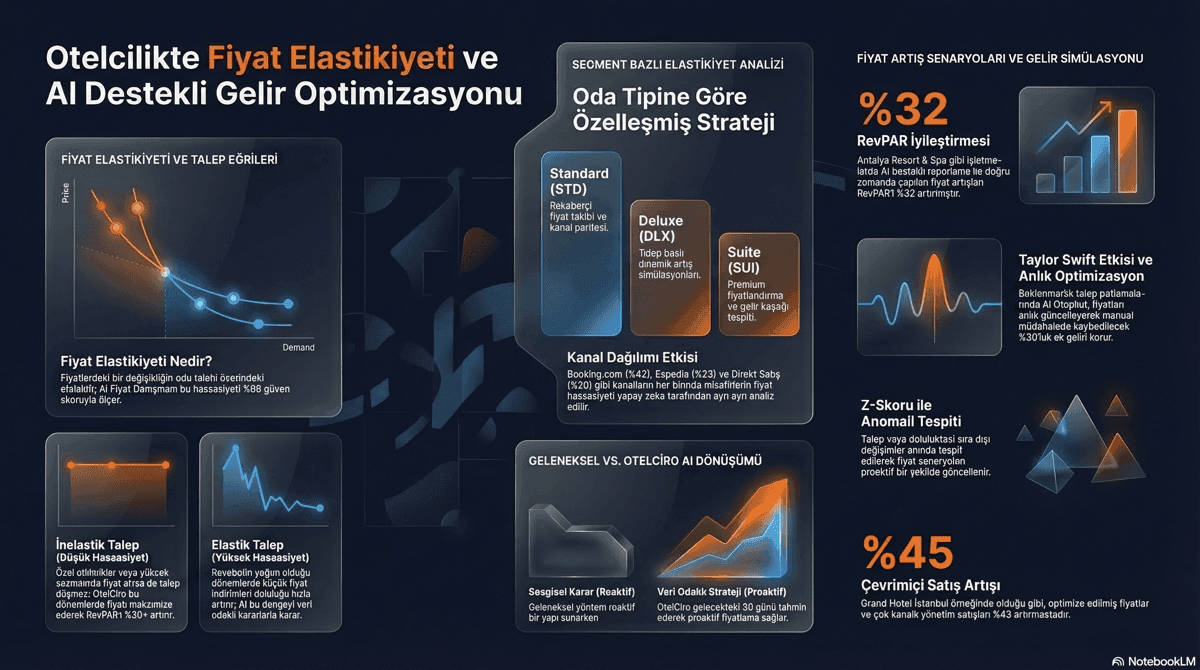
Do you know if a 10% price increase will lead to a 5% or 20% drop in demand? Price elasticity answers this question and is a critical concept forming one of the cornerstones of hotel revenue management. Accurate elasticity analysis allows you to base your pricing decisions on data and place revenue optimization on scientific foundations.
What is Price Elasticity?
Price elasticity is the ratio of the percentage change in the quantity demanded to the percentage change in price:
Elasticity = % Change in Demand / % Change in Price
- |E| > 1 → Elastic demand: A price change leads to a disproportionately large change in demand.
- |E| < 1 → Inelastic demand: Demand is insensitive to price changes.
- |E| = 1 → Unit elastic: Price and demand change proportionally.
Embed this image on your site
<a href="https://otelciro.com/en/news/hotel-price-elasticity-maximize-revenue-2026-strategy-guide">
  <img src="https://cdn.sanity.io/images/1la98t0z/production/cd640559b7e2baeb3213041a2a2f0051fdcbe0a6-1200x670.png" alt="Otel Fiyat Elastikiyeti Analizi İnfografiği" width="800" />
</a>
<p>Source: <a href="https://otelciro.com">OtelCiro</a> — AI Hotel Revenue Management</p>
Related reading: How Many Hours Does Your Hotel Operate Empty Annually? The True Cost of an Empty Room
Related reading: Dynamic vs. Static Pricing: Maximize Your Profits with the Taylor Swift Effect
Elastic vs. Inelastic Demand: A Hotel Perspective
Elastic Demand Scenarios
- Leisure guests traveling for holidays
- OTA traffic coming from price comparison sites
- Low season periods
- Destinations with numerous competitor alternatives
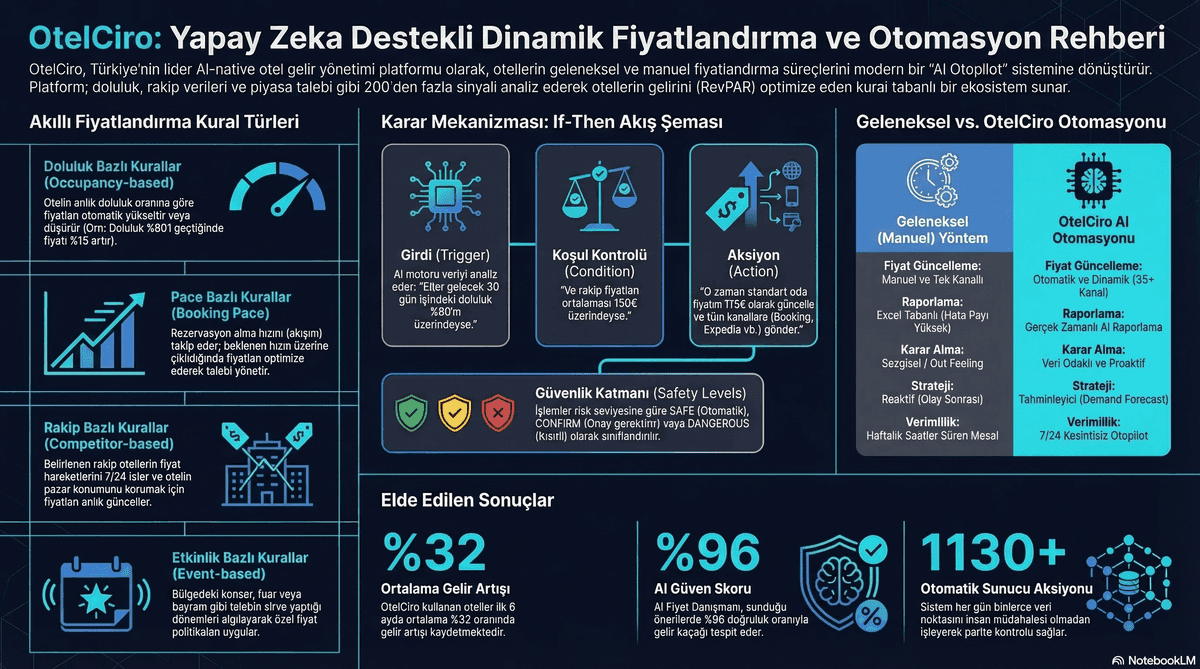
Strategy: Price reductions significantly increase occupancy. Aggressive pricing can be effective during low seasons.
Inelastic Demand Scenarios
- Corporate guests traveling for business
- Special event periods (conferences, festivals)
- High season and holiday periods
- Hotels in niche locations with few alternatives
Strategy: Price increases do not lead to significant demand loss. Prices should be raised during these periods to maximize revenue.
Embed this image on your site
<a href="https://otelciro.com/en/news/hotel-price-elasticity-maximize-revenue-2026-strategy-guide">
  <img src="https://cdn.sanity.io/images/1la98t0z/production/2d9c99599d308dc44740f17d18a63ef05a6a3127-1200x669.png" alt="Otel otomatik fiyat kuralları motoru" width="800" />
</a>
<p>Source: <a href="https://otelciro.com">OtelCiro</a> — AI Hotel Revenue Management</p>
Segment-Based Elasticity Table
Each guest segment has different price sensitivities:
| Segment | Elasticity Coefficient | Commentary |
|---|---|---|
| Corporate (business travel) | 0.3 - 0.5 | Very low elasticity, price insensitive |
| Leisure (holiday) | 1.2 - 2.0 | High elasticity, compares prices |
| Group | 0.8 - 1.5 | Medium elasticity, negotiates volume |
| OTA traffic | 1.5 - 2.5 | Very high elasticity, price ranking is critical |
| Direct channel | 0.8 - 1.2 | Medium elasticity, loyalty effect present |
| Meeting/convention | 0.2 - 0.4 | Lowest elasticity |
You can use this data as the foundation for your segment-based pricing strategy. An AI-powered pricing engine calculates real-time elasticity to determine the optimal price for each segment.
Related reading: Dynamic Pricing and AI: The Complete Guide to Hotel Price Optimization with Artificial Intelligence
Related reading: 65% of Travelers Accept Dynamic Pricing: Transparency Builds Trust
Price Increase Scenarios and Revenue Impact
Different scenarios for a 100-room hotel:
Scenario 1: 10% Price Increase (High Season)
- Current situation: 90% occupancy, 1.000 TL ADR → 90.000 TL/night revenue
- After price increase: 87% occupancy (inelastic), 1.100 TL ADR → 95.700 TL/night
- Result: +6.3% revenue increase
Scenario 2: 10% Price Increase (Low Season)
- Current situation: 50% occupancy, 600 TL ADR → 30.000 TL/night revenue
- After price increase: 38% occupancy (elastic), 660 TL ADR → 25.080 TL/night
- Result: -16.4% revenue loss
Scenario 3: 15% Price Discount (Low Season)
- Current situation: 50% occupancy, 600 TL ADR → 30.000 TL/night revenue
- After discount: 72% occupancy (elastic response), 510 TL ADR → 36.720 TL/night
- Result: +22.4% revenue increase
These scenarios clearly demonstrate why elasticity analysis is critical for pricing decisions.
Embed this image on your site
<a href="https://otelciro.com/en/news/hotel-price-elasticity-maximize-revenue-2026-strategy-guide">
  <img src="https://cdn.sanity.io/images/1la98t0z/production/e4a81170ea23bc3464834633cf98f17b6e55f514-1200x669.png" alt="Otel dinamik fiyatlandırma stratejileri karşılaştırması" width="800" />
</a>
<p>Source: <a href="https://otelciro.com">OtelCiro</a> — AI Hotel Revenue Management</p>
Factors Affecting Elasticity
External Factors
- Seasonality: Demand becomes inelastic during summer and holiday periods.
- Number of competitors: The more alternatives there are, the higher the elasticity.
- Economic conditions: Price sensitivity increases during recessionary periods.
- Exchange rate: A favorable exchange rate for foreign guests reduces elasticity.
Internal Factors
- Brand strength: A strong brand creates inelastic demand.
- Location advantage: A unique location (seaside, city center) reduces elasticity.
- Service quality: High review scores decrease price sensitivity.
- Loyalty program: Regular guests are less price sensitive.
Elasticity Analysis with AI
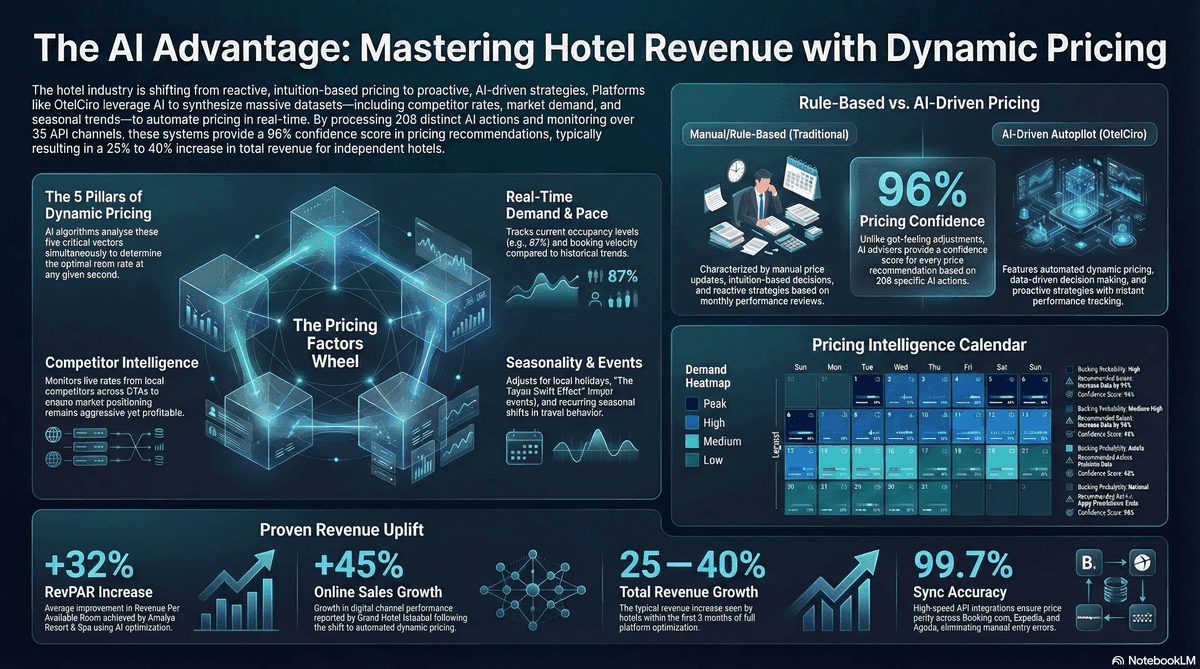
Calculating elasticity using traditional methods can take weeks, and the results quickly become outdated. AI-powered systems, however, offer:
- Real-time calculation: Instantly measures the demand impact of daily price changes.
- Segment-based analysis: Calculates separate elasticity coefficients for each guest segment.
- Forecasting: Provides elasticity projections for future periods.
- Automated price adjustment: Automatically optimizes prices based on elasticity data.
Related reading: What is Dynamic Pricing? 5 Ways to Increase Your Hotel Revenue
Guide to Using Elasticity Data
Step 1: Collect Historical Data
Compile at least 12 months of price and occupancy data, segmented by guest type. Advanced reporting tools automatically provide this data.
Step 2: Define Segments
Group your guests based on their price sensitivity.
Step 3: A/B Testing
Measure actual elasticity by carefully testing different price points.
Step 4: Create Price Bands
Determine optimal price ranges for each period and segment based on elasticity data.
Step 5: Continuous Optimization
Elasticity is not static; it changes with market conditions. Implement consistent and optimized pricing across all channels with channel management integration.
Conclusion
Price elasticity analysis is the scientific foundation of hotel revenue management. Knowing how much you can change prices for which segment, during which period, allows you to develop data-driven strategies instead of intuition-based decisions. Automate your elasticity analyses with AI-powered revenue management to optimize every pricing decision.
![Hotel Ancillary Revenue: Monetizing Spa, F&B & Activities [2026 Guide]](https://cdn.sanity.io/images/1la98t0z/production/cfce3407a5ef8f70edd19853e8059317fca7b6a6-2752x1536.jpg?w=1920&q=50&auto=format&fit=max)
![FIFA 2026 World Cup: Hotel Dynamic Pricing Strategy [2026 Guide]](https://cdn.sanity.io/images/1la98t0z/production/7a76affe61333341ec47bb0c705011068a1afd24-2752x1536.jpg?w=1920&q=50&auto=format&fit=max)