
Key Takeaways
- Price Elasticity is Foundational: Understanding price elasticity—how much demand changes with price fluctuations—is critical for optimal hotel pricing.
- Segment-Specific Sensitivity: Price sensitivity varies significantly by segment. Corporate travelers are less price-sensitive (elasticity of -0.4 to -0.8), while leisure guests are highly sensitive (-1.5 to -2.5).
- AI for Precision: AI-powered prediction engines offer real-time, multivariate, and micro-segment elasticity calculations, leading to 18-24% higher RevPAR for hotels using these models.
- Strategic Pricing Actions: Increase prices confidently during low elasticity periods (e.g., MICE events) and add value packages during high elasticity periods (e.g., low season) instead of just dropping prices.
- Avoid Common Pitfalls: Do not rely on average elasticity; consider segments, channels, and market dynamics. Differentiate correlation from causation, use real prices in high-inflation environments, and factor in competitive reactions.
Why Price Elasticity is Fundamental to Revenue Management
In the hotel industry, pricing is as much an art as it is a science. If you don't know how much demand will drop when you increase your price by 10%, you're shooting in the dark. This is precisely where the concept of price elasticity comes into play.
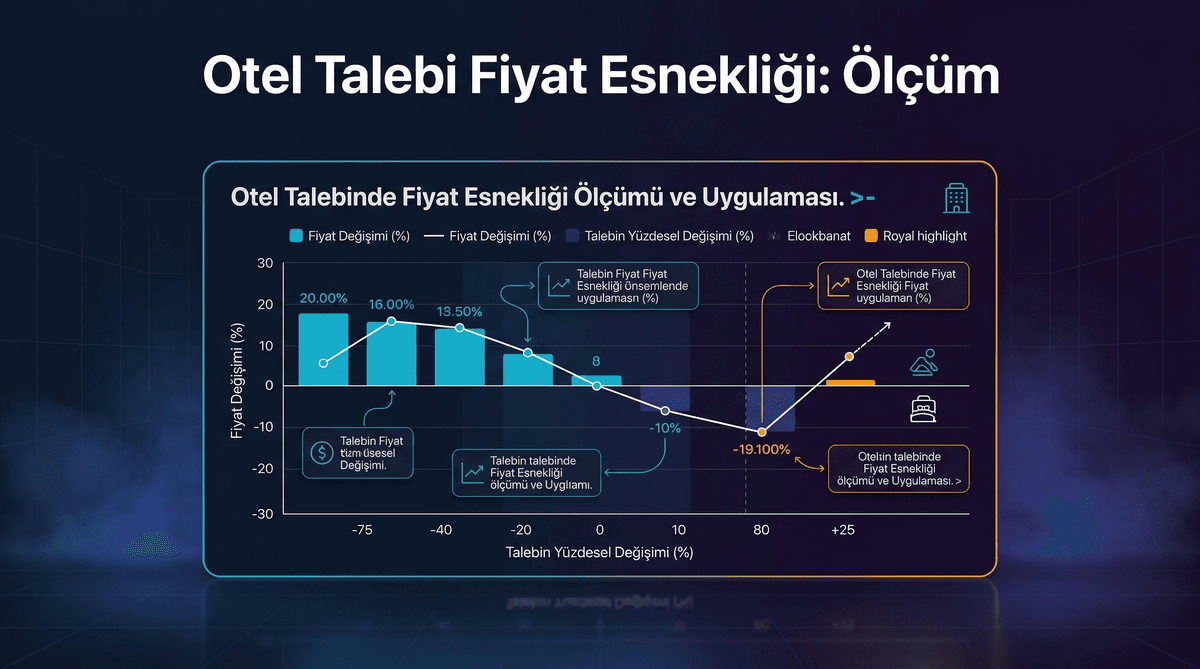
Price elasticity measures the percentage change in demand in response to a percentage change in price. The formula is simple: Ed = (% Change in Demand) / (% Change in Price). However, accurately calculating this in hospitality requires controlling many variables simultaneously.
Research indicates that the average price elasticity in the Turkish hotel sector ranges between -1.2 and -1.8. This means a 10% increase in price leads to a 12-18% decrease in demand. However, this average figure shows dramatic differences across segments.
Related reading: Explore OtelCiro's revenue optimization solutions
Segment-Based Elasticity Analysis
Each guest segment has different price sensitivity. An effective pricing strategy stems from understanding these differences:
Business travel segment (Elasticity: -0.4 to -0.8): Corporate travelers are the least price-sensitive group. Their travel dates are fixed, and they operate within company budgets. Price increases in this segment have a limited impact on demand. For example, when a business hotel in Ankara increased weekday prices by 15%, occupancy only declined by 3%—resulting in an 11.5% net revenue increase.
Leisure segment (Elasticity: -1.5 to -2.5): Leisure travelers compare prices, have flexible dates, and consider alternatives. Aggressive price increases in this segment lead to significant demand loss. A study in coastal hotels in Antalya showed that a 20% price increase resulted in a 35% drop in demand within the leisure segment.
Last-minute segment (Elasticity: -0.6 to -1.0): Guests booking less than 48 hours before check-in are less price-sensitive because they have difficulty finding alternatives.
Loyalty program members (Elasticity: -0.8 to -1.2): Brand-loyal guests show elasticity close to the average but are more likely to accept price increases if the perceived value is high.
AI-Powered Price Elasticity Forecasting
Calculating price elasticity with traditional methods is a static approach based on historical data. However, AI-powered prediction engines produce much more dynamic and precise results.
Advantages of AI-based elasticity models:
- Real-time calculation: Instantly updates the elasticity coefficient as market conditions change.
- Multivariate analysis: Simultaneously evaluates over 50 variables, such as weather, events, competitor prices, and holiday calendars.
- Micro-segment precision: Calculates elasticity not just for "business travel" but for narrow segments like "single-night business travel from Germany on a Tuesday."
- A/B test automation: Conducts controlled tests of different price points and determines the optimal price once statistical significance is reached.
Hotels in Turkey utilizing AI-powered price elasticity models demonstrate 18-24% higher RevPAR performance compared to those that do not.
Data Requirements for Elasticity Measurement
Systematic data collection is essential for accurate price elasticity measurement. The primary data sets required include:
Historical price and occupancy data: At least 24 months of daily price changes and corresponding occupancy rates. The more granular the data, the more accurate the model.
Competitive set data: Price movements of hotels in the comp set and their impact on your own demand. This data is critical for calculating cross-price elasticity.
Channel-based distribution: The same price change will have different effects across OTA, direct website, and corporate channels. A separate elasticity coefficient should be calculated for each channel.
Macroeconomic indicators: Macro data such as inflation rates, exchange rates, and consumer confidence indices directly affect elasticity calculations, especially in high-inflation environments like Turkey.
An ideal data set should contain a minimum of 10,000 observation points. This may require combining multiple room types, channels, and periods to reach this number.
Elasticity-Based Pricing Strategies
Once elasticity data is collected and analyzed, the next step is to translate it into concrete pricing strategies:
Price increases during low elasticity periods: Elasticity decreases during periods of conventions, trade shows, and high demand. Boldly increase prices during these times—demand loss will be minimal. An Istanbul hotel, by increasing prices by 25% during the MICE season, experienced only a 4% loss in occupancy, leading to a 20% increase in net revenue.
Value packages during high elasticity periods: During high elasticity periods, such as the low season, add value instead of just dropping prices. Additional services like complimentary breakfast, spa credit, or late check-out increase perceived value, thereby lowering elasticity.
Channel-based differentiation: Elasticity is generally lower for direct channels than for OTAs. Optimize your channel mix by leveraging this with a direct channel price advantage.
Dynamic minimum length of stay (MLOS): Implementing an MLOS during periods of low elasticity increases total revenue. Conversely, removing this restriction during high elasticity periods helps maintain occupancy.
Common Mistakes and What to Avoid
Here are common errors in price elasticity analysis:
Relying on averages: Using a single elasticity coefficient for all segments is the most common and costly mistake. Calculate separately for segments, channels, days, and seasons.
Mistaking correlation for causation: An increase in demand coinciding with a price drop might be due to external factors, not just the price. Controlled experiments mitigate this risk.
Focusing on nominal prices: In a high-inflation environment, a nominal price increase might actually be a real price decrease. Use real prices in elasticity calculations.
Neglecting competitive effects: Your own price change will yield different results depending on competitors' reactions. Incorporate a game theory perspective into the model.
Measuring price elasticity is one of the most powerful tools in revenue management. With AI-powered modern tools, making this measurement continuous, precise, and actionable is now accessible to hotels of all sizes.
![Hotel Ancillary Revenue: Monetizing Spa, F&B & Activities [2026 Guide]](https://cdn.sanity.io/images/1la98t0z/production/cfce3407a5ef8f70edd19853e8059317fca7b6a6-2752x1536.jpg?w=1920&q=50&auto=format&fit=max)
![FIFA 2026 World Cup: Hotel Dynamic Pricing Strategy [2026 Guide]](https://cdn.sanity.io/images/1la98t0z/production/7a76affe61333341ec47bb0c705011068a1afd24-2752x1536.jpg?w=1920&q=50&auto=format&fit=max)