
![Hotel Predictive Maintenance: IoT & AI for Uptime [2026 Guide]](https://cdn.sanity.io/images/1la98t0z/production/6048dec151e82d0c456a71726cf57c50f92786b2-1200x669.png?w=1920&q=65&auto=format&fit=max)
Key Takeaways
- High Cost of Reactive Maintenance: 78% of hotels still rely on reactive or calendar-based maintenance, leading to significant financial and reputational losses when equipment fails.
- Proactive Failure Prediction: IoT sensors and AI enable hotels to predict equipment malfunctions days or weeks in advance, preventing costly disruptions.
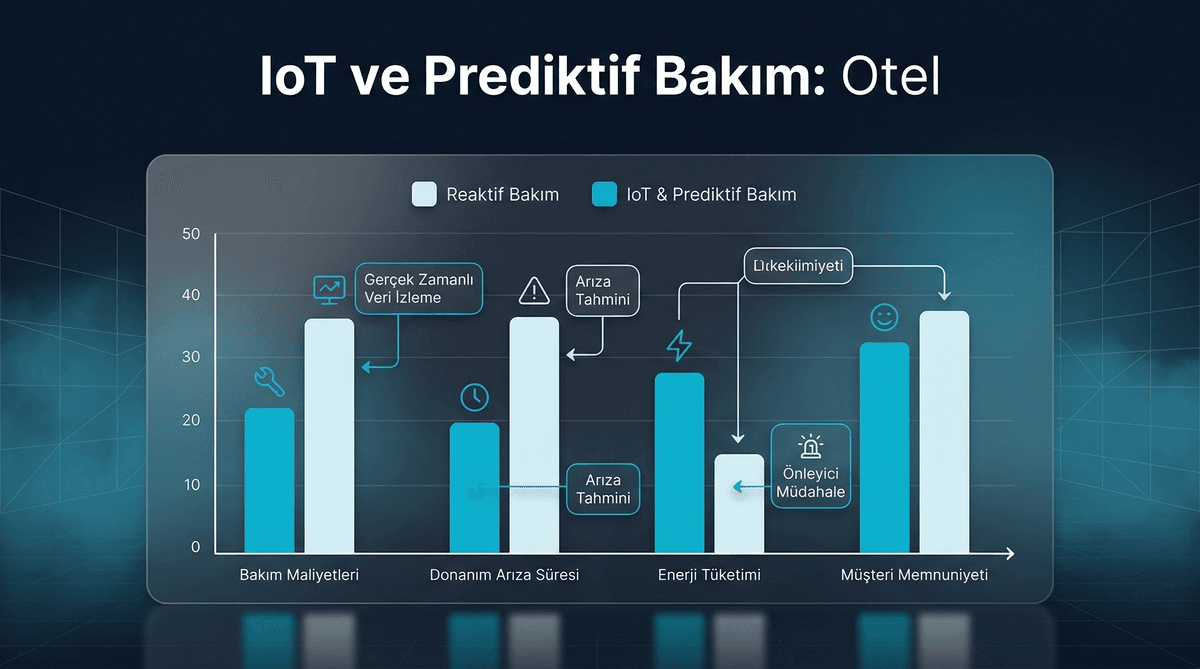
- Significant ROI: Predictive maintenance reduces overall maintenance costs by 25-40%, extends equipment lifespan by 20-30%, cuts guest complaints by 60-75%, and offers an average ROI of 10-16 months.
- Strategic Implementation: Prioritize high-impact equipment like HVAC, elevators, and hot water systems. Adopt a phased, step-by-step approach to integrate IoT and AI across your facilities.
- Future-Proof Operations: Embracing predictive maintenance transforms operations from reactive "fix-it" to proactive "prevent-it," paving the way for autonomous maintenance systems and sustainable competitive advantage.
The High Cost of Reactive Maintenance
A hotel's air conditioning system malfunctions on the hottest day of summer. 30 rooms are affected, guests complain, some request room changes, and a few even check out of the hotel entirely. Emergency technical service is called, parts are awaited, and the total repair takes 48 hours. The result: an estimated 85,000 TL in direct costs, irreversible damage to reputation, and declining review scores.
This scenario plays out every season in many hotels in Turkey. This is because 78% of hotels still use reactive maintenance (repairing after a breakdown) or calendar-based preventive maintenance (routine checks at fixed intervals). However, IoT sensors and AI-powered predictive maintenance systems can forecast a breakdown days or even weeks in advance.
Embed this image on your site
<a href="https://otelciro.com/en/news/hotel-predictive-maintenance-iot-ai-for-uptime-2026-guide">
  <img src="https://cdn.sanity.io/images/1la98t0z/production/6048dec151e82d0c456a71726cf57c50f92786b2-1200x669.png" alt="IoT Predictive Maintenance Hotel Facilities Infographic" width="800" />
</a>
<p>Source: <a href="https://otelciro.com">OtelCiro</a> — AI Hotel Revenue Management</p>
What is Predictive Maintenance and How Does It Work?
Predictive maintenance is an approach that continuously monitors the current condition of equipment to estimate the probability of a failure. Its key differences from traditional maintenance methods are:
| Maintenance Type | Approach | Cost Impact | Failure Risk |
|---|---|---|---|
| Reactive | Repair when broken | Highest | 100% (failure occurs) |
| Preventive | Maintain by schedule | Medium | 30-40% (early/late maintenance) |
| Predictive | Forecast failure with data | Lowest | 5-10% (optimized) |
An IoT-based predictive maintenance system consists of three main layers:
Sensor Layer: Vibration, temperature, humidity, pressure, current, and sound sensors are mounted on equipment. A vibration sensor attached to an HVAC system detects bearing wear in the compressor at microscopic levels that a normal user would not notice.
Communication Layer: Sensor data is transmitted to a central gateway via LoRaWAN, Zigbee, or Wi-Fi protocols. A medium-sized hotel generates 2-5 GB of sensor data daily.
Analysis Layer: Machine learning algorithms analyze sensor data in real-time. When deviations from normal operating patterns are detected, a notification is sent to the maintenance team, along with the type of potential failure and its estimated occurrence time.
The OtelCiro operations ecosystem centralizes maintenance management by collecting IoT sensor data in a single dashboard.
Related reading: Hotel IoT and Smart Room Technologies
Which Hotel Equipment Should Be Monitored?
Equipping all equipment with sensors simultaneously is neither practical nor cost-effective. A risk and impact matrix should be used for prioritization:
High-Priority Equipment:
- HVAC Systems (Heating-Cooling-Ventilation): Dozens of rooms are affected in case of a breakdown. The compressor, fan motor, and refrigerant circuit must be monitored. A compressor failure typically incurs an average repair cost of 35,000-80,000 TL.
- Elevators: Critical for guest safety. Motors, brake systems, and door mechanisms are monitored.
- Boiler and Hot Water Systems: Especially during winter, hot water outages are one of the most common causes of guest complaints.
Medium-Priority Equipment:
- Laundry Machines: In large hotels, over 500 kg of laundry is washed daily. The bearing and motor conditions of industrial washing machines are monitored.
- Generators: It is vital for generators to be ready for immediate activation during power outages.
- Pool Pumps and Filters: A breakdown during the summer season can lead to pool closure and significant revenue loss.
Low-Priority (Optional):
- Lighting systems, automatic doors, mini-bar units.
Real-World Results and ROI Analysis
The return on investment for predictive maintenance generally exceeds industry averages. Concrete data:
Maintenance Cost Reduction: Hotels adopting predictive maintenance see an average 25-40% reduction in total maintenance expenditures. The main source of this reduction is the minimization of emergency repair costs (which are 3-8 times more expensive than normal maintenance).
Extended Equipment Life: Continuous monitoring and timely intervention extend the life of HVAC systems by an average of 20-30%. Extending the life of a 15-year-old chiller unit to 18-19 years avoids early replacement costs.
Guest Experience: Unexpected breakdown-related room changes, complaints, and compensation claims decrease by 60-75%.
Energy Efficiency: Equipment operating at optimal performance consumes 8-15% less energy. For a hotel, this means an annual energy saving of 50,000-120,000 TL.
The installation cost of an IoT predictive maintenance system for a 200-room hotel (including sensors, gateway, and software license) ranges from 180,000-350,000 TL. The average payback period is estimated at 10-16 months.
Implementation Strategy: A Step-by-Step Transition
The transition to predictive maintenance should be phased, not immediate:
Phase 1 — Discovery and Pilot (1-2 months): Sensors are installed on 3-5 of the most critical equipment groups. HVAC and elevators are typically the first targets. This phase involves collecting initial data and familiarizing the maintenance team with the system.
Phase 2 — Expansion (3-6 months): Based on pilot results, sensor coverage is expanded. Boilers, generators, and laundry equipment are included. As the AI model collects sufficient data, prediction accuracy improves.
Phase 3 — Full Integration (6-12 months): Full integration with the Computerized Maintenance Management System (CMMS) is achieved. Automatic work order creation, spare part inventory management, and supplier coordination are incorporated into the system.
Technical infrastructure challenges in Turkey should not be overlooked. Cabling may be limited in older buildings; in such cases, wireless sensor solutions and LoRaWAN-based devices with 5-10 year battery life should be preferred. Additionally, IP67 protection class sensors should be used in hot and humid environments (boiler rooms, laundries).
Related reading: Smart Building Automation: Energy and Comfort Balance
Preparing for the Future: Autonomous Maintenance Systems
The next evolution of predictive maintenance is autonomous maintenance systems. In these systems, AI not only predicts failures but also automatically performs simple interventions. For example, mechanisms that automatically replenish refrigerant levels in HVAC systems when they drop, or smart controllers that automatically adjust operating modes when an energy consumption anomaly is detected, are already entering the market.
IoT and predictive maintenance are cornerstones of the hospitality industry's shift from a "fix-it" culture to a "prevent-it" culture. Facilities that adopt this transformation early will achieve a sustainable advantage in both cost efficiency and guest satisfaction.
![AI Chatbot Revenue Impact for Hotels: 2026 Strategy [Data Analysis]](https://cdn.sanity.io/images/1la98t0z/production/28a6b8cebd12686a668a97549c9e9a619c6f4277-2752x1536.jpg?w=1920&q=50&auto=format&fit=max)
![Hotel AI Technology Budgets 2027: 8-Point Investment Framework That Delivers 15x ROI [2026]](https://cdn.sanity.io/images/1la98t0z/production/7e64ec0aab777ec433ec0f4f1257373a84f39d1d-2048x2048.png?w=1920&q=50&auto=format&fit=max)