
![Hotel Package Pricing: Boost Value & Revenue with Bundles [2026 Guide]](https://cdn.sanity.io/images/1la98t0z/production/6629ab9c6df4a7282a62d2f1e0cdb8ee0912a971-1200x669.png?w=1920&q=65&auto=format&fit=max)
Key Takeaways
- Bundling increases the perceived value of hotel services, simplifying guest decision-making and driving higher spending.
- Hotels utilizing package pricing achieve 20-35% higher total guest spend and 12% greater guest satisfaction compared to those that don't.
- AI-powered systems enable sophisticated package design through purchase correlation analysis, price sensitivity determination, seasonal optimization, and segment-specific matching.
- Strategic channel differentiation is crucial; offer comprehensive, exclusive packages on direct channels and simpler versions on OTAs.
- Regularly measure package performance using metrics like penetration rate, average package value, component usage, and cancellation rates to continually refine your strategy.
The Power of Package Pricing: Why Bundle?
A guest might be hesitant to pay 2,000 TL for a hotel room, but they might find a 3,200 TL offer—presented as "2 nights accommodation + romantic dinner + spa package"—to be a valuable deal. This illustrates the fundamental psychology of package pricing (bundling): increasing perceived value and simplifying the guest's decision-making process by offering services that would total 4,000 TL if purchased separately, all in one package.
According to Phocuswright's 2025 research, hotels that implement package pricing achieve 20-35% higher total spend per guest compared to those that don't. Moreover, satisfaction scores for guests who purchase packages are 12% higher—because every part of their experience is pre-planned and guaranteed.
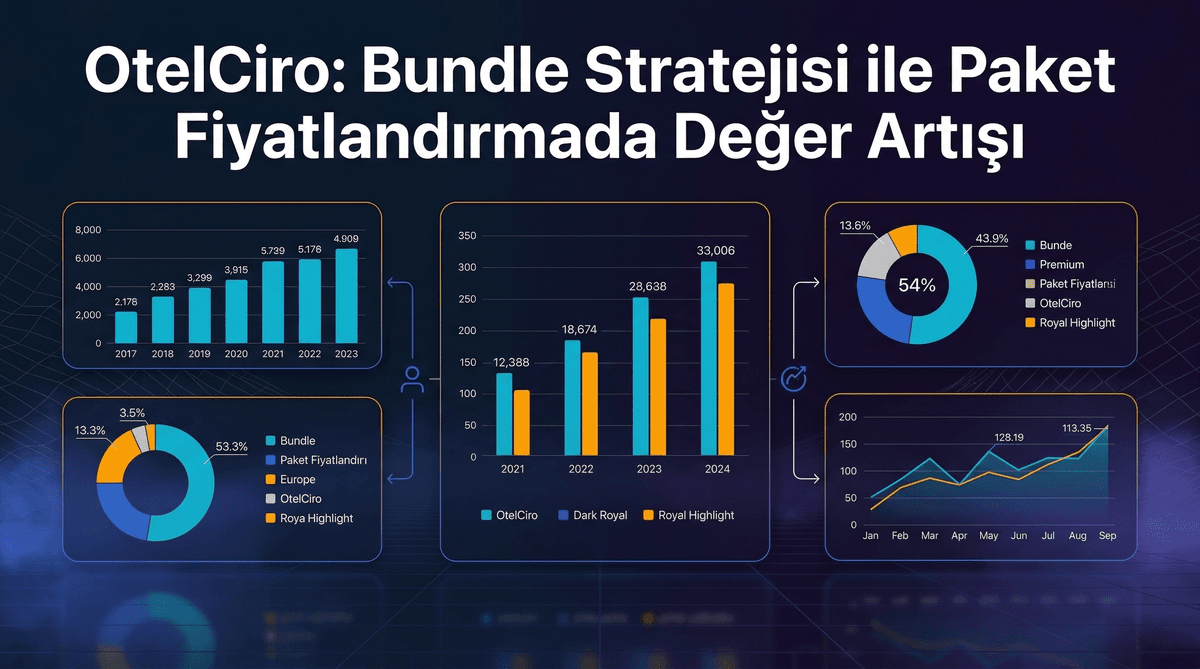
Embed this image on your site
<a href="https://otelciro.com/en/news/hotel-package-pricing-boost-value-revenue-with-bundles-2026-guide">
  <img src="https://cdn.sanity.io/images/1la98t0z/production/6629ab9c6df4a7282a62d2f1e0cdb8ee0912a971-1200x669.png" alt="Hotel Package Pricing Infographic" width="800" />
</a>
<p>Source: <a href="https://otelciro.com">OtelCiro</a> — AI Hotel Revenue Management</p>
Related reading: Hotel Upselling and Cross-selling Techniques
Package Types and Strategic Applications
Pure Bundling vs. Mixed Bundling
Pure bundling is a model where components are sold only as a package. For example, the "All-Inclusive" concept is a pure bundle. Mixed bundling offers both a package and individual purchase options. Research indicates that mixed bundling in hospitality generates 15-20% higher revenue because guests benefit from both the package discount and the freedom of individual choice.
Common Package Models
Romantic Getaway Package: Room + champagne + couples spa massage + private dinner. Average basket value is 45% higher compared to a single room sale. Ideal for increasing weekend occupancy rates.
Business Travel Package: Room + high-speed WiFi + airport transfer + business center access. Builds loyalty in the corporate segment and increases direct channel preference.
Family Vacation Package: Family room + kids' club + breakfast + tour. Reported to extend the average length of stay by 1.4 nights.
Wellness Package: Room + daily yoga + detox menu + spa treatments. Appeals to the rising wellness tourism trend and bundles high-profit margin services.
AI-Powered Package Design
Traditional package creation often relies on intuition: "Guests love spas, let's add a romantic dinner." However, AI-powered systems can design much more sophisticated packages through data analysis.
OtelCiro AI engine performs the following analyses to recommend optimal packages:
Purchase correlation: Identifies which services are highly likely to be purchased together. For instance, it might discover that 68% of guests who book a pool-view room also opt for the buffet dinner.
Price sensitivity analysis: Determines the optimal discount rate for each segment. Research shows that package discounts generate the highest conversion rates when they are in the 15-25% range. Below 15% is not appealing, while above 25% leads to revenue loss.
Seasonal optimization: Automatically creates more aggressive packages during low-demand periods and premium packages during high-demand periods.
Segment matching: Designs tailored packages for each guest segment. It offers local experience packages to Gen Z travelers while recommending comfort-focused packages to the Baby Boomer segment.
Pricing Math: Optimal Discount Rate
The basic formula for determining a package price is:
Package Price = (Component A + Component B + Component C) × (1 - Discount Rate)
However, the critical question is: What is the true cost of each component? A spa massage might have a list price of 800 TL, but if it's given during a therapist's idle hour, its marginal cost might only be 120 TL. This difference provides significant flexibility in package pricing.
Example calculation:
| Component | List Price | Marginal Cost |
|---|---|---|
| Deluxe Room (1 night) | 2,500 TL | 450 TL |
| Spa Massage | 800 TL | 120 TL |
| Dinner (2 people) | 1,200 TL | 380 TL |
| Total | 4,500 TL | 950 TL |
Package price with a 25% discount based on list price: 3,375 TL Profit margin: 3,375 - 950 = 2,425 TL (72% gross profit)
While the guest believes they are saving 1,125 TL, the hotel secures spa and dining revenue that might never have materialized through individual sales.
Distribution Channel and Package Strategy
Offering the same package across all distribution channels is a strategic error. Channel-based differentiation suggestions:
Direct channel (hotel website): The most comprehensive and attractive packages should be offered here. Encourage direct bookings with a "site-exclusive" label. Direct channel packages have a 30% higher conversion rate than OTA packages.
OTA channels: Offer simpler packages on Booking.com and Expedia. While factoring commission costs into the package price, select minimal components that still create value for the guest.
GDS / Corporate: Business travel-focused, standard packages. Prioritize components that align with company policies and are easily billable.
Social media / Campaign: Short-term, urgency-creating special packages. Use FOMO (Fear of Missing Out) triggers like "48-hour wellness getaway."
Related reading: Channel Management and OTA Distribution Strategies
Performance Measurement and Iteration
Key metrics to track to measure the success of your package strategy:
- Package penetration rate: What percentage of total bookings are package sales? The industry average is 18-25%, with leading hotels reaching 35-40%.
- Average package value vs. single room sale: The revenue difference generated per guest by packages.
- Package component utilization rate: How many of the services in a purchased package did the guest actually use? Low utilization rates indicate poor component selection.
- Cancellation rate comparison: Package bookings typically have a 40% lower cancellation rate than single reservations—this is a significant advantage in itself.
AI-powered analytics tools continuously monitor these metrics, automatically deactivating underperforming packages and increasing the budget for high-performing ones.
Conclusion: Create Value, Increase Revenue
When implemented correctly, package pricing is one of the rare win-win strategies that increases both guest satisfaction and hotel revenue. The critical point is that packages should be designed data-driven, not intuitively, continuously tested, and personalized based on segments.
Design, price, and deliver optimal packages based on your guest data to the right guest on every channel with the OtelCiro AI engine.
![Hotel Ancillary Revenue: Monetizing Spa, F&B & Activities [2026 Guide]](https://cdn.sanity.io/images/1la98t0z/production/cfce3407a5ef8f70edd19853e8059317fca7b6a6-2752x1536.jpg?w=1920&q=50&auto=format&fit=max)
![FIFA 2026 World Cup: Hotel Dynamic Pricing Strategy [2026 Guide]](https://cdn.sanity.io/images/1la98t0z/production/7a76affe61333341ec47bb0c705011068a1afd24-2752x1536.jpg?w=1920&q=50&auto=format&fit=max)