The Largest Line Item You Are Not Optimizing
Ask any hotel general manager about their biggest controllable operating cost, and the answer is almost always energy. Within the energy budget, one system dominates everything else: HVAC — heating, ventilation, and air conditioning. Industry data consistently shows that HVAC accounts for 50-60% of a hotel's total energy consumption, making it the single largest variable cost after labor.
Despite this, most hotels still operate their HVAC systems on static schedules and manual overrides. Rooms are cooled or heated regardless of occupancy. Common areas maintain fixed temperature setpoints regardless of foot traffic. The building management system (BMS) responds to conditions after they occur, not before.
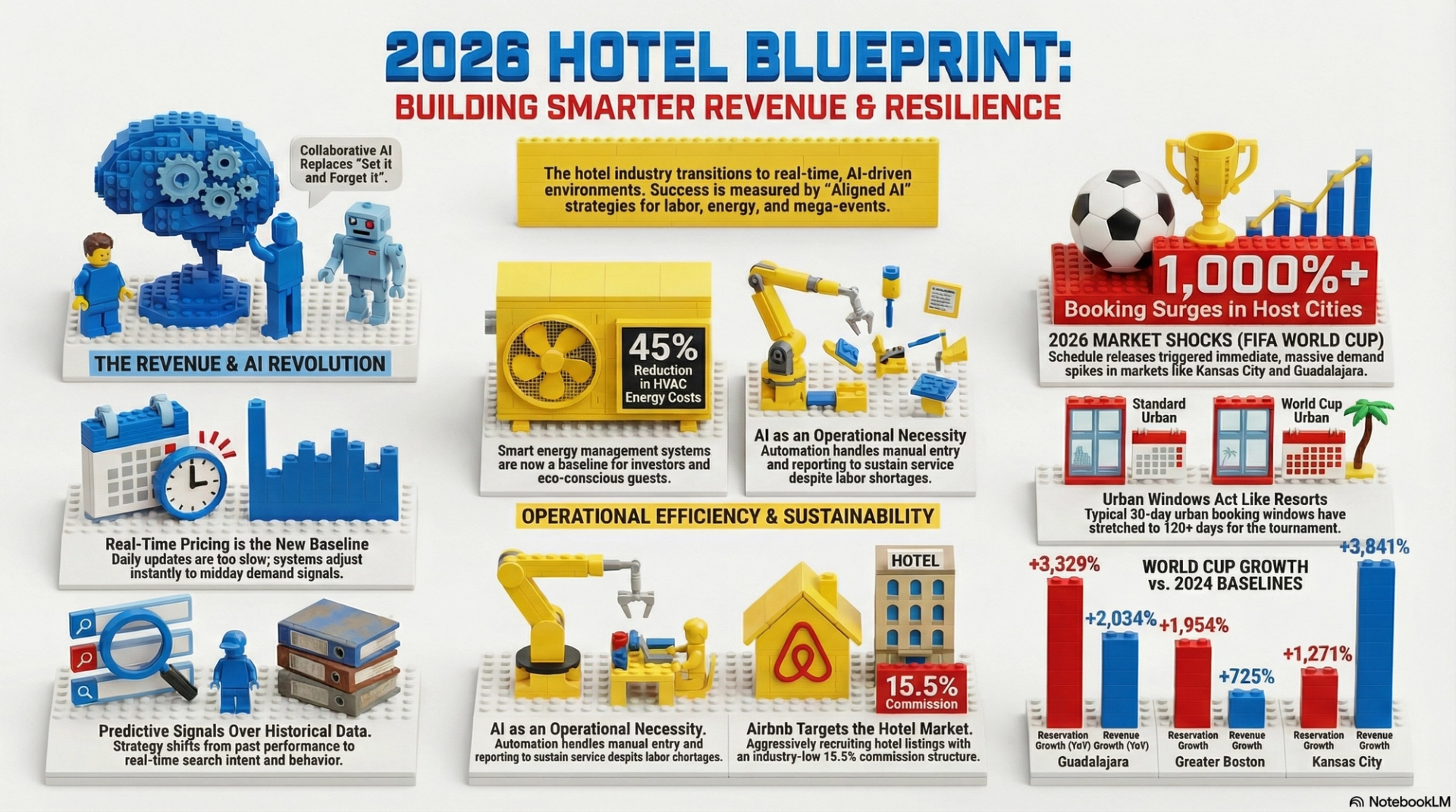
AI-driven HVAC optimization changes this equation fundamentally. By analyzing occupancy patterns, weather forecasts, historical consumption data, and real-time sensor inputs, AI systems can reduce HVAC energy consumption by 25-40% — translating to a 15-25% reduction in total property energy costs.
Where the Energy Goes
Understanding the HVAC energy profile is the first step toward optimizing it:
| HVAC Component | % of HVAC Energy | Optimization Potential |
|---|---|---|
| Guest room cooling/heating | 40-50% | High — occupancy-based control |
| Common area climate control | 20-25% | High — traffic pattern analysis |
| Chiller/boiler plant | 15-20% | Medium — load optimization |
| Ventilation and air handling | 10-15% | Medium — demand-based ventilation |
| Kitchen exhaust and makeup air | 5-8% | Low-medium — schedule optimization |
Guest room climate control represents the largest share and the highest optimization potential. A 200-room hotel with 70% occupancy has 60 unoccupied rooms on any given night — each one being cooled or heated to guest-comfort temperatures by default. This waste is entirely eliminable with intelligent controls.
How AI HVAC Optimization Works
Predictive occupancy modeling
The AI system integrates with the property management system (PMS) to understand occupancy in real time and, critically, to predict it. When a guest checks out at 10 AM and the next arrival is not expected until 4 PM, the system transitions the room to an energy-saving setpoint within minutes — not hours.
More sophisticated models use booking data to predict occupancy days in advance:
- Rooms confirmed for tomorrow are pre-conditioned 60-90 minutes before expected arrival, not maintained at comfort temperature all day.
- Rooms with no reservation for the next 48 hours drop to deep energy-saving mode — a wider temperature band that prevents mold or pipe damage but uses 70-80% less energy than guest-comfort settings.
- Check-in pattern analysis allows the system to learn that business hotels see a 3-5 PM arrival cluster and resort properties see a 12-2 PM pattern, timing pre-conditioning accordingly.
Weather-responsive control
Traditional BMS systems react to current conditions. AI systems anticipate them. By integrating weather forecast data — temperature, humidity, solar radiation, wind speed — the AI can:
- Pre-cool the building during early morning hours when electricity rates are lower (in time-of-use tariff structures), reducing the cooling load during expensive afternoon peak hours.
- Anticipate humidity spikes and adjust ventilation preemptively, avoiding the energy-intensive scenario of dehumidifying already-saturated indoor air.
- Leverage natural ventilation when outdoor conditions permit, reducing mechanical cooling demand by 20-30% during shoulder seasons.
Historical pattern learning
The AI continuously learns from historical data. Over time, it develops increasingly accurate models of:
- How quickly different zones of the building heat up or cool down (thermal mass characteristics)
- Which rooms receive direct afternoon sun and need earlier or more aggressive cooling
- How conference room temperature rises when occupied by 50+ people
- The lag time between chiller startup and achieving target temperatures in distant rooms
This learning eliminates the over-conditioning that occurs when static systems use worst-case assumptions for every scenario.
Energy Savings Breakdown
Properties implementing AI HVAC optimization report the following measurable results:
| Optimization Strategy | Energy Reduction | Implementation Complexity |
|---|---|---|
| Occupancy-based room control | 15-25% of room HVAC | Low — PMS integration + smart thermostats |
| Predictive pre-conditioning | 8-12% of room HVAC | Medium — AI model + weather API |
| Common area traffic optimization | 10-18% of common area HVAC | Medium — occupancy sensors + AI |
| Chiller plant load optimization | 5-10% of plant energy | High — BMS integration + AI |
| Demand-based ventilation | 8-15% of ventilation energy | Medium — CO2 sensors + controls |
| Combined total | 25-40% of total HVAC energy | — |
For a mid-size hotel spending EUR 200,000-400,000 annually on energy, with HVAC representing 55% of that cost, a 30% reduction in HVAC energy translates to EUR 33,000-66,000 in annual savings. The payback period for most AI HVAC implementations is 12-24 months.
Real-World Performance Data
Case: Mediterranean resort property (280 rooms)
A resort on Turkey's Mediterranean coast implemented AI HVAC optimization in early 2025. The property's climate challenges include extreme summer cooling demand (40C+ outdoor temperatures), high humidity, and significant occupancy variation between peak and shoulder seasons.
Results after 12 months:
- Total energy reduction: 28%
- HVAC energy reduction: 34%
- Annual savings: EUR 52,000
- Guest comfort complaints: Decreased by 15% (the AI maintains tighter temperature control than manual systems)
- Payback period: 14 months
The counterintuitive finding — that guest comfort improved alongside energy reduction — is consistent across implementations. AI systems maintain more consistent temperatures by anticipating thermal loads, while static systems allow temperatures to drift before correcting.
Case: Urban business hotel (150 rooms)
A business hotel in Istanbul with high weekday occupancy and low weekend occupancy implemented occupancy-based HVAC control integrated with its PMS.
Results after 8 months:
- Weekend energy reduction: 42% (significantly reduced cooling of unoccupied rooms)
- Weekday energy reduction: 18% (optimization of occupied room pre-conditioning)
- Annual savings: EUR 28,000
- Implementation cost: EUR 22,000
- Payback period: 9.4 months
Implementation Architecture
A complete AI HVAC optimization system consists of four layers:
1. Sensor layer
- Room occupancy sensors: PIR (passive infrared) or radar-based presence detection in guest rooms. These tell the system whether a room is physically occupied, not just reserved.
- Environmental sensors: Temperature, humidity, and CO2 sensors in rooms, corridors, and common areas. CO2 levels are particularly valuable for demand-based ventilation in conference rooms and restaurants.
- Energy meters: Sub-metering for HVAC components (chillers, air handling units, fan coil units) to measure actual consumption by zone.
2. Integration layer
- PMS connection: Real-time occupancy status, arrival/departure times, and booking forecasts.
- Weather API: Multi-day forecasts including temperature, humidity, solar radiation, and wind.
- BMS interface: Bidirectional communication with the building management system to read current states and issue control commands.
3. AI/ML layer
- Thermal model: Learns the building's thermal characteristics — heat gain, cooling rates, zone interactions.
- Occupancy predictor: Forecasts room and common area occupancy based on PMS data, day of week, season, and events.
- Optimization engine: Continuously calculates the most energy-efficient HVAC settings that maintain guest comfort targets.
4. Control layer
- Smart thermostats: In-room units that accept setpoint commands from the AI system while allowing guest overrides within a defined range.
- BMS commands: Automated adjustments to chiller staging, air handling unit speeds, and ventilation rates.
- Override management: Guest comfort always takes priority. If a guest adjusts the thermostat, the AI respects the override and optimizes around it.
Common Implementation Mistakes
Over-aggressive setback temperatures
Setting unoccupied room temperatures too far from comfort range means the system needs excessive energy to recover when a guest arrives unexpectedly early. A 4-6 degree setback is optimal; a 10+ degree setback creates comfort complaints and energy spikes.
Ignoring thermal mass
Hotels with thick stone or concrete walls (common in Turkish Mediterranean architecture) have high thermal mass — they retain heat and cold for extended periods. AI systems that do not account for this characteristic will over-condition, wasting energy on a building that would have maintained acceptable temperatures naturally.
Neglecting maintenance
AI optimization cannot compensate for poorly maintained equipment. Dirty filters, refrigerant leaks, and malfunctioning dampers undermine the system's ability to execute efficient control strategies. An AI system should flag maintenance issues through anomaly detection — unexpected energy consumption patterns that indicate equipment degradation.
Treating guest overrides as failures
When a guest adjusts the thermostat, some systems interpret this as an optimization failure and fight the override. This creates a frustrating experience. The correct approach is to learn from overrides — if guests in south-facing rooms consistently set temperatures 2 degrees lower than the AI's target, the model should adjust its comfort assumptions for those rooms.
The Fastest Sustainability Win
Among all sustainability investments a hotel can make — solar panels, water recycling, waste management, green building certification — AI HVAC optimization offers the fastest measurable return. The reasons are straightforward:
- No construction required: The system layers onto existing HVAC infrastructure.
- Immediate impact: Energy savings begin from the first day of operation.
- Short payback: 9-24 months, compared to 5-10 years for solar installations.
- Measurable and reportable: Energy consumption data provides the documentation needed for sustainability certification, green financing, and corporate client requirements.
For hotels navigating the shift from voluntary sustainability to compliance requirement, AI HVAC optimization is the logical starting point — it reduces costs, improves guest comfort, and generates the verified data that regulators and corporate clients now demand.
![Hotel Staff Management Software with Audit Logs & Tracking [2026]](https://cdn.sanity.io/images/1la98t0z/production/9b981b83601ab9b3b5d18cb6e8819bb539b4d2f7-1200x630.png?w=1920&q=50&auto=format&fit=max)