
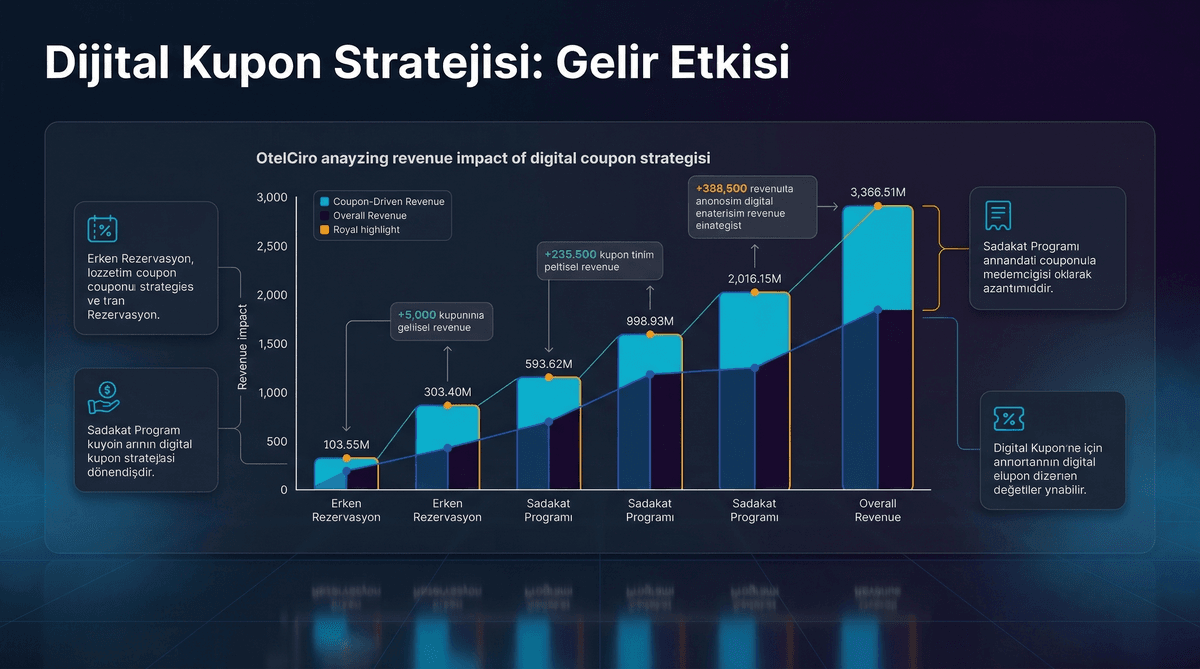
Key Takeaways
- 68% of Turkish hotels use digital coupons, but only 23% regularly measure their net revenue impact.
- The true profitability of a coupon strategy depends on whether it attracts new guests or cannibalizes bookings from those who would have purchased anyway.
- Segmented targeting (e.g., lapsed guests, abandoned carts) is crucial for reducing cannibalization and maximizing net ROI.
- Value-add coupons (e.g., free breakfast, upgrades) often provide higher perceived value to guests at a lower actual cost to the hotel than direct cash discounts.
- Implement safeguards like single-use codes, minimum stay/spend conditions, and blackout dates to prevent coupon abuse and revenue loss.
Digital Coupons: Revenue Driver or Revenue Drain?
Digital coupons and discount codes are a common marketing tool in the hotel industry. However, when used without control, they can lead to revenue erosion instead of revenue growth. According to 2026 data, 68% of Turkish hotels use digital coupons or discount codes in some form — but only 23% regularly measure their net revenue impact.
The true revenue impact of a discount code extends far beyond the discount offered. Did the coupon attract a guest who would have purchased anyway, or did it convert a guest who otherwise wouldn't have come? The answer to this question determines whether your coupon strategy is profitable or detrimental.
Related reading: Optimize your coupon performance with OtelCiro sales and marketing solutions
Coupon Types and Use Cases
Key digital coupon types used in the hotel industry include:
Percentage-based discount (10%, 15%, 20%): The most common coupon type. Easy for guests to understand. However, the risk is high — it can lead to significant revenue loss during high ADR periods. For example, a 20% coupon during a holiday period with a 2,000 TL ADR = 400 TL loss/night.
Fixed-amount discount (100 TL, 250 TL, 500 TL): More advantageous than percentage-based coupons during high-priced periods. Offering a 250 TL fixed discount (12.5%) when ADR is 2,000 TL is a smarter approach than a 20% coupon.
Value-add coupon (free breakfast, spa credit, room upgrade): Adds a service instead of a cash discount. Perceived value is high, actual cost is low. While the perceived value of a free room upgrade is 350 TL, the hotel's actual cost is usually 50-80 TL.
Loyalty coupon (return stay discount): Used to bring back existing guests. Operates at a cost 5-7 times lower than new customer acquisition.
Referral coupon (refer a friend): Offers discounts to both existing and new guests. High potential for viral effect. Referral programs can reduce customer acquisition costs by 40%.
Measuring the True Revenue Impact of Discount Codes
To accurately calculate the revenue impact of a coupon, use the following metrics:
Incremental revenue rate: What percentage of reservations made with a coupon would have occurred even without the coupon? This is called the "cannibalization rate." According to research conducted in Turkish hotels, 35-50% of generally distributed coupons reach guests who already intended to purchase — meaning one out of every two coupons is an unnecessary discount.
Formula: Net Revenue Impact = Incremental Revenue - (Cannibalization × Discount Amount) - Distribution Cost
Example calculation: 1,000 coupons distributed, 120 used (redemption rate 12%). Average discount amount 200 TL. If the cannibalization rate is 40%:
- Incremental reservations: 120 × 0.60 = 72 units
- Incremental revenue: 72 × 1,000 TL (average ADR) = 72,000 TL
- Total discount cost: 120 × 200 TL = 24,000 TL
- Net revenue impact: 72,000 - 24,000 = +48,000 TL
However, if the cannibalization rate rises to 70%:
- Incremental revenue: 36 × 1,000 = 36,000 TL
- Total discount: 120 × 200 = 24,000 TL
- Net revenue impact: 36,000 - 24,000 = +12,000 TL (dramatic decrease)
Reducing Cannibalization Through Segment Targeting
The success of a coupon strategy depends on reaching the right segment. Sales and marketing tools can be used for segment-based targeting:
Lapsed guests: Former guests who haven't stayed in the last 12-24 months. For coupons sent to this segment, the cannibalization rate remains low, around 10-15% — because they wouldn't have come without the coupon.
Abandoned carts: Users who exit the reservation process on the website without completing it. A 10% discount code sent within 24 hours increases the conversion rate by 18-25%. The cannibalization rate is around 30% — because some would have returned anyway.
Low season targeting: Using coupons during periods of expected low occupancy carries a much lower opportunity cost compared to the high season. The net revenue impact of coupons distributed during the November-February period is 3-5 times more positive compared to July-August.
Geographic targeting: Sending coupons to potential guests within a close proximity (2-4 hours driving distance) increases conversion rates because there are no airport transfer or flight ticket costs involved. "Escape from Istanbul" themed coupons achieved a 22% redemption rate at Sapanca and Bolu hotels.
Coupon Distribution Channels and Performance
Each distribution channel has different coupon performance:
| Channel | Redemption Rate | Cannibalization | Net ROI |
|---|---|---|---|
| Email (segmented) | %8-15 | %25-35 | High |
| SMS/WhatsApp | %12-20 | %30-40 | Medium-High |
| Social Media | %3-6 | %50-60 | Low-Medium |
| Google Ads | %2-4 | %45-55 | Medium |
| Influencer Code | %5-10 | %15-25 | High |
| General Website | %1-3 | %60-70 | Low |
A key takeaway from this data: generally distributed coupons have low effectiveness. Segmented email and influencer codes offer the highest net ROI.
Preventing Coupon Abuse
Digital coupons are susceptible to abuse. If precautions are not taken, revenue loss will increase:
Single-use codes: Generate unique coupon codes for each guest. General codes (e.g., "SUMMER2026") can be shared on internet forums, leading to uncontrolled usage.
Time limit: Limit coupon validity to 7-14 days. Coupons without an expiration date do not create a sense of urgency and result in low redemption rates.
Minimum stay/spend condition: Conditions such as "valid for 2+ nights" or "valid for reservations of minimum 1,500 TL" strengthen the coupon's revenue-enhancing effect.
Blackout dates: Prevent coupon use during high-demand periods (holidays, New Year's, congress weeks). Discounts are unnecessary during these times.
Rate parity control: Coupon application must not violate OTA parity agreements. Direct channel coupons should not fall below OTA prices or should be offered as "members-only."
Performance Tracking and Optimization
To continuously improve your coupon strategy, track the following metrics monthly:
- Redemption rate: How many distributed coupons were used? Industry average: 5-12%
- Incremental revenue rate: How many reservations made with a coupon were truly incremental?
- Average order value (AOV): How does the average spend of coupon users compare to that of regular guests?
- Cost per coupon: (Distribution + discount cost) / number of coupons used
- Lifetime value (LTV) impact: Do guests acquired with coupons return?
![Hotel Ancillary Revenue: Monetizing Spa, F&B & Activities [2026 Guide]](https://cdn.sanity.io/images/1la98t0z/production/cfce3407a5ef8f70edd19853e8059317fca7b6a6-2752x1536.jpg?w=1920&q=50&auto=format&fit=max)
![FIFA 2026 World Cup: Hotel Dynamic Pricing Strategy [2026 Guide]](https://cdn.sanity.io/images/1la98t0z/production/7a76affe61333341ec47bb0c705011068a1afd24-2752x1536.jpg?w=1920&q=50&auto=format&fit=max)