
![Hotel Cancellation Management: Prevent Revenue Loss [Strategy Guide]](https://cdn.sanity.io/images/1la98t0z/production/241a81c7ea837d07255de87c4799b53f946e30fa-1200x669.png?w=1920&q=65&auto=format&fit=max)
Key Takeaways
- Hotel cancellations are a major revenue threat, with global averages at 28% and up to 35% in some Turkish markets, leading to significant financial losses.
- Understand the four main reasons for cancellations: price sensitivity (35%), plan changes (28%), opportunistic bookings (22%), and operational issues (15%).
- Leverage AI-powered prediction models to proactively identify high-risk reservations (scoring 0-100% probability) based on booking characteristics, guest profiles, and market conditions.
- Implement strategic loss prevention techniques including tiered cancellation policies, offering non-refundable rates (reducing cancellations by 70%), optimized overbooking formulas, and targeted win-back campaigns.
- Continuously monitor key performance indicators via a dedicated cancellation analysis dashboard to manage inevitable cancellations and minimize their impact on total revenue.
The Invisible Cost of Cancellations
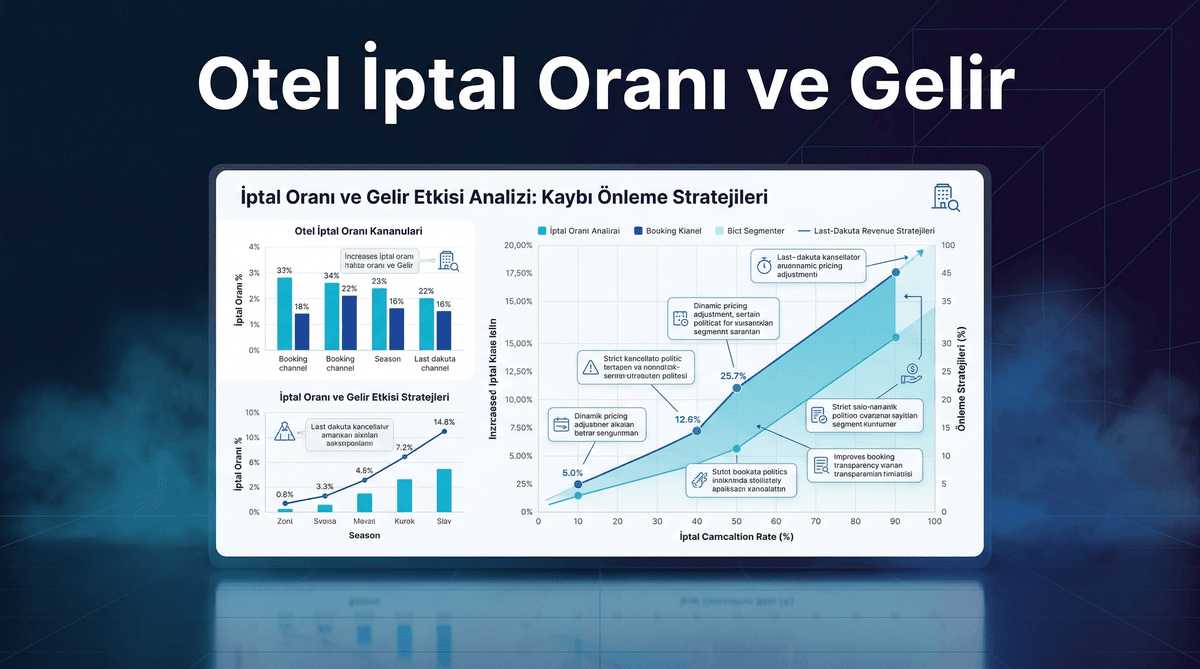
Hotel reservation cancellations are one of the industry's most underestimated revenue killers. According to Booking.com data, the global average cancellation rate is 28% — meaning approximately 3 out of every 10 reservations are canceled before the check-in date. In the Turkish market, this rate can reach up to 35% in some destinations.
The revenue impact of these cancellations can be demonstrated with a simple calculation: a 200-room hotel aiming for 80% occupancy expects to sell 160 rooms daily. With a 28% cancellation rate, 45 of these rooms will be canceled. If not all of them can be re-sold — and typically only 40-60% of canceled rooms are re-sold — a daily loss of 18-27 rooms occurs.
Embed this image on your site
<a href="https://otelciro.com/en/news/hotel-cancellation-management-prevent-revenue-loss-strategy-guide">
  <img src="https://cdn.sanity.io/images/1la98t0z/production/241a81c7ea837d07255de87c4799b53f946e30fa-1200x669.png" alt="İptal Oranı ve Gelir Etkisi İnfografiği" width="800" />
</a>
<p>Source: <a href="https://otelciro.com">OtelCiro</a> — AI Hotel Revenue Management</p>
For a hotel with an ADR of 2,000 TL, this loss translates to a daily revenue erosion of 36,000-54,000 TL, and an annual erosion of 13-20 million TL. And this calculation only includes room revenue — it doesn't account for the lost F&B, spa, and other expenditures from canceled guests.
Related reading: The True Cost of an Empty Room: How Many Hours a Year Does Your Hotel Operate in Vain?
Understanding Cancellation Reasons
To reduce the cancellation rate, it's essential to first categorize the reasons for cancellations. Cornell Hospitality Research's analysis lists the primary reasons for hotel cancellations as follows:
Price-driven cancellations (35%): Guests cancel because they found a lower price. This is the most common reason and is directly related to price parity strategy. If your hotel's price on price comparison sites is higher than on other channels, these cancellations are inevitable.
Change of plans (28%): The travel plan is completely changed or postponed. This category is largely out of control, but flexible re-scheduling options can convert a "cancellation" into a "postponement."
Opportunistic bookings (22%): Guests book multiple hotels and decide at the last minute. This is the biggest side effect of free cancellation policies.
Operational reasons (15%): External factors such as flight cancellations, visa rejections, or health issues. These are uncontrollable but can be managed with insurance and flexible policies.
Cancellation Prediction: Proactive Management with AI
Modern revenue management deals with cancellations proactively, not reactively. AI-powered cancellation prediction models calculate the probability of cancellation for each reservation in advance and suggest strategies accordingly.
The cancellation prediction model implemented with the OtelCiro reporting and analysis module analyzes the following variables:
Reservation characteristics:
- Lead time (longer lead time = higher cancellation risk)
- Payment status (prepaid = 85% lower cancellation rate)
- Channel (OTA cancellations are 40% higher than direct bookings)
- Price type (non-refundable rates reduce cancellation rates by 70%)
Guest profile:
- Past cancellation history (guests who have canceled before are 3.2 times more likely to cancel again)
- Loyalty program membership (members cancel 45% less often)
- Geographic source (some markets systematically show higher cancellation rates)
Market conditions:
- Competitor price movements (if competitors lower prices, cancellation risk increases)
- Destination demand (cancellations increase during periods of falling demand)
- External factors (weather warnings, health threats)
The AI model assigns a cancellation probability score between 0-100% to each reservation. For high-risk reservations (>60%), proactive intervention strategies are triggered.
Loss Prevention Strategies
1. Cancellation Policy Optimization
The cancellation policy is the most powerful control mechanism for cancellation rates. However, overly restrictive policies can reduce the number of reservations. For an optimal balance:
Tiered cancellation structure:
- 30+ days prior: Free cancellation (ensures demand guarantee)
- 14-29 days: 1-night penalty
- 7-13 days: 50% penalty
- 0-6 days: 100% penalty (non-refundable)
This structure tolerates early cancellations while deterring last-minute cancellations. Research shows that a tiered structure reduces the cancellation rate by 12-18% compared to a flat "free cancellation" policy.
2. Non-Refundable Rate Strategy
When non-refundable rates are offered with an 8-15% discount compared to the standard rate, price-sensitive guests prefer this option. Reservations made with non-refundable rates have very low cancellation rates, typically around 3-5%.
Critical point: The share of non-refundable rates should not exceed 20-30% of total reservations. Higher percentages can lead to revenue loss during high-demand periods — as guests get a discounted rate when the cancellation risk is already low.
3. Overbooking Strategy
The most direct way to compensate for cancellation and no-show losses is to overbook by the expected cancellation + no-show rate.
Optimal overbooking formula:
Overbooking Limit = Total Rooms × Expected Cancellation + No-show Rate × Confidence Factor
The confidence factor is usually kept between 0.7-0.9 — relying 100% on cancellation prediction is risky. For a 200-room hotel with an expected cancellation + no-show rate of 12% and a confidence factor of 0.8:
Overbooking limit = 200 × 0.12 × 0.8 = 19 rooms
This means up to 219 rooms can be sold. These 19 additional rooms, with an ADR of 2,000 TL, generate an extra 38,000 TL in daily revenue.
4. Win-back Campaigns
Automated "win-back" emails sent to canceling guests can recover 8-12% of cancellations:
- Immediately upon cancellation: "Have your plans changed? Re-book with a special 5% discount just for you."
- 24 hours later: "Only a few rooms left for your desired dates" (if true).
- 7 days later: Offer to re-schedule with alternative date suggestions.
Related reading: Booking.com Overbooking Management
Cancellation Analysis Dashboard: What to Monitor?
A dedicated section for cancellations should be part of the revenue management KPI dashboard. Key metrics to monitor:
- Gross cancellation rate: Total cancellations / total reservations
- Net cancellation rate: Unresalable cancellations / total reservations (actual loss)
- Channel-specific cancellation rates: Which channel has the highest cancellation rate
- Segment-specific cancellation rates: Leisure vs. corporate vs. group cancellations
- Cancellation timing distribution: Distribution of cancellations relative to the check-in date
- Post-cancellation re-sale rate: How many canceled rooms were re-sold?
- Revenue impact: Total revenue loss from cancellations (in TL)
Conclusion: Don't Fight Cancellations, Manage Them
Cancellations are an unavoidable reality of the hotel industry. Aiming for zero cancellations is neither realistic nor desirable — a near-zero cancellation rate often indicates that overly restrictive policies are suppressing reservation volume. The goal is to determine the optimal cancellation rate and minimize its revenue impact.
With AI-powered cancellation prediction, proactive management strategies, and intelligent overbooking, it's possible to reduce cancellation losses by 40-60%. Deeply analyze your cancellation dynamics and strengthen your revenue protection with OtelCiro reporting and analysis solutions.
![Hotel Ancillary Revenue: Monetizing Spa, F&B & Activities [2026 Guide]](https://cdn.sanity.io/images/1la98t0z/production/cfce3407a5ef8f70edd19853e8059317fca7b6a6-2752x1536.jpg?w=1920&q=50&auto=format&fit=max)
![FIFA 2026 World Cup: Hotel Dynamic Pricing Strategy [2026 Guide]](https://cdn.sanity.io/images/1la98t0z/production/7a76affe61333341ec47bb0c705011068a1afd24-2752x1536.jpg?w=1920&q=50&auto=format&fit=max)