
![Hotel AI ROI Report: 17% Revenue, 20% Faster Cleaning [2026 Insights]](https://cdn.sanity.io/images/1la98t0z/production/c41eba81d1395243dc5a8bc2919775320695a0a9-1200x669.png?w=1920&q=65&auto=format&fit=max)
Key Takeaways
- Significant Revenue Growth: Hotels leveraging AI see an average of 17% total revenue increase, driven by 10-15% higher ADR and 3-5% occupancy optimization.
- Boosted Operational Efficiency: AI speeds up room cleaning by 20% and achieves a 50% reduction in food waste within 8 months, alongside 15-25% energy savings.
- Enhanced Guest Experience: AI-powered chatbots reduce call center workload by 43% and improve guest satisfaction scores by 8-12 points through instant, personalized service.
- Rapid ROI: Comprehensive AI investments typically pay for themselves within 6-12 months, with revenue management modules seeing ROI in as little as 3-6 months.
- Strategic Imperative: By 2026, AI is no longer a luxury but an essential business tool, with 82% of hotel executives expanding their AI budgets for competitive advantage.
The Real ROI of AI Investment: What Do the Numbers Say?
Discussions about artificial intelligence in the hotel industry often center on "future promises." However, by 2026, concrete data is now available. Metrics compiled from BCG (Boston Consulting Group) reports, industry analyses, and real-world hotel implementations prove that AI investment has moved from theory to practice.
In this report, we examine the return on hotel AI investment in four critical areas, backed by numbers: revenue growth, operational efficiency, guest satisfaction, and cost reduction.
Summary Metrics: 17% total revenue growth, 10-15% ADR increase, 20% faster room cleaning, 50% food waste reduction (in 8 months), 43% decrease in call center workload.
Revenue Impact: How is 17% Total Revenue Growth Achieved?
According to reports from hotels using AI-powered revenue management systems, total revenue growth averages 17%. This figure results from multiple revenue levers working in synergy:
ADR Increase: 10-15%
AI-based dynamic pricing analyzes competitor rates, demand signals, weather, event calendars, and historical performance data in real time to determine the optimal price point. This results in 10-15% higher ADR compared to traditional methods.
Sources of this increase:
- Instant price optimization: Responding to competitor price changes within minutes
- Demand forecasting accuracy: Preventing excessively low or high pricing with forecasting accuracy improving from 82% to 96%
- Segment-based pricing: Offering different value propositions to diverse traveler segments
- Channel optimization: Automatically prioritizing the highest-yielding channels
Occupancy Optimization: 3-5% Increase
AI identifies periods of low demand in advance, triggering proactive campaigns. It increases occupancy rates by 3-5% through dynamic price adjustments for last-minute vacant rooms.
Ancillary Revenue Growth: 15-20%
AI-powered personalized up-sell and cross-sell recommendations increase ancillary revenue per guest (F&B, spa, room upgrades) by 15-20%. Recommending the right product at the right time through the right channel makes all the difference.
OtelCiro AI Engine maximizes total revenue impact by managing these three levers in an integrated manner.
Operational Efficiency: Lower Costs, Higher Quality
Beyond revenue growth, AI's impact on reducing operational costs is just as significant.
Room Cleaning: 20% Faster
AI-powered housekeeping management reduces cleaning times by an average of 20%. How is this possible?
- Smart task assignment: Analyzing guest check-out times, new check-in times, and room locations to determine the most efficient cleaning routes
- Priority sequencing: Automatically prioritizing VIP guests, early check-in requests, and sales-priority rooms
- Resource optimization: Determining daily staffing needs based on occupancy forecasts, preventing overstaffing or understaffing
- Quality control: Automatically verifying cleaning quality with IoT sensors and AI image analysis
For a 200-room hotel, this 20% increase in speed translates to an annual saving of 800-1,200 hours. Based on hourly cost calculations, this means a direct cost reduction of approximately 25,000-40,000 TL per year.
Food Waste: 50% Reduction in 8 Months
AI-powered kitchen management dramatically reduces food waste. In a pilot implementation, a 50% reduction in food waste within 8 months was reported.
Operating principle:
- Demand forecasting: Estimating daily meal demand based on occupancy data, historical consumption patterns, and weather conditions
- Portion optimization: Determining ideal portion sizes for buffet or à la carte service
- Inventory management: Automatically adjusting ingredient orders based on demand forecasts
- Waste analysis: Monitoring which dishes are wasted, on which days, and by how much, to optimize menu planning
A medium-sized hotel's monthly food cost ranges from 150,000-300,000 TL. A 50% reduction in waste translates to an annual savings potential of 200,000-400,000 TL.
Energy Management: 15-25% Savings
AI-powered energy management systems provide 15-25% energy savings by automatically adjusting climate control in vacant rooms, optimizing common area lighting, and balancing peak-hour energy consumption.
OtelCiro Smart PMS enables you to manage all these operational optimizations from a single platform.
Operational ROI Summary: AI reduces total operational costs by 12-18% in housekeeping, food, and energy sectors.
Guest Satisfaction and Call Center Impact
One of AI's least discussed, yet most impactful, areas is guest communication and call center optimization.
Call Center Workload: 43% Reduction
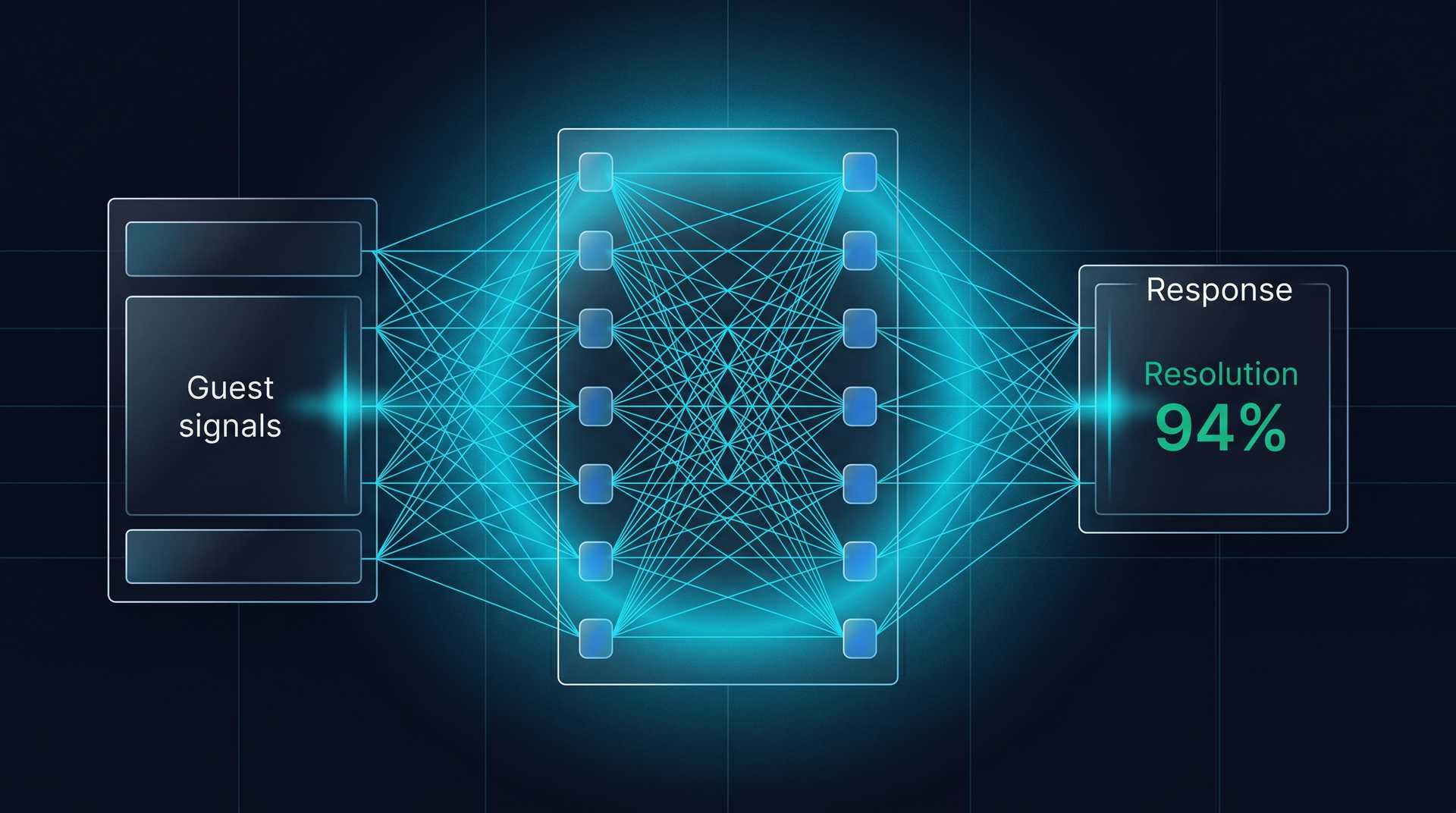
AI-powered chatbots and voice assistants resolve 43% of guest inquiries without human intervention. This allows call center teams to focus on complex and high-value requests.
Automatically resolved inquiries:
- Reservation status inquiries
- Check-in/check-out time information
- Information about room features and hotel services
- Simple modification requests (date changes, extra bed requests)
- Directions and transportation information
Guest Satisfaction Score: +8-12 Points
An average increase of 8-12 points in guest satisfaction scores (NPS or Guest Satisfaction Score) is observed after AI implementation. The main reasons for this include:
- Instant responses: Guest inquiries are answered 24/7 within seconds
- Personalization: Guest preferences are remembered, and proactive recommendations are offered
- Problem resolution: Potential issues are detected and resolved before guests even complain
- Consistency: Service quality remains unaffected by staff changes
With the OtelCiro reporting system, you can monitor all these metrics in real-time and track your AI investment's ROI with concrete data.
Cost-Benefit Analysis Framework: Calculate Your Own ROI
You can use the following framework to calculate the ROI of your AI investment:
Revenue Side (Annual)
| Metric | Current Value | Expected with AI | Difference |
|---|---|---|---|
| ADR | Current ADR | +10-15% | ADR increase × room-nights |
| Occupancy | Current % | +3-5 points | Additional room-night revenue |
| Ancillary Revenue | Per guest | +15-20% | Additional F&B/Spa revenue |
| Total Revenue Impact | — | — | ~+17% |
Cost Side (Annual)
| Area | Current Cost | Savings with AI | Annual Savings |
|---|---|---|---|
| Housekeeping | Staff cost | 20% efficiency | Hours × unit cost |
| Food | Monthly food cost | 50% waste reduction | Waste amount × unit |
| Energy | Monthly energy bill | 15-25% reduction | Bill difference |
| Call Center | Staff cost | 43% workload reduction | Labor savings |
Investment Payback Period
Industry averages indicate that a comprehensive AI investment amortizes itself within 6-12 months. For just the revenue management module, this period decreases to 3-6 months.
Important Note: When calculating ROI, consider not only direct revenue growth and cost reduction but also indirect benefits such as competitive advantage, guest loyalty, and brand value.
Building the Business Case: How to Convince the Board?
Securing budget approval for AI investment remains a challenging process in many hotels. To convince the board, create a data-driven business case:
1. Present industry benchmarks: Show that 82% of hotel executives are expanding their AI budgets, indicating it's a necessity, not just a trend.
2. Conduct competitor analysis: Research the AI adoption status of competitor hotels in your region. Early adopters gain an advantage.
3. Propose a pilot project: Instead of a large investment covering the entire hotel, start a pilot in a single area (e.g., dynamic pricing). Showcase 90-day results.
4. Use concrete metrics: Combine the data from this report with your hotel's own figures to present an estimated ROI calculation.
5. Conduct a risk analysis: Also calculate the cost of not investing in AI. If competitors are using AI and you are not, your competitive disadvantage grows each month.
Conclusion: The Data Ends the Debate
In 2026, the question "should our hotel invest in AI?" is no longer the right one. The correct question should be "which AI solution should we invest in, how much, and where should we start?"
The numbers are clear: 17% revenue growth, 20% operational speed gains, 50% food waste reduction, and a 43% decrease in call center workload. These metrics prove that AI is not a luxury technology for hospitality, but an essential business tool.
With OtelCiro AI Engine, Smart PMS, and reporting tools, you can measure, optimize, and track your AI investment's ROI every step of the way in real time.
Next Step: Request an OtelCiro demo for a customized AI ROI simulation for your hotel. Let us calculate your potential returns with your own data.
![AI Chatbot Revenue Impact for Hotels: 2026 Strategy [Data Analysis]](https://cdn.sanity.io/images/1la98t0z/production/28a6b8cebd12686a668a97549c9e9a619c6f4277-2752x1536.jpg?w=1920&q=50&auto=format&fit=max)
![Hotel AI Technology Budgets 2027: 8-Point Investment Framework That Delivers 15x ROI [2026]](https://cdn.sanity.io/images/1la98t0z/production/7e64ec0aab777ec433ec0f4f1257373a84f39d1d-2048x2048.png?w=1920&q=50&auto=format&fit=max)