
Key Takeaways
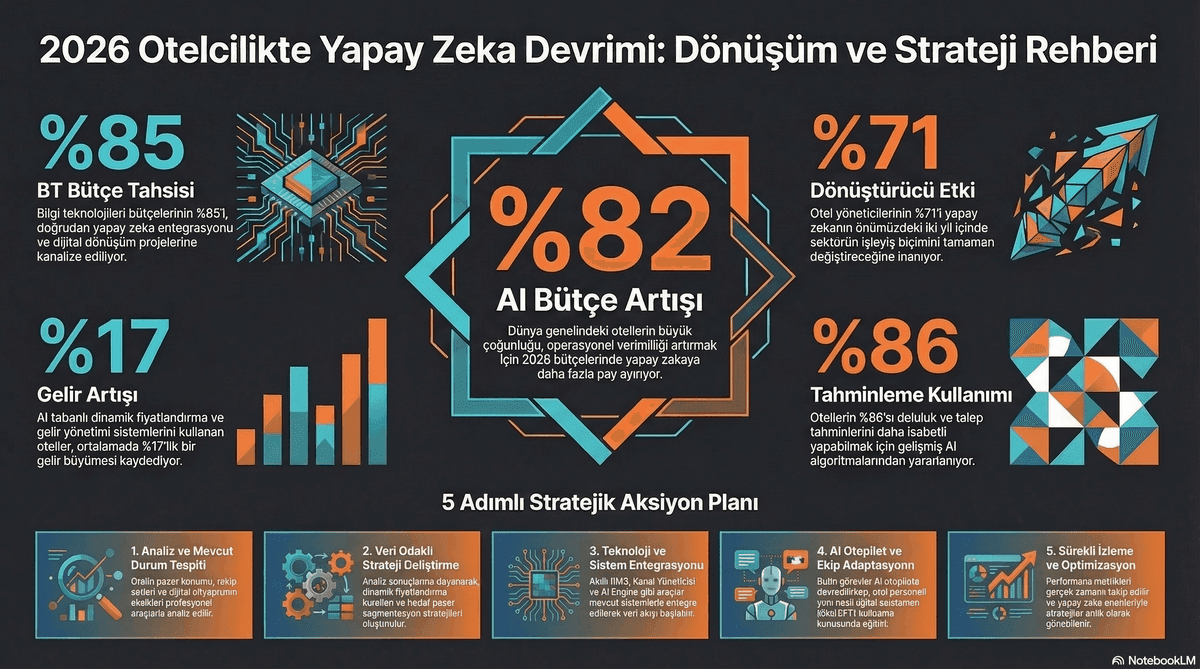
- Massive AI Adoption: A staggering 82% of hotels are increasing their AI budgets by 2026, with 85% allocating over 5% of their total IT budget to AI, signifying a critical shift from experimentation to mainstream adoption.
- Strategic Investment Areas: Primary AI investments are concentrated in revenue management (86%), operational automation (68%), guest experience personalization (54%), and distribution/channel management (47%).
- Proven ROI: AI adoption delivers substantial measurable returns, including an average of 17% revenue growth for AI-RMS users, 10-15% higher ADR, and 5-10% operational cost reduction.
- Accessible for All: AI is democratizing; smaller hotels can leverage scalable, cloud-based, and integrated AI solutions, with new per-resolved-request pricing models making advanced technology affordable.
- Significant Risks for Laggards: Hotels that delay AI adoption face severe competitive disadvantages, including 5-10 points lower GOP, reduced market visibility, higher operational costs, and an inability to meet evolving guest expectations.
The Numbers Speak: Hospitality Enters the AI Race
A 2026 hospitality technology survey published by PRNewswire reveals how rapidly the industry's approach to artificial intelligence is changing. Key findings from the report include:
- 82% of hotels are expanding their AI budget in 2026.
- 85% allocate more than 5% of their total IT budget to AI.
- 71% state that AI has a "transformative impact" on their operations.
- 86% use AI for revenue forecasting and pricing.
These figures clearly indicate that AI in hospitality is no longer in an "experimental phase" but has become a mainstream investment priority. The real question, however, is: What will the remaining 18% do?
Critical Threshold: When an industry's adoption rate surpasses 80%, those left behind face a competitive disadvantage. Hospitality crossed this threshold in 2026.
Related reading: Who's Ahead in the AI Race? Accor vs. Hyatt vs. Marriott — 2026 Scorecard
What Are Hotels Investing In?
The 82% budget increase does not signify a blanket AI investment but rather strategic spending focused on specific areas. According to the research, hotels' AI investment priorities are as follows:
1. Revenue Management and Dynamic Pricing (86%)
The most intensive investment area is revenue management. 86% of hotels are either using or planning to use AI-powered forecasting and pricing systems. These systems:
- Monitor competitor prices in real-time.
- Enrich demand forecasts with weather, events, and macroeconomic data.
- Implement segment-based dynamic pricing.
- Automatically detect rate parity violations.
OtelCiro's AI engine operates with 208 different action points in this area, making hotels' pricing decisions data-driven.
2. Operational Automation (68%)
The second priority is the automation of operational processes:
- Housekeeping scheduling and optimization
- Digitalization of check-in/check-out processes
- Inventory and procurement management
- Energy and resource optimization
Smart PMS solutions serve as the central nervous system for this operational automation.
3. Guest Experience and Personalization (54%)
The third area is AI-powered guest experience:
- Chatbots and virtual assistants
- Personalized room and service recommendations
- Proactive service management (predicting guest needs before they arise)
- Loyalty program optimization
4. Distribution and Channel Management (47%)
AI-powered distribution strategies are also on the investment radar:
- AI-supported channel optimization
- MCP integration and ChatGPT/AI assistant visibility
- Dynamic commission management
- Direct channel strengthening
ROI Proof Points: Is AI Investment Paying Off?
For skeptics, the most convincing argument lies in concrete ROI data. Research and industry reports indicate that AI investment yields measurable returns.
17% Revenue Increase with AI-RMS
Hotels utilizing AI-powered Revenue Management Systems (AI-RMS) report an average of 17% revenue increase. This increase occurs through several mechanisms:
- Price optimization: AI identifies pricing opportunities that human analysts might overlook.
- Demand capture: Strategic pricing boosts occupancy during low-demand periods.
- Segment management: Prioritizing high-value segments increases ADR.
10-15% Increase in ADR
Hotels using AI-powered dynamic pricing achieve an Average Daily Rate (ADR) that is 10-15% higher compared to those that do not. This difference stems from AI's ability to react to instantaneous market conditions and continuously optimize pricing.
Operational Cost Reduction
AI automation leads to 8-12% savings in labor costs, 15-25% in energy costs, and 30-50% in food waste. Overall, the operational cost base can be reduced by 5-10%.
Calculation: A 100-room hotel, using AI-RMS, increases its annual revenue by an average of 1.2 million TL, while gaining an additional 600,000 TL through operational savings. The annual AI investment cost typically remains at 10-15% of this gain.
Related reading: AI in Dynamic Pricing: The New Way to Boost Hotel Revenue
Roadmap for Smaller Hotels
The question "These figures apply to large chains; what can my 50-room hotel do?" is one of the most frequently asked by Turkish hoteliers. The answer is promising: AI has democratized.
Scalable Pricing Models
In 2024, AI-RMS solutions were typically offered at prices like 3-5 USD/month per room — a heavy burden for smaller hotels. In 2026, the per-resolved-request pricing model is becoming widespread. You only pay for what you use.
All-in-One Platforms
Instead of purchasing separate PMS, RMS, CRM, and channel managers, integrated ecosystem solutions offer all these functionalities within a single platform. This reduces costs and ensures data integrity.
Cloud-Based Access
Cloud-based AI solutions, which do not require on-premise server investments, minimize the initial cost for smaller hotels. Any hotel with an internet connection can access enterprise-level AI.
Pilot Start Strategy
The recommended approach for smaller hotels:
- Month 1-2: Clean and standardize existing data.
- Month 3-4: Start a pilot with the revenue management (dynamic pricing) module.
- Month 5-6: Add operational automation (housekeeping, check-in).
- Month 7-8: Implement MCP integration and AI channel visibility.
- Month 9-12: Full ecosystem integration and optimization.
5 Steps to Join the 82%
Here's a concrete action plan for hotels that haven't yet increased their AI budget or are planning to do so:
Step 1: Digital Maturity Assessment
Evaluate your current technology infrastructure and data quality. Is your PMS cloud-based? Is your data standardized? Do you have API support? If you answer "no" to these questions, start with infrastructure modernization.
Step 2: ROI-Driven Budget Planning
Plan your AI budget as a minimum of 5% of your total IT budget (this is the industry average). Position the budget as an "investment," not an "expense," and set measurable KPIs: RevPAR increase, GOP improvement, conversion rate increase.
Step 3: Start with High-ROI Areas
Don't try to implement all AI modules simultaneously. Begin with the area that provides the fastest return: dynamic pricing. Most hotels see a positive ROI with AI-powered pricing within the first 3 months.
Step 4: Develop Team Competency
No matter how powerful AI tools are, human expertise is needed to interpret results and make strategic decisions. Provide AI literacy training to your revenue managers and operations team.
Step 5: Choose an Integrated Ecosystem
Opt for an ecosystem centered around a smart PMS rather than fragmented solutions. Data silos are the biggest obstacle to AI's effectiveness. An integrated platform consolidates data from every department into a single intelligence layer.
Related reading: 2026 Survival Guide: Digital Transformation for Hotels
Risks for Those Left Behind
An 82% adoption rate means increasing competitive disadvantage for the remaining 18%. This disadvantage manifests in several dimensions:
- Price competition: AI-using competitors are more competitive at every price point with dynamic pricing.
- Loss of visibility: Hotels without MCP integration do not appear in AI searches.
- Cost disadvantage: Manual operations are 10-15% more expensive compared to AI-powered competitors.
- Guest expectations: The 2026 traveler expects personalized AI-powered services — those who cannot provide them lose points.
- Talent loss: Technology-focused employees prefer hotels that use AI.
The sum of these risks translates into a 5-10 point GOP difference in the medium term. This means a hotel that does not invest in AI operates with 5-10 points lower profitability each year compared to its AI-first competitor in the same location.
Frequently Asked Questions
What does a 5% IT budget allocation translate to?
This varies depending on the hotel's size and current technology spending. For an average Turkish hotel, 5% of the total IT budget corresponds to an average of 5,000-25,000 TL per month. The monthly costs of cloud-based AI solutions typically fall within this range.
We've increased our AI budget, but we don't know where to start. Any recommendations?
Start with revenue management (dynamic pricing). This area is the fastest and most measurable ROI-generating AI application. Most hotels begin to see a return on investment within 2-3 months. Then, gradually add operational automation and guest experience modules.
Our current PMS is old; can we still use AI?
Yes, but you may need additional integration layers. Platforms like OtelCiro offer middleware solutions that can work with older PMS systems. In the long term, transitioning to a cloud-based smart PMS is recommended to maximize AI's effectiveness.
To create your hotel's AI investment roadmap and join the 82% majority, contact OtelCiro. Let's collaboratively prepare a data-driven, measurable, and sustainable digital transformation plan.
![AI Chatbot Revenue Impact for Hotels: 2026 Strategy [Data Analysis]](https://cdn.sanity.io/images/1la98t0z/production/28a6b8cebd12686a668a97549c9e9a619c6f4277-2752x1536.jpg?w=1920&q=50&auto=format&fit=max)
![Hotel AI Technology Budgets 2027: 8-Point Investment Framework That Delivers 15x ROI [2026]](https://cdn.sanity.io/images/1la98t0z/production/7e64ec0aab777ec433ec0f4f1257373a84f39d1d-2048x2048.png?w=1920&q=50&auto=format&fit=max)