
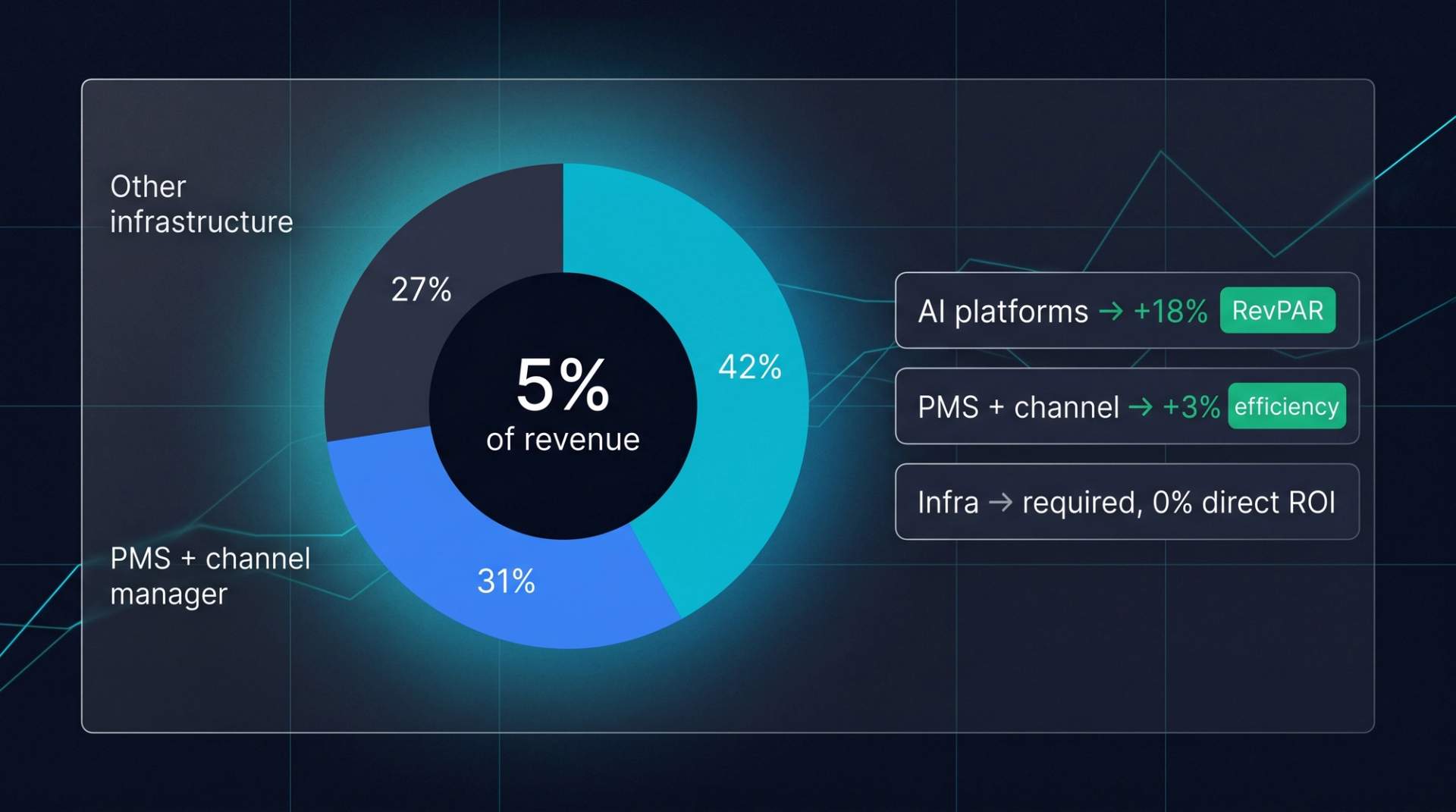
Key Takeaways
- AI Investment Surge: 85% of hotels plan to allocate over 5% of their IT budget to AI by 2026, marking a significant shift from experimental to operational necessity within the hospitality sector.
- Highest ROI from RMS: AI-powered Revenue Management Systems (RMS) are the top investment, projected to deliver an average 10-15% ADR increase and 3-5% occupancy improvement, resulting in a 13-20% RevPAR boost.
- Operational Efficiency & Guest Satisfaction: Chatbots offer significant operational savings by handling 60-80% of repetitive guest inquiries, leading to a 430-870% ROI, while Voice AI reduces reception calls by 35-50%.
- Phased Implementation is Key: A strategic, gradual approach, beginning with high-ROI areas like RMS and chatbots, is crucial for successful AI adoption, ensuring proper data infrastructure, team training, and systematic ROI measurement.
- AI as a Strategic Revenue Driver: Allocating 5% of the IT budget to AI is not merely a cost but a strategic investment that, when executed correctly, holds the potential for a 13-20% increase in total revenue and a 15-25% reduction in operational costs.
Embed this image on your site
<a href="https://otelciro.com/en/news/hotel-ai-budget-2026-allocating-5-of-your-it-spend-strategy-guide">
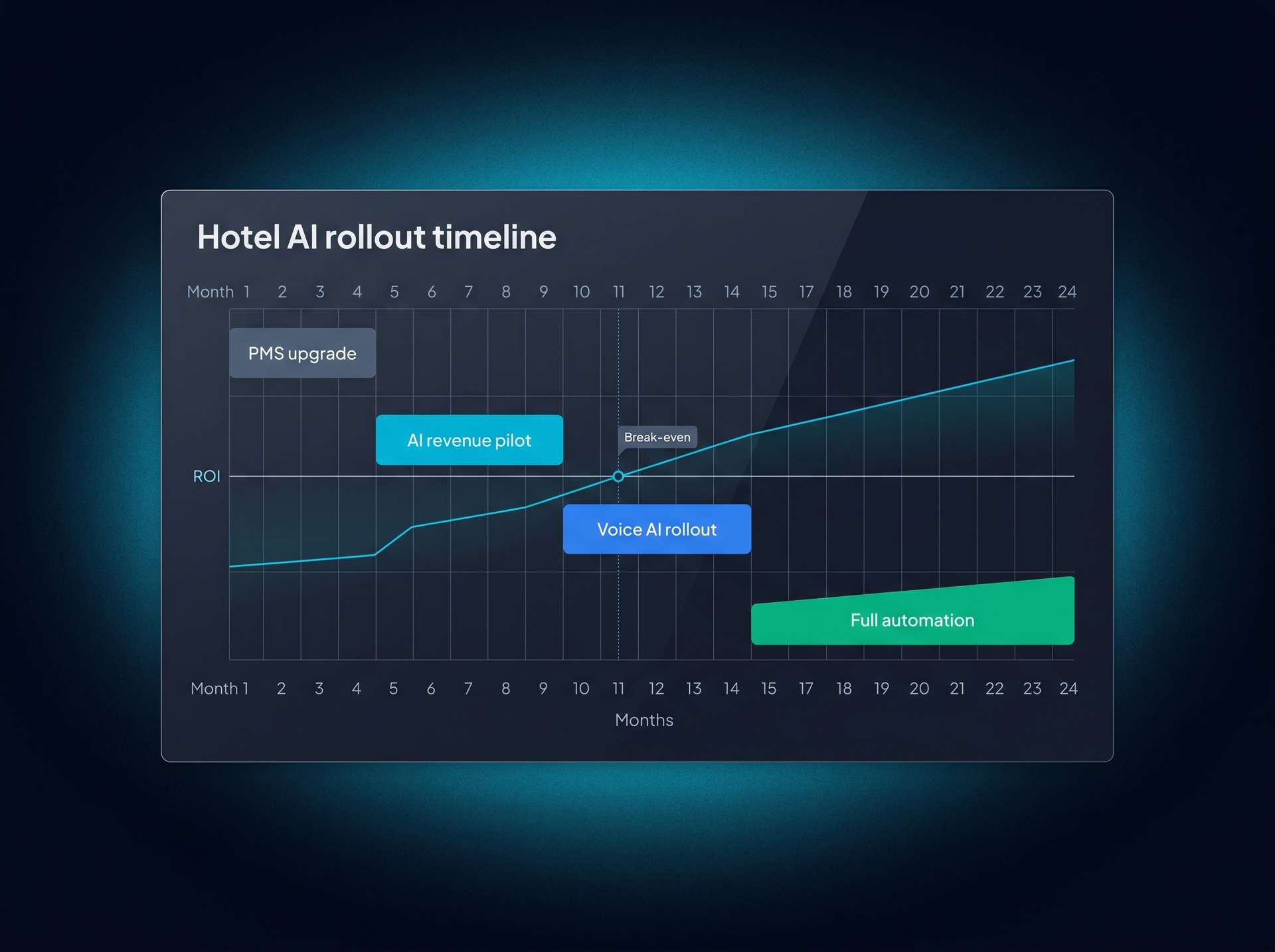
  <img src="https://cdn.sanity.io/images/1la98t0z/production/7f640c52469f4a0fbffedb1114f911a243fb4297-2400x1792.jpg" alt="24-month rollout Gantt chart. PMS upgrade months 0-3, AI revenue pilot months 3-9, Voice AI rollout months 9-15, and full automation months 15-24. A cyan ROI line crosses zero at month 11 marked as break-even." width="800" />
</a>
<p>Source: <a href="https://otelciro.com">OtelCiro</a> — AI Hotel Revenue Management</p>
Why AI Investment Became Essential in 2026?
The hospitality sector is experiencing a tipping point in artificial intelligence investments. According to Phocuswright's 2025 Global Hotel Technology report, 85% of hotels worldwide plan to allocate more than 5% of their IT budgets to artificial intelligence technologies in 2026 — an increase from just 28% in 2023. This threefold increase in three years proves that the industry now views AI not as "experimental" but as an "operational necessity."
However, this growth brings a critical question: how much of the limited IT budget should be allocated to AI, to which technologies, in what order, and to what extent? Incorrect investment decisions can lead to unmet ROI expectations and organizational disappointment.
In this guide, we present an AI budget planning framework for hotels of varying scales, priority investment areas, a cost-benefit analysis for each technology category, and a phased implementation roadmap.
Embed this image on your site
<a href="https://otelciro.com/en/news/hotel-ai-budget-2026-allocating-5-of-your-it-spend-strategy-guide">
  <img src="https://cdn.sanity.io/images/1la98t0z/production/1babf8b81de37f709432621d6f8b7c04334fac01-1408x768.png" alt="Hotel AI budget planning and investment distribution 2026" width="800" />
</a>
<p>Source: <a href="https://otelciro.com">OtelCiro</a> — AI Hotel Revenue Management</p>
AI Investment Budget: How Much Should You Allocate?
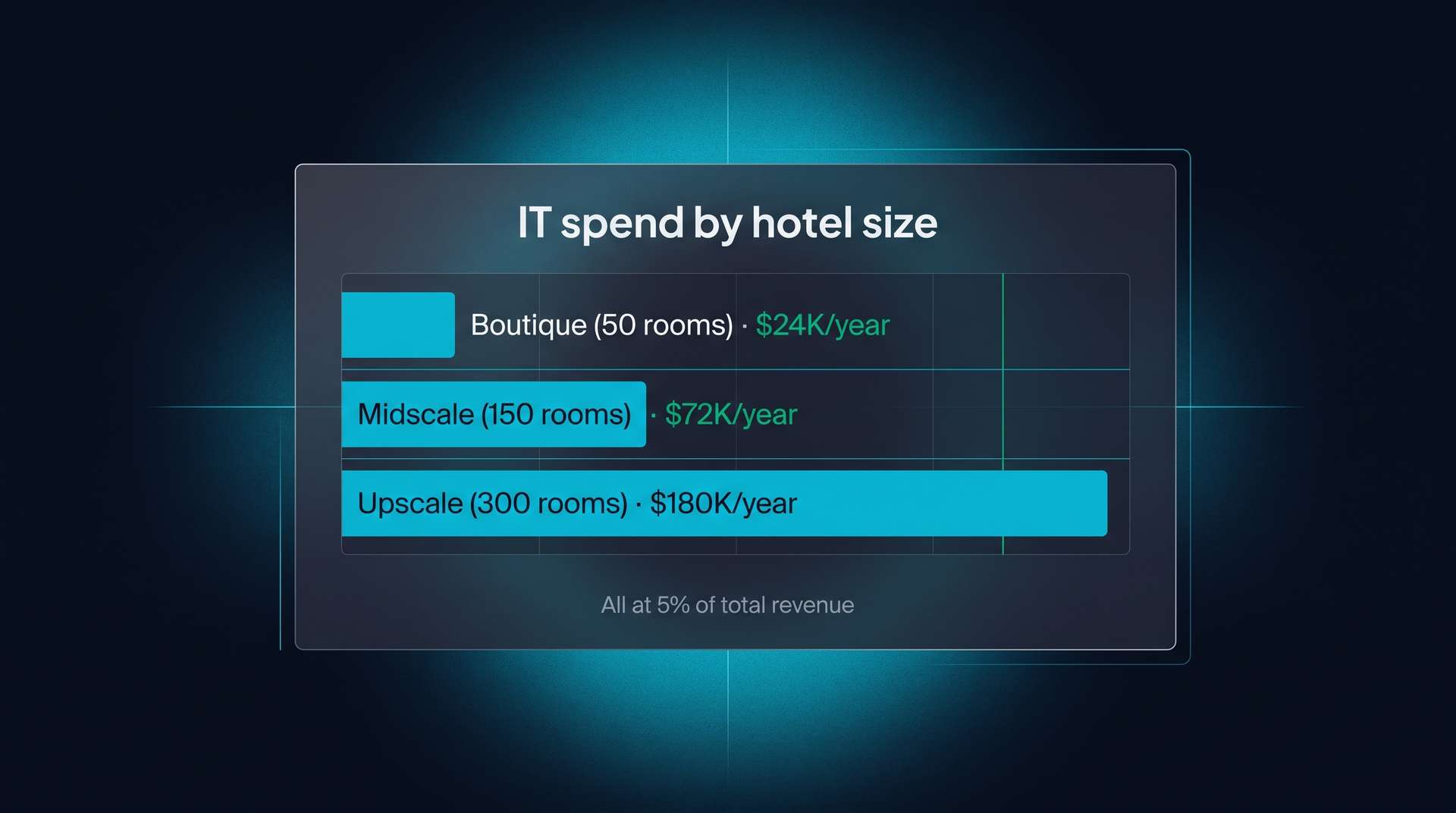
While "5% of the IT budget" is a general guideline, the optimal AI investment rate varies depending on the hotel's size, segment, and current digital maturity.
Budget Framework by Scale
Small hotels (50-100 rooms):
- Total annual IT budget: 150,000-400,000 TL
- Recommended AI share: 5-8% (7,500-32,000 TL)
- Priority: AI-powered dynamic pricing + basic chatbot
- Approach: SaaS model, monthly subscription, minimal integration
Mid-sized hotels (100-250 rooms):
- Total annual IT budget: 400,000-1,200,000 TL
- Recommended AI share: 7-12% (28,000-144,000 TL)
- Priority: RMS + chatbot + energy management AI
- Approach: Integrated solutions, PMS-connected, data analytics
Large hotels and chains (250+ rooms or multi-property):
- Total annual IT budget: 1,200,000-5,000,000 TL
- Recommended AI share: 10-18% (120,000-900,000 TL)
- Priority: Comprehensive RMS + chatbot + voice AI + housekeeping AI + energy AI
- Approach: Platform integration, custom development, data science team
Budget Distribution Matrix
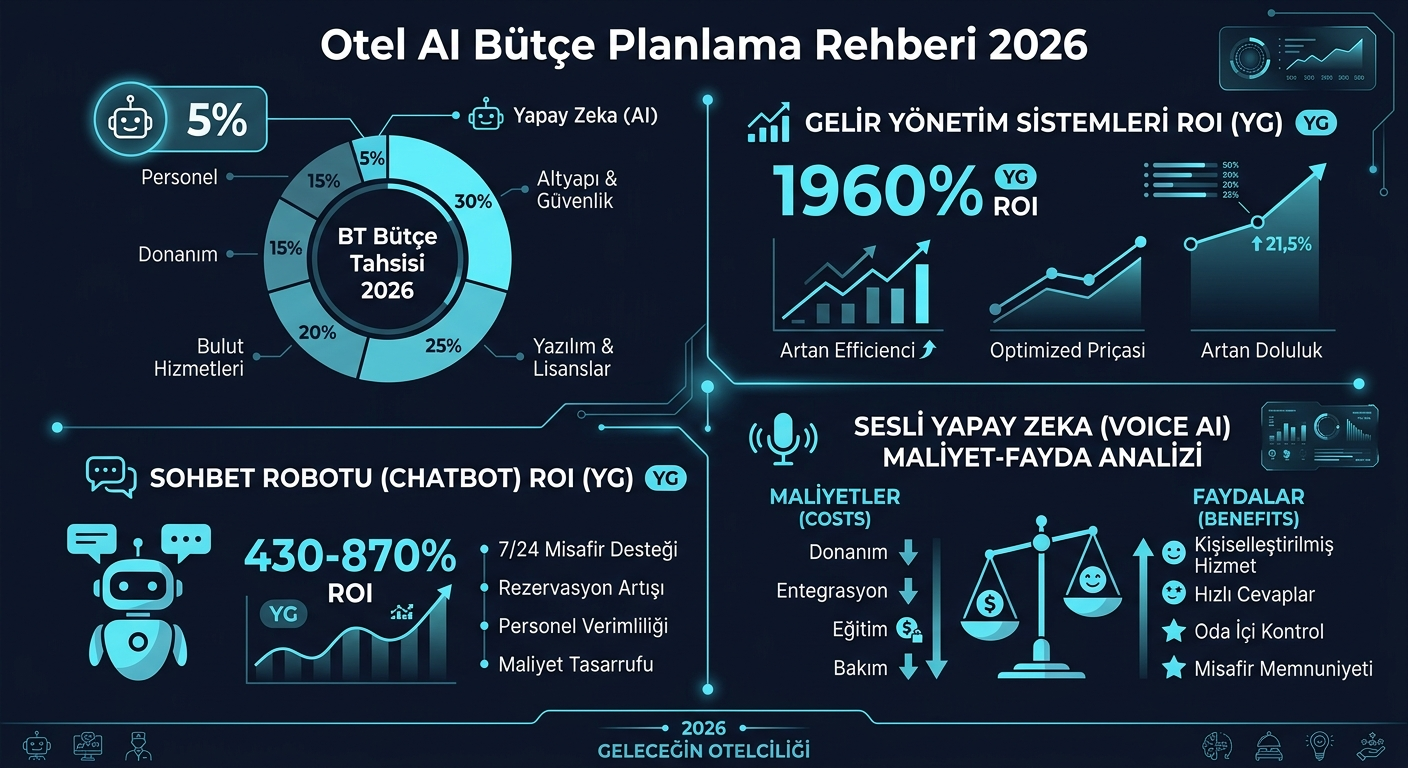
The ideal distribution of a typical hotel AI budget by category:
- Revenue management (RMS): 35-45% — Highest ROI area
- Guest engagement (chatbot, voice AI): 20-25% — Operational savings + guest satisfaction
- Operational optimization (housekeeping, energy): 15-20% — Cost reduction
- Data infrastructure and integration: 10-15% — Fundamental AI infrastructure
- Training and change management: 5-10% — Often overlooked but critical area
Embed this image on your site
<a href="https://otelciro.com/en/news/hotel-ai-budget-2026-allocating-5-of-your-it-spend-strategy-guide">
  <img src="https://cdn.sanity.io/images/1la98t0z/production/86f6f9df4bbdb532ff3136e7ace6cb918670bfe3-2752x1536.jpg" alt="Bar chart of annual IT spend by hotel size. Boutique 50-room: $24K. Midscale 150-room: $72K. Upscale 300-room: $180K. All three represent 5% of total revenue." width="800" />
</a>
<p>Source: <a href="https://otelciro.com">OtelCiro</a> — AI Hotel Revenue Management</p>
AI-Powered Dynamic Pricing (RMS): Cost and Return
A Revenue Management System (RMS) is the area where hoteliers achieve the highest return on AI investment. According to BCG data, hotels using AI-powered RMS achieve an average 10-15% ADR increase and 3-5% occupancy improvement — the combined effect of which translates to a 13-20% increase in RevPAR.
Market RMS Solutions and Costs
Cloud-based SaaS solutions (for small-to-mid-sized hotels):
- Monthly cost: 3-8 euros per room (3,600-9,600 euros annually for a 100-room hotel)
- Installation time: 2-6 weeks
- Integration: PMS and channel manager API connection
- Examples: IDeaS G3 RMS, Atomize, RoomPriceGenie, Duetto
Enterprise platform solutions (for large chains):
- Annual license: 15,000-80,000 euros (depending on portfolio size)
- Installation time: 3-6 months
- Integration: Full PMS/CRS/channel manager integration, custom API development
- Examples: IDeaS, Duetto, Pace Revenue, OtelCiro AI Engine
ROI Calculation Example
For a 100-room hotel with an average annual occupancy of 70% and an ADR of 1,200 TL:
- Current annual room revenue: 100 × 365 × 0.70 × 1,200 = 30,660,000 TL
- Expected ADR increase with AI RMS (12%): New ADR = 1,344 TL
- Expected occupancy increase with AI RMS (3%): New occupancy = 73%
- New annual room revenue: 100 × 365 × 0.73 × 1,344 = 35,810,880 TL
- Additional revenue: 5,150,880 TL
- Annual RMS cost: ~250,000 TL (first year, including setup)
- Net ROI: Approximately 1,960%
- Payback period: Approximately 18 days
Why are these figures so high? Because RMS optimizes your entire room inventory for a fixed cost. The micro-optimizations made for each of 100 rooms over 365 days collectively make a significant difference.
Related content: For concrete return figures on AI investment, our article Hotel AI ROI Report delves into BCG and industry data in detail.
Chatbot Investment: Cost-Benefit Analysis
AI-powered chatbots are the second priority artificial intelligence investment area for hotels. 60-80% of guest inquiries are repetitive (check-in/out times, WiFi password, restaurant hours, parking information, local recommendations), and answering these questions with an AI chatbot provides both operational savings and guest satisfaction.
Chatbot Types and Costs
Rule-based chatbot (basic):
- Monthly cost: 200-800 TL
- Scope: Standard answers to predefined questions
- Channels: Website, WhatsApp
- Languages: Typically 2-3 languages
- Limitations: Inadequate for unexpected questions, low natural language understanding capacity
AI-powered conversational chatbot (advanced):
- Monthly cost: 1,500-5,000 TL
- Scope: Natural language processing, context understanding, real-time information provision via PMS integration
- Channels: Web, WhatsApp, Facebook Messenger, Instagram DM
- Languages: 10+ languages, automatic translation
- Features: Booking redirection, personalized recommendations, sentiment analysis for escalation
Fully integrated AI assistant:
- Monthly cost: 5,000-15,000 TL
- Scope: Full integration with PMS, CRM, restaurant management system, and concierge services
- Features: Room service ordering, spa appointments, in-room control (IoT), complaint management
- Extra: Autonomous transaction completion (taking action, not just providing information)
Chatbot ROI Calculation
The return on investment for an advanced AI chatbot for a mid-sized hotel (150 rooms):
- Daily guest inquiries: Average 80-120 (phone, email, in-person)
- Percentage answered by chatbot: 65% (52-78 inquiries)
- Front desk staff time savings: 3-4 hours daily
- Annual staff cost savings: 120,000-180,000 TL
- Direct booking increase (chatbot redirection): 8-12% — annual additional revenue of 200,000-400,000 TL
- Total annual benefit: 320,000-580,000 TL
- Annual chatbot cost: 36,000-60,000 TL
- Net ROI: 430-870%
Voice AI: An Emerging Investment Area
Voice AI is the fastest-growing AI category in the hospitality sector in 2026. Alexa for Hospitality, Google Nest Hub, and custom-developed voice assistants are transforming the in-room experience.
Voice AI Use Cases
- In-room control: Voice commands such as "Dim the room slightly," "Set the AC to 22 degrees," "Open the curtains."
- Information provision: Questions like "What time does the restaurant open?", "How do I get to the airport?", "What will the weather be like tomorrow?"
- Service requests: Requests such as "I need an extra pillow," "Show me the room service menu," "I'd like to book a spa appointment."
- Reception call reduction: Voice AI reduces reception calls by 35-50% (industry data).
Cost and Implementation
- Hardware cost: 1,500-3,500 TL per room (voice assistant device + IoT integration module)
- Software and platform: 15-40 TL per room per month
- Installation and integration: 500-1,500 TL per room (initial setup)
- Total first-year cost (100 rooms): 280,000-700,000 TL
The ROI calculation for Voice AI is based on operational savings and guest satisfaction rather than direct revenue increase. When combining reception call reduction, housekeeping request optimization, and energy savings (turning off devices with voice command upon checkout), the payback period is typically 14-20 months.
Phased Implementation Roadmap
Attempting to implement all AI technologies simultaneously is risky, both financially and organizationally. Successful hotels adopt a phased approach:
Phase 1: Foundational (0-6 months) — 40-50% of the Budget
- AI-powered RMS implementation: Start with the highest ROI area. Complete PMS integration.
- Basic chatbot deployment: Launch a fundamental Q&A chatbot on the website and WhatsApp.
- Data infrastructure preparation: Connect all data sources to a single platform.
Phase 2: Expansion (6-12 months) — 30-35% of the Budget
- Chatbot enhancement: Add real-time room availability, pricing information, and booking redirection via PMS integration.
- Energy management AI: Empty room detection and climate control automation.
- Reporting and analytics: AI-powered forecasting models and performance dashboards.
Phase 3: Maturation (12-18 months) — 15-25% of the Budget
- Voice AI pilot: Pilot implementation in 10-20 rooms.
- Housekeeping AI: Cleaning scheduling and resource optimization.
- Personalization engine: Automated upsell and cross-sell recommendations based on guest profiles.
Measurement at Each Phase
Key KPIs that must be measured at the end of each phase:
- Revenue metrics: ADR change, RevPAR change, total revenue growth
- Operational metrics: Call center/front desk workload, housekeeping efficiency, energy consumption
- Guest metrics: NPS (Net Promoter Score), average online rating, complaint rate
- Financial metrics: AI investment ROI, payback period, cost reduction per unit
Common Mistakes and Avoidance Strategies
The most common mistakes in AI budget planning and their solutions:
-
Mistake: Starting too big. Trying to implement all AI solutions simultaneously. Solution: Start with RMS, achieve initial success from the highest ROI area, and convince the organization.
-
Mistake: Neglecting data infrastructure. Acquiring AI software without integrating PMS, channel manager, and CRM data. Solution: Allocate 10-15% of the budget to data infrastructure.
-
Mistake: Skipping training. Purchasing software without training the team. Solution: Create a user training program for each AI tool. Allocate 5-10% of the budget to training.
-
Mistake: Not measuring ROI. Failing to systematically track the return on AI investment. Solution: Define baseline values for each AI tool and conduct monthly performance tracking.
-
Mistake: Vendor lock-in. Becoming dependent on a single vendor. Solution: Prefer API-based, open-platform solutions. Integrated yet modular platforms like OtelCiro can work compatibly with various AI tools.
Embed this image on your site
<a href="https://otelciro.com/en/news/hotel-ai-budget-2026-allocating-5-of-your-it-spend-strategy-guide">
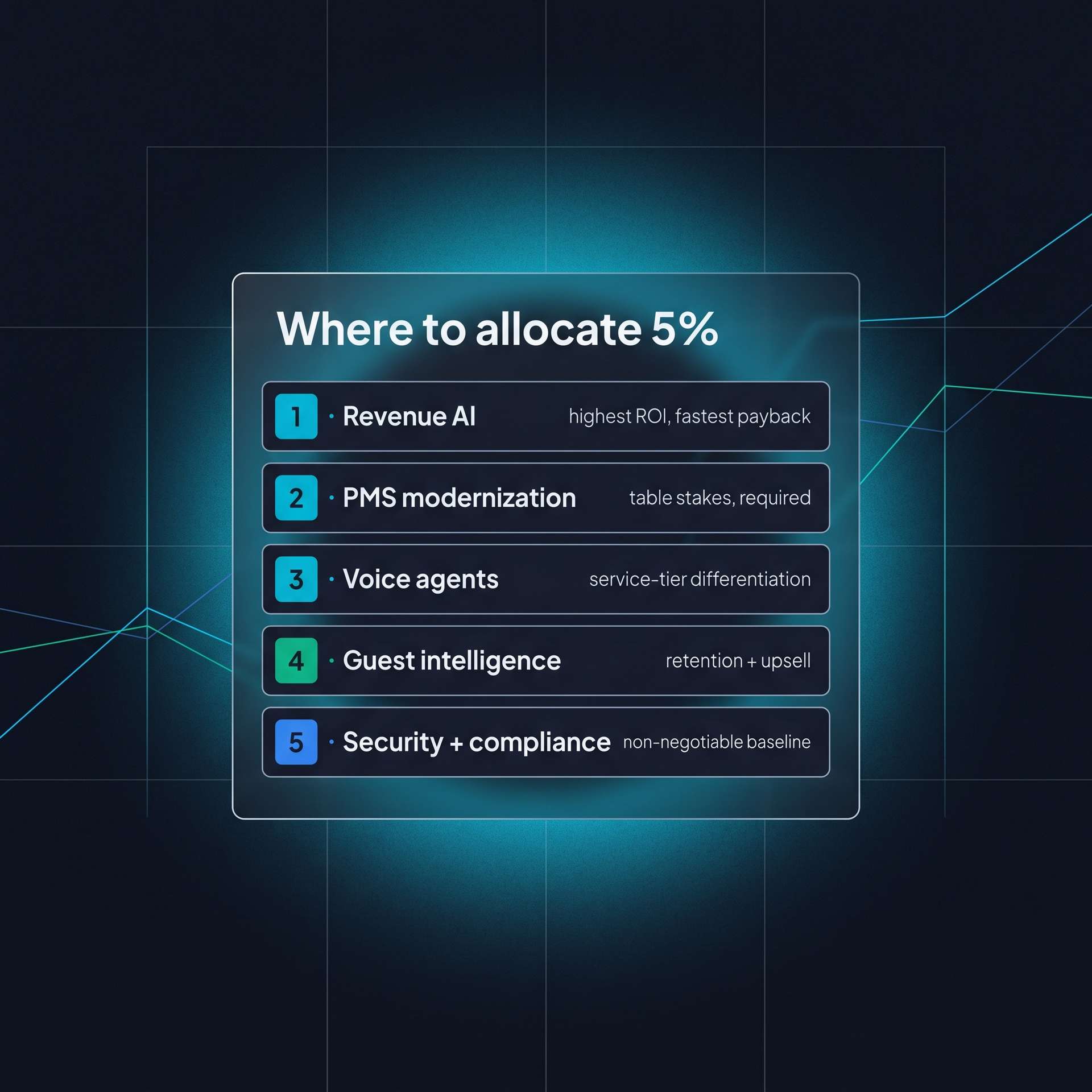
  <img src="https://cdn.sanity.io/images/1la98t0z/production/4258c4cd64572d6a4b3765b0bac1d0887a6efa43-2048x2048.jpg" alt="Priority card titled 'Where to allocate 5%'. Five ordered items: Revenue AI (highest ROI), PMS modernization (required), Voice agents (service differentiation), Guest intelligence (retention and upsell), Security and compliance (non-negotiable)." width="800" />
</a>
<p>Source: <a href="https://otelciro.com">OtelCiro</a> — AI Hotel Revenue Management</p>
Conclusion: The AI Budget is Not a Cost, But a Revenue Investment
In 2026, hotel AI budget planning is no longer focused on "should we do it?" but on "how and when?" The data is clear: AI-powered RMS provides a 10-15% ADR increase, chatbots yield 430-870% ROI, and voice AI solutions reduce calls by 35-50%. A suitable starting point and budget level exist for hotels of every scale.
Critical success factors include: phased implementation, investment in data infrastructure, organizational training, and systematic ROI measurement. Allocating 5% of the IT budget to AI, when implemented correctly, has the potential for a 13-20% increase in total revenue and a 15-25% reduction in operational costs.
OtelCiro's AI-powered revenue management, dynamic pricing, and chatbot solutions offer all the investment areas mentioned in this guide through an integrated platform, enabling hotels to gain maximum value from their AI investments. With its modular structure, the solutions are adaptable for hotels ranging from small establishments to large chains, supporting a phased implementation strategy.
Suggested reading: For a concrete AI investment success story, our article CitizenM Case Study: 18% RevPAR Increase with Artificial Intelligence examines real-world results in detail.
![AI Chatbot Revenue Impact for Hotels: 2026 Strategy [Data Analysis]](https://cdn.sanity.io/images/1la98t0z/production/28a6b8cebd12686a668a97549c9e9a619c6f4277-2752x1536.jpg?w=1920&q=50&auto=format&fit=max)
![Hotel AI Technology Budgets 2027: 8-Point Investment Framework That Delivers 15x ROI [2026]](https://cdn.sanity.io/images/1la98t0z/production/7e64ec0aab777ec433ec0f4f1257373a84f39d1d-2048x2048.png?w=1920&q=50&auto=format&fit=max)