
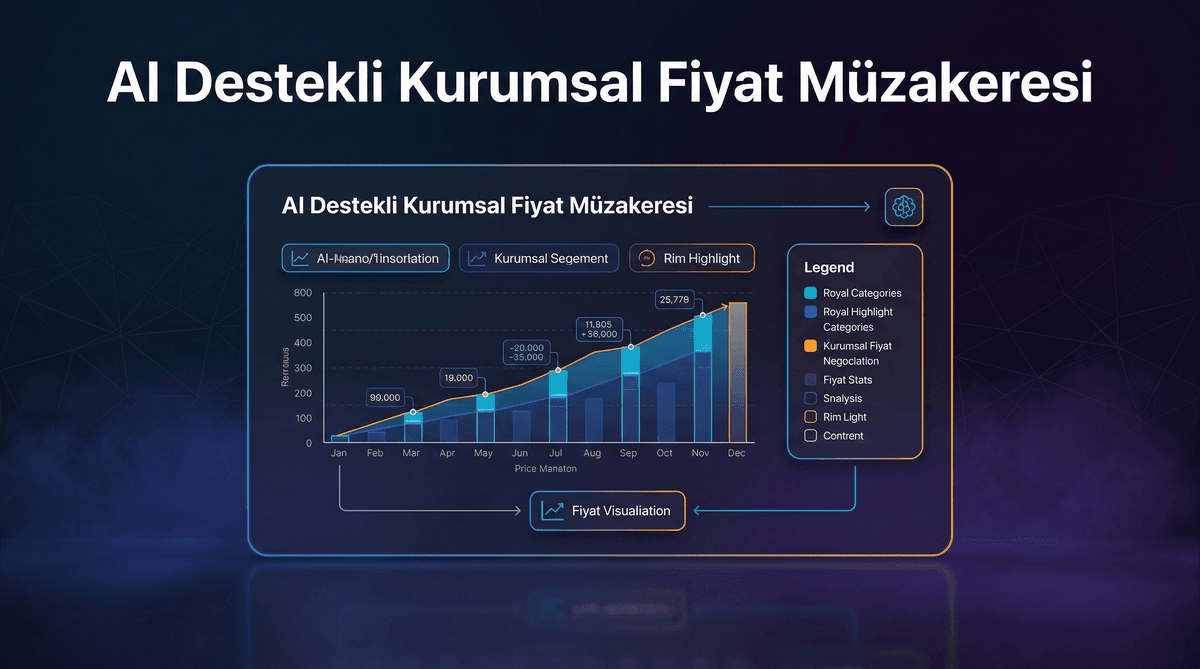
Key Takeaways
- The corporate segment is vital for hotels, contributing 30-50% of total revenue, but negotiations are often challenging and power-based.
- AI-supported strategies transform corporate rate negotiations from intuition to data-driven, enhancing profitability and guest satisfaction.
- Thorough pre-negotiation data analysis—including past performance, displacement costs, and total segment profitability—is crucial for success.
- AI enables the creation and evaluation of various pricing scenarios, from fixed volume commitments to dynamic rate bands and total spend-based incentives.
- Future trends indicate a shift towards automated corporate pricing, dynamic agreements, real-time offer optimization, and predictive churn analysis, giving early adopters a competitive edge.
Corporate Segment: Hotels' Most Valuable Yet Most Challenging Revenue Source
Corporate clients represent a critical segment, particularly for city hotels, often accounting for 30-50% of total revenue. In Turkey, 4 and 5-star city hotels average a 38% share from the corporate segment, a figure that can rise to 52% for business hotels in Istanbul. However, corporate rate negotiations remain one of the most challenging processes for revenue managers.
Traditional corporate negotiations often proceed under pressure from procurement departments, relying on power rather than data. Companies demand low prices, and hotels often concede due to the fear of losing market share. The result: long-term agreements that reduce profitability. AI-powered negotiation strategies, however, rebalance this dynamic with data, enabling hotels to protect their profitability while simultaneously enhancing customer satisfaction.
Pre-Negotiation: Data Preparation and Analysis
70% of a successful corporate negotiation is determined by the preparation undertaken before sitting at the table. AI-powered analysis brings the following data to the negotiation:
Past performance analysis: The corporate account's actual room nights, average room revenue, F&B spend, cancellation rate, and no-show percentage over the last 12-24 months. Revealing that a corporate client only utilized 62% of their committed 500 room nights can completely alter the course of a negotiation.
Displacement cost calculation: Comparing the revenue generated by a room sold at a corporate rate with the potential revenue if sold through individual or OTA channels on the same date. AI calculates the displacement cost for each night based on historical occupancy and demand data. This analysis helps determine the minimum acceptable corporate rate.
Segment profitability analysis: Beyond room revenue, measure the total hotel spend (TRevPAR contribution) of corporate guests. Include additional revenues such as meeting room usage, restaurant income, minibar, and parking.
Related reading: Group Reservation Yield Management: Finding the Right Price
Creating Price Scenarios with AI
The most powerful weapon in corporate negotiations is modeling different scenarios in advance. With the OtelCiro AI Engine, you can create customized pricing scenarios for each corporate account:
Scenario 1 — Fixed price, volume commitment: An 18% discount in exchange for a guaranteed 600 room nights annually. If the utilization rate falls below 80%, the discount rate decreases the following year.
Scenario 2 — Dynamic price band: A 20% discount when occupancy is below 70%, a 12% discount between 70-85% occupancy, and BAR (Best Available Rate) above 85%. This ensures the company can always find rooms, while the hotel prevents revenue loss during peak periods.
Scenario 3 — Total spend-based: A 10% discount on room rates + an end-of-year bonus discount based on total spending, including meeting rooms, F&B, and spa. This incentivizes increased overall spending.
The annual revenue impact, occupancy contribution, and profitability ratio of each scenario are calculated by AI and presented to decision-makers.
Data-Driven Communication at the Negotiation Table
Corporate procurement teams often use the argument, "a competitor hotel offers a cheaper rate." AI-supported preparation generates strong responses to such tactics:
- Competitor price comparison: Know actual competitor prices through rate shopping data to detect bluffs.
- Value proposition: Prepare data-backed arguments such as, "Our price might be 5% higher, but we achieve a 92% guest satisfaction score due to our prime location and F&B quality."
- Win-win scenarios: Develop low-cost but high perceived-value offers like, "We cannot lower the price, but we can offer complimentary meeting room usage."
In successful implementations in Turkey, hotels utilizing AI-supported negotiation strategies have managed to increase their corporate ADR by an average of 8% while keeping their customer loss rate below 3%.
Contract Management and Performance Tracking
The real work begins after a corporate agreement is signed. AI-powered contract management monitors the following metrics in real-time:
| Metric | Target | Warning Threshold |
|---|---|---|
| Room night utilization | >%80 | <%65 |
| Average lead time | 7-14 days | <3 days |
| Cancellation rate | <%15 | >%25 |
| No-show rate | <%5 | >%10 |
| F&B spend/night | >200 TL | <100 TL |
These metrics are critical for reviewing agreement terms mid-year or carrying data forward for the following year's negotiation. Reminding companies with low utilization rates mid-year has shown to increase commitment performance by 15-20%.
Future Trends: Automated Corporate Pricing
In 2026 and beyond, corporate pricing processes are becoming increasingly automated. AI-powered platforms are now transforming the negotiation process itself:
- Dynamic corporate agreements: Instead of fixed annual prices, price bands automatically adjust based on market conditions.
- Real-time offer optimization: During the RFP (Request for Proposal) process, AI prepares the optimal offer based on the company's historical behavior.
- Portfolio management: AI Engine solutions optimize the total profitability of the corporate account portfolio, identifying low-performing accounts and reallocating resources.
- Predictive churn analysis: Identifies corporate clients at risk of not renewing their contracts 3-6 months in advance, enabling proactive actions.
Success in corporate rate negotiation is now shaped more by data and AI-supported analytics than by experience and intuition. Hotels that adapt to this transformation will gain a competitive advantage in the corporate segment, both in terms of volume and profitability.
Related reading: RevPAR Index Comparison: Outperform Your Competitors
![Hotel Ancillary Revenue: Monetizing Spa, F&B & Activities [2026 Guide]](https://cdn.sanity.io/images/1la98t0z/production/cfce3407a5ef8f70edd19853e8059317fca7b6a6-2752x1536.jpg?w=1920&q=50&auto=format&fit=max)
![FIFA 2026 World Cup: Hotel Dynamic Pricing Strategy [2026 Guide]](https://cdn.sanity.io/images/1la98t0z/production/7a76affe61333341ec47bb0c705011068a1afd24-2752x1536.jpg?w=1920&q=50&auto=format&fit=max)