![Turkey's Law No. 7464: Airbnb Regulations & Hotel Strategy [2026 Guide]](https://cdn.sanity.io/images/1la98t0z/production/56ebd0e2a676693dfde0ea4f769b2b1e6300b085-1408x768.png?w=1920&q=65&auto=format&fit=max)
Key Takeaways
- Law No. 7464 mandates a strict 100-day annual limit for unlicensed short-term residential rentals.
- Property owners must obtain 51% neighbor consent and a commercial license to operate beyond the 100-day limit.
- Short-term rentals are now subject to a 2% accommodation tax and VAT, eliminating the previous unfair price advantage over hotels.
- Market analysts expect 40-50% of current unlicensed listings to exit the market, driving a 5-8% occupancy boost for hotels.
- Digital platforms like Airbnb and Booking.com are now legally required to remove listings that lack a valid government license number.
Law No. 7464: Turkey's Short-Term Rental Revolution
The Turkish hospitality sector is undergoing a profound transformation following the enactment of Law No. 7464 on the Rental of Residential Properties for Tourism Purposes and Amendments to Certain Laws. Known colloquially as the "Tourism Housing Law" or the "Airbnb Law," this regulation impacts more than 350,000 residential units across Turkey, establishing a comprehensive legal framework for the short-term rental market for the first time.
The motivation behind the law is multi-layered: combating the informal economy in the lodging sector, reducing pressure on rising rent prices in tourism hubs, ensuring guest safety standards, and broadening the tax base. According to Ministry of Culture and Tourism data, in 2024, approximately 18-22% of total lodging revenue in Turkey was generated by unlicensed short-term rentals—revenue that remained largely untaxed.
For hotels, this law serves as a market stabilizer in a landscape where they have struggled against unequal competition for years. While unlicensed Airbnb properties previously operated without VAT, accommodation tax, tourism fund contributions, fire safety audits, or hygiene standards, hotels bore the full weight of these obligations. The new law largely eliminates this asymmetry.
Related reading: Airbnb Plus vs. Hotel Premium: A Comparison
The 100-Day Rule and Licensing Requirements
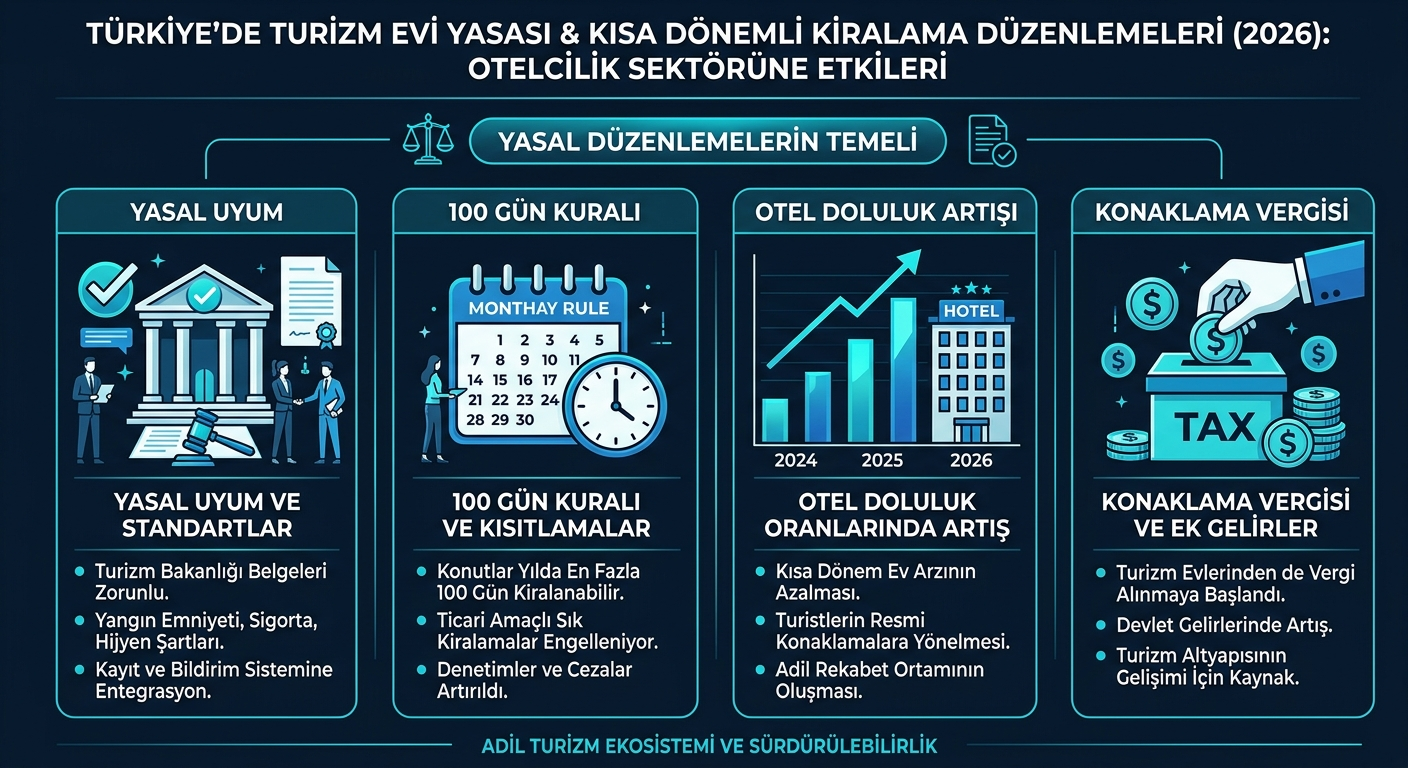
The most significant and controversial provision is the "100-day rule": residential properties can only be rented for tourism purposes (stays shorter than 30 days) for a maximum of 100 days per year. Owners wishing to exceed this limit must transition to "tourism rental enterprise" status and meet full commercial licensing requirements.
The Licensing Application Process
Applications made via the e-Government (e-Devlet) portal require the following documentation:
- Title deed or lease agreement – Proof of property ownership or rental rights.
- Condominium board approval – For apartment units, written consent from 51% of property owners is required (the law's most challenging clause).
- Business and working license – Obtained from the local municipality.
- Fire safety report – A certificate of compliance issued by the fire department.
- Occupancy permit – Verification that the building is suitable for lodging.
- Tax registration certificate – Separate tax registration for lodging activities.
- Identity reporting system registration – Mandatory reporting of guest identity information to the Provincial Security Directorate.
While the digitalization of the application process is a positive step, the neighbor consent requirement (51% majority) is a formidable barrier for many hosts. In major tourism centers like Istanbul, Antalya, and Muğla, securing neighbor approval in apartment blocks is causing social and legal friction. Real estate experts predict that 40-50% of current unlicensed short-term rental properties will exit the market because they cannot meet this requirement.
Financial Obligations
Licensed tourism residences are subject to the following taxes and fees:
- 2% Accommodation Tax – Calculated on the overnight rate, equal to the rate applied to hotels.
- VAT – 10% for lodging services (the reduced rate).
- Tourism Contribution Share – 10,000 TL annually (as of the 2026 update).
- Municipal Fees – Business opening and environmental cleaning taxes varying by region.
- Social Security (SGK) Obligations – Required in the case of full-time employment.
When these financial burdens are totaled, the effective tax load for hosts—who previously kept 90-95% of gross income as net profit—rises to the 25-35% range. This aligns closely with the tax burden of hotels, significantly restoring competitive parity.
Embed this image on your site
<a href="https://otelciro.com/en/news/turkey-s-law-no-7464-airbnb-regulations-hotel-strategy-2026-guide">
  <img src="https://cdn.sanity.io/images/1la98t0z/production/56ebd0e2a676693dfde0ea4f769b2b1e6300b085-1408x768.png" alt="Turkey Tourism Housing Law 100-day rule and hotel impact" width="800" />
</a>
<p>Source: <a href="https://otelciro.com">OtelCiro</a> — AI Hotel Revenue Management</p>
Sanctions and Enforcement Mechanisms
The law’s deterrence stems from the severity of its penalties:
Administrative Fines:
- Unlicensed activity: 100,000 TL (2026 updated amount).
- Exceeding the 100-day limit: 10,000 TL for each additional day.
- Violation of identity reporting: 50,000 TL.
- Failure to declare/pay accommodation tax: A penalty of 50% of the tax principal.
- Repeated violations: Suspension of activity and license revocation.
Enforcement Channels:
- Periodic audits by Provincial Directorates of Culture and Tourism.
- Platform-based monitoring: Mandatory license numbers on Airbnb, Booking.com, and other OTAs.
- Citizen tip-line (ALO 176).
- Municipal police (Zabıta) inspections.
- Cross-checks by the Tax Office (comparing platform revenues against declarations).
One of the most effective enforcement tools is platform liability: Airbnb, Booking.com, Vrbo, and other platforms are legally required to remove unlicensed listings in Turkey and display the license number prominently. Platforms failing to comply face potential access blocks. As of November 2025, Airbnb announced it had removed 35% of its Turkish listings due to licensing deficiencies.
Strategic Opportunities for Hotels
Law No. 7464 does not just reduce competitive pressure; it creates active strategic opportunities for hotels to leverage:
1. Market Share Recovery
With 40-50% of unlicensed short-term rentals exiting the market, city hotels specifically expect an increase in occupancy rates of 5-8%. STR Global data for Q1 2026 indicates that hotel occupancy in Istanbul and Antalya has already risen by 3.2% compared to the pre-regulation period.
2. Pricing Power
The contraction in short-term rental supply allows hotels to implement more aggressive pricing, especially during peak seasons and major events. Since Airbnb prices must now reflect tax and licensing costs, the price gap between hotels and Airbnbs is narrowing. This makes it easier for hotels to counter the "price advantage" perception of rentals.
3. Accelerated Digital Transformation
The law subjects all lodging facilities to digital reporting requirements. This increases the pressure for digitalization across the sector, favoring hotels that invest in technology. Integrated PMS, automated tax calculation, digital identity reporting, and platform integrations are no longer luxuries but necessities.
4. The Hybrid Model Opportunity
Some hotel groups are using the new licensing framework to create their own short-term rental portfolios. By offering "hotel-quality apartments," they can capture market share from both traditional hospitality and the short-term rental segment. In this hybrid model, the hotel's brand equity, operational standards, and existing distribution channels provide a massive advantage.
5. Strengthening the Corporate Segment
Unlicensed rentals often caused safety and invoicing issues for the business travel segment. With these regulations, corporate clients are shifting back to properties that can issue valid invoices and provide certified standards—creating an opportunity for hotels to strengthen their corporate rate plan strategies.
Implementation Challenges and Criticisms
It would be unrealistic to ignore the challenges in enforcing the law:
Audit Capacity: Inspecting an estimated 350,000+ units across Turkey is a massive logistical challenge. Effective audit capacity remains limited, particularly in rural tourism zones and small coastal towns.
The Neighbor Consent Problem: The 51% consent requirement prevents many apartment owners from operating legally, leading some to continue "underground" activities. Legal circles are currently debating whether to increase this threshold to 67% (a 2/3 majority) for better community harmony.
Platform Compliance: It takes time for international platforms to achieve full compliance with Turkish regulations. While Airbnb has been proactive, some smaller-scale platforms still host unlicensed listings.
Property Rights Debate: Some owners view the restrictions on how they use their property as a violation of property rights. Individual appeals to the Constitutional Court are ongoing.
While these hurdles limit the law's effectiveness to an extent, experiences from similar European regulations (Barcelona, Amsterdam, Paris, Vienna) show that with gradual implementation and tech-supported auditing, compliance rates eventually reach the 70-80% range.
Conclusion: Regulation Favors Hotels—But Action Is Mandatory
Law No. 7464 opens a historic window of opportunity for the Turkish hotel industry. Hotels that have struggled for years against unequal competition will now operate in a more balanced market. However, capitalizing on this opportunity requires more than passive waiting—hotels must update their pricing strategies, optimize digital distribution channels, and clearly position the "hotel quality" difference.
OtelCiro's integrated distribution management platform helps hotels maximize benefits from these new market dynamics. With real-time price optimization, multi-channel distribution management, automated tax calculation, and competitive analysis tools, you can position your hotel as a winner in this new era.
Related reading: Hotel Competition with Vrbo and Vacation Rental Platforms — The impact of short-term rental platforms on hotel distribution strategy and counter-move plans.
![How Booking.com Uses Machine Learning to Rank Hotels [2026]](https://cdn.sanity.io/images/1la98t0z/production/b5e42eae20b08b1a662436df1775c657f98f7871-2752x1536.jpg?w=1920&q=50&auto=format&fit=max)