
![Scope 3 Carbon Reporting for Hotels: 90% of Footprint [2026 Guide]](https://cdn.sanity.io/images/1la98t0z/production/479839ecf9c8b437664b9c9f9ca3ff5e2d360f30-1024x1024.png?w=1920&q=65&auto=format&fit=max)
Key Takeaways
- Scope 3 emissions represent 70-90% of a hotel's total carbon footprint, encompassing supply chain, guest travel, and waste.
- Mandatory Scope 3 reporting under the EU's CSRD begins for many hotels by 2026-2027, significantly impacting Turkish properties through supply chain pressures and international brand requirements.
- The PEFCR methodology provides a framework for measuring these complex emissions, recommending a hybrid approach of primary and secondary data.
- The hotel sector aims to reduce carbon emissions per room by 66% by 2030, necessitating comprehensive strategies across the supply chain, guest transportation, and digital transformation.
- Proactive adoption of Scope 3 reporting offers crucial benefits: ensuring legal compliance, driving cost efficiencies through optimization, and gaining a competitive advantage with sustainability-conscious travelers who are willing to pay 15-20% more.
What is Scope 3 in Hospitality and Why Is It Critical?
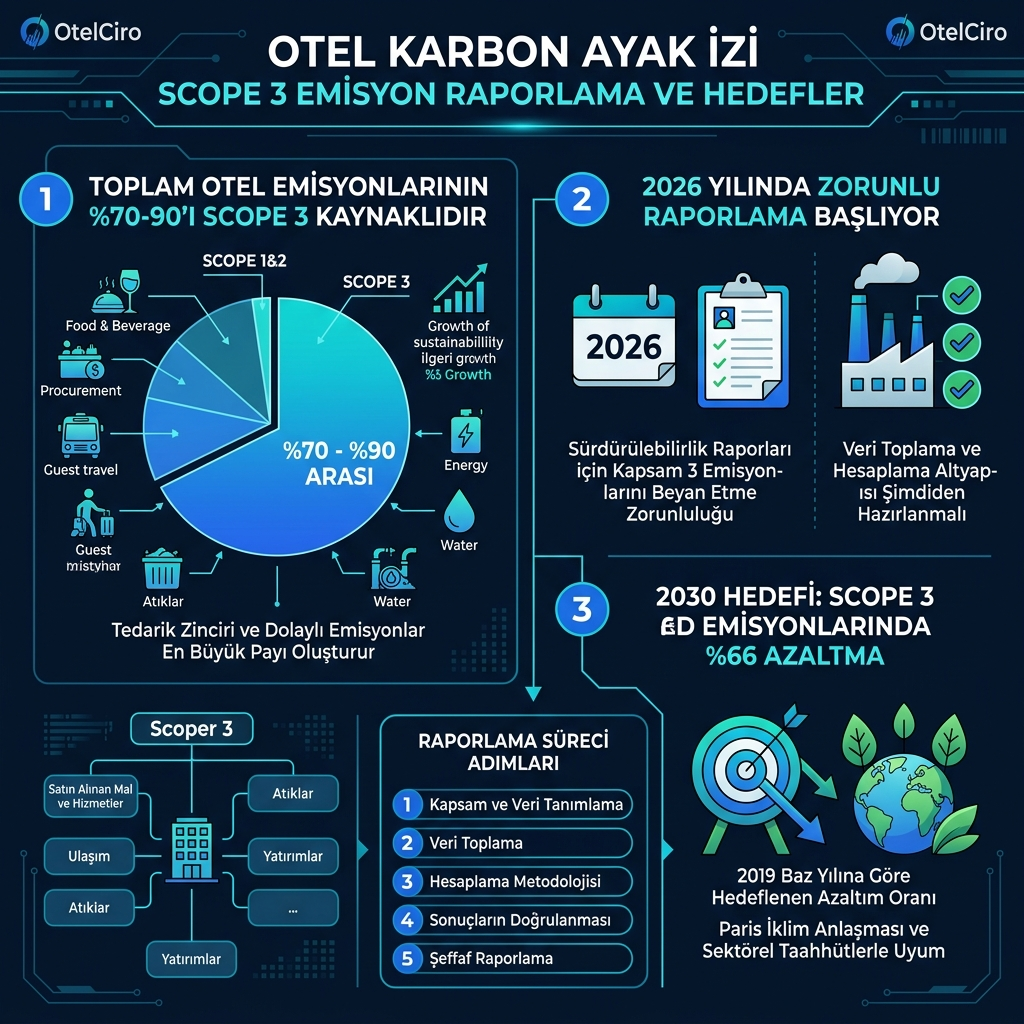
Discussions around carbon emissions in hospitality have long focused on energy consumption and fuel use. Scope 1 (direct emissions: boilers, generators, vehicle fleet) and Scope 2 (indirect emissions: purchased electricity and heating) categories are relatively straightforward metrics to measure. However, according to a 2025 Cornell University study, 70 to 90% of a hotel's total carbon footprint falls under the Scope 3 category — emissions originating from sources outside the hotel's direct control, such as its supply chain, guest transportation, food procurement, and waste management.
Scope 3 emissions are classified into 15 sub-categories. For the hospitality sector, the sub-categories with the largest share are:
- Purchased goods and services (Category 1): Emissions from the supply chain, including food, beverages, cleaning supplies, laundry chemicals, and linen sets. This accounts for approximately 35-45% of a hotel's Scope 3 emissions.
- Guest transportation (Categories 6 and 7): Emissions from guests' travel to and from the hotel — particularly air travel. This item alone contributes 20-30%.
- Waste generated in operations (Category 5): Emissions from food waste, packaging waste, and the disposal of hazardous waste.
- Capital goods (Category 2): Emissions from the production processes of furniture, appliances, HVAC systems, and renovation materials.
According to WTTC (World Travel & Tourism Council) data, the tourism sector is responsible for 8-11% of global carbon emissions. A significant portion of this comes from Scope 3 sources. Therefore, for hoteliers to understand their true carbon impact, simply looking at the electricity bill is not enough.
Embed this image on your site
<a href="https://otelciro.com/en/news/scope-3-carbon-reporting-for-hotels-90-of-footprint-2026-guide">
  <img src="https://cdn.sanity.io/images/1la98t0z/production/479839ecf9c8b437664b9c9f9ca3ff5e2d360f30-1024x1024.png" alt="Otellerde Scope 3 karbon emisyon dağılımı ve raporlama süreci" width="800" />
</a>
<p>Source: <a href="https://otelciro.com">OtelCiro</a> — AI Hotel Revenue Management</p>
EU CSRD Mandate: 2026-2027 Timeline and Impact on Turkey
The European Union's Corporate Sustainability Reporting Directive (CSRD) marks a turning point for the hospitality sector. Mandatory reporting, which began for large companies in 2025, will expand its scope in the 2026-2027 period to cover all medium and large-sized hotels operating in the EU or linked to the EU market.
Who is Affected?
Companies meeting at least two of the following criteria fall under CSRD reporting obligations:
- More than 250 employees
- Net turnover exceeding 40 million euros
- Balance sheet total exceeding 20 million euros
Although Turkey is not an EU member, Turkish hotel chains and management companies are affected through multiple channels. First, tour operators and OTAs (Booking.com, Expedia) in the EU are requesting Scope 3 data from their suppliers — because Turkish hotels are part of these companies' own Scope 3 supply chain emissions. Second, international brand agreements (Accor, Hilton, Marriott) have begun to mandate emission data sharing from franchisees. Third, as part of Turkey's alignment with the EU Green Deal, the Carbon Border Adjustment Mechanism (CBAM) set to start in 2027 and national climate legislation will introduce similar reporting standards.
The ESRS E1 standard, prepared by EFRAG (European Financial Reporting Advisory Group), mandates the reporting of Scope 3 emissions. For hotels, this means collecting data from the entire supply chain, applying emission factors, and undergoing an independent audit process.
Further reading: For a detailed analysis of the EU CSRD mandate's impact on Turkish hotels, please refer to our article EU CSRD Mandatory Sustainability Reporting and Hotels.
PEFCR Methodology: How is Measurement Done?
Measuring Scope 3 emissions is a far more complex process compared to Scope 1 and 2. The primary methodology recommended by the EU, PEFCR (Product Environmental Footprint Category Rules), offers a standard framework for the hospitality sector.
Data Collection Approaches
Within the PEFCR framework, there are three main data collection methods:
-
Primary data (supplier-specific): Directly obtaining emission data from each supplier. This is the most accurate method but also the most operationally challenging. For large chain hotels, the number of suppliers can range from 200-500.
-
Secondary data (industry averages): Using industry average emission factors from databases. Databases like Ecoinvent and GaBi provide these factors. This is more practical but yields results that are not hotel-specific.
-
Hybrid approach: Using primary data for high-impact categories and secondary data for low-impact categories. PEFCR recommends this approach, and it is becoming the most common practice.
Calculation Steps
The steps to follow for Scope 3 reporting are:
- Scope definition: Identify which of the 15 Scope 3 categories are applicable to your hotel. For hotels, typically 8-10 categories are relevant.
- Data inventory creation: Collect expenditure-based or activity-based data for each category. For example, for food purchases, use kilogram-based procurement records or Turkish Lira-based expenditure data.
- Application of emission factors: Select appropriate emission factors from DEFRA, EPA, or Ecoinvent databases. In the expenditure-based method, kgCO2e per Turkish Lira is used, while in the activity-based method, kgCO2e per unit is used.
- Uncertainty analysis: Report the reliability level by indicating which data are primary and which are based on estimates.
- Independent verification: Obtain third-party auditor approval to certify the reliability of the report.
According to Greenview's Cornell Hotel Sustainability Benchmark report, the first-year cost for a hotel preparing a comprehensive Scope 3 report ranges from 15,000-50,000 euros. However, from the second year onwards, the cost drops by 60-70% as data collection systems and processes become established.
2030 Targets: 66% Reduction Roadmap
In line with the Paris Agreement goals, the hospitality sector aims to reduce carbon emissions per room by 66% by 2030. This target defines the sector's decarbonization pathway consistent with a 1.5°C scenario. However, achieving the 2030 target at the current pace of progress presents a critical challenge.
Reduction Strategies and Levers
Concrete strategies hotels can implement to reduce Scope 3 emissions:
Supply chain transformation:
- Increasing the proportion of local suppliers: Using suppliers within a 500 km radius can reduce transportation emissions by 40-60%.
- Increasing procurement of organic and sustainably certified food: 20-30% lower carbon intensity compared to conventional agriculture.
- Elimination of single-use plastics: Saving 2-5 tons of plastic waste annually.
Guest transportation optimization:
- Marketing and promoting train-connected locations.
- Electric transfer services from airport to hotel.
- Integrating carbon offsetting options into the booking process (however, it is important to note that the claim of "carbon neutral" has been prohibited by new EU regulations).
Impact of digital transformation:
- 15-25% savings in Scope 2 with AI-powered energy management (indirectly impacting Scope 3).
- Reducing food waste by 30-50% through smart supply chain optimization.
- Reducing paper consumption by 90% with digital check-in/check-out.
According to ITP (International Tourism Partnership) data, the number of hotel companies setting SBTi (Science Based Targets initiative) approved targets tripled from 2024 to 2026. 72% of these hotels also include Scope 3 targets in their scope.
Implementation Checklist for Turkish Hotels
Steps Turkish hotels should take to prepare for Scope 3 reporting:
- Current state analysis: You should already be measuring your Scope 1 and 2 emissions. If not, start there.
- Category screening: Review the 15 Scope 3 categories and determine which ones are applicable to your hotel.
- Supplier mapping: List your top 20 suppliers and assess their capacity to share carbon data.
- Data infrastructure setup: Establish a system for collecting purchasing, transportation, waste, and energy data in a digital environment.
- Emission calculation tool selection: Choose one of the following: Hotel Carbon Measurement Initiative (HCMI), Greenview Portal, or specialized software solutions.
- Base year determination: Set 2024 or 2025 as the base year and make comparisons with subsequent years.
- Setting reduction targets: Define science-based targets consistent with the SBTi methodology.
- Reporting format creation: Prepare a reporting template compliant with one of the GRI, ESRS, or TCFD frameworks.
- Training program: Educate department heads on Scope 3 concepts and data collection obligations.
- Independent auditor selection: Plan the audit process before the first reporting cycle.
According to data from the Turkish Hoteliers Federation (TÜROFED), only 12% of Turkish hotels conduct any carbon reporting, and only 3% of these include Scope 3. This rate is significantly below the EU average of 34%. Considering the legal obligations in 2027, hotels that prepare early will gain both compliance and a competitive advantage.
Carbon Accounting Software Solutions
Scope 3 reporting is not sustainable with manual methods. Various carbon accounting software solutions specifically for the hospitality sector are available on the market:
Industry-specific solutions:
- Greenview Portal: Based on the HCMI methodology, a free basic tool used by over 25,000 hotels. The Scope 3 module is available in the premium version.
- BeCause (Booking.com): OTA's own sustainability scoring and reporting tool. Works integrally for hotels selling through Booking.com.
- Measurabl: ESG reporting platform specifically for the real estate and lodging sectors.
General carbon accounting platforms:
- Watershed: A comprehensive enterprise platform offering Scope 3 analysis.
- Persefoni: ISSB and ESRS-compliant reporting tool.
- Plan A: European-based, CSRD-compliant carbon management platform.
A critical factor in choosing these tools is PMS (Property Management System) integration. If purchasing data, energy consumption, and occupancy rates can be automatically transferred, the data collection process is dramatically simplified. OtelCiro's integrated data infrastructure facilitates such integrations, offering a single data source for both operational efficiency and sustainability reporting.
Conclusion: Scope 3 – A Mandate, An Opportunity
Scope 3 carbon emission reporting is becoming an unavoidable obligation for the hospitality sector by 2026-2027. However, viewing this obligation merely as a cost item would be a significant mistake. According to EY's research, hotels that conduct comprehensive sustainability reporting achieve 8-12% higher ADR compared to those that do not — because the conscious traveler segment is rapidly growing, and these travelers are willing to pay 15-20% more for sustainable hotels.
Hotels that act early gain three critical advantages: spreading legal compliance costs over time, achieving cost savings from supply chain optimization, and gaining a competitive edge in the conscious traveler market. OtelCiro's data management infrastructure facilitates the integration of hotel operational data with sustainability reporting, offering a reliable technology partner in this transformation process.
Related content: Our article Hotel Greenwashing Risk 2026, which details greenwashing risks and legal penalties in hotels, also complements this topic.
![Hotel Labor Crisis: 8.6M Shortage & AI Solutions [2035 Strategy]](https://cdn.sanity.io/images/1la98t0z/production/d19b18ebdaf612bd18dfffca0a17b8a4864cba9b-2752x1536.png?w=1920&q=50&auto=format&fit=max)
![Hotel ESG Reporting: EU CSRD 2026 Compliance [Strategy Guide]](https://cdn.sanity.io/images/1la98t0z/production/7c0ed4b96b182e49b9bafa47a0494428d9ce5a1e-2048x2048.png?w=1920&q=50&auto=format&fit=max)