
![PCI DSS 4.0 Hotel Compliance: Your [2026 Strategy Guide]](https://cdn.sanity.io/images/1la98t0z/production/d2451308fa9b4aa3d7c7bbaee973561829cd038f-2048x2048.png?w=1920&q=65&auto=format&fit=max)
Key Takeaways
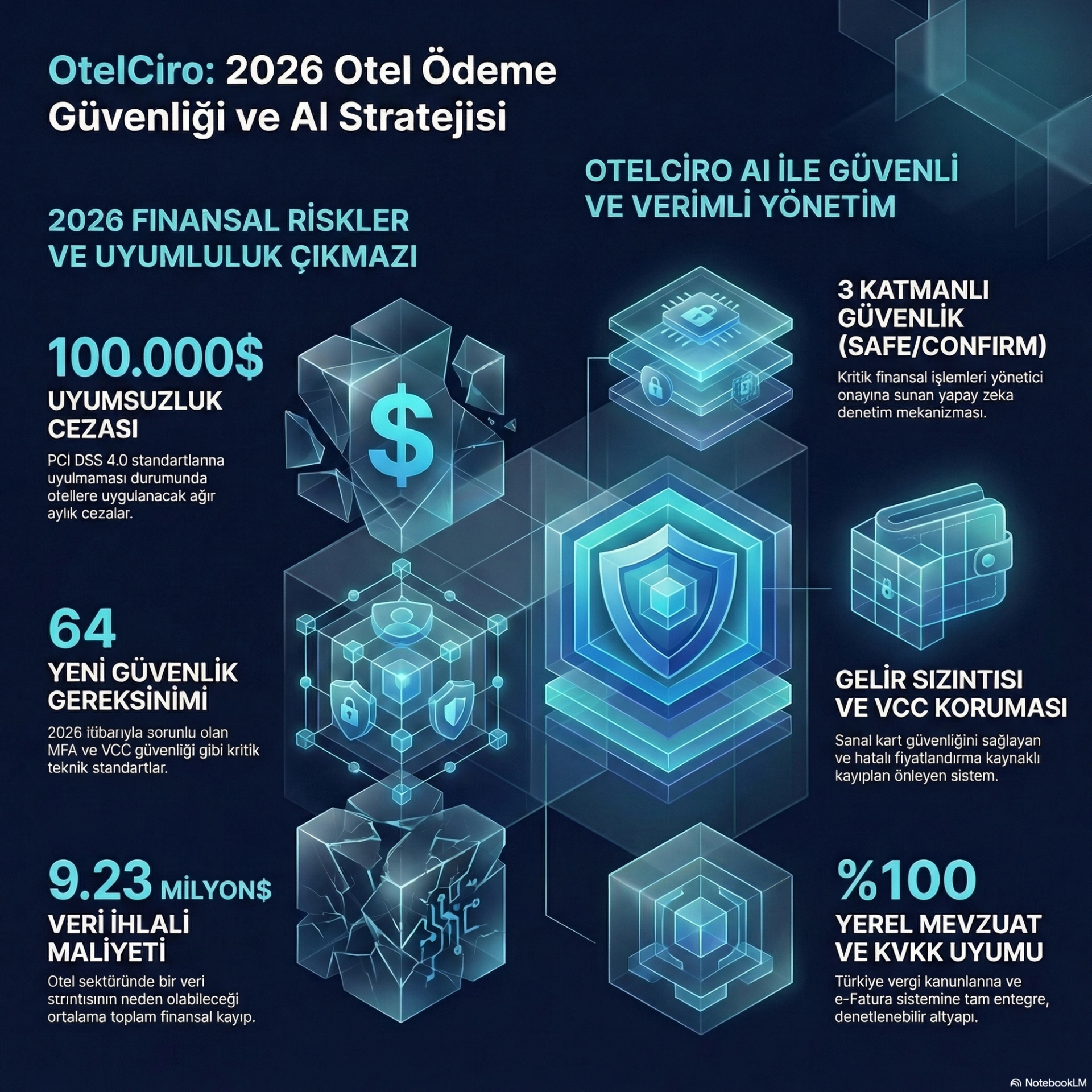
- PCI DSS 4.0 is fully enforced in 2026, introducing 64 new requirements and significantly tightening payment security standards for the hospitality industry.
- Hotels are a high-risk sector, accounting for 24% of card data breaches with an average cost of $9.23 million per incident.
- Critical updates include mandatory phishing-resistant MFA for all CDE access, a detailed six-month card data inventory, and new client-side security controls.
- Virtual Credit Card (VCC) security is a specific focus, requiring hotels to cease receiving VCC details via email and implement tokenization.
- Non-compliance carries severe penalties, including monthly fines of $5,000-$100,000 and significant reputational damage, making proactive compliance a strategic advantage.
PCI DSS 4.0: A New Era for the Hospitality Sector
Following the transition period that ended on March 31, 2025, PCI DSS 4.0 is now entering its first full year of implementation in 2026. This major update to the Payment Card Industry Data Security Standard is the most comprehensive revision since 2004, featuring a total of 64 new requirements and 51 control points previously classified as "best practices" that are now mandatory.
The hospitality sector is one of the highest-risk industries in terms of PCI DSS compliance. According to Verizon's 2025 Data Breach Investigations Report, the accommodation and food services sector accounts for 24% of all card data breaches — second only to retail. IBM's Cost of a Data Breach Report for the same year revealed that the average cost of a data breach in the hospitality industry reached $9.23 million — a 31% increase over the sector's 2022 average.
The risk multiplier for hotels stems from several factors: multiple points of payment (front desk, restaurant, spa, minibar), a tradition of long-term card data retention (no-show guarantees, pre-authorizations), the intensity of third-party integrations (OTAs, PMS, POS), and training gaps created by high staff turnover rates. PCI DSS 4.0 introduces specific and measurable controls for each of these risks.
Related reading: Hotel Cybersecurity and Data Protection
Analysis of 64 New Requirements for Hoteliers
The changes brought by PCI DSS 4.0 need to be addressed in six critical categories for hotels:
1. Mandatory Multi-Factor Authentication (MFA)
Previously mandatory only for remote access, MFA is now required for every access to the Cardholder Data Environment (CDE). This covers all processes, from front desk staff logging into the PMS, to night auditors accessing payment reports, to IT teams managing POS terminals.
The practical impact for hotels is significant: in an average hotel, 15-30 personnel access card data daily. MFA infrastructure must be set up for each — biometric authentication, hardware tokens, or mobile authenticator applications. According to Requirement 8.4.2, MFA implementation must be phishing-resistant, meaning SMS-based one-time passwords are no longer considered sufficient. Standards like FIDO2/WebAuthn are preferred.
2. Customized Security Approach
One of the most significant innovations of PCI DSS 4.0 is that companies can design their own security control mechanisms to meet specific requirements. However, this flexibility brings an additional audit burden for hotels: customized controls must be supported by a Targeted Risk Analysis (TRA) and additionally approved by a QSA (Qualified Security Assessor).
3. Card Data Discovery and Inventory Requirements
Requirement 12.5.2 mandates that all card data flows be mapped and verified every six months. For hotels, this is a highly complex process because card data can be found in unexpected places: old PMS backups, email servers (guest requests), fax machines, Excel spreadsheets, and even written logbooks. According to Verizon DBIR data, 34% of hotel data breaches originate from unknown or forgotten data repositories.
4. Client-Side Security
Requirements 6.4.3 and 11.6.1 mandate the inventorying of all JavaScript code on payment pages and the monitoring of changes. This is critical for direct bookings made via the hotel website: third-party scripts running in the booking engine's payment form (analytics, chat widgets, advertising pixels) pose a potential Magecart attack vector. Hotels are now required to implement Content Security Policy (CSP) and Subresource Integrity (SRI).
5. Security Awareness Training
Requirement 12.6 mandates that security awareness training be provided at least once a year and include social engineering (phishing) scenarios. Given the high staff turnover rate in the hotel industry (60-80%), these trainings need to be integrated into the onboarding process and periodically updated.
6. Encryption and Key Management
Disk-level encryption alone is no longer considered sufficient. Card data must be encrypted at the field level or application level. Hotels not using Point-to-Point Encryption (P2PE) certified terminals may need to completely overhaul their data encryption infrastructure.
Embed this image on your site
<a href="https://otelciro.com/en/news/pci-dss-4-0-hotel-compliance-your-2026-strategy-guide">
  <img src="https://cdn.sanity.io/images/1la98t0z/production/d2451308fa9b4aa3d7c7bbaee973561829cd038f-2048x2048.png" alt="PCI DSS 4.0 Hotel Payment Security Compliance Requirements" width="800" />
</a>
<p>Source: <a href="https://otelciro.com">OtelCiro</a> — AI Hotel Revenue Management</p>
VCC (Virtual Credit Card) Security
Virtual credit cards (VCCs) are widely used for reservations coming through OTAs. Booking.com, Expedia, and other major OTAs process a large portion of hotel payments via VCCs. VCC security becomes a separate focus area under PCI DSS 4.0.
Points hotels should pay attention to regarding VCC transactions:
- Do not receive VCC data via email. Many hotels still receive VCC details in plain text email — this is a clear violation of PCI DSS 4.0 Requirement 4.2.1. VCC data should only be received via encrypted channels (API integration, secure extranet portal).
- Do not store VCC data in the PMS. Many PMS systems store VCC numbers in plain text or with weak encryption. Tokenization should be implemented: a token should be stored instead of the card number, with the actual card data kept in a secure vault.
- Secure charge-back processes. Sharing card data in VCC disputes should be done through secure and auditable channels.
- Establish automated VCC processing infrastructure. Manual VCC entry creates both a security risk and operational cost. Integrated PMS solutions like OtelCiro automatically process OTA VCCs, ensuring both PCI DSS compliance and operational efficiency.
According to Mastercard's 2025 data, the VCC fraud rate is 2.3% higher compared to physical cards — this difference is due to insecure processing of VCC data in hotels. PCI DSS 4.0 tightens controls in this area.
Penalties and Cost Analysis
The financial consequences of PCI DSS non-compliance are evaluated in two categories: direct and indirect.
Direct Penalties:
- Fines imposed by card brands (Visa, Mastercard) on acquirer banks: $5,000-$100,000 per month
- These fines are passed on to the hotel operator by the acquirer bank
- Suspension of card acceptance privileges for repeated non-compliance — a disaster scenario for a hotel
- Forensic investigation costs in case of a data breach: $50,000-$500,000
Indirect Costs:
- Guest notification and credit monitoring service costs
- Impact of reputational damage on revenue: According to the Ponemon Institute, hotels experiencing a data breach see an 11-14% drop in bookings in the first 6 months
- Legal proceedings and compensation claims
- Increase in cyber insurance premiums
A comparison of compliance costs with breach costs presents a clear picture: while a full PCI DSS 4.0 compliance project for a mid-sized hotel may cost $50,000-$150,000, the average cost of a data breach is $9.23 million. In terms of Return on Investment (ROI), compliance is always more economical.
Compliance Roadmap: 10-Step Action Plan
Follow these steps in order for your hotel's PCI DSS 4.0 compliance:
- Map card data flow — document where all card data is collected, processed, stored, and transmitted.
- Conduct a scoping assessment — clarify CDE boundaries, identify segmentation opportunities.
- Implement MFA infrastructure — apply phishing-resistant MFA for all personnel and systems accessing the CDE.
- Apply tokenization — tokenize card data in PMS, POS, and booking engines.
- Transition to P2PE terminals — PCI P2PE certified terminals dramatically reduce CDE scope.
- Establish client-side security controls — implement CSP, SRI, and script monitoring mechanisms on payment pages.
- Initiate a security awareness training program — integrated into onboarding, annual refresh, phishing simulations.
- Plan vulnerability scanning and penetration tests — internal and external scans, at least one pentest annually.
- Update incident response plan — specific procedures for card data breach scenarios.
- Schedule QSA or ISA assessment — set a timeline for SAQ (Self-Assessment Questionnaire) or full ROC (Report on Compliance).
Related reading: Hotel Staff Retention Strategy and AI — The impact of high staff turnover on security compliance and AI-powered training solutions.
Conclusion: Security Compliance Becomes a Competitive Advantage
PCI DSS 4.0 presents a significant operational and financial responsibility for hotels. However, hotels that proactively meet these requirements can turn security from a cost item into a competitive advantage. Corporate clients and event organizers are now considering PCI DSS compliance certification as a selection criterion; especially in the MICE segment, this document plays a decisive role in bids.
OtelCiro's integrated payment security module inherently meets PCI DSS 4.0 requirements: automatic VCC processing, tokenization, MFA integration, and real-time anomaly detection make your payment processes both secure and efficient. Manage your card data flow from a single platform while automatically generating compliance reports.
![Hotel Labor Crisis: 8.6M Shortage & AI Solutions [2035 Strategy]](https://cdn.sanity.io/images/1la98t0z/production/d19b18ebdaf612bd18dfffca0a17b8a4864cba9b-2752x1536.png?w=1920&q=50&auto=format&fit=max)
![Hotel ESG Reporting: EU CSRD 2026 Compliance [Strategy Guide]](https://cdn.sanity.io/images/1la98t0z/production/7c0ed4b96b182e49b9bafa47a0494428d9ce5a1e-2048x2048.png?w=1920&q=50&auto=format&fit=max)