![Maximizing Hotel Visibility: AI Overviews & Zero-Click Search [2026 Guide]](https://cdn.sanity.io/images/1la98t0z/production/0a8283d3100daddb4d10f95e8bff84893e6467d4-2048x2048.png?w=1920&q=65&auto=format&fit=max)
Key Takeaways
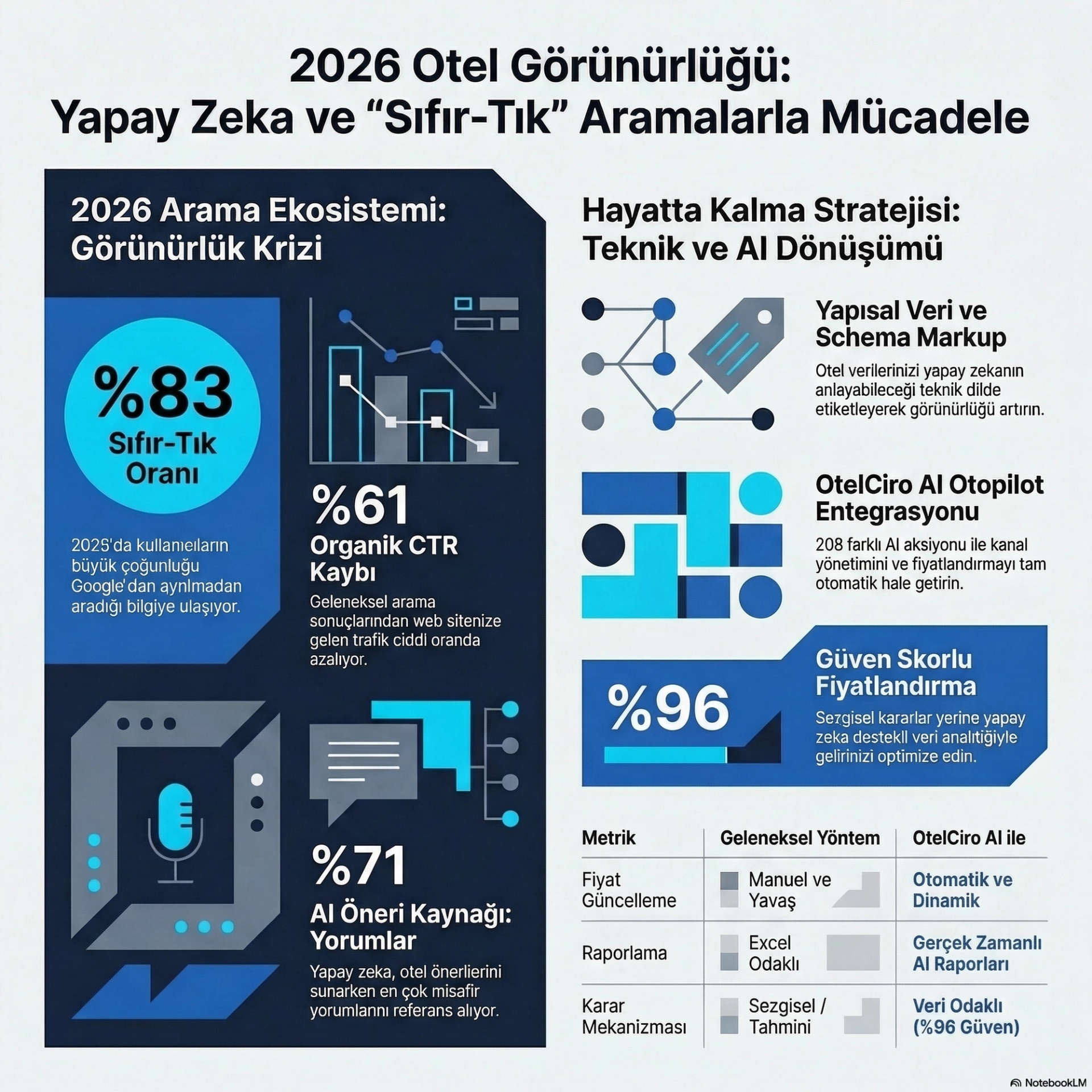
- Google's AI Overviews now handle 83% of searches as "zero-click," with organic CTR for hotels dropping by 61%.
- AI Overviews predominantly (71%) source user reviews, with hotel websites contributing only 9% of their answers.
- Hotels must adopt "GEO" (Generative Engine Optimization) strategies, focusing on EEAT, robust structured data, and comprehensive reputation management across platforms.
- Key GEO actions include maximizing Google Business Profile, producing long-form data-rich content, and establishing automated review request processes.
- New metrics like AI Overview Visibility Rate and Zero-Click Impression Value are crucial for tracking performance in this evolving search landscape.
The New Reality of Search Engines: The Zero-Click Era
Google's search results page (SERP) underwent a radical transformation between 2024-2026. AI Overviews (formerly SGE — Search Generative Experience) now present comprehensive, AI-generated answer blocks above organic results for the vast majority of hospitality-related searches. According to SparkToro's Q4 2025 data, 83% of all Google searches now result in "zero-click" — users find the information they need without clicking on any website.
The hospitality sector is one of the most affected by this transformation. Ahrefs' 2025 analysis reveals that the organic click-through rate (CTR) for hospitality-related searches like "hotel recommendations," "where to stay," and "best hotels" has decreased by 61%. According to a sector report by UK-based digital marketing agency Semetrical, an AI Overviews block for a query like "where to stay in Antalya" occupies the first 1200 pixels of the screen — organic results only become visible after scrolling down the page.
This situation means that traditional SEO strategies alone are no longer sufficient for hotel websites. Now, the primary goal is not just to appear on Google's first page, but to be referenced as a source within AI Overviews. This new discipline is called "GEO" (Generative Engine Optimization) and requires fundamentally different strategies than traditional SEO.
Related reading: GEO: Hotel Visibility Strategies in the Shadow of SEO 2026
How AI Overviews Works and Where It Selects Its Sources
Google's AI Overviews engine uses a complex source selection algorithm when generating zero-click responses. Understanding the behavior of this algorithm in the hospitality sector is fundamental to developing a visibility strategy.
According to joint research by Princeton University and Georgia Tech, the distribution of sources used by AI Overviews for hospitality-related answers is as follows:
- 71% — User reviews and ratings (Google Reviews, Booking.com, TripAdvisor)
- 14% — Authoritative content sites (travel blogs, accommodation guides, industry publications)
- 9% — Direct content from hotel websites
- 6% — Structured data sources (Google Business Profile, schema.org)
This distribution reveals a striking fact: hotel websites constitute only 9% of AI Overviews sources. In contrast, guest reviews are the dominant source at 71%. This indicates that hotel managers must focus not only on website SEO but also on their reputation management across all digital ecosystems.
AI Overviews' source selection criteria differ from traditional SEO ranking factors:
Increased EEAT Weight: Experience, Expertise, Authoritativeness, and Trustworthiness signals are much more decisive in AI Overviews source selection. As stated in Google's own documentation, "For YMYL (Your Money or Your Life) topics, AI Overviews answers are compiled only from sources with high EEAT signals." Hospitality is considered a YMYL category as it involves travel expenses.
Data Specificity: Content containing specific data is preferred over general statements. Instead of "The hotel's location is nice," measurable information like "The hotel is a 120-meter walk to the beach, 15 minutes by taxi to the city center, and 45 minutes for airport transfer" is referenced at a higher rate by AI Overviews.
Timeliness: AI Overviews actively evaluates when sources were last updated. A source updated within the last 3 months is much more likely to be referenced than a "Cappadocia hotel guide" written in 2024.
Embed this image on your site
<a href="https://otelciro.com/en/news/maximizing-hotel-visibility-ai-overviews-zero-click-search-2026-guide">
  <img src="https://cdn.sanity.io/images/1la98t0z/production/0a8283d3100daddb4d10f95e8bff84893e6467d4-2048x2048.png" alt="Google AI Overviews zero-click search hotel visibility strategies" width="800" />
</a>
<p>Source: <a href="https://otelciro.com">OtelCiro</a> — AI Hotel Revenue Management</p>
GEO Optimization Strategies for Hotel Websites
The transition from traditional SEO to GEO requires fundamental changes in content production and technical infrastructure approaches. Here are the key strategies hotels should implement:
1. Strengthen Your Structured Data Layer
Schema.org markups are the most critical technical factor for AI Overviews to "understand" your hotel. Beyond standard Hotel schema, you need to add the following structured data types:
- FAQPage: Frequently asked questions and answers (at least 10 Q&A pairs)
- Review and AggregateRating: Structured presentation of guest reviews
- LocalBusiness: Location, operating hours, service area
- Event: Hotel events, package offers
- BreadcrumbList: Clarification of site hierarchy
- HowTo: Check-in processes, use of hotel services
After validating all markups with Google's Rich Results Test tool, regularly monitor the structured data report in Search Console. Incorrect or missing markups can cause you to be excluded from the AI Overviews source pool.
2. Produce Long-Form, Data-Rich Content
The content format most referenced by AI Overviews is long-form content, between 2,000-4,000 words, supported by specific data, and demonstrating subject authority. For hotels, this means redesigning the blog strategy:
- Regional travel guides (e.g., "3-Day Cappadocia Itinerary: Routes, Budget, Accommodation Recommendations")
- Comparison content (e.g., "Antalya Belek vs. Lara: Which for a Family Vacation?")
- Data-driven analyses (e.g., "2026 Turkey Hotel Price Index: Region-Based Trends")
- Guest experience guides (e.g., "From Airport to Hotel: Comparing Antalya Transfer Options")
Each content piece should include at least 5 statistics or data points, sources should be clearly stated, and the content should be updated at least every 3 months.
3. Prioritize Review Ecosystem Management
Since 71% of AI Overviews sources come from user reviews, review management is no longer just reputation management but central to search visibility strategy. Tactics to implement:
- Increase review volume: Automatic review request emails after check-out, QR code review cards, polite prompting by staff.
- Improve response quality: Respond to every review within 48 hours with personalized and detailed answers. AI Overviews also uses hotel responses as a source.
- Ensure platform diversity: Not just Google Reviews; reviews on Booking.com, TripAdvisor, Trustpilot, and industry-specific platforms are also scanned by AI Overviews.
- Keyword awareness: Specific phrases mentioned in reviews (room size, cleanliness, location, breakfast quality) directly reflect into AI Overviews answers.
4. Maximize Google Business Profile Optimization
Google Business Profile (GBP) is one of the most frequently consulted structured data sources for hospitality queries by AI Overviews. GBP optimization is no longer "set it and forget it" but a continuously updated live platform:
- Weekly GBP posts (events, seasonal offers, innovations)
- Complete listing of all services and amenities
- Proactive filling of the Q&A section (at least 20 questions)
- Monthly updating of photo and video content
- Accurate maintenance of seasonal operating hours
Measurement: How to Track AI Overviews Performance
Traditional SEO metrics (ranking, organic traffic, CTR) are insufficient alone in the age of AI Overviews. New metrics need to be defined and monitored:
-
AI Overview Visibility Rate: How often your hotel is cited as a source in AI Overviews answers for your target keywords. Tools like SEMrush and Ahrefs started offering this metric from 2025.
-
Brand Mention Rate: The number of times your hotel's name or brand appears within AI Overviews. This measures brand awareness even without direct clicks.
-
Source Diversity Index: The distribution of source references coming from different platforms (website, GBP, review sites, social media).
-
Zero-Click Impression Value: The estimated brand value of impressions that occur without a click. Cross-analysis can be done with impression data from Google Search Console.
-
Assistant Conversion Rate: The rate at which voice assistants like Google Assistant, Siri, and Alexa recommend your hotel — these platforms also use the AI Overviews infrastructure.
Google Search Console has been providing impression and click data under the "AI Overviews" filter since 2025. Monitoring this data weekly is critical to evaluating the effectiveness of your GEO strategy. Furthermore, integrating hotel digital reputation management efforts with your GEO strategy is essential for multi-channel visibility.
Practical Application: 8-Step GEO Action Plan
Steps you can start immediately to increase your hotel's AI Overviews visibility:
- Conduct a structured data audit — Check existing markups with Schema Markup Validator, add missing schemas
- Create a content calendar — Plan at least 4 long-form, data-rich blog posts monthly
- Automate the review request process — Send automatic emails and SMS within 24 hours after check-out
- Update GBP weekly — Keep Post, photo, and Q&A sections active
- Perform competitor AI Overview analysis — Monitor which competitors are cited as sources for your target queries
- Create an FAQ page — At least 30 Q&A pairs, marked up with structured data
- Establish a content update schedule — Update each page at least every 3 months and add a date stamp
- Develop a multi-platform content strategy — Create a consistent brand voice across your website, blog, social media, and review platforms
Conclusion: Invisibility is Your New Competitor
In the era of zero-click search, the biggest threat is not appearing before competitor hotels in search results — it's not appearing at all. AI Overviews provides answers to the vast majority of users without them ever clicking on websites. To survive this new reality, hotels must fundamentally redesign their search strategies, transform their content production approaches, and manage their digital assets holistically.
OtelCiro's AI-powered digital marketing module maximizes your hotel's visibility in both traditional search results and within AI Overviews, with automated structured data management, multi-platform review tracking, and GEO performance analytics. Search algorithms are changing — your hotel's strategy must change too.
Related reading: Hotel Blog SEO and Organic Traffic Strategy — Discover how content marketing is evolving in the AI Overviews era and how hotels should adapt their organic traffic strategies.
![EU Ecolabel for Hotels: How Green Certification Boosts Revenue [2026 Guide]](https://cdn.sanity.io/images/1la98t0z/production/8ee831a08361640644cf1e535d78c369291e715d-2752x1536.jpg?w=1920&q=50&auto=format&fit=max)
![US Hotel Labor Costs Hit $131 Billion in 2026: AI Automation Strategies That Cut Costs Fast [2026 Guide]](https://cdn.sanity.io/images/1la98t0z/production/6765e31b08a1c04cce66f9bf9482693dbefdcce5-2752x1536.jpg?w=1920&q=50&auto=format&fit=max)