
![Hotel Staffing Crisis 2026: Hybrid Automation for Efficiency [Guide]](https://cdn.sanity.io/images/1la98t0z/production/380882e30d9946a377413acad4ba60b0d68e5788-1408x768.png?w=1920&q=65&auto=format&fit=max)
Key Takeaways
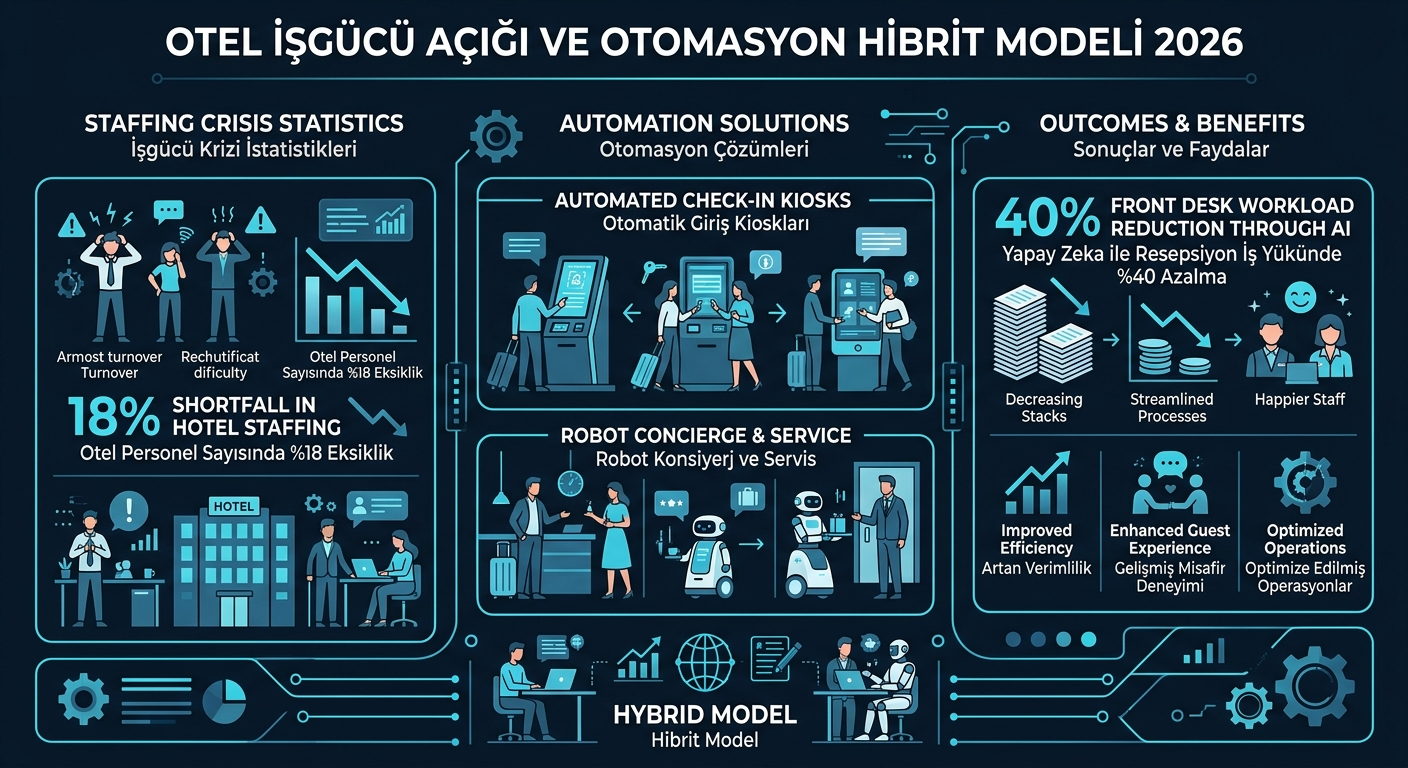
- Global Labor Shortage: The hospitality industry faces a chronic labor shortage, with 7.4 million open positions globally (18% of the total workforce), significantly increasing filling times for critical roles.
- Hybrid Automation Model: A structural solution involves a hybrid model that automates repetitive, standardized tasks (35-45% of hotel operations) and redirects human talent to high-value, empathetic, and decision-making roles.
- Departmental Automation Potential: Front office (up to 40% workload reduction), F&B (25-30% staff reduction in order taking), and Revenue Management (significant AI-driven value) show high automation potential, while housekeeping offers moderate efficiency gains.
- Balancing Tech & Touch: Successful hybrid models, exemplified by Marriott and CitizenM, emphasize that technology should enhance, not replace, human connection, especially in cultures that value personal hospitality.
- Strategic Implementation: Hotels, particularly in Turkey, should adopt a phased automation strategy, invest in staff transformation, conduct ROI analysis, and proactively manage guest expectations to seamlessly integrate these new technologies.
Global Hospitality Workforce Crisis: Figures and Facts
The hospitality sector is experiencing one of its most severe structural crises since the COVID-19 pandemic: a chronic staff shortage. According to the joint 2025 report by the World Travel & Tourism Council (WTTC) and Oxford Economics, there are 7.4 million open positions in the global tourism and hospitality sector — this accounts for 18% of the sector's total workforce needs. In Europe, this rate is 15%, in North America 21%, and in Turkey, it is estimated to be around 16-19%.
This crisis is not only quantitative but also qualitative. According to data from the American Hotel & Lodging Association (AHLA), the average time to fill open positions in the sector rose from 23 days in 2019 to 42 days in 2025. Finding qualified personnel is even more challenging: the average filling time for experienced front office managers, revenue managers, or chef positions exceeds 67 days.
The root causes of the crisis are complex and multi-layered:
Permanent exit from the sector: 40% of employees who left the hospitality sector during the pandemic did not return. According to a 2025 McKinsey study, most of these employees transitioned to sectors offering technology, healthcare, and remote work opportunities.
Demographic pressure: The proportion of the working-age population is decreasing in developed countries. Although Turkey still enjoys a demographic advantage, the interest of the younger generation in the hospitality sector is declining — application rates to university tourism departments have fallen by 28% in the last 5 years (Turkish Council of Higher Education (YÖK) data).
Wage competitiveness: Hospitality sector wages continue to lag behind the averages for retail, logistics, and general service sectors. In Turkey, the average monthly wage in the hotel industry is 12-18% below the general service sector average.
Working conditions: Shift work, weekend and holiday hours, physical fatigue, and irregular working hours deter young talent.
Related reading: Hotel Staff Retention Strategy and AI
Automation: Where, How Much, How?
The solution to the workforce crisis cannot be simply "pay more" — it requires a structural transformation. At the heart of this transformation is the hybrid automation model: delegating repetitive, standardized tasks to technology, and directing human effort to high-value, empathetic, and decision-making areas.
According to a 2025 study by the Cornell University School of Hotel Administration, 35-45% of tasks in hotel operations can be automated with existing technology. However, the "correct dosage" of automation varies dramatically by department:
Front Office / Reception — Automation Potential: High
According to Oracle Hospitality's 2025 industry survey, 80% of guests prefer automated check-in/check-out systems — this rate rises to 91% for business travelers. Thanks to self-service kiosks, mobile check-in applications, and digital key systems, front office workload can be reduced by up to 40%.
Automateable front office tasks:
- Check-in/check-out processes (self-service kiosks and mobile apps)
- Identity verification and passport scanning (AI-powered OCR)
- Room assignment (AI optimization algorithms)
- Invoice generation and payment processing
- Information requests (chatbot and voice assistant)
- Wake-up calls and reminder services
However, a critical distinction must be made: the check-in process can be automated, but the check-in experience requires a human touch. Value-added interactions such as greeting guests by name, proactively managing special requests, and offering local recommendations should not be delegated to automation.
Housekeeping — Automation Potential: Moderate
Housekeeping is the furthest department from full automation due to the intensity of physical labor. However, significant efficiency gains are possible in planning, reporting, and communication processes:
- AI-based room cleaning scheduling: Automatic work order creation based on check-out, occupancy, and guest preference data — 20-25% increase in efficiency
- IoT sensor-based mini-bar tracking: Automatic stock notification instead of manual checks
- Mobile task management: Tablet/phone-based task distribution instead of paper-based work orders
- Robot-assisted linen transport: Corridor delivery robots in large hotels — reducing the physical burden on staff
Food & Beverage — Automation Potential: Moderate-High
Automation in the F&B department is rapidly being adopted, especially in order taking, payment, and inventory management:
- QR menus and self-order tablets — reduce waiter need by 25-30%
- Automated kitchen display system (KDS) — lowers order error rate by 70%
- AI-powered inventory and portion management — reduces food waste by 15-20%
- Room service robots — eliminate the need for staff in corridor deliveries
Revenue Management and Sales — Automation Potential: Very High
Revenue management is the area where AI and automation create the highest value. Manual pricing and forecasting processes can now be performed much faster and more accurately by AI algorithms:
- Dynamic pricing (real-time rate optimization)
- Demand forecasting (machine learning models)
- Channel-based price parity control
- Competitor rate tracking and automatic adjustments
- Reporting and performance analytics
Embed this image on your site
<a href="https://otelciro.com/en/news/hotel-staffing-crisis-2026-hybrid-automation-for-efficiency-guide">
  <img src="https://cdn.sanity.io/images/1la98t0z/production/380882e30d9946a377413acad4ba60b0d68e5788-1408x768.png" alt="2026 hotel workforce crisis staff shortage hybrid automation model" width="800" />
</a>
<p>Source: <a href="https://otelciro.com">OtelCiro</a> — AI Hotel Revenue Management</p>
Hybrid Model: The Human + Machine Formula
Escaping the dilemma between full automation and full human power is possible with the hybrid model. This model evaluates each task using an "automation suitability matrix":
| Criteria | High Automation | Human Input Required |
|---|---|---|
| Repetition Frequency | High | Low |
| Decision Complexity | Low | High |
| Empathy Requirement | None | Yes |
| Error Tolerance | High | Low |
| Personalization | Standard | Unique |
| Physical Dexterity | Low | High |
Successful applications of the hybrid model are supported by examples from around the world:
Marriott International — "Digital Concierge + Human Touch" Model: 65% of check-in, room control, service requests, and check-out processes are performed digitally via the Marriott Bonvoy app. However, human interaction is maintained by positioning an "experience host" on each floor. Result: staff requirements decreased by 22%, while guest satisfaction scores increased by 8%.
CitizenM Hotels — "One-Touch" Model: Check-in is entirely via self-service kiosks, and room controls are managed by tablet. A small number of "Ambassadors" circulate in the lobby to assist guests. The staff-to-room ratio is half that of traditional hotels, yet guest satisfaction scores are above the industry average.
Henn-na Hotel (Japan) — Robot Hotel Experiment: This full automation experiment, which gained global attention in 2015, was later revised. Robotic receptionists were replaced by "semi-autonomous" systems — because the fully robotic approach had increased guest complaints by 200%. Lesson: technology is an aid, but humans must be at the center of the experience.
Implementation Strategy for Turkish Hotels
There are specific conditions to consider when Turkish hotel sector transitions to the hybrid automation model:
1. Phased Implementation
Attempting to implement all automation solutions simultaneously is risky, both financially and operationally. Recommended implementation sequence:
Phase 1 (0-6 months): Mobile check-in, digital key, chatbot, automated reporting Phase 2 (6-12 months): AI pricing, self-order F&B, IoT mini-bar, smart scheduling Phase 3 (12-24 months): Robot delivery, voice command room control, predictive maintenance, fully integrated ecosystem
2. Staff Transformation Program
Automation should not be used to lay off staff but to transform their work. Role transformations such as Receptionist → Experience Designer, Waiter → Gastronomy Consultant, Housekeeper → Comfort Specialist, increase both employee satisfaction and guest experience.
3. Investment-Return Calculation
Average investment and return expectations for the hybrid automation model:
- Mobile check-in system: $15,000-$30,000 USD investment → annual savings equivalent to 2 full-time employees (FTE)
- AI pricing engine: $500-$2,000 USD monthly → 5-12% revenue increase
- Chatbot: $5,000-$15,000 USD investment → 40% reduction in reception calls
- Self-order F&B: $20,000-$50,000 USD investment → 25-30% reduction in F&B staffing needs
4. Guest Expectation Management
An important cultural factor: the Turkish hospitality tradition is based on "face-to-face, warm welcoming." Balancing this cultural expectation in automation applications is critical. Solution: technology should work in the background, guests should not feel "automated." For example, a guest using mobile check-in should still be greeted with a smile upon entering the lobby — only the paperwork is skipped.
10-Step Action Plan Against the Workforce Crisis
- Map current business processes — evaluate the duration, frequency, and automation suitability of each task.
- Conduct staff turnover analysis — identify which positions, why, and how often you experience losses.
- Perform a wage benchmark study — compare with industry and regional averages.
- Administer employee satisfaction surveys — anonymous, regular, and share results.
- Develop an automation roadmap — three-phased, budgeted, and with KPIs.
- Initiate a pilot program — a small-scale test in the area with the highest ROI potential.
- Design a staff transformation program — prepare existing employees for new roles.
- Develop flexible working models — part-time, gig-economy, and remote work options.
- Form educational partnerships — internship programs with tourism vocational high schools and universities.
- Measure the ROI of technology investments — evaluate in 6-month cycles.
Conclusion: Crisis Can Turn into Opportunity
The workforce crisis is pushing the hotel industry towards a more efficient, technology-focused, and sustainable model. Hotels that proactively manage this transformation will gain a competitive advantage in both cost efficiency and guest experience. The hybrid automation model means not "providing the same service with less staff" — but "providing much better service with the same staff."
OtelCiro provides seamless transition for hotels to the hybrid automation model with AI-powered revenue management, automated channel distribution, digital check-in infrastructure, and smart reporting modules. Close the staff gap with technology while preserving the power of the human touch.
Related reading: AI-Powered Housekeeping Scheduling — Explore how automation technologies are applied in the housekeeping department and the resulting efficiency gains.
![Hotel Labor Crisis: 8.6M Shortage & AI Solutions [2035 Strategy]](https://cdn.sanity.io/images/1la98t0z/production/d19b18ebdaf612bd18dfffca0a17b8a4864cba9b-2752x1536.png?w=1920&q=50&auto=format&fit=max)
![Hotel ESG Reporting: EU CSRD 2026 Compliance [Strategy Guide]](https://cdn.sanity.io/images/1la98t0z/production/7c0ed4b96b182e49b9bafa47a0494428d9ce5a1e-2048x2048.png?w=1920&q=50&auto=format&fit=max)