
![Hotel Data Privacy: KVKK 2026 Compliance & Penalties [Guide]](https://cdn.sanity.io/images/1la98t0z/production/3dd9e36edeedf92603fbf9af27c27f8c5dee449b-1408x768.png?w=1920&q=65&auto=format&fit=max)
Key Takeaways
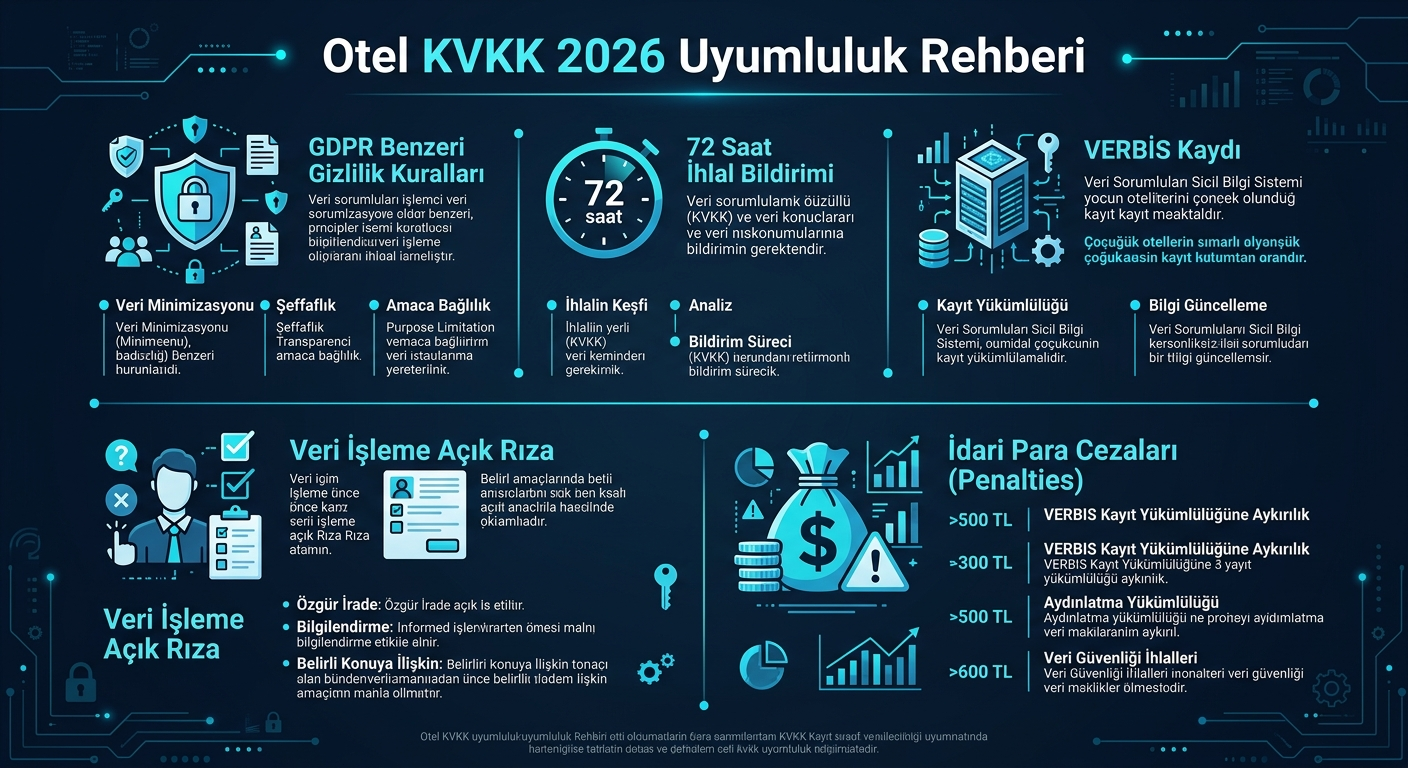
- Stricter Compliance: KVKK 2026, with updates aligning with EU GDPR, introduces a more detailed and penalty-heavy framework for hotels, emphasizing comprehensive guest data protection.
- 72-Hour Breach Notification: Hotels are now subject to a mandatory 72-hour data breach notification rule, requiring immediate detection, assessment, and reporting to the KVKK Board and affected individuals.
- Mandatory VERBİS Registration: All hotels must register with the Data Controllers' Registry Information System (VERBİS) and maintain a thorough data inventory, facing penalties up to 3,000,000 TL for non-compliance.
- Complex International Data Transfers: Transferring data abroad, especially to countries without an "adequate protection decision" (e.g., US-based cloud services or OTAs), necessitates Standard Contractual Clauses (SCC) or explicit guest consent.
- Enhanced Cookie Management: Hotel websites and apps require robust Consent Management Platforms (CMPs) for cookie usage, with strict consent requirements impacting analytics data and demanding a shift to first-party data strategies.
- Increased Penalties: Updated fines for KVKK violations in 2026 range from 75,000 TL to 6,000,000 TL per violation, potentially accumulating to 7,500,000 TL for combined infringements, alongside individual compensation claims.
KVKK 2026: What Has Changed for Hotels?
The Law on the Protection of Personal Data (KVKK) No. 6698 has been the most significant data protection regulation directly impacting the hospitality sector since its enactment in 2016. With comprehensive amendments in 2024 and 2025—particularly updates aimed at harmonization with EU GDPR—KVKK 2026 offers a much more detailed and penalty-heavy framework for hotels.
The hospitality sector carries a high-risk profile for KVKK compliance. The breadth of personal data types an hotel collects in its daily operations is astonishing: identity information (passport, Turkish ID number), contact details, credit card data, travel habits, dietary preferences, health information (allergies, dietary restrictions), location data (Wi-Fi connection logs), security camera footage, and even biometric data (in facilities using fingerprint/facial recognition).
According to the "Personal Data Processing Guide for the Hospitality Sector" published by the KVKK Board in 2025, an average hotel processes personal data in 23 different data categories—this figure represents the second highest sectoral rate after the healthcare sector. The guide explicitly requires hotels to re-evaluate their data processing operations and update their compliance programs.
Related reading: Hotel Cybersecurity and Data Protection
Data Breach Notification: The 72-Hour Rule
The 72-hour data breach notification obligation, introduced with the 2024 KVKK amendment and fully implemented in 2025, is one of the most critical changes for hotels. This regulation has been fully aligned with GDPR's 72-hour rule and fundamentally alters incident management processes.
Scope of Notification Obligation
What a hotel must do upon detecting a data breach:
0-24 hours: Detection and Assessment
- Determine the scope of the breach: how many individuals were affected, which data categories are involved
- Identify the source of the breach: external attack, internal leakage, system error, human error
- Implement immediate measures to contain the breach
- Inform legal counsel and the DPO (Data Protection Officer) if one exists
24-48 hours: Preparation for Board Notification
- Prepare the notification form for the KVKK Board
- Compile a list of affected data subjects
- Document measures taken and planned
- Conduct a risk assessment of potential consequences
48-72 hours: Notification
- Submit official notification to the KVKK Board (via electronic form)
- Directly notify affected individuals in cases of high-risk breaches
- Evaluate whether a press release is necessary
Data Breach Examples in Hotel Scenarios
Common data breach scenarios hotels may encounter and their management approaches:
Scenario 1 — PMS database leak: An attacker gains access to the PMS, obtaining guest names, passport numbers, and credit card information. This is a high-risk breach requiring dual notification under both KVKK and PCI DSS. The estimated number of affected individuals can range from hundreds to tens of thousands.
Scenario 2 — Former employee data exfiltration: A departing sales employee copies the customer database onto a USB drive. This situation, considered "unauthorized access" under KVKK, requires a review of technical measures as well as employee offboarding procedures.
Scenario 3 — Email misdelivery: Group reservation details (guest names, room numbers, payment information) are sent to the wrong recipient. Although seemingly low-risk, a notification obligation may arise if financial data is included.
Scenario 4 — Security camera breach: The hotel's IP camera system is hacked, and images of the lobby/pool area are disseminated online. Images constituting biometric data fall under KVKK's special categories of personal data—triggering the most severe penalties.
Embed this image on your site
<a href="https://otelciro.com/en/news/hotel-data-privacy-kvkk-2026-compliance-penalties-guide">
  <img src="https://cdn.sanity.io/images/1la98t0z/production/3dd9e36edeedf92603fbf9af27c27f8c5dee449b-1408x768.png" alt="KVKK 2026 compliance requirements and guest data protection in hotels" width="800" />
</a>
<p>Source: <a href="https://otelciro.com">OtelCiro</a> — AI Hotel Revenue Management</p>
VERBİS Registration and Data Inventory
The Data Controllers' Registry Information System (VERBİS) is a central registration system mandated by KVKK. All hotels—regardless of employee count—must register with VERBİS. As of 2026, hotels without VERBİS registration face administrative fines ranging from 50,000 to 1,000,000 TL.
The data inventory to be prepared for VERBİS registration must include the following information:
- Data categories: Identity, contact, financial, location, health, biometric, visual/auditory
- Data subjects: Guests, employees, suppliers, business partners, visitors
- Processing purposes: Accommodation service, legal obligation, marketing, security
- Legal basis: Contract, legal obligation, explicit consent, legitimate interest
- Retention periods: Defined retention period for each data category
- Recipients of data transfers: OTAs, payment processors, CRM providers, government agencies
- Technical and administrative measures: Encryption, access control, training programs
For hotels, the most complex part of the data inventory is third-party data transfers. A hotel transfers data to dozens of different companies in its daily operations: OTAs (Booking.com, Expedia), payment processors (iyzico, PayTR), CRM and email platforms (HubSpot, Mailchimp), survey tools (SurveyMonkey), Wi-Fi providers, security companies, and government agencies (Police, tax authority). A data processing agreement and compliance document must be filed for each.
International Data Transfers: OTAs and Cloud Services
The rules for international data transfers, updated with the 2024 KVKK amendment, are particularly critical for hotels. This is because modern hotel operations inherently rely on international data flows:
Adequate Protection Decision
The KVKK Board has identified "countries providing adequate protection" to which personal data may be transferred. EU/EEA countries (under GDPR) are generally considered to provide adequate protection. However, the USA, China, and many Asian countries are not on this list—this implies different legal processes for Booking.com (headquartered in the Netherlands, covered by adequate protection) versus Expedia (headquartered in the USA, potentially requiring additional safeguards).
Standard Contractual Clauses
For data transfers to countries without an adequate protection decision, Standard Contractual Clauses (SCC) must be used. Hotels may need to sign SCCs with the following service providers:
- US-based cloud services (AWS, Google Cloud, Microsoft Azure)
- US-based CRM and marketing platforms
- US-based payment processors
- OTAs from countries not providing adequate protection
- Data transfers to the headquarters of international hotel chains
Explicit Consent
If the above mechanisms cannot be implemented, explicit consent must be obtained from the guest. However, according to the latest interpretation of KVKK, explicit consent must be "specific, informed, and freely given"—small-print general consent texts on check-in forms are no longer considered sufficient.
Cookie Management and Digital Consent
Hotel websites and mobile applications must meet KVKK's updated requirements regarding cookie management. The "Guide on Cookie Applications" published in 2025 has practical implications for hotels:
Mandatory cookie classification:
- Strictly necessary cookies: Session management, shopping cart function — no consent required
- Functional cookies: Language preference, room filter recall — consent required
- Analytical cookies: Google Analytics, Hotjar — consent required
- Marketing cookies: Meta Pixel, Google Ads, remarketing — consent required
Consent Management Platform (CMP) requirements:
- Consent must be obtained before cookies are activated (opt-in model, not opt-out)
- Refusing consent must be as easy as accepting it
- Consent records must be stored for at least 2 years
- Consent must be revocable at any time
- Separate consent options must be provided for each cookie category
Practical impact for hotels: A 15-25% drop in Google Analytics data is expected (users who do not give consent cannot be measured). This requires a redesign of hotel web analytics strategies. Server-side tracking, first-party data strategies, and cookie-independent measurement methods are gaining priority.
2026 Updated Sanction Amounts
KVKK sanctions are updated annually based on the revaluation rate. The amounts valid for 2026 are:
| Violation Type | 2026 Penalty Range |
|---|---|
| Violation of the obligation to inform | 75,000 — 1,500,000 TL |
| Violation of data security obligation | 150,000 — 6,000,000 TL |
| Non-compliance with KVKK Board decisions | 375,000 — 6,000,000 TL |
| Violation of VERBİS registration obligation | 150,000 — 3,000,000 TL |
| Violation of 72-hour notification obligation | 200,000 — 4,000,000 TL |
These penalties can be applied separately for each violation. For example, a hotel that violates both the obligation to inform and fails to take data security measures could face a total penalty of up to 7,500,000 TL. Furthermore, guests retain the right to file individual compensation lawsuits.
According to the KVKK Board's 2025 activity report, complaints against the accommodation sector increased by 43% compared to the previous year. The most frequent complaint topics were: unauthorized marketing emails (34%), security camera footage (22%), excessive data collection on check-in forms (18%), and failure to fulfill data deletion requests (15%).
Compliance Checklist: 15 Items
Evaluate your hotel's KVKK 2026 compliance level with the following checklist:
- Is your VERBİS registration current and accurate?
- Does your data inventory cover all data categories?
- Are privacy notices available on your website, check-in forms, and applications?
- Are explicit consent forms compliant with KVKK standards (specific, informed, freely given)?
- Is a Consent Management Platform (CMP) installed and operational?
- Are data processing agreements signed with all third parties?
- Are international data transfer mechanisms (SCC or adequacy decision) in place?
- Is a 72-hour data breach notification procedure documented and tested?
- Is your data deletion procedure functional (can data be deleted within 30 days upon guest request)?
- Are security camera recording durations and warning signs appropriate?
- Are Wi-Fi connection logs subject to proper retention periods and privacy notices?
- Has staff awareness training been conducted within the last 12 months?
- Has a DPO or data protection officer been appointed?
- Is a data retention and destruction policy documented and implemented?
- Has a periodic compliance audit been performed within the last 6 months?
Conclusion: Data Security is the Foundation of Guest Trust
KVKK compliance for hotels is not merely about avoiding penalty risks; it is about establishing the foundation of guest trust. In the digital age, guests seek a secure environment when sharing their personal data—and hotels that provide this trust gain measurable advantages in loyalty and repeat stay rates. According to Accenture's 2025 consumer research, loyalty to brands that prioritize data privacy is 37% higher.
OtelCiro automates hotels' data protection processes with built-in KVKK compliance modules: managing automatic privacy notices, tracking consent, controlling data retention periods, supporting VERBİS reporting, and data breach notification workflows, allowing you to manage your compliance from a single platform.
Related reading: Hotel Certification, Licensing, and Legal Monitoring — Other legal compliance requirements for hotels beyond KVKK and strategies for monitoring them.
![Hotel Labor Crisis: 8.6M Shortage & AI Solutions [2035 Strategy]](https://cdn.sanity.io/images/1la98t0z/production/d19b18ebdaf612bd18dfffca0a17b8a4864cba9b-2752x1536.png?w=1920&q=50&auto=format&fit=max)
![Hotel ESG Reporting: EU CSRD 2026 Compliance [Strategy Guide]](https://cdn.sanity.io/images/1la98t0z/production/7c0ed4b96b182e49b9bafa47a0494428d9ce5a1e-2048x2048.png?w=1920&q=50&auto=format&fit=max)