![Hotel Channel Management & OTA Strategy [2026 Guide]](https://cdn.sanity.io/images/1la98t0z/production/1c2859c1cc6c68b376c0574bfa625f0cca22ed90-1200x2150.png?w=1920&q=65&auto=format&fit=max)
Key Takeaways
- Modern hotels navigate 10+ distribution channels, making robust channel management critical for profitability and survival.
- Understanding the unique algorithms, commission structures, and target segments of OTAs like Booking.com, Expedia, and Google Hotels is vital for optimizing distribution.
- Prioritizing direct bookings (0% commission vs. 15-30% for OTAs) significantly boosts net revenue, with strategies like the 'billboard effect' leveraging OTA presence.
- Real-time channel manager synchronization and AI-powered tools are essential to prevent costly overbooking, maintain rate parity, and optimize inventory across diverse platforms.
- AI is reshaping distribution, with tools like OtelCiro automating channel strategy and preparing hotels for future AI agent-driven bookings.
Why Is Channel Management the Hotel's Most Critical Strategic Decision?
Today, a hotel room is no longer sold solely through a reception phone. Booking.com, Expedia, Agoda, Google Hotels, Airbnb, HotelBeds, GDS platforms, metasearch engines, and direct websites — a hotel maintains a presence on an average of more than 10 distribution channels. Each channel operates with a different customer profile, a different commission structure, and different algorithmic rules.
In this complex ecosystem, selling in the right channel, at the right price, at the right time is not a choice, but a necessity for survival. This is precisely the strategic challenge that hotel channel management addresses.
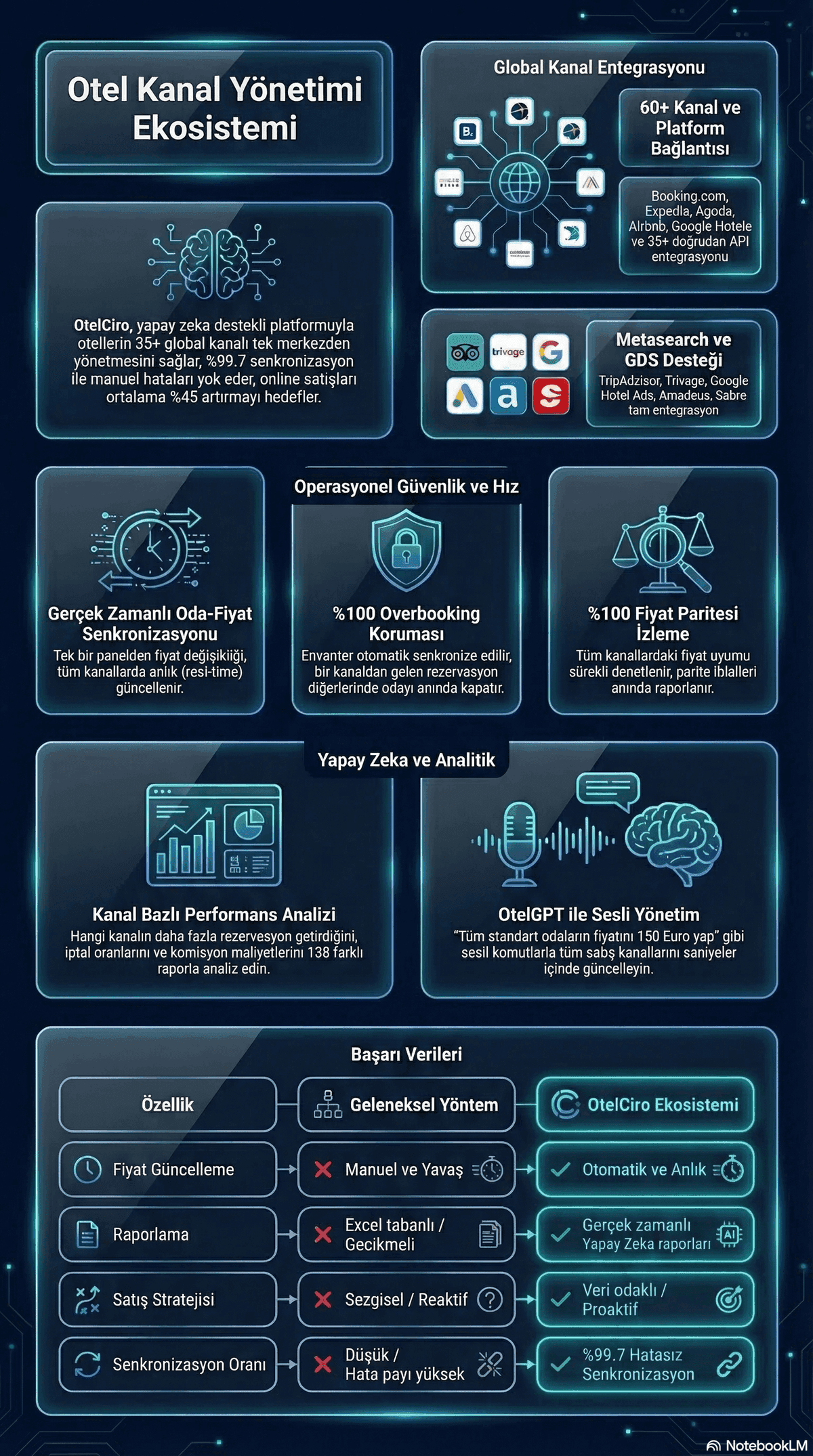
Embed this image on your site
<a href="https://otelciro.com/en/news/hotel-channel-management-ota-strategy-2026-guide">
  <img src="https://cdn.sanity.io/images/1la98t0z/production/1c2859c1cc6c68b376c0574bfa625f0cca22ed90-1200x2150.png" alt="Hotel Channel Management Ecosystem Infographic" width="800" />
</a>
<p>Source: <a href="https://otelciro.com">OtelCiro</a> — AI Hotel Revenue Management</p>
In this article, we will delve into the fundamentals of channel management, the dynamics of the OTA ecosystem, rate parity issues, overbooking prevention strategies, and direct booking optimization.
Related reading: Hotel Channel Management Guide: How to Maximize Revenue from OTAs
What Is Channel Management?
Channel management is the process by which a hotel consistently distributes, prices, and updates its room inventory across multiple sales channels. At the heart of this process is channel manager software.
A channel manager facilitates two-way data exchange between the hotel's PMS system and all OTA platforms. When a reservation comes through one channel, availability on all other channels is automatically updated. When a price change is made, this change is reflected across all channels within seconds.
OtelCiro's channel management and sales platform takes this process a step further with AI-powered automation — it not only synchronizes but also determines the optimal strategy for each channel.
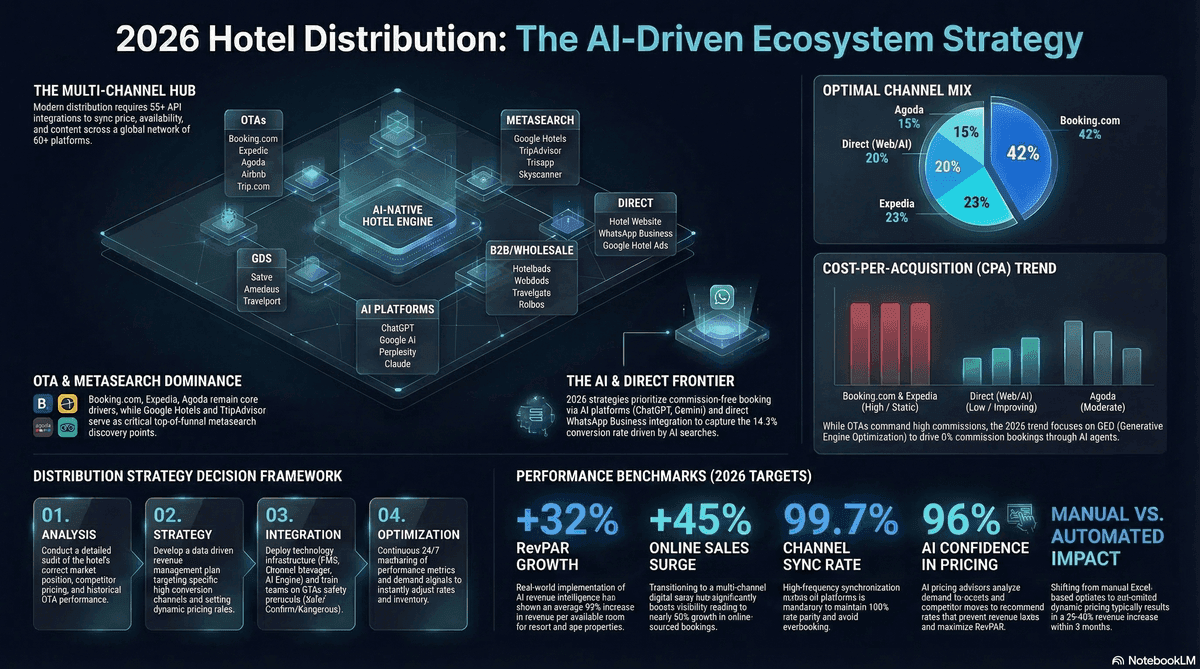
Embed this image on your site
<a href="https://otelciro.com/en/news/hotel-channel-management-ota-strategy-2026-guide">
  <img src="https://cdn.sanity.io/images/1la98t0z/production/dcf7630bd7cfddca14a13081e5ce4d8d874ebc55-1200x669.png" alt="2026 hotel distribution strategy guide" width="800" />
</a>
<p>Source: <a href="https://otelciro.com">OtelCiro</a> — AI Hotel Revenue Management</p>
The OTA Ecosystem: Unique Rules for Each Channel
Booking.com: King of Volume
Still the largest source of reservations for hotels in Turkey, Booking.com has 28 million listed properties globally. Platform features:
- Commission: 15-30% (average 18%)
- Target segment: European travelers, price-sensitive consumers, Genius loyalty members
- Algorithm factors: Content Score, conversion rate, cancellation policy flexibility, mobile discount, review score
- Strengths: Massive traffic volume, strong brand recognition, Genius loyalty program
- Considerations: Commission burden, rate parity pressure, algorithmic penalty risks
Success on Booking.com starts with understanding the algorithm and consistently maintaining a high Content Score.
Expedia: The Power of Package Sales
Expedia Group (Expedia, Hotels.com, Vrbo, Orbitz) is a powerful ecosystem, especially strong in flight+hotel packages:
- Commission: 15-25% (fixed with Merchant Model)
- Target segment: US and Canadian markets, package buyers, long-haul travelers
- Strengths: High ADR package sales, guaranteed prepayment with Merchant Model
- Strategy: Offer special pricing advantages for package sales, maintain high photo and content quality
Google Hotels: Metasearch Revolution
Google Hotels is a powerful metasearch platform that can drive traffic directly to the hotel website without being an OTA:
- Commission: CPC (cost per click) or CPA (12-15% commission-based)
- Target segment: Research-oriented travelers, price comparison shoppers
- Strengths: Potential to drive traffic to the direct booking channel, Google Maps integration
- Strategy: Google Business Profile optimization, offering direct price advantages, using Free Booking Links
Direct Sales: Highest Profit Margin
Reservations made through the hotel's own website and phone line offer the highest profit margin with zero commission:
- Commission: 0% (only payment processing fees, ~2-3%)
- Target segment: Loyal guests, potential guests with brand awareness
- Strengths: Full customer data ownership, personalization opportunities, relationship management
- Strategy: Offer more advantageous direct pricing than OTAs, loyalty programs, remarketing
Related reading: 2026 Hotel Survival Guide: Everything on One Page
Rate Parity: The Most Complex Balance
Rate parity is the principle of offering the same or consistent prices across all channels. OTAs do not want to see higher prices on their platforms than on competing channels and algorithmically penalize rate parity violations.
Why Is Rate Parity Becoming More Difficult?
- Different commission rates: Offering the same gross price is not equal in terms of net revenue when Booking.com charges 18%, Expedia 20%, and direct sales 0%.
- Dynamic price changes: Temporary parity violations occur when price updates do not reach all channels simultaneously.
- Package sales: Parity control becomes difficult when room prices cannot be disaggregated in flight+hotel packages.
- Mobile and member discounts: Discounts offered by OTAs through their own mobile apps and loyalty programs disrupt the parity balance.
Rate Parity Management with OtelCiro
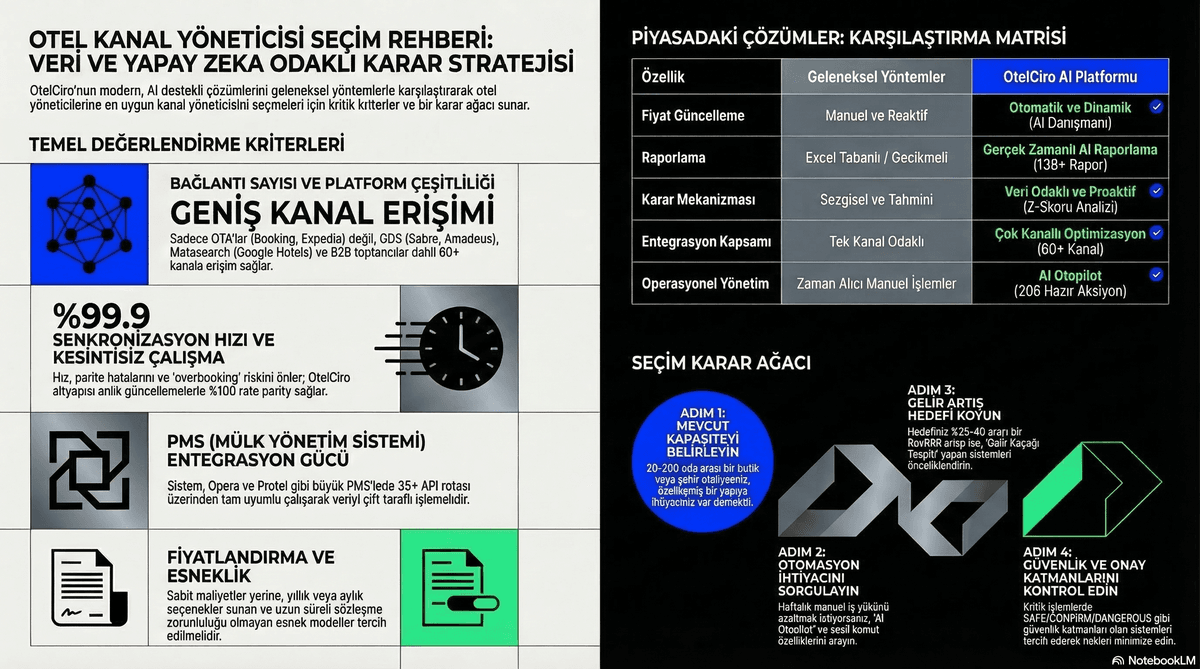
OtelCiro's AI engine automates rate parity management:
- Instant synchronization: Price changes are reflected across all channels within 30 seconds.
- Parity monitor: Live prices across all channels are continuously checked, and alerts are issued if deviations are detected.
- Net revenue optimization: Adjusts gross price on a channel-by-channel basis, considering each channel's commission structure.
- DMA compliance: Strategies to leverage pricing freedom regulations under the European Digital Markets Act (DMA).
Embed this image on your site
<a href="https://otelciro.com/en/news/hotel-channel-management-ota-strategy-2026-guide">
  <img src="https://cdn.sanity.io/images/1la98t0z/production/d7d8dd717a0471ca7d480294091db24c1186f694-1200x669.png" alt="2026 hotel channel manager selection guide" width="800" />
</a>
<p>Source: <a href="https://otelciro.com">OtelCiro</a> — AI Hotel Revenue Management</p>
Overbooking Prevention: Critical Risk Management
Overbooking occurs when the same room inventory is simultaneously sold on multiple channels. The consequences are severe:
- Guest dissatisfaction: Serious reputational damage in case of a walk-out.
- Financial loss: Costs of relocating guests to alternative hotels, compensation, and loss of reputation.
- OTA penalties: Algorithmic ranking demotion for hotels with frequent overbookings.
How to Prevent Overbooking?
1. Real-time inventory synchronization It is essential for the channel manager to have two-way, instant data exchange with all channels. OtelCiro's system minimizes overbooking risk with a 99.7% synchronization success rate.
2. Buffer stock management During high-demand periods, strategically pulling inventory from certain channels or holding the last room exclusively for high-profit channels is a strategic approach.
3. Automated channel closing When occupancy crosses a certain threshold (e.g., 95%), automatically closing low-performing channels reduces overbooking risk to near zero.
4. AI-powered cancellation prediction OtelCiro's AI engine predicts the expected number of cancellations for each day based on past cancellation patterns. Controlled overbooking can be implemented based on this prediction — meaning that inventory is optimized by overselling up to the number of expected cancellations.
Direct Booking Optimization: Breaking Free from OTA Dependency
A major challenge for many Turkish hotels is that 60-80% of their revenue comes from OTAs. This means both a high commission burden and the loss of guest data. Increasing the direct booking ratio is one of the most effective revenue optimization strategies.
Leveraging the Billboard Effect
Listing on OTAs also drives traffic to your direct website. According to one study, 65% of guests visit a hotel's own website after discovering it on an OTA. This is a powerful channel synergy known as the billboard effect.
To leverage this effect:
- Maintain an excellent OTA profile (high-quality photos, complete descriptions).
- Offer more advantageous pricing or added value on your website than on OTAs.
- Create direct booking incentives (free breakfast, room upgrade, late checkout).
Price Advantage Strategy
If your price on OTAs is 1,000 TL, offering 950 TL + free breakfast on your website is a strong direct booking incentive. In terms of net revenue, this scenario is much more profitable:
| Channel | Room Price | Commission | Net Revenue |
|---|---|---|---|
| Booking.com | 1,000 TL | 18% (180 TL) | 820 TL |
| Direct Website | 950 TL + breakfast | 0% (breakfast cost ~50 TL) | 900 TL |
Even though you offer a lower price on the direct channel, your net revenue is 80 TL higher — and you also retain full ownership of the guest data.
Channel Mix Optimization: How to Find the Right Balance?
Every hotel's ideal channel mix is different. Optimal distribution varies depending on location, target segment, brand awareness, and existing digital infrastructure. However, as a general guide:
Recommended Channel Distribution
| Channel | Target Share | Role |
|---|---|---|
| Direct website | 25-35% | Highest profit margin, guest relationship |
| Booking.com | 25-30% | Volume, European market |
| Expedia Group | 10-15% | Package sales, US market |
| Google Hotels | 10-15% | Metasearch, direct referral |
| Other OTAs | 5-10% | Niche markets, diversification |
| GDS / Wholesale | 5-10% | Corporate, tour operators |
You can find detailed optimization tactics for each channel in our 5-channel optimization guide.
Channel Performance Analysis
To measure the true profitability of each channel, looking only at gross revenue is not enough. Metrics that should be used for evaluation include:
- Net ADR: Gross ADR - commission cost
- CPOR (Cost Per Occupied Room): Total cost per occupied room on a channel-by-channel basis
- Cancellation rate: Which channels have a higher risk of cancellations?
- Lead time: Average booking lead time for each channel
- LOS (Length of Stay): Average length of stay on a channel-by-channel basis
- Guest lifetime value: Which guests from which channels return?
OtelCiro's reporting tools provide all these metrics on a channel-by-channel, periodic, and competitor-comparative basis.
The Future of Channel Management with AI
In 2026, channel management is no longer just inventory synchronization — it is a complex optimization problem requiring a separate strategy for each channel, every day, for every room type.
Automated Channel Strategy
OtelCiro's AI engine continuously analyzes performance data for each channel to make automated strategy adjustments:
- During low occupancy periods: Opens inventory to high-volume OTAs, launches promotions.
- During high-demand periods: Narrows low-profit channels, prioritizes direct and high-ADR channels.
- For last-minute vacancies: Automatically transfers inventory to last-minute platforms.
- Upon detection of parity violations: Applies immediate correction or alerts management.
AI Agents and the New Distribution Paradigm
The biggest distribution revolution of 2026 is the involvement of ChatGPT, Google AI Mode, and other AI agents in the hotel search and booking process. These agents bypass traditional OTA rankings to directly access hotel information.
OtelCiro's MCP (Model Context Protocol) integration ensures your hotel is discovered by AI agents and represented with accurate information — this has the potential to become the most important distribution channel of the future.
Related reading: 7 Proven Ways to Reduce Booking.com Commissions (2026 Guide)
Frequently Asked Questions
"How many channels should I sell on?"
The general rule is to be present on as many channels as you can maintain quality. However, a minimum of 5 active channels — Booking.com, Expedia, Google Hotels, direct website, and a metasearch/GDS platform — is recommended.
"Should I completely exit OTAs?"
Absolutely not. OTAs are both a source of direct traffic (the billboard effect) and provide access to a broad customer base. The strategy is to reduce dependence and diversify the channel mix.
"Can channel management be done without a channel manager?"
It is technically possible, but manual management across more than 3 channels leads to overbooking risk, price inconsistency, and significant time loss. A channel manager is a fundamental infrastructure requirement for modern hotel management.
"Do I need to break rate parity?"
The DMA regulation in Europe allows hotels to offer different prices on their own websites than on OTAs. Leveraging this regulation to offer a 5-10% price advantage on the direct channel is a strategic option.
Conclusion: Channel Management Is the Foundation of Revenue Management
Without a sound channel strategy, even the best pricing algorithm falls short. Channel management is a strategic discipline at the intersection of pricing, inventory control, and guest relationships.
OtelCiro's sales and channel management platform, with AI-powered automation, real-time synchronization, and channel-based performance analysis, ensures your hotel generates maximum revenue from every channel. With 35+ API integrations and a 99.7% synchronization success rate, it eliminates overbooking risk while continuously optimizing your channel mix.
Ready to optimize your hotel's channel strategy? Contact us for a free channel analysis.
![How Booking.com Uses Machine Learning to Rank Hotels [2026]](https://cdn.sanity.io/images/1la98t0z/production/b5e42eae20b08b1a662436df1775c657f98f7871-2752x1536.jpg?w=1920&q=50&auto=format&fit=max)